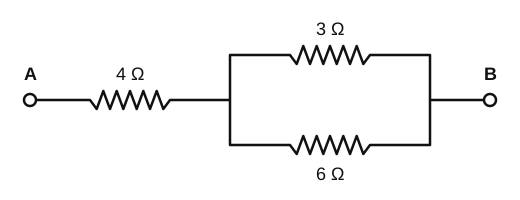
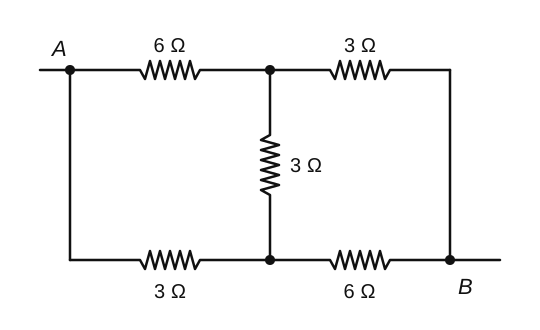
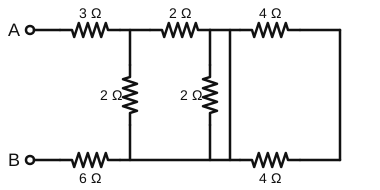
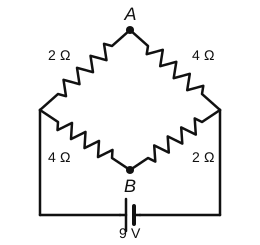
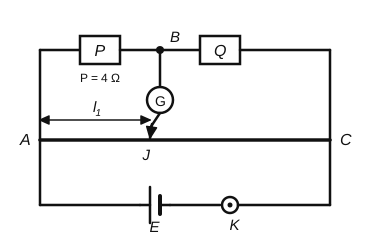
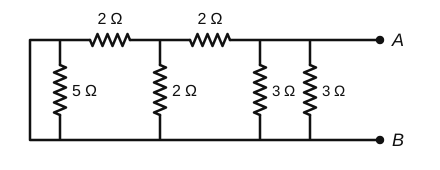
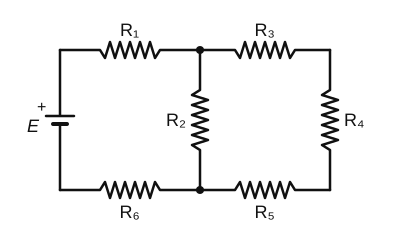
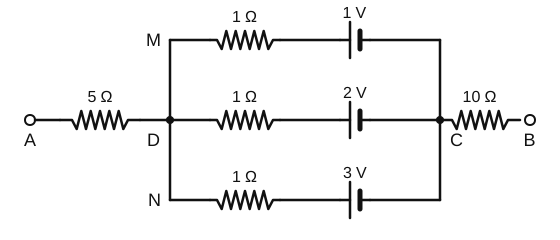
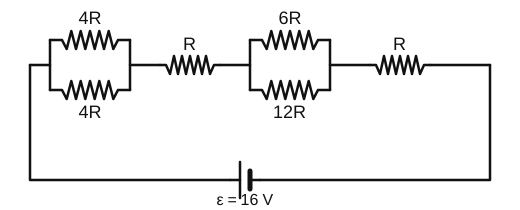
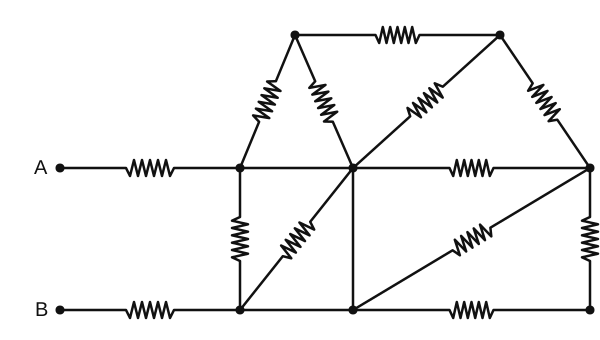
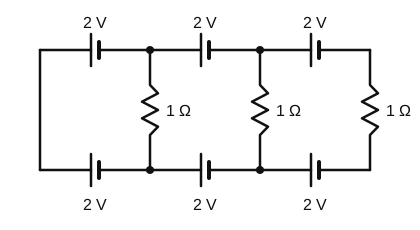
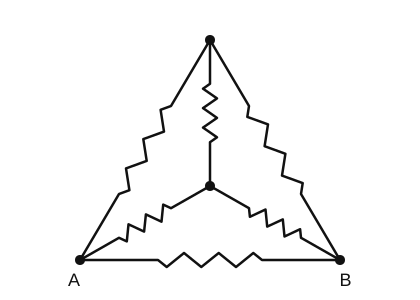
The $3\ \Omega$ and $6\ \Omega$ resistors are in parallel: $$R_p = \frac{3\times 6}{3+6} = 2\ \Omega$$ This is in series with $4\ \Omega$: $R_{AB} = 4 + 2 = 6\ \Omega$.
Solution by Sreeraj P, M.Sc Physics
Q 12-03-003NEETNEET 2026Top questionMedium
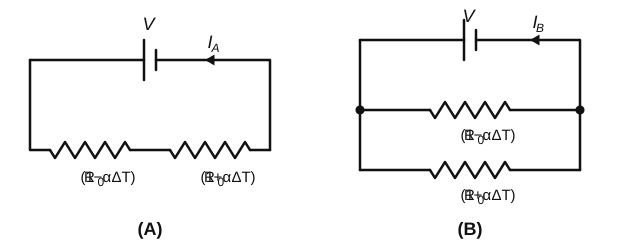
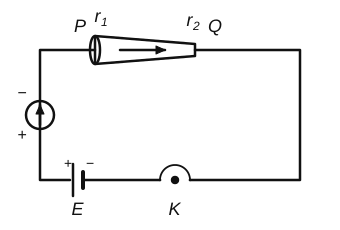
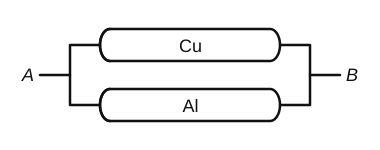
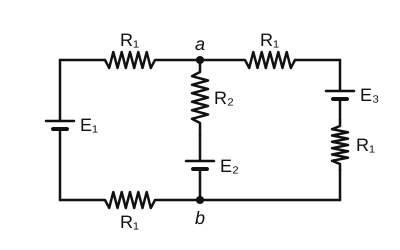
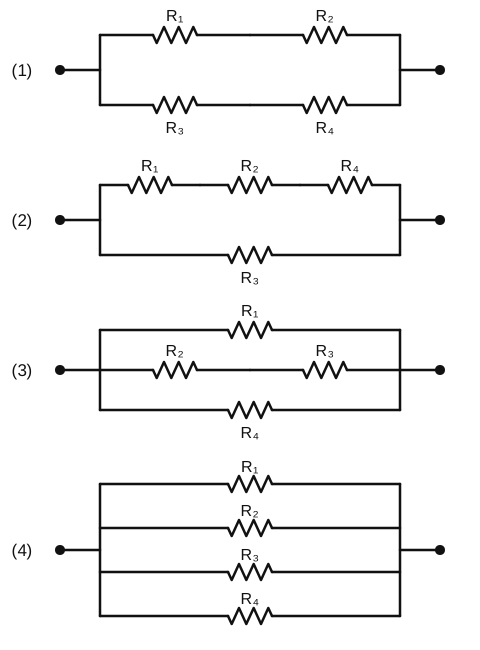
Consider two circuits, (A) and (B), each having two resistors. One of them has a positive temperature coefficient of resistance, $+\alpha$, while the other one has a negative temperature of coefficient, $-\alpha$, as shown in the figure. The current through these circuits are denoted by $I_A$ and $I_B$. At initial temperature, the resistance of the two resistors is $R_0$. As the temperature is increased, the correct option that describes the variation of current in these circuits is :
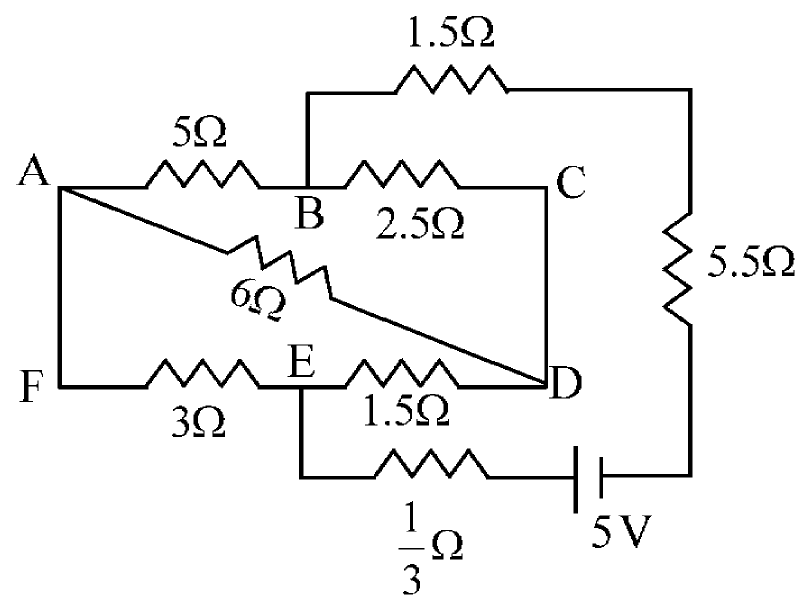
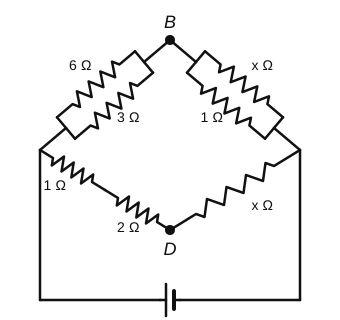
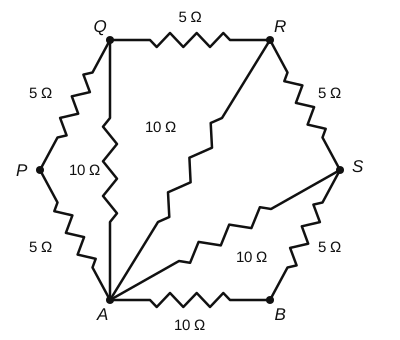
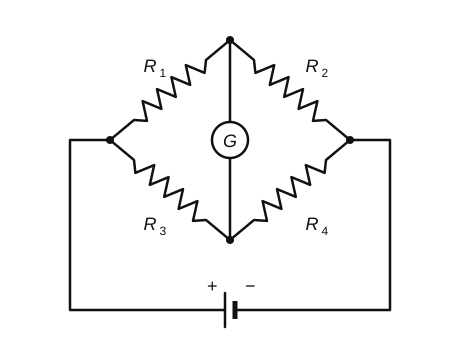
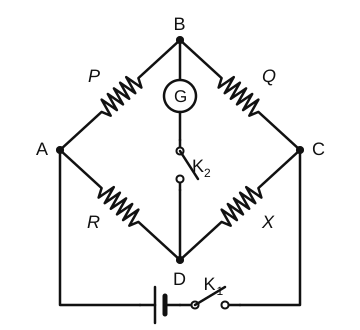
A and F are joined by a plain wire, and so are C and D. The network between B and E therefore has:
$R_{BA} = 5\ \Omega$, $R_{BD} = 2.5\ \Omega$ (through C), $R_{AE} = 3\ \Omega$ (through F), $R_{DE} = 1.5\ \Omega$, and $R_{AD} = 6\ \Omega$ as the bridge.
Check the Wheatstone condition: $$\frac{R_{BA}}{R_{BD}} = \frac{5}{2.5} = 2, \qquad \frac{R_{AE}}{R_{DE}} = \frac{3}{1.5} = 2$$ The bridge is balanced, so no current flows through the $6\ \Omega$ resistor.
Total resistance in the battery loop: $$R = \frac{8}{3} + 1.5 + 5.5 + \frac{1}{3} = 3 + 7 = 10\ \Omega$$
$$I = \frac{5}{10} = 0.5\ \text{A}$$
Solution by Sreeraj P, M.Sc Physics
Q 12-03-005NEETNEET 2025Top questionEasy
A wire of resistance R is cut into $8$ equal pieces. From these pieces two equivalent resistances are made by adding four of these together in parallel. Then these two sets are added in series. The net effective resistance of the combination is :
Four in parallel: $\dfrac{R/8}{4} = \dfrac{R}{32}$.
Two such sets in series: $2 \times \dfrac{R}{32} = \dfrac{R}{16}$.
Solution by Sreeraj P, M.Sc Physics
Q 12-03-006NEETNEET 2025Top questionMedium
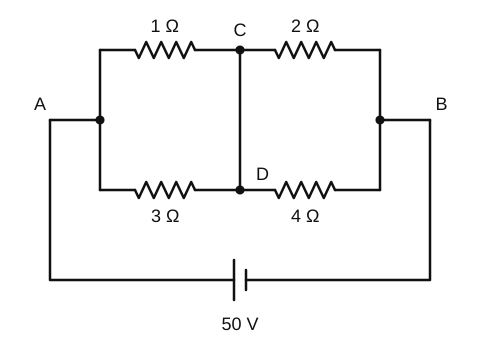
A constant voltage of $50$ V is maintained between the points A and B of the circuit shown in the figure. The current through the branch CD of the circuit is :
C and D are joined by a wire, so they are at the same potential. The circuit is ($1\ \Omega \parallel 3\ \Omega$) in series with ($2\ \Omega \parallel 4\ \Omega$): $$R = \frac{1 \times 3}{4} + \frac{2 \times 4}{6} = \frac{3}{4} + \frac{4}{3} = \frac{25}{12}\ \Omega$$ $$I = \frac{50}{25/12} = 24\ \text{A}$$
Current through $1\ \Omega$ (into C): $24 \times \dfrac{3}{4} = 18$ A.
Current through $2\ \Omega$ (out of C): $24 \times \dfrac{4}{6} = 16$ A.
Current in CD $= 18 - 16 = 2.0$ A (from C to D).
Solution by Sreeraj P, M.Sc Physics
Q 12-03-007NEETNEET 2024Top questionEasy
A wire of length '$l$' and resistance $100\ \Omega$ is divided into $10$ equal parts. The first $5$ parts are connected in series while the next $5$ parts are connected in parallel. The two combinations are again connected in series. The resistance of this final combination is:
Each part has resistance $\dfrac{100}{10} = 10\ \Omega$.
Five in series: $5 \times 10 = 50\ \Omega$.
Five in parallel: $\dfrac{10}{5} = 2\ \Omega$.
Total: $50 + 2 = 52\ \Omega$.
Solution by Sreeraj P, M.Sc Physics
Q 12-03-008NEETNEET 2024Top questionEasy
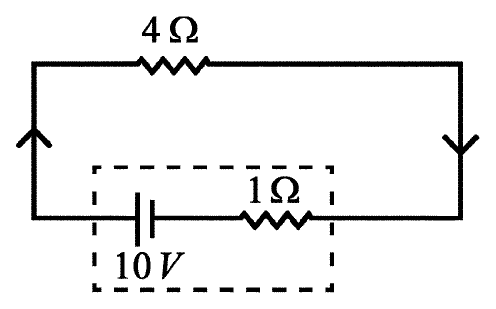
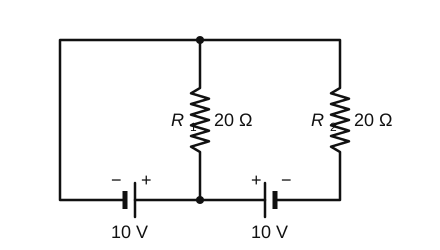
The terminal voltage of the battery, whose emf is $10$ V and internal resistance $1\ \Omega$, when connected through an external resistance of $4\ \Omega$ as shown in the figure is :
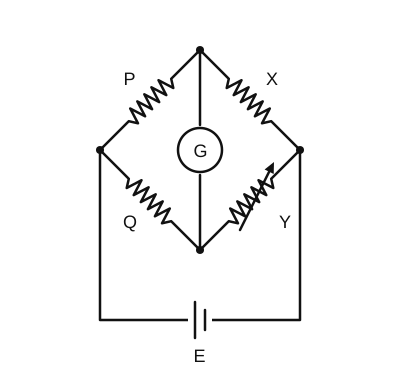
Two heaters A and B have power rating of $1$ kW and $2$ kW, respectively. Those two are first connected in series and then in parallel to a fixed power source. The ratio of power outputs for these two cases is:
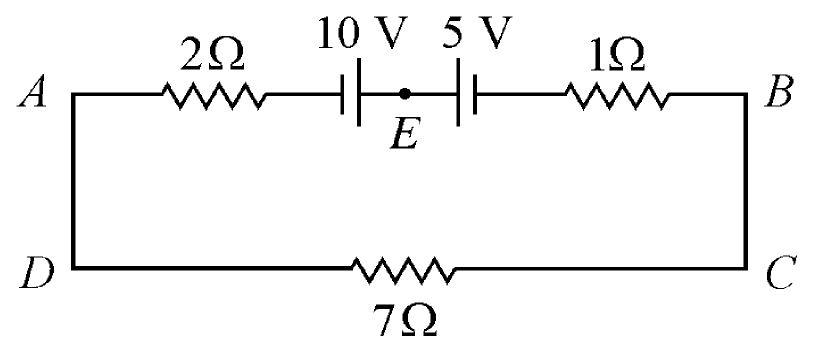
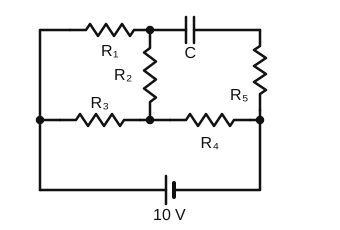
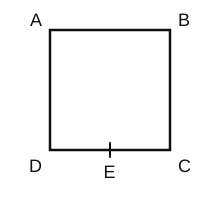
The two cells have their positive terminals facing each other at E, so they oppose. The $10$ V cell wins, and the net emf is $10 - 5 = 5$ V.
Total resistance: $2 + 1 + 7 = 10\ \Omega$.
$$I = \frac{5}{10} = 0.5\ \text{A}$$
The $10$ V cell drives current out of its positive terminal towards E, i.e. from A to B through E.
Solution by Sreeraj P, M.Sc Physics
Q 12-03-013NEETNEET 2023Top questionEasy
$10$ resistors, each of resistance $R$ are connected in series to a battery of emf $E$ and negligible internal resistance. Then those are connected in parallel to the same battery, the current is increased $n$ times. The value of $n$ is :
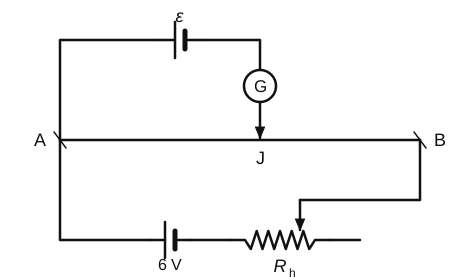
In a potentiometer circuit a cell of EMF $1.5$ V gives balance point at $36$ cm length of wire. If another cell of EMF $2.5$ V replaces the first cell, then at what length of the wire, the balance point occurs ?
The balancing length is proportional to the emf: $E \propto l$. $$l_2 = 36 \times \frac{2.5}{1.5} = 60\ \text{cm}$$
Solution by Sreeraj P, M.Sc Physics
Q 12-03-016NEETNEET 2021Top questionEasy
The effective resistance of a parallel connection that consists of four wires of equal length, equal area of cross-section and same material is $0.25\ \Omega$. What will be the effective resistance if they are connected in series ?
Parallel: $\dfrac{R}{4} = 0.25$, so each wire has $R = 1\ \Omega$.
Series: $4R = 4\ \Omega$.
Solution by Sreeraj P, M.Sc Physics
Q 12-03-017NEETNEET 2021Top questionMedium
Column - I gives certain physical terms associated with flow of current through a metallic conductor. Column - II gives some mathematical relations involving electrical quantities. Match Column - I and Column - II with appropriate relations.
Column - I: (A) Drift Velocity (B) Electrical Resistivity (C) Relaxation Period (D) Current Density
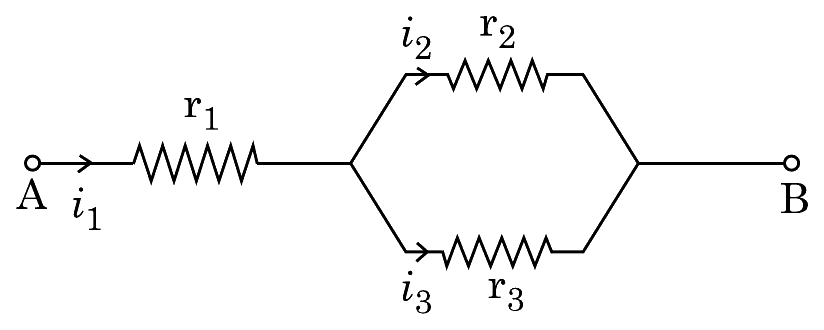
Three resistors having resistances $r_1$, $r_2$ and $r_3$ are connected as shown in the given circuit. The ratio $\dfrac{i_3}{i_1}$ of currents in terms of resistances used in the circuit is :
$i_1$ splits between $r_2$ and $r_3$, which are in parallel. The current divides in inverse ratio of resistance: $$i_3 = i_1\frac{r_2}{r_2 + r_3} \;\Rightarrow\; \frac{i_3}{i_1} = \frac{r_2}{r_2 + r_3}$$
Solution by Sreeraj P, M.Sc Physics
Q 12-03-019NEETNEET 2020Top questionEasy
The solids which have the negative temperature coefficient of resistance are :
In semiconductors and insulators, heating frees more charge carriers across the band gap, so the resistance falls as the temperature rises: a negative temperature coefficient.
In metals, the carrier number is fixed and more collisions at higher temperature raise the resistance: a positive coefficient.
Solution by Sreeraj P, M.Sc Physics
Q 12-03-020NEETNEET 2020Top questionEasy
Which of the following graph represents the variation of resistivity ($\rho$) with temperature (T) for copper ?
For a metal such as copper, resistivity rises with temperature. It has a small non-zero value at low temperature and increases more steeply as the temperature rises (it is not a straight line over a wide range).
Graph (3) shows this rising, upward-curving shape.
Solution by Sreeraj P, M.Sc Physics
Q 12-03-021NEETNEET 2020Top questionEasy
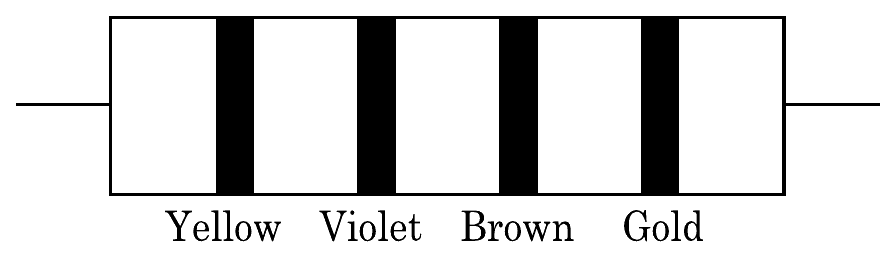
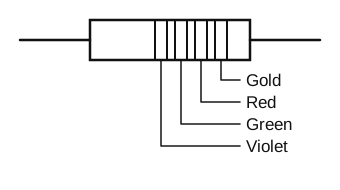
The color code of a resistance is given below : The values of resistance and tolerance, respectively, are :
A charged particle having drift velocity of $7.5 \times 10^{-4}\ \text{m s}^{-1}$ in an electric field of $3 \times 10^{-10}\ \text{V m}^{-1}$, has a mobility in $\text{m}^2\text{V}^{-1}\text{s}^{-1}$ of :
A resistance wire connected in the left gap of a metre bridge balances a $10\ \Omega$ resistance in the right gap at a point which divides the bridge wire in the ratio $3 : 2$. If the length of the resistance wire is $1.5$ m, then the length of $1\ \Omega$ of the resistance wire is :
A copper wire of cross-section $1\ \text{mm}^2$ carries $1.6$ A. If the number density of free electrons is $10^{29}\ \text{m}^{-3}$, the drift speed is ($e = 1.6 \times 10^{-19}$ C)
$P = \dfrac{E^2R}{(R + r)^2}$ is maximum when $\dfrac{dP}{dR} = 0$, which gives $R = r$. Then $P_{max} = \dfrac{E^2}{4r}$.
Solution by Sreeraj P, M.Sc Physics
Q 12-03-033NEETJEE MainMedium
Four identical cells, each of emf $1.5$ V and internal resistance $0.5\ \Omega$, are connected in series across a $4\ \Omega$ resistor. The current through the resistor is
Two cells of emf $2$ V and $4$ V, with internal resistances $1\ \Omega$ and $2\ \Omega$, are connected in parallel (like terminals together). The emf of the combination is
A $6$ V battery of negligible internal resistance is connected across $3\ \Omega$ in series with a parallel combination of $6\ \Omega$ and $3\ \Omega$. The current through the $6\ \Omega$ resistor is
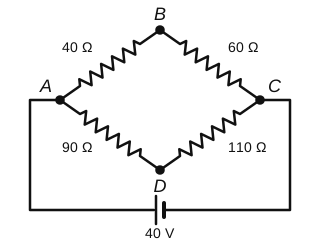
$\dfrac{6}{S} = \dfrac{40}{60} \Rightarrow S = 9\ \Omega$.
Solution by Sreeraj P, M.Sc Physics
Q 12-03-038NEETJEE MainMedium
The emfs of two cells are compared with a potentiometer. The balancing lengths are $300$ cm and $200$ cm when used singly, and the cells are then connected in series so as to aid each other. The balancing length for the combination is
A cell balances at $60$ cm on a potentiometer when on open circuit, and at $50$ cm when a $5\ \Omega$ resistor is connected across it. Its internal resistance is
$R = \dfrac{V^2}{P}$, so the $60$ W bulb has the larger resistance. In series the current is the same, and $P = I^2R$ is larger for the larger resistance: the $60$ W bulb glows brighter.
Solution by Sreeraj P, M.Sc Physics
Q 12-03-043NEETJEE MainEasy
An electric heater of $1$ kW is used for $2$ hours a day for $30$ days. At ₹$6$ per unit, the cost is
Half the length gives half the resistance, so $P = \dfrac{V^2}{R}$ doubles and the time halves: $5$ min.
Solution by Sreeraj P, M.Sc Physics
Q 12-03-045JEE MainMedium
Using Kirchhoff's laws, find the current, in amperes, through a $2\ \Omega$ resistor connected between the positive terminals of two cells whose negative terminals are joined, with emfs $10$ V and $4$ V and negligible internal resistance.
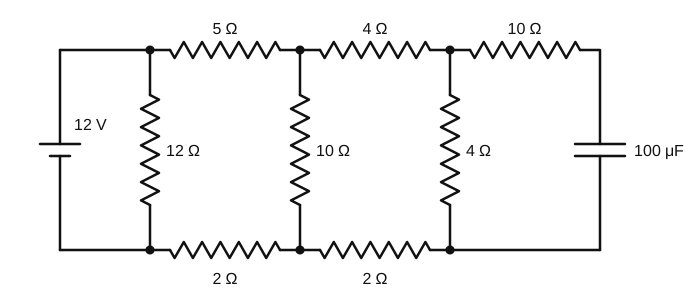
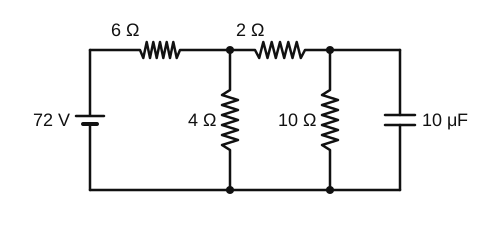
In steady state no current flows through the capacitor branch, so the $10\ \Omega$ in series with it carries no current and the capacitor voltage equals the voltage across the $4\ \Omega$ vertical resistor.
Reduce the ladder from the right:
$4\ \Omega$ (top) $+ 4\ \Omega$ (vertical) $+ 2\ \Omega$ (bottom) $= 10\ \Omega$, in parallel with the $10\ \Omega$ vertical $\Rightarrow 5\ \Omega$.
$5\ \Omega$ (top) $+ 5\ \Omega + 2\ \Omega$ (bottom) $= 12\ \Omega$. This is directly across the $12$ V battery (in parallel with the $12\ \Omega$), so it carries $1$ A.
Voltage across the $10\ \Omega$ vertical $= 12 - 1 \times 7 = 5$ V. Current in the right branch $= \dfrac{5}{10} = 0.5$ A, so the $4\ \Omega$ vertical has $2$ V.
Q 12-03-048JEE MainJEE Main 2026 (6 Apr, Shift 1)Hard
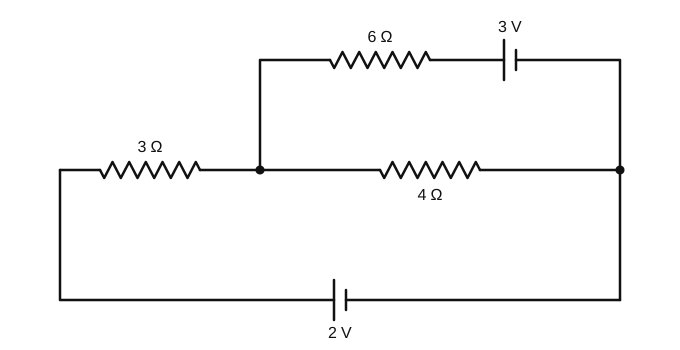
Refer to the circuit diagram given below. The heat generated across the $6\ \Omega$ resistance in $100$ second is $\dfrac{\alpha}{100}$ J. The value of $\alpha$ is ______. (Nearest integer)
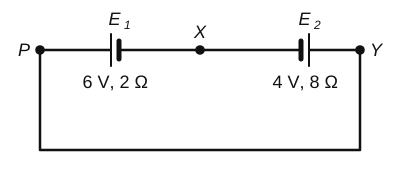
Label the node joining the $3\ \Omega$, $4\ \Omega$ and $6\ \Omega$ as $X$, and take the right-hand wire (joined to the negative terminals of both cells) as $0$ V. The left wire is then at $+2$ V, and the $6\ \Omega$ branch ends at the $+$ terminal of the $3$ V cell, i.e. at $3$ V.
Q 12-03-049JEE MainJEE Main 2026 (6 Apr, Shift 2)Hard
Two cells of emfs $1$ V and $2$ V and internal resistance $2\ \Omega$ and $1\ \Omega$, respectively connected in parallel, gave a current of $1$ A through an external resistance. If the polarity of one cell is reversed, then value of current through the external resistance will be $\dfrac{\alpha}{5}$ A. The value of $\alpha$ is ______.
Concept. Cells in parallel act as one cell: $E_{\text{eq}}=\dfrac{E_1/r_1+E_2/r_2}{1/r_1+1/r_2}$, $r_{\text{eq}}=\dfrac{r_1r_2}{r_1+r_2}$. Reversing a cell changes the sign of its emf.
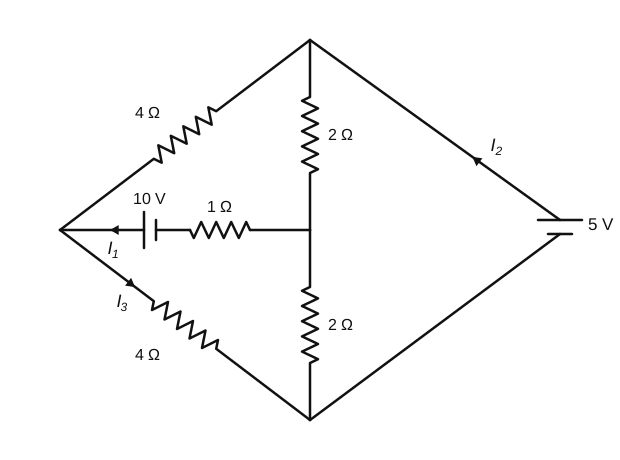
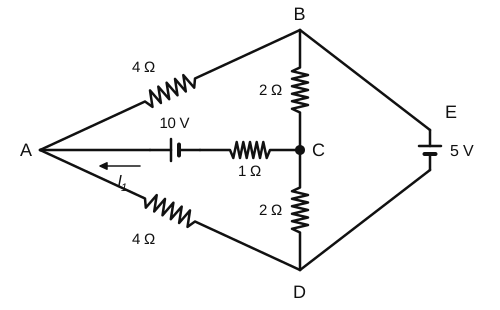
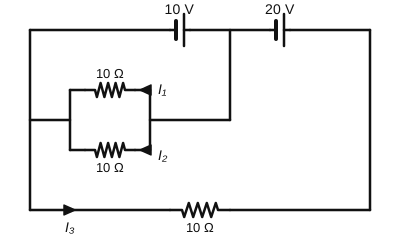
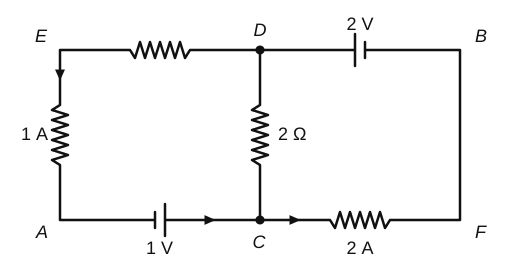
Answer: (A) $I_1 = 2.5$ A, $I_2 = 1.875$ A, $I_3 = 1.875$ A
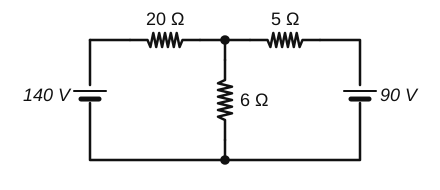
Concept. Use node potentials with Kirchhoff's junction law. The 5 V cell fixes the difference between the top and bottom corners, so the unknowns reduce to two potentials. Take the left corner as $0$ V; call the top $T$, the bottom $D$ and the centre $C$.
Step 1. Fix the cells. The 5 V cell (positive at the top) gives $V_T=V_D+5$. The 10 V cell (positive towards the left corner) with $1\ \Omega$: the current $I_1$ from $C$ to the left corner is $I_1=V_C+10$.
Step 2. Junction law at $C$. Current leaving $C$ through the two $2\ \Omega$ resistors and the cell branch is zero: $\dfrac{V_C-V_T}{2}+\dfrac{V_C-V_D}{2}+(V_C+10)=0$.
Step 3. Junction law for $T$ and $D$ together (the 5 V cell's current stays inside): $\dfrac{0-V_T}{4}+\dfrac{0-V_D}{4}+\dfrac{V_C-V_T}{2}+\dfrac{V_C-V_D}{2}=0\Rightarrow4V_C=3(V_T+V_D)$.
Step 4. Solve. Step 2 is $2V_C-\dfrac{V_T+V_D}{2}+10=0$; with $V_T+V_D=\dfrac{4V_C}{3}$ from Step 3, $2V_C-\dfrac{2V_C}{3}+10=0\Rightarrow V_C=-7.5$ V. Then $V_T+V_D=-10$ and $V_T-V_D=5$: $V_T=-2.5$ V, $V_D=-7.5$ V.
Step 5. Currents. $I_1=-7.5+10=2.5$ A. In the lower $4\ \Omega$: $I_3=\dfrac{0-(-7.5)}{4}=1.875$ A. At $T$: $\dfrac{V_T-V_C}{2}=2.5$ A leaves towards $C$ and $\dfrac{0-V_T}{4}=0.625$ A arrives from the left, so the cell branch supplies $I_2=2.5-0.625=1.875$ A.
Answer. $I_1=2.5$ A, $I_2=1.875$ A, $I_3=1.875$ A (Option A).
Solution by Sreeraj P, M.Sc Physics
Q 12-03-051JEE MainJEE Main 2026 (5 Apr, Shift 1)Medium
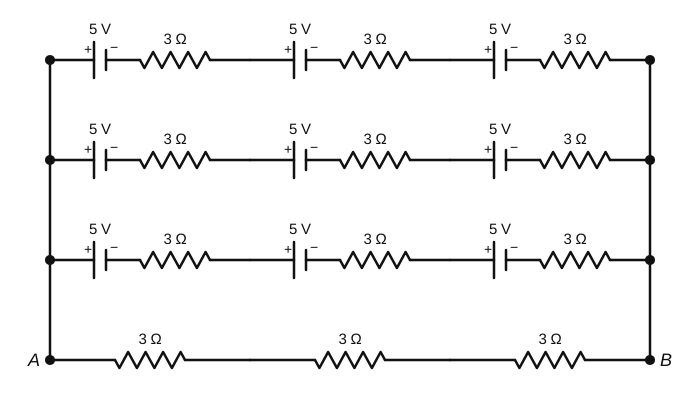
Refer to the figure given below, current between terminals $A$ and $B$ is ______ A.
Each of the top three rows has three $5$ V cells (all the same way round) and three $3\ \Omega$ resistors: emf $15$ V, resistance $9\ \Omega$. The three rows are in parallel between the two side rails, so together they act as a $15$ V source with $3\ \Omega$ internal resistance.
The bottom row from $A$ to $B$ ($3 \times 3 = 9\ \Omega$) is the load: $$I = \frac{15}{3 + 9} = 1.25\ \text{A}$$
Solution by Sreeraj P, M.Sc Physics
Q 12-03-052JEE MainJEE Main 2026 (5 Apr, Shift 2)Medium
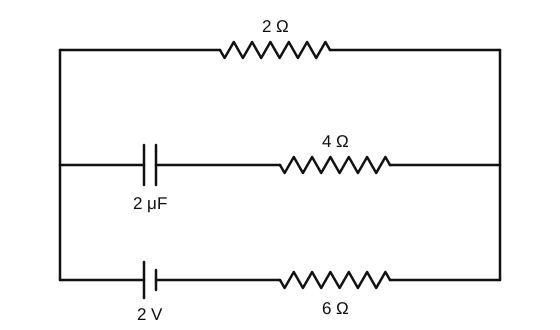
Under steady state condition the potential difference across the capacitor in the circuit is ______ V.
In steady state no current flows in the capacitor branch, so there is no drop across its $4\ \Omega$ resistor.
Current flows round the loop of the $2$ V cell, the $6\ \Omega$ and the $2\ \Omega$: $I = \dfrac{2}{8} = 0.25$ A.
The capacitor branch is in parallel with the $2\ \Omega$, so $V_C = 0.25 \times 2 = 0.5$ V.
Solution by Sreeraj P, M.Sc Physics
Q 12-03-053JEE MainJEE Main 2026 (5 Apr, Shift 2)Easy
When an external resistance of $5\ \Omega$ is connected across terminals of a cell, a current of $0.25$ A flows through it. When the $5\ \Omega$ resistor is replaced by a $2\ \Omega$ resistor, a current of $0.5$ A flows through it. The internal resistance of the cell is ______ $\Omega$.
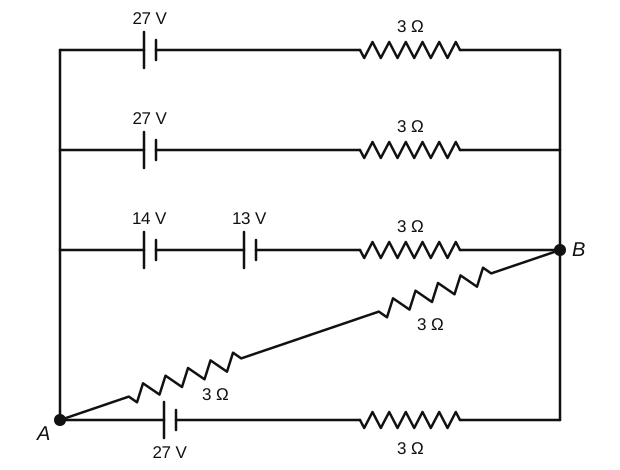
Concept. Identical branches (same emf, same internal resistance) in parallel behave like one cell with the same emf and the internal resistance divided by the number of branches. The third branch's 14 V and 13 V cells add to 27 V, so all four branches are identical.
Step 2. Load. The two $3\ \Omega$ resistors from $A$ to $B$ are in series: $6\ \Omega$.
Step 3. Current. $I=\dfrac{27}{6+0.75}=4$ A.
Step 4. Voltage. $V_{AB}=4\times6=24$ V.
Answer. $24$ V, $4$ A (Option B).
Solution by Sreeraj P, M.Sc Physics
Q 12-03-055JEE MainJEE Main 2026 (2 Apr, Shift 2)Easy
Two resistors of $200\ \Omega$ and $400\ \Omega$ are connected in series with a battery of $100$ V. A bulb rated at $200$ V, $100$ W is connected across the $400\ \Omega$ resistance. The potential drop across the bulb is ______ V.
Concept. The bulb is a resistor, $R=\dfrac{V^2}{P}=400\ \Omega$, in parallel with the $400\ \Omega$ resistor.
Step 1. Parallel. $200\ \Omega$, in series with $200\ \Omega$.
Step 2. Voltage. Half of $100$ V $=50$ V.
Answer. Option B.
Solution by Sreeraj P, M.Sc Physics
Q 12-03-056JEE MainJEE Main 2026 (28 Jan, Shift 2)Medium
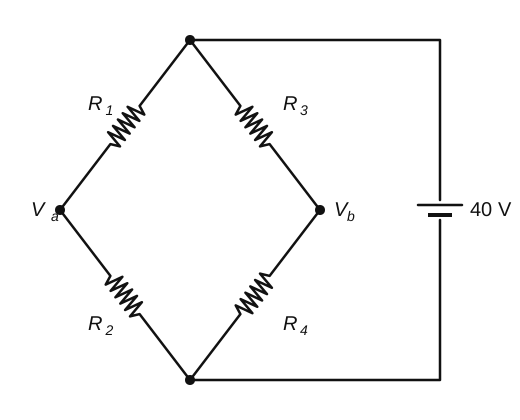
A Wheatstone bridge is initially at room temperature and all arms of the bridge have same value of resistances ($R_1 = R_2 = R_3 = R_4$). When $R_3$ resistance is heated to some temperature, its resistance value has gone up by 10%. The potential difference $(V_a - V_b)$ (after $R_3$ is heated) is ______ V.
Concept. In an unbalanced bridge each side is a potential divider across the cell. Find the potential at each midpoint and subtract.
Step 1. Side through $a$. $R_1=R_2$: $V_a=\dfrac{40}{2}=20$ V (taking the bottom as 0).
Step 2. Side through $b$. $R_3=1.1R$, $R_4=R$: $V_b=40\times\dfrac{R}{1.1R+R}=\dfrac{40}{2.1}\approx19.05$ V.
Step 3. Difference. $V_a-V_b\approx20-19.05=0.95$ V.
Answer. $0.95$ V (Option B).
Solution by Sreeraj P, M.Sc Physics
Q 12-03-057JEE MainJEE Main 2026 (28 Jan, Shift 1)Medium
For the two cells having same EMF $E$ and internal resistance $r$, the current passing through the external resistor $6\Omega$ is same when both the cells are connected either in parallel or in series. The value of internal resistance $r$ is ______ $\Omega$.
Answer. Option B. (In general they are equal when $r=R$.)
Solution by Sreeraj P, M.Sc Physics
Q 12-03-058JEE MainJEE Main 2026 (28 Jan, Shift 1)Medium
In the potentiometer, when the cell in the secondary circuit is shunted with $4\Omega$ resistance, the balance is obtained at the length 120 cm of wire. Now when the same cell is shunted with $12\Omega$ resistance, the balance is shifted to a length of 180 cm . The internal resistance of cell is ______ $\Omega$
Concept. This bridge is unbalanced ($\frac63\neq\frac36$) and has no symmetry that removes the middle resistor, so use Kirchhoff's junction law with node potentials. Apply 1 V across $A$ and $B$, find the current, and $R=\dfrac{1}{I}$.
Step 1. Set up. $V_A=1$, $V_B=0$. Node $M$: $6\ \Omega$ to $A$, $3\ \Omega$ to $B$, $3\ \Omega$ to $N$. Node $N$: $3\ \Omega$ to $A$, $6\ \Omega$ to $B$.
Step 2. Junction law at $M$ (×6). $(1-V_M)+2(0-V_M)+2(V_N-V_M)=0\Rightarrow1-5V_M+2V_N=0$.
Step 3. Junction law at $N$ (×6). $2(1-V_N)+(0-V_N)+2(V_M-V_N)=0\Rightarrow2-5V_N+2V_M=0$.
Step 4. Solve. $V_M=\dfrac37$ V, $V_N=\dfrac47$ V.
Step 5. Current from $A$. $\dfrac{1-3/7}{6}+\dfrac{1-4/7}{3}=\dfrac{4}{42}+\dfrac{6}{42}=\dfrac{5}{21}$ A, so $R=\dfrac{21}{5}\ \Omega$.
Answer. $x=21$.
Solution by Sreeraj P, M.Sc Physics
Q 12-03-060JEE MainJEE Main 2026 (24 Jan, Shift 2)Medium
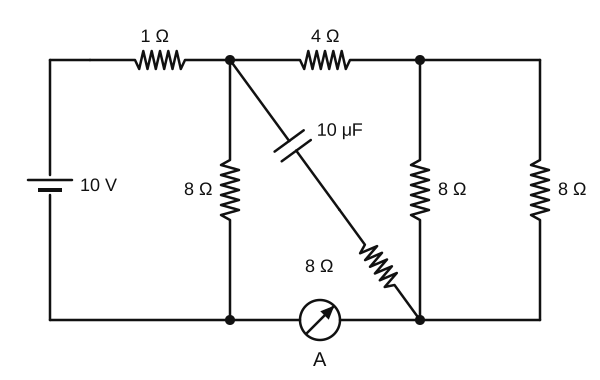
The reading of the ammeter $(A)$ in steady state in the following circuit (assuming negligible internal resistance of the ammeter) is ______ A.
In steady state no current flows through the capacitor, so the diagonal branch ($10\ \mu$F in series with $8\ \Omega$) carries no current.
Let $P$ be the junction after the $1\ \Omega$ resistor. From $P$ the current has two paths back to the cell:
through the left $8\ \Omega$ directly to the bottom wire, and
through $4\ \Omega$, then the two right-hand $8\ \Omega$ resistors in parallel ($4\ \Omega$), then through the ammeter to the bottom wire: $4 + 4 = 8\ \Omega$.
These two $8\ \Omega$ paths are in parallel: $4\ \Omega$. Total resistance $= 1 + 4 = 5\ \Omega$. $$I = \frac{10}{5} = 2\ \text{A}$$ It divides equally between the two equal paths, so the ammeter reads $1$ A.
Solution by Sreeraj P, M.Sc Physics
Q 12-03-061JEE MainJEE Main 2026 (24 Jan, Shift 2)Medium
A regular hexagon is formed by six wires each of resistance $r\Omega$ and the corners are joined to the centre by wires of same resistance. If the current enters at one corner and leaves at the opposite corner, the equivalent resistance of the hexagon between the two opposite corners will be
Concept. Use symmetry. With $V$ at the entry corner A and $0$ at the opposite corner D, the centre O is at $V/2$; neighbours B, F of A are equipotential at $x$, and C, E are at $V-x$.
Step 1. Node B. Currents out of B sum to zero: $(x-V)+(x-\tfrac V2)+(x-(V-x))=0\Rightarrow x=\tfrac58V$.
Step 2. Current from A. To B and F: $2\cdot\dfrac{3V/8}{r}$; to O: $\dfrac{V/2}{r}$; total $\dfrac{5V}{4r}$.
Step 3. Resistance. $\dfrac{V}{I}=\dfrac45r$.
Answer. Option B.
Solution by Sreeraj P, M.Sc Physics
Q 12-03-062JEE MainJEE Main 2026 (24 Jan, Shift 2)Medium
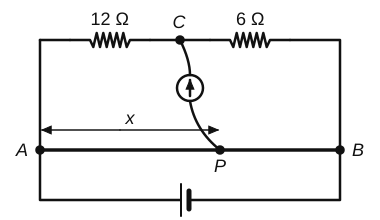
In a meter bridge experiment to determine the value of unknown resistance, first the resistances $2\Omega$ and $3\Omega$ are connected in the left and right gaps of the bridge and the null point is obtained at a distance $l$ cm from the left. Now when an unknown resistance $x\Omega$ is connected in parallel to $3\Omega$ resistance, the null point is shifted by 10 cm to the right of wire. The value of unknown resistance $x$ is
First balance: $\dfrac23 = \dfrac{l}{100 - l}\Rightarrow l = 40$ cm.
New null point at $50$ cm, so the right gap now equals the left gap: $$\frac{2}{R_{\text{right}}} = \frac{50}{50}\Rightarrow R_{\text{right}} = 2\ \Omega$$ $$\frac{3x}{3 + x} = 2\Rightarrow 3x = 6 + 2x\Rightarrow x = 6\ \Omega$$
Solution by Sreeraj P, M.Sc Physics
Q 12-03-063JEE MainJEE Main 2026 (24 Jan, Shift 1)Easy
Two resistors of $100\Omega$ each are connected in series with a 9 V battery. A voltmeter of $400\Omega$ resistance is connected to measure the voltage drop across one of the resistors. The voltmeter reading is ______ V.
Concept. A real voltmeter is a resistor in parallel with what it measures, so it lowers the reading.
Step 1. Parallel. $100\parallel400=80\ \Omega$.
Step 2. Divider. $9\times\dfrac{80}{180}=4$ V.
Answer. Option C.
Solution by Sreeraj P, M.Sc Physics
Q 12-03-064JEE MainJEE Main 2026 (24 Jan, Shift 1)Medium
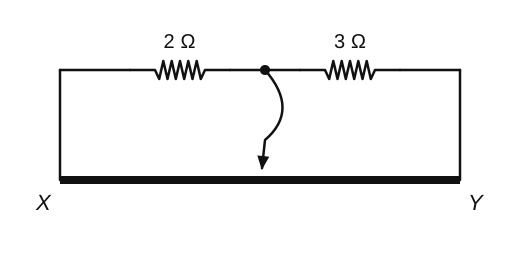
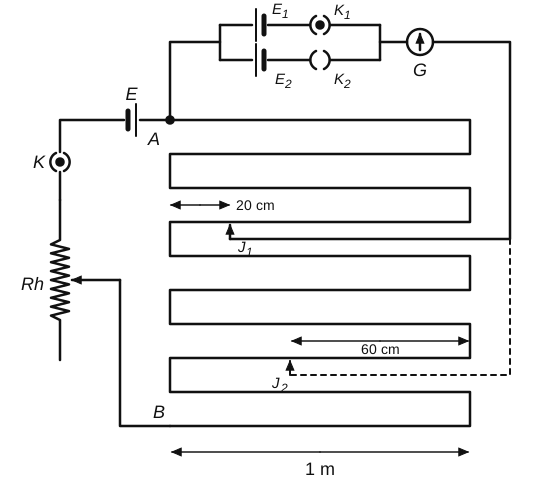
Two resistors $2\Omega$ and $3\Omega$ are connected in the gaps of bridge as shown in figure. The null point is obtained with the contact of jockey at some point on wire $XY$. When an unknown resistor is connected in parallel with $3\Omega$ resistor, the null point is shifted by 22.5 cm toward $Y$. The resistance of unknown resistor is ______ $\Omega$.
Initially: $\dfrac23 = \dfrac{l}{100 - l}\Rightarrow l = 40$ cm.
New null point: $40 + 22.5 = 62.5$ cm. $$\frac{2}{R'} = \frac{62.5}{37.5} = \frac53\Rightarrow R' = 1.2\ \Omega$$ $R'$ is $3\ \Omega$ in parallel with $x$: $$\frac{3x}{3 + x} = 1.2\Rightarrow 3x = 3.6 + 1.2x\Rightarrow x = 2\ \Omega$$
Solution by Sreeraj P, M.Sc Physics
Q 12-03-065JEE MainJEE Main 2025 (22 Jan, Shift 1)Easy
Given below are two statements:
Statement-I: The equivalent emf of two nonideal batteries connected in parallel is smaller than either of the two emfs.
Statement-II: The equivalent internal resistance of two nonideal batteries connected in parallel is smaller than the internal resistance of either of the two batteries.
In the light of the above statements, choose the correct answer from the options given below.
Answer: (B) Statement-I is false but Statement-II is true
Concept. Two unequal cells in parallel: $E_{eq}=\dfrac{E_1r_2+E_2r_1}{r_1+r_2}$, a weighted average of the two emfs, and $r_{eq}=\dfrac{r_1r_2}{r_1+r_2}$.
Step 1. Statement I. A weighted average lies between $E_1$ and $E_2$, so it is not smaller than both. Statement I is false.
Step 2. Statement II. $\dfrac{r_1r_2}{r_1+r_2}$ is smaller than either $r_1$ or $r_2$ (like resistors in parallel). Statement II is true.
Answer. Statement I is false but Statement II is true (Option B).
Solution by Sreeraj P, M.Sc Physics
Q 12-03-066JEE MainJEE Main 2025 (22 Jan, Shift 1)Medium
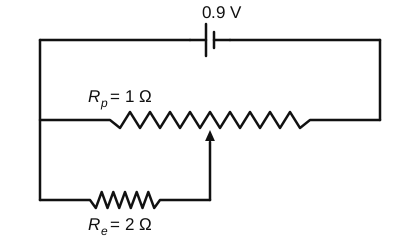
The sliding contact of a potentiometer is in the middle of the potentiometer wire having resistance $R_p = 1\ \Omega$ as shown in the figure. An external resistance of $R_e = 2\ \Omega$ is connected via the sliding contact. The electric current in the circuit is
The slider divides the wire into two halves of $0.5\ \Omega$ each.
$R_e = 2\ \Omega$ is connected between the left end of the wire and the slider, so it is in parallel with the left half: $$R_{\parallel} = \frac{0.5\times2}{0.5+2} = 0.4\ \Omega$$
This is in series with the right half: $$R_{total} = 0.4 + 0.5 = 0.9\ \Omega$$ $$I = \frac{0.9\ \text{V}}{0.9\ \Omega} = 1.0\ \text{A}$$
Solution by Sreeraj P, M.Sc Physics
Q 12-03-067JEE MainJEE Main 2025 (22 Jan, Shift 1)Easy
Which of the following resistivity ($\rho$) vs temperature ($T$) curves is most suitable to be used in wire bound standard resistors?
A standard resistor must keep its resistance almost constant when its temperature changes. It is made of an alloy such as manganin or constantan, which has a fairly high resistivity and a very small temperature coefficient of resistivity.
So the suitable curve is a nearly flat line at a non-zero resistivity: option (4).
Solution by Sreeraj P, M.Sc Physics
Q 12-03-068JEE MainJEE Main 2025 (22 Jan, Shift 2)Medium
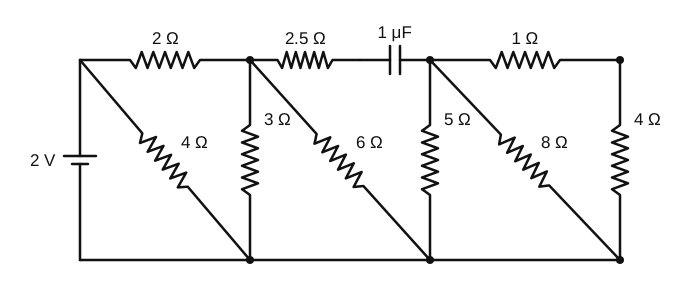
The net current flowing in the given circuit is ______ A.
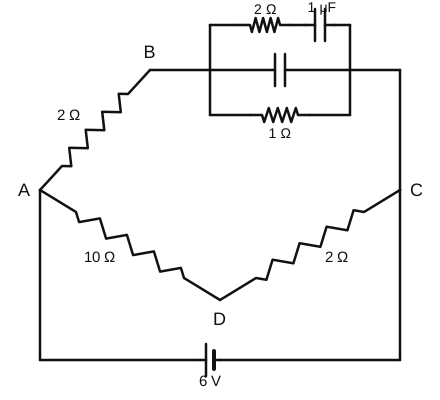
In steady state no current flows through the $1\ \mu\text{F}$ capacitor, so the branch $2.5\ \Omega$–$1\ \mu\text{F}$ and everything to its right ($1\ \Omega$, $5\ \Omega$, $8\ \Omega$, $4\ \Omega$) carry no current.
The $3\ \Omega$ and $6\ \Omega$ resistors both connect the second top junction to the bottom wire, so they are in parallel: $$\frac{3\times6}{3+6} = 2\ \Omega$$
This is in series with the $2\ \Omega$: $2 + 2 = 4\ \Omega$. That branch is in parallel with the diagonal $4\ \Omega$ across the cell: $$R = \frac{4\times4}{4+4} = 2\ \Omega$$ $$I = \frac{2\ \text{V}}{2\ \Omega} = 1\ \text{A}$$
Solution by Sreeraj P, M.Sc Physics
Q 12-03-069JEE MainJEE Main 2025 (23 Jan, Shift 2)Easy
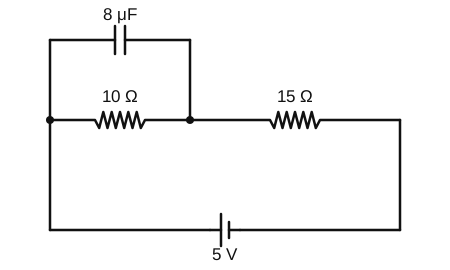
At steady state the charge on the capacitor, as shown in the circuit below, is ______ $\mu\text{C}$.
In steady state no current flows into the capacitor, so the $10\ \Omega$ and $15\ \Omega$ resistors carry the same current: $$I = \frac{5}{10 + 15} = 0.2\ \text{A}$$
The capacitor is connected across the $10\ \Omega$ resistor: $$V_C = 0.2\times10 = 2\ \text{V}, \qquad Q = CV = 8\ \mu\text{F}\times2\ \text{V} = 16\ \mu\text{C}$$
Solution by Sreeraj P, M.Sc Physics
Q 12-03-070JEE MainJEE Main 2025 (24 Jan, Shift 1)Easy
A wire of resistance $9\ \Omega$ is bent to form an equilateral triangle. Then the equivalent resistance across any two vertices will be ______ ohm.
Concept. Between two vertices of a triangle, one side is in parallel with the other two sides in series.
Step 1. Sides. $3\ \Omega$ each.
Step 2. Combine. $\dfrac{3\times6}{9}=2\ \Omega$.
Answer. $2$.
Solution by Sreeraj P, M.Sc Physics
Q 12-03-071JEE MainJEE Main 2025 (28 Jan, Shift 1)Medium
A wire of resistance $R$ is bent into an equilateral triangle and an identical wire is bent into a square. The ratio of resistance between the two end points of an edge of the triangle to that of the square is
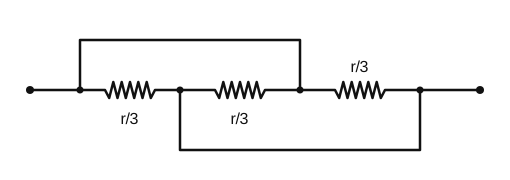
Label the junctions along the line: left end $L$, then $P$ (between the first and second resistors), then $Q$ (between the second and third), then the right end $R'$.
The upper wire joins $L$ to $Q$, so $L$ and $Q$ are the same node.
The lower wire joins $P$ to $R'$, so $P$ and $R'$ are the same node.
Each $r/3$ resistor now connects the node $\{L, Q\}$ to the node $\{P, R'\}$: all three are in parallel between the two ends. $$R_{eq} = \frac{r/3}{3} = \frac{r}{9}$$
Solution by Sreeraj P, M.Sc Physics
Q 12-03-073JEE MainJEE Main 2025 (28 Jan, Shift 2)Easy
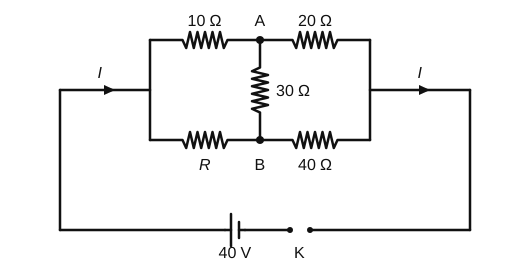
The value of current $I$ in the electrical circuit given below, when the potential at A is equal to the potential at B, will be ______ A.
With $V_A = V_B$ no current flows through the $30\ \Omega$ resistor, and the bridge is balanced: $$\frac{10}{20} = \frac{R}{40} \Rightarrow R = 20\ \Omega$$
The $30\ \Omega$ can be removed: $(10 + 20) = 30\ \Omega$ in parallel with $(20 + 40) = 60\ \Omega$ gives $20\ \Omega$. $$I = \frac{40}{20} = 2\ \text{A}$$
Solution by Sreeraj P, M.Sc Physics
Q 12-03-074JEE MainJEE Main 2024 (1 Feb, Shift 1)Top questionMedium
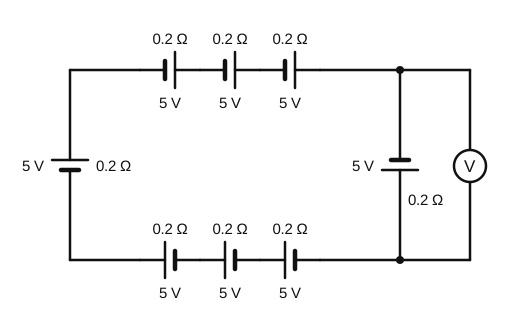
The reading of the ideal voltmeter $V$ in the circuit shown is (each cell has emf $5\ \text{V}$ and internal resistance $0.2\ \Omega$)
Concept. In a closed ring of identical cells all aiding each other, the current is $I=\dfrac{nE}{nr}=\dfrac Er$, and the terminal voltage of each cell is $E-Ir=0$.
Step 1. Current. Eight cells: $I=\dfrac{8\times5}{8\times0.2}=25$ A.
Step 2. Terminal voltage of one cell. $V=5-25\times0.2=0$.
Step 3. Reading. The ideal voltmeter across one cell reads its terminal voltage.
Answer. $0$ V (Option C).
Solution by Sreeraj P, M.Sc Physics
Q 12-03-075JEE MainJEE Main 2024 (1 Feb, Shift 1)Easy
The current in a conductor is expressed as $I = 3t^2 + 4t^3$, where $I$ is in ampere and $t$ is in second. The amount of electric charge that flows through a section of the conductor from $t = 1\ \text{s}$ to $t = 2\ \text{s}$ is ______ C.
Q 12-03-076JEE MainJEE Main 2024 (1 Feb, Shift 2)Medium
In a metre bridge, when a resistance in the left gap is $2\ \Omega$ and an unknown resistance is in the right gap, the balance length is found to be $40\ \text{cm}$. On shunting the unknown resistance with $2\ \Omega$, the balance length changes by
Step 2. Shunted. $3\parallel2=1.2\ \Omega$; $\dfrac{2}{1.2}=\dfrac{l}{100-l}\Rightarrow l=62.5$ cm.
Step 3. Shift. $62.5-40=22.5$ cm.
Answer. Option A.
Solution by Sreeraj P, M.Sc Physics
Q 12-03-077JEE MainJEE Main 2024 (4 Apr, Shift 1)Easy
The resistances of the platinum wire of a platinum resistance thermometer at the ice point and steam point are $8\ \Omega$ and $10\ \Omega$ respectively. After inserting it in a hot bath of temperature $400^\circ\text{C}$, the resistance of the platinum wire is
Q 12-03-078JEE MainJEE Main 2024 (4 Apr, Shift 1)Hard
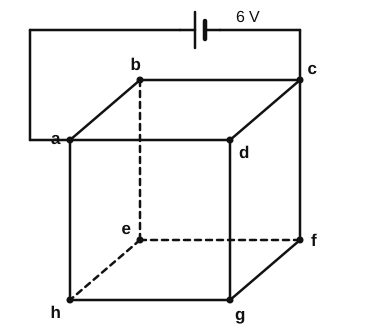
Twelve wires each having resistance $2\ \Omega$ are joined to form a cube. A battery of $6\ \text{V}$ emf is joined across points $a$ and $c$. The voltage difference between $e$ and $f$ is ______ V.
Concept. Use symmetry to fix the potentials of as many corners as possible, then apply Kirchhoff's junction law at one remaining corner.
Step 1. Potentials of the symmetric corners. Let $V_a=6$ V, $V_c=0$. The plane midway between $a$ and $c$ contains $b$, $d$ and the corners below them, $e$ and $g$, so $V_b=V_d=V_e=V_g=3$ V.
Step 2. Corner $h$ (below $a$). Its neighbours are $a$ (6 V), $e$ (3 V) and $g$ (3 V), all through equal resistors: $(6-V_h)+(3-V_h)+(3-V_h)=0\Rightarrow V_h=4$ V.
Step 3. Corner $f$ (below $c$). By the same symmetry (reversing the battery), $V_f=6-V_h=2$ V.
Step 4. Difference. $V_e-V_f=3-2=1$ V.
Answer. $1$.
Solution by Sreeraj P, M.Sc Physics
Q 12-03-079JEE MainJEE Main 2024 (4 Apr, Shift 2)Easy
An electric bulb rated $50\ \text{W}$ – $200\ \text{V}$ is connected across a $100\ \text{V}$ supply. The power dissipated by the bulb is
The resistance is fixed, so $P \propto V^2$: $$P = 50\left(\frac{100}{200}\right)^2 = 12.5\ \text{W}$$
Solution by Sreeraj P, M.Sc Physics
Q 12-03-080JEE MainJEE Main 2024 (4 Apr, Shift 2)Medium
Two wires A and B are made of the same material and have the same mass. Wire A has a radius of $2.0\ \text{mm}$ and wire B has a radius of $4.0\ \text{mm}$. The resistance of wire B is $2\ \Omega$. The resistance of wire A is ______ $\Omega$.
Q 12-03-081JEE MainJEE Main 2024 (5 Apr, Shift 1)Medium
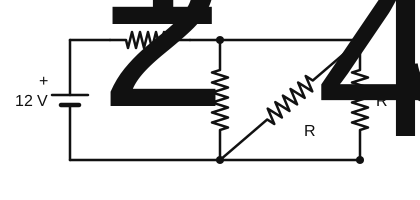
In the given figure $R_1 = 10\ \Omega$, $R_2 = 8\ \Omega$, $R_3 = 4\ \Omega$ and $R_4 = 8\ \Omega$. The battery is ideal with emf $12\ \text{V}$. The equivalent resistance of the circuit and the current supplied by the battery are respectively
Concept. Follow each resistor's two ends to the nodes. $R_2$, $R_3$ and the diagonal $R_4$ all run between the top wire and the bottom wire, so they are in parallel, however they are drawn.
Step 1. Parallel group. $\dfrac1{R_p}=\dfrac18+\dfrac14+\dfrac18=\dfrac12$, so $R_p=2\ \Omega$.
Step 2. Total. $R=R_1+R_p=10+2=12\ \Omega$.
Step 3. Current. $I=\dfrac{12}{12}=1$ A.
Answer. $12\ \Omega$ and $1$ A (Option B).
Solution by Sreeraj P, M.Sc Physics
Q 12-03-082JEE MainJEE Main 2024 (5 Apr, Shift 2)Easy
A $20\ \Omega$ resistor is connected in series with a parallel combination of $5\ \Omega$ and $10\ \Omega$ resistors across a $10\ \text{V}$ battery. The ratio of heat dissipated per second through the $5\ \Omega$ and $10\ \Omega$ resistances is
The $5\ \Omega$ and $10\ \Omega$ resistors are in parallel, so they have the same voltage. With $P = \dfrac{V^2}{R}$: $$\frac{P_5}{P_{10}} = \frac{10}{5} = 2:1$$
Solution by Sreeraj P, M.Sc Physics
Q 12-03-083JEE MainJEE Main 2024 (5 Apr, Shift 2)Easy
A wire of resistance $20\ \Omega$ is divided into 10 equal parts. Pairs of these parts are connected in parallel, and the resulting parallel pairs are then connected in series. The equivalent resistance of the final combination is ______ $\Omega$.
Each part: $2\ \Omega$. Each parallel pair: $1\ \Omega$. Five pairs in series: $5\ \Omega$.
Solution by Sreeraj P, M.Sc Physics
Q 12-03-084JEE MainJEE Main 2024 (6 Apr, Shift 1)Easy
A wire of resistance $R$ and radius $r$ is stretched till its radius becomes $r/2$. If the new resistance of the stretched wire is $xR$, then the value of $x$ is ______.
Each part has resistance $R/5$. Five equal resistors in parallel give $$R_{eq} = \frac{R/5}{5} = \frac{R}{25}$$
Solution by Sreeraj P, M.Sc Physics
Q 12-03-086JEE MainJEE Main 2024 (27 Jan, Shift 1)Medium
A wire of length $10\ \text{cm}$ and radius $\sqrt7\times10^{-4}\ \text{m}$ is connected across the right gap of a meter bridge. When a resistance of $4.5\ \Omega$ is connected on the left gap by using a resistance box, the balance length is found to be at $60\ \text{cm}$ from the left end. If the resistivity of the wire is $R\times10^{-7}\ \Omega\,\text{m}$, then value of $R$ is:
Step 2. Resistivity. $\rho=\dfrac{3\times\frac{22}{7}\times7\times10^{-8}}{0.1}=66\times10^{-7}\ \Omega$ m.
Answer. Option C.
Solution by Sreeraj P, M.Sc Physics
Q 12-03-087JEE MainJEE Main 2024 (27 Jan, Shift 2)Easy
Wheatstone bridge principle is used to measure the specific resistance $S_1$ of a given wire, having length $L$ and radius $r$. If $X$ is the resistance of the wire, then specific resistance is $S_1 = X\dfrac{\pi r^2}{L}$. If the length of the wire gets doubled, then the value of specific resistance will be:
Specific resistance (resistivity) is a property of the material only. Doubling the length doubles $X$, and $X\pi r^2/L$ remains unchanged, so it stays $S_1$.
Solution by Sreeraj P, M.Sc Physics
Q 12-03-088JEE MainJEE Main 2024 (27 Jan, Shift 2)Easy
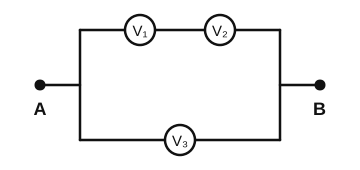
Three voltmeters, all having different internal resistances, are joined as shown in figure. When some potential difference is applied across A and B, their readings are $V_1$, $V_2$ and $V_3$. Choose the correct option.
Concept. A voltmeter reads the potential difference across its own terminals, whatever its resistance. Going round any closed loop, the potential differences add up to zero (Kirchhoff's loop law).
Step 1. Upper branch. $V_1$ and $V_2$ are in series between $A$ and $B$, so $V_1+V_2=V_A-V_B$.
Step 2. Lower branch. $V_3$ is directly across $A$ and $B$: $V_3=V_A-V_B$.
Step 3. Compare. $V_1+V_2=V_3$, regardless of the internal resistances. ($V_1=V_2$ only if their resistances were equal.)
Answer. $V_1+V_2=V_3$ (Option D).
Solution by Sreeraj P, M.Sc Physics
Q 12-03-089JEE MainJEE Main 2024 (29 Jan, Shift 1)Easy
The electric current through a wire varies with time as $I = I_0 + \beta t$, where $I_0 = 20\ \text{A}$ and $\beta = 3\ \text{A s}^{-1}$. The amount of electric charge crossed through a section of the wire in $20\ \text{s}$ is:
Q 12-03-090JEE MainJEE Main 2024 (29 Jan, Shift 1)Hard
A $16\ \Omega$ wire is bent to form a square loop. A $9\ \text{V}$ battery with internal resistance $1\ \Omega$ is connected across one of its sides. If a $4\ \mu\text{F}$ capacitor is connected across one of its diagonals, the energy stored by the capacitor will be $\dfrac{x}{2}\ \mu\text{J}$, where $x =$ ______.
Concept. In steady state no current flows into the capacitor, so it just measures the voltage between two corners of the loop.
Step 1. Circuit. Sides $4\ \Omega$; the side across the battery is parallel with the other three ($12\ \Omega$): $3\ \Omega$. Current $\dfrac{9}{3+1}=2.25$ A; voltage $6.75$ V.
Step 2. Diagonal. Along the $12\ \Omega$ path the current is $0.5625$ A; two sides take $0.5625\times8=4.5$ V.
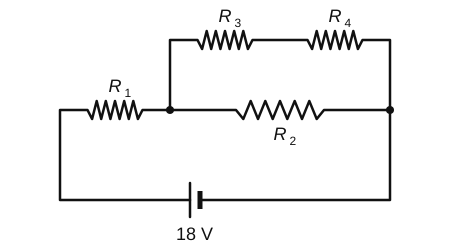
$R_2 \parallel R_3 = 2\ \Omega$, so the total resistance is $2 + 2 + 1 = 5\ \Omega$. $$I = \frac{10}{5} = 2\ \text{A}$$ This divides equally between the equal resistors $R_2$ and $R_3$, so the current in $R_3$ is $1\ \text{A}$.
Solution by Sreeraj P, M.Sc Physics
Q 12-03-092JEE MainJEE Main 2024 (29 Jan, Shift 2)Easy
In the given circuit, the current flowing through the resistance $20\ \Omega$ is $0.3\ \text{A}$, while the ammeter reads $0.9\ \text{A}$. The value of $R_1$ is ______ $\Omega$.
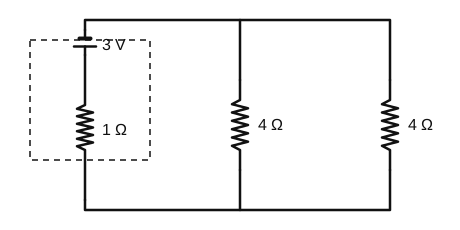
The two $4\ \Omega$ resistors in parallel give $2\ \Omega$. $$I = \frac{3}{2 + 1} = 1\ \text{A},\qquad V = \varepsilon - Ir = 3 - 1 = 2\ \text{V}$$
Solution by Sreeraj P, M.Sc Physics
Q 12-03-094JEE MainJEE Main 2024 (8 Apr, Shift 1)Easy
Resistance of a wire at $0\,{}^\circ\text{C}$, $100\,{}^\circ\text{C}$ and $t\,{}^\circ\text{C}$ is found to be $10\ \Omega$, $10.2\ \Omega$ and $10.95\ \Omega$ respectively. The temperature $t$ in Kelvin scale is ______.
Step 2. Temperature. $10.95=10(1+2\times10^{-4}t)\Rightarrow t=475^\circ$C $=748$ K.
Answer. $748$.
Solution by Sreeraj P, M.Sc Physics
Q 12-03-095JEE MainJEE Main 2024 (8 Apr, Shift 2)Easy
Water boils in an electric kettle in 20 minutes after being switched on. Using the same main supply, the length of the heating element should be ______ to ______ times of its initial length if the water is to be boiled in 15 minutes.
Concept. Same supply: $P=\dfrac{V^2}{R}$, and the heat needed is fixed, so time $\propto R\propto$ length.
Step 1. Ratio. $\dfrac{15}{20}=\dfrac34$.
Answer. Decreased to $\dfrac34$ (Option A).
Solution by Sreeraj P, M.Sc Physics
Q 12-03-096JEE MainJEE Main 2024 (8 Apr, Shift 2)Medium
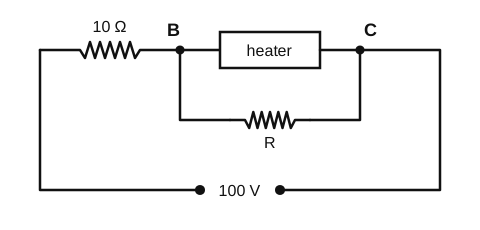
A heater is designed to operate with a power of $1000\ \text{W}$ in a $100\ \text{V}$ line. It is connected in combination with a resistance of $10\ \Omega$ and a resistance $R$ to a $100\ \text{V}$ mains as shown in the figure. For the heater to operate at $62.5\ \text{W}$, the value of $R$ should be ______ $\Omega$.
Concept. The heater's resistance follows from its rating. To run it at 62.5 W, find the voltage it needs, then use the series $10\ \Omega$ and the parallel $R$ to share the 100 V.
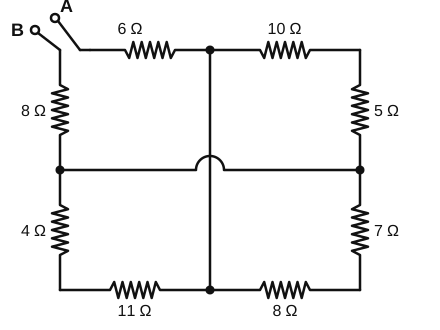
The vertical wire joins the top and bottom midpoints into one node X; the horizontal wire (which hops over it without contact) joins the left and right midpoints into another node Y.
A to X: $6\ \Omega$. Between X and Y there are three paths: $10 + 5 = 15\ \Omega$, $7 + 8 = 15\ \Omega$ and $11 + 4 = 15\ \Omega$, in parallel giving $5\ \Omega$. Y to B: $8\ \Omega$. $$R_{AB} = 6 + 5 + 8 = 19\ \Omega$$
Solution by Sreeraj P, M.Sc Physics
Q 12-03-098JEE MainJEE Main 2024 (9 Apr, Shift 1)Hard
The current flowing through the $1\ \Omega$ resistor is $\dfrac{n}{10}\ \text{A}$. The value of $n$ is ______.
Take $V_D = 0$; the 5 V cell gives $V_B = 5\ \text{V}$. Let the potentials of A and C be $V_A$ and $V_C$. The 10 V cell raises the potential towards A, so the current in the $1\ \Omega$ branch (C to A) is $I_1 = V_C + 10 - V_A$.
KCL at A: $I_1 = \dfrac{V_A - 5}{4} + \dfrac{V_A}{4}$
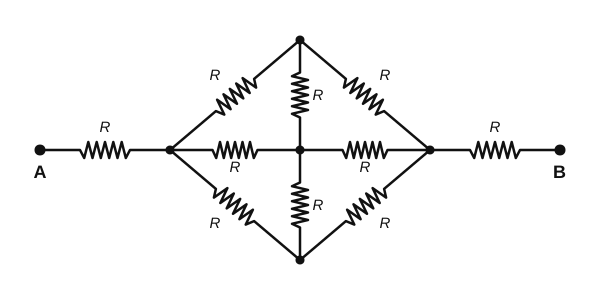
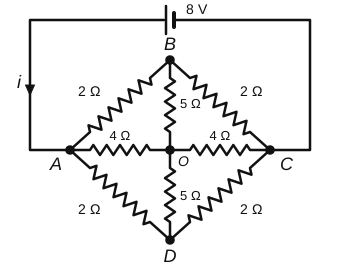
Concept. Inside the diamond, the top, centre and bottom points are symmetric between its left and right corners, so they are at the same potential. The vertical resistors between them carry no current.
Step 1. Remove the verticals. Left corner to right corner: three identical paths (top, centre, bottom), each $R+R=2R$.
Step 2. Diamond. Three $2R$ paths in parallel: $\dfrac{2R}{3}$.
Step 3. Add the end resistors. $R+\dfrac{2R}3+R=\dfrac{8R}{3}$.
Answer. $\dfrac{8R}{3}$ (Option A).
Solution by Sreeraj P, M.Sc Physics
Q 12-03-100JEE MainJEE Main 2024 (9 Apr, Shift 2)Easy
At room temperature ($27\,{}^\circ\text{C}$), the resistance of a heating element is $50\ \Omega$. The temperature coefficient of the material is $2.4\times10^{-4}\ ^\circ\text{C}^{-1}$. The temperature of the element, when its resistance is $62\ \Omega$, is ______ $^\circ\text{C}$.
Q 12-03-101JEE MainJEE Main 2024 (9 Apr, Shift 2)Medium
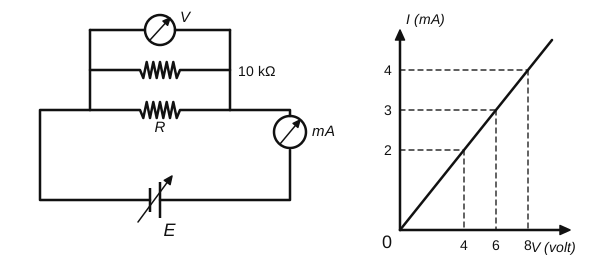
To determine the resistance ($R$) of a wire, a circuit is designed below. The $V$–$I$ characteristic curve for this circuit is plotted for the voltmeter and the ammeter readings as shown in the figure. The value of $R$ is ______ $\Omega$.
From the graph, $\dfrac VI = \dfrac{8\ \text{V}}{4\ \text{mA}} = 2\ \text{k}\Omega$. This is the resistance of $R$ in parallel with $10\ \text{k}\Omega$: $$\frac{10R}{10 + R} = 2 \;\Rightarrow\; 8R = 20 \;\Rightarrow\; R = 2.5\ \text{k}\Omega = 2500\ \Omega$$
Solution by Sreeraj P, M.Sc Physics
Q 12-03-102JEE MainJEE Main 2024 (30 Jan, Shift 1)Medium
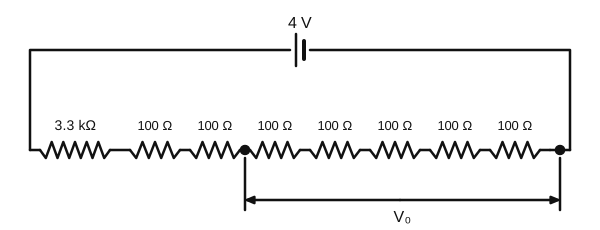
A potential divider circuit is shown in the figure. The output voltage $V_0$ is
Concept. In a series chain, the current is the same everywhere, so the output across part of the chain is the current times the resistance of that part.
Step 1. Total resistance. $3300+7\times100=4000\ \Omega$.
Step 2. Current. $I=\dfrac{4}{4000}=1$ mA.
Step 3. Output. $V_0$ is across five $100\ \Omega$ resistors: $1\ \text{mA}\times500\ \Omega=0.5$ V.
Answer. $0.5$ V (Option C).
Solution by Sreeraj P, M.Sc Physics
Q 12-03-103JEE MainJEE Main 2024 (30 Jan, Shift 1)Medium
An electric toaster has resistance of $60\ \Omega$ at room temperature ($27^\circ\text{C}$). The toaster is connected to a $220\ \text{V}$ supply. If the current flowing through it reaches $2.75\ \text{A}$, the temperature attained by the toaster is around: (if $\alpha = 2\times10^{-4}\ {}^\circ\text{C}^{-1}$)
Concept. The toaster's resistance rises with temperature, $R=R_0(1+\alpha\,\Delta T)$, so the hot resistance from $V/I$ tells how much it has heated. Here the given value $60\ \Omega$ at $27^\circ$C is used as the reference.
Step 1. Hot resistance. $R=\dfrac{220}{2.75}=80\ \Omega$.
Step 2. Rise in temperature. $80=60\left(1+2\times10^{-4}\,\Delta T\right)\Rightarrow\Delta T=\dfrac{1/3}{2\times10^{-4}}\approx1667^\circ$C.
Q 12-03-104JEE MainJEE Main 2024 (30 Jan, Shift 1)Medium
Two cells are connected in opposition in a single closed loop. Cell $E_1$ has $8\ \text{V}$ emf and $2\ \Omega$ internal resistance; cell $E_2$ has $2\ \text{V}$ emf and $4\ \Omega$ internal resistance. There is no other resistance in the circuit. The terminal potential difference of cell $E_2$ is ______ V.
Concept. Cells in opposition: net emf is the difference. The weaker cell is charged, so its terminal voltage is $E+Ir$.
Step 1. Current. $\dfrac{8-2}{2+4}=1$ A.
Step 2. Terminal voltage of $E_2$. $2+1\times4=6$ V.
Answer. $6$.
Solution by Sreeraj P, M.Sc Physics
Q 12-03-105JEE MainJEE Main 2024 (30 Jan, Shift 2)Easy
When a potential difference $V$ is applied across a wire of resistance $R$, it dissipates energy at a rate $W$. If the wire is cut into two halves and these halves are connected mutually parallel across the same supply, the energy dissipation rate will become:
Each half has resistance $R/2$; in parallel they give $R/4$. $$W' = \frac{V^2}{R/4} = 4\frac{V^2}{R} = 4W$$
Solution by Sreeraj P, M.Sc Physics
Q 12-03-106JEE MainJEE Main 2024 (30 Jan, Shift 2)Medium
Two resistances of $100\ \Omega$ and $200\ \Omega$ are connected in series with a battery of $4\ \text{V}$ and negligible internal resistance. A voltmeter is used to measure the voltage across the $100\ \Omega$ resistance, and it gives a reading of $1\ \text{V}$. The resistance of the voltmeter must be ______ $\Omega$.
Q 12-03-107JEE MainJEE Main 2024 (31 Jan, Shift 1)Medium
Two conductors have the same resistance at $0^\circ\text{C}$ but their temperature coefficients of resistance are $\alpha_1$ and $\alpha_2$. The respective temperature coefficients for their series and parallel combinations are:
Concept. Write each resistance as $R_0(1+\alpha t)$, combine, and read off the coefficient of $t$ in the form $R_{eq,0}(1+\alpha_{eq}t)$.
Step 1. Series. $R_s=R_0(1+\alpha_1t)+R_0(1+\alpha_2t)=2R_0\left(1+\dfrac{\alpha_1+\alpha_2}{2}t\right)$, so $\alpha_s=\dfrac{\alpha_1+\alpha_2}{2}$.
Step 2. Parallel. For small $\alpha t$, $\dfrac1{R_p}=\dfrac{1}{R_0}\left[(1-\alpha_1t)+(1-\alpha_2t)\right]=\dfrac{2}{R_0}\left(1-\dfrac{\alpha_1+\alpha_2}{2}t\right)$, so $R_p=\dfrac{R_0}{2}\left(1+\dfrac{\alpha_1+\alpha_2}{2}t\right)$.
Step 3. Compare. Both combinations have $\alpha_{eq}=\dfrac{\alpha_1+\alpha_2}{2}$.
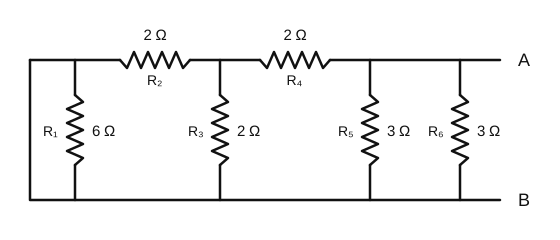
Concept. In a ladder, start at the end away from the terminals and fold the network towards $A$ and $B$ one rung at a time. A plain wire across the rails shorts anything in parallel with it.
Step 1. Far end. The plain wire at the left shorts $R_1$ ($6\ \Omega$), so the left end is $0\ \Omega$.
Step 2. Next rung. $R_2$ ($2\ \Omega$) in series with the short gives $2\ \Omega$, in parallel with $R_3$ ($2\ \Omega$): $1\ \Omega$.
Step 3. Next. Add $R_4$: $1+2=3\ \Omega$, in parallel with $R_5$ ($3\ \Omega$): $1.5\ \Omega$.
Step 4. Last rung. In parallel with $R_6$ ($3\ \Omega$): $\dfrac{1.5\times3}{4.5}=1\ \Omega$.
Answer. $1$.
Solution by Sreeraj P, M.Sc Physics
Q 12-03-109JEE MainJEE Main 2024 (31 Jan, Shift 2)Medium
By what percentage will the illumination of the lamp decrease if the current drops by $20\%$?
Concept. The illumination is proportional to the power, $P=I^2R$, so it changes as the square of the current.
Step 1. New power. $I\to0.8I$: $P\to0.64P$.
Step 2. Decrease. $1-0.64=0.36$, i.e. $36\%$.
Answer. $36\%$ (Option C).
Solution by Sreeraj P, M.Sc Physics
Q 12-03-110JEE MainJEE Main 2024 (31 Jan, Shift 2)Medium
The resistance per centimetre of a metre bridge wire is $r$, with $X\ \Omega$ resistance in the left gap. The balancing length from the left end is at $40\ \text{cm}$ with $25\ \Omega$ resistance in the right gap. Now the wire is replaced by another wire of $2r$ resistance per centimetre. The new balancing length for the same settings will be at
Concept. In a metre bridge with a uniform wire, the two parts of the wire have resistances $rl$ and $r(100-l)$. The ratio $\dfrac{l}{100-l}$ does not depend on $r$.
Step 2. New wire. Doubling $r$ cancels in the ratio, so the balance length stays the same.
Answer. $40$ cm (Option D).
Solution by Sreeraj P, M.Sc Physics
Q 12-03-111JEE MainJEE Main 2024 (31 Jan, Shift 2)Medium
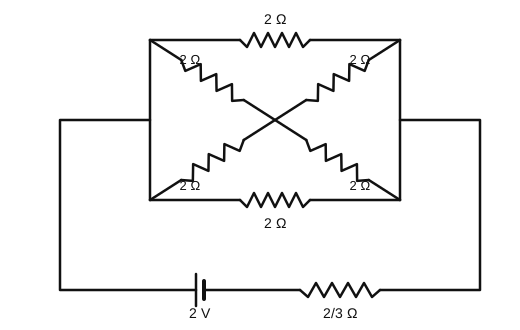
In the following circuit, the battery has an emf of $2\ \text{V}$ and an internal resistance of $\dfrac23\ \Omega$. The power consumption in the entire circuit is ______ W.
Concept. The left and right sides of the rectangle are plain wires, so every resistor branch (the top, the bottom and each diagonal) runs between the same two nodes. The crossing diagonals are not joined.
Step 1. Branches. Top $2\ \Omega$, bottom $2\ \Omega$, each diagonal $2+2=4\ \Omega$.
Step 2. Parallel. $\dfrac1R=\dfrac12+\dfrac12+\dfrac14+\dfrac14=\dfrac32$, so $R=\dfrac23\ \Omega$.
Step 3. Current. $I=\dfrac{2}{\frac23+\frac23}=1.5$ A.
Step 4. Power of the whole circuit. $P=EI=2\times1.5=3$ W.
Answer. $3$.
Solution by Sreeraj P, M.Sc Physics
Q 12-03-112JEE MainJEE Main 2023 (29 Jan, Shift 1)Easy
Ratio of thermal energy released in two resistors $R$ and $3R$ connected in parallel in an electric circuit is
In parallel the voltage is common, so $H=\dfrac{V^2t}{R}\propto\dfrac1R$. $$H_R:H_{3R}=\frac1R:\frac1{3R}=3:1$$
Solution by Sreeraj P, M.Sc Physics
Q 12-03-113JEE MainJEE Main 2023 (29 Jan, Shift 1)Medium
In a metre bridge experiment the balance point is obtained if the gaps are closed by $2\ \Omega$ and $3\ \Omega$. A shunt of $X\ \Omega$ is added to the $3\ \Omega$ resistor to shift the balancing point by $22.5\ \text{cm}$. The value of $X$ is ______.
Concept. A potentiometer is more sensitive when a small change in voltage gives a larger change in balancing length, that is, when the potential gradient $k$ is small. For a given current, a longer wire gives a smaller $k$.
Step 1. Gradient. Sensitivity $\propto\dfrac1k$: (C) is true and (B) is false.
Step 2. Length. $k=\dfrac{V}{L}$, so a longer wire gives a smaller $k$ and higher sensitivity: (A) is true and (D) is false.
Answer. A and C only (Option B).
Solution by Sreeraj P, M.Sc Physics
Q 12-03-115JEE MainJEE Main 2023 (29 Jan, Shift 2)Medium
A null point is found at $200\ \text{cm}$ in potentiometer when cell in secondary circuit is shunted by $5\ \Omega$. When a resistance of $15\ \Omega$ is used for shunting, null point moves to $300\ \text{cm}$. The internal resistance of the cell is ______ $\Omega$.
The terminal voltage $\dfrac{\varepsilon R}{R+r}$ is balanced, so it is proportional to the balancing length: $$\frac{5/(5+r)}{15/(15+r)}=\frac{200}{300}\ \Rightarrow\ 3\times5(15+r)=2\times15(5+r)$$ $$225+15r=150+30r\ \Rightarrow\ r=5\ \Omega$$
Solution by Sreeraj P, M.Sc Physics
Q 12-03-116JEE MainJEE Main 2023 (29 Jan, Shift 2)Medium
When two resistances $R_1$ and $R_2$ connected in series and introduced into the left gap of a meter bridge and a resistance of $10\ \Omega$ is introduced into the right gap, a null point is found at $60\ \text{cm}$ from left side. When $R_1$ and $R_2$ are connected in parallel and introduced into the left gap, a resistance of $3\ \Omega$ is introduced into the right gap to get null point at $40\ \text{cm}$ from left end. The product of $R_1R_2$ is ______ $\Omega^2$.
Q 12-03-117JEE MainJEE Main 2023 (30 Jan, Shift 1)Medium
The charge flowing in a conductor changes with time as $Q(t)=\alpha t-\beta t^2+\gamma t^3$, where $\alpha$, $\beta$ and $\gamma$ are constants. Minimum value of current is
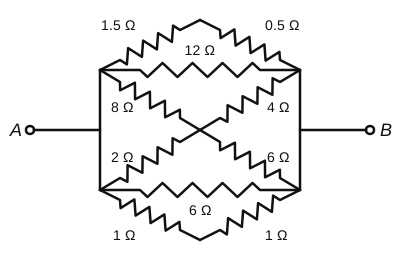
The left vertical wire is a single node (joined to $A$) and the right vertical wire is a single node (joined to $B$). So every path runs between $A$ and $B$:
Top arc: $1.5+0.5=2\ \Omega$
Top straight: $12\ \Omega$
The X: $8\parallel2=1.6\ \Omega$ to the centre, then $4\parallel6=2.4\ \Omega$ to $B$: $4\ \Omega$
Bottom straight: $6\ \Omega$
Bottom arc: $1+1=2\ \Omega$
All in parallel: $$\frac1{R}=\frac12+\frac1{12}+\frac14+\frac16+\frac12=\frac{18}{12}\ \Rightarrow\ R=\frac23\ \Omega$$
Solution by Sreeraj P, M.Sc Physics
Q 12-03-120JEE MainJEE Main 2023 (30 Jan, Shift 2)Medium
If the potential difference between $B$ and $D$ is zero, the value of $x$ is $\dfrac1n\ \Omega$. The value of $n$ is ______.
Q 12-03-121JEE MainJEE Main 2023 (31 Jan, Shift 1)Easy
The drift velocity of electrons for a conductor connected in an electrical circuit is $V_d$. The conductor is now replaced by another conductor with same material and same length but double the area of cross-section. The applied voltage remains same. The new drift velocity of electrons will be
Concept. $v_d=\dfrac{eE\tau}{m}$ and $E=\dfrac VL$. The drift speed depends on the field, not on the area.
Step 1. Same $V$ and $L$. $E$ is unchanged, so $v_d$ is unchanged (the larger area simply carries more current).
Answer. $V_d$ (Option A).
Solution by Sreeraj P, M.Sc Physics
Q 12-03-122JEE MainJEE Main 2023 (31 Jan, Shift 1)Easy
Two identical cells, when connected either in parallel or in series give same current in an external resistance $5\ \Omega$. The internal resistance of each cell will be ______ $\Omega$.
Q 12-03-123JEE MainJEE Main 2023 (31 Jan, Shift 2)Easy
$H$ amount of thermal energy is developed by a resistor in $10\ \text{s}$ when a current of $4\ \text{A}$ is passed through it. If the current is increased to $16\ \text{A}$, the thermal energy developed by the resistor in $10\ \text{s}$ will be
Concept. In steady state the capacitor branches carry no current, so between $B$ and $C$ only the $1\ \Omega$ resistor conducts. Then each side of the network is a simple potential divider across 6 V.
Step 1. Path $ABC$. $2+1=3\ \Omega$: $I=\dfrac63=2$ A, so the drop $A\to B$ is $2\times2=4$ V.
Step 2. Path $ADC$. $10+2=12\ \Omega$: $I=\dfrac6{12}=0.5$ A, so the drop $A\to D$ is $0.5\times10=5$ V.
Step 3. Difference. $|V_B-V_D|=|(V_A-4)-(V_A-5)|=1$ V.
Answer. $1$.
Solution by Sreeraj P, M.Sc Physics
Q 12-03-125JEE MainJEE Main 2023 (24 Jan, Shift 1)Medium
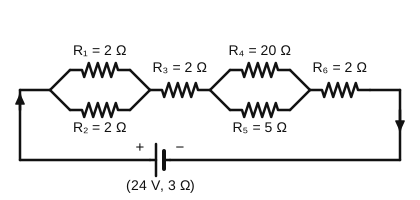
As shown in the figure, a network of resistors is connected to a battery of $24\ \text{V}$ with an internal resistance of $3\ \Omega$. The currents through the resistors $R_4$ and $R_5$ are $I_4$ and $I_5$ respectively. The values of $I_4$ and $I_5$ are
Answer: (D) $I_4=\dfrac25\ \text{A}$ and $I_5=\dfrac85\ \text{A}$
Concept. Reduce each parallel pair, add everything in series with the internal resistance, find the main current, then split it inversely as the resistances.
Step 2. Total resistance. $1+2+4+2+3=12\ \Omega$ (including the $3\ \Omega$ internal resistance).
Step 3. Main current. $I=\dfrac{24}{12}=2$ A.
Step 4. Divide between $R_4$ and $R_5$. $I_4=2\times\dfrac{5}{25}=\dfrac25$ A, $I_5=2\times\dfrac{20}{25}=\dfrac85$ A.
Answer. $I_4=\dfrac25$ A and $I_5=\dfrac85$ A (Option D).
Solution by Sreeraj P, M.Sc Physics
Q 12-03-126JEE MainJEE Main 2023 (24 Jan, Shift 1)Easy
A hollow cylindrical conductor has length of $3.14\ \text{m}$, while its inner and outer diameters are $4\ \text{mm}$ and $8\ \text{mm}$ respectively. The resistance of the conductor is $n\times10^{-3}\ \Omega$. If the resistivity of the material is $2.4\times10^{-8}\ \Omega\,\text{m}$, the value of $n$ is ______.
Q 12-03-127JEE MainJEE Main 2023 (24 Jan, Shift 2)Easy
A cell of emf $90\ \text{V}$ is connected across series combination of two resistors each of $100\ \Omega$ resistance. A voltmeter of resistance $400\ \Omega$ is used to measure the potential difference across each resistor. The reading of the voltmeter will be
Volume is constant, so $R=\dfrac{\rho l}{A}=\dfrac{\rho l^2}{V}\propto l^2$. $R'=(1.2)^2R=1.44R$: an increase of $44\%$.
Solution by Sreeraj P, M.Sc Physics
Q 12-03-129JEE MainJEE Main 2023 (25 Jan, Shift 1)Medium
A uniform metallic wire carries a current $2\ \text{A}$, when $3.4\ \text{V}$ battery is connected across it. The mass of uniform metallic wire is $8.92\times10^{-3}\ \text{kg}$, density is $8.92\times10^3\ \text{kg m}^{-3}$ and resistivity is $1.7\times10^{-8}\ \Omega\,\text{m}$. The length of wire is
Concept. $R=\dfrac{\rho l}{A}$, and the volume $Al$ is fixed by the mass and density. Writing $A=\dfrac{\text{volume}}{l}$ gives $R=\dfrac{\rho l^2}{\text{volume}}$.
The plain vertical wire joins the top and bottom rails, so everything to its right (the two $4\ \Omega$ resistors and the end wire) carries no current, and the second vertical $2\ \Omega$ resistor has both ends on the same node, so it is shorted out.
What remains: $3\ \Omega$, then the top $2\ \Omega$ in parallel with the first vertical $2\ \Omega$ ($=1\ \Omega$), then $6\ \Omega$: $$R_{AB}=3+1+6=10\ \Omega$$
Solution by Sreeraj P, M.Sc Physics
Q 12-03-131JEE MainJEE Main 2023 (25 Jan, Shift 2)Easy
The resistance of a wire is $5\ \Omega$. Its new resistance in ohm, if stretched to $5$ times of its original length will be
At constant volume $R\propto l^2$: $R'=5\times25=125\ \Omega$.
Solution by Sreeraj P, M.Sc Physics
Q 12-03-132JEE MainJEE Main 2023 (25 Jan, Shift 2)Medium
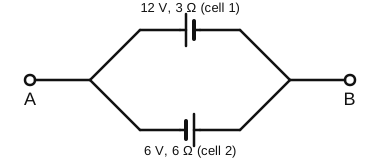
Two cells are connected between points $A$ and $B$ as shown. Cell 1 has emf of $12\ \text{V}$ and internal resistance of $3\ \Omega$. Cell 2 has emf of $6\ \text{V}$ and internal resistance of $6\ \Omega$. An external resistor $R$ of $4\ \Omega$ is connected across $A$ and $B$. The current flowing through $R$ will be ______ A.
The cells are connected with opposite polarities. Treat each as a source between $A$ and $B$ and use the parallel-cell formula with one emf negative: $$\varepsilon_{eq}=\frac{\frac{12}{3}-\frac{6}{6}}{\frac13+\frac16}=\frac{3}{1/2}=6\ \text{V},\qquad r_{eq}=\frac{3\times6}{3+6}=2\ \Omega$$ $$I=\frac{6}{2+4}=1\ \text{A}$$
Solution by Sreeraj P, M.Sc Physics
Q 12-03-133JEE MainJEE Main 2023 (15 Apr, Shift 1)Easy
Given below are two statements:
Statement I: The equivalent resistance of resistors in a series combination is smaller than least resistance used in the combination.
Statement II: The resistivity of the material is independent of temperature.
In the light of the above statements, choose the correct answer from the options given below:
Answer: (A) Both Statement I and Statement II are false
In series the equivalent resistance exceeds the largest resistance, so Statement I is false. Resistivity changes with temperature, so Statement II is false.
Solution by Sreeraj P, M.Sc Physics
Q 12-03-134JEE MainJEE Main 2023 (15 Apr, Shift 1)Medium
A network of four resistances is connected to $9\ \text{V}$ battery, as shown in figure. The magnitude of voltage difference between the points $A$ and $B$ is ______ V.
Answer: (D) Move in the curved paths from lower potential to higher potential
Concept. Free electrons keep their fast random thermal motion. Between collisions the field accelerates them (force $-e\vec E$, opposite to the field), so each path bends; the net effect is a slow drift towards higher potential.
Step 1. Direction. The field points from higher to lower potential; electrons are pushed the other way, from lower to higher potential. Option A is wrong.
Step 2. Path. A charge accelerated sideways to its velocity moves on a curve (like a projectile), and collisions keep changing its direction. So the paths are neither straight nor uniform. Options B and C are wrong.
Answer. They move in curved paths from lower potential to higher potential (Option D).
Solution by Sreeraj P, M.Sc Physics
Q 12-03-136JEE MainJEE Main 2023 (10 Apr, Shift 2)Easy
A rectangular parallelepiped is measured as $1\ \text{cm}\times1\ \text{cm}\times100\ \text{cm}$. If its specific resistance is $3\times10^{-7}\ \Omega\,\text{m}$, then the resistance between its two opposite rectangular faces will be ______ $\times10^{-7}\ \Omega$.
The rectangular faces are $1\ \text{cm}\times100\ \text{cm}$ and are $1\ \text{cm}$ apart: $$R=\frac{\rho l}{A}=\frac{3\times10^{-7}\times0.01}{0.01\times1}=3\times10^{-7}\ \Omega$$
Solution by Sreeraj P, M.Sc Physics
Q 12-03-137JEE MainJEE Main 2023 (11 Apr, Shift 1)Easy
Two identical heater filaments are connected first in parallel and then in series. At the same applied voltage, the ratio of heat produced in same time for parallel to series will be
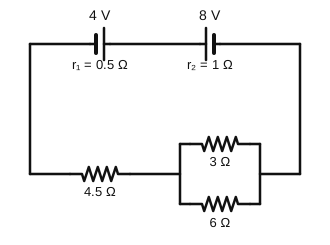
Concept. Cells in series opposing each other: the net emf is the difference, the internal resistances add, and the current then divides in the parallel pair.
Step 1. Net emf. $8-4=4$ V.
Step 2. Total resistance. $0.5+1+4.5+(3\parallel6)=6+2=8\ \Omega$.
Step 3. Main current. $I=\dfrac48=0.5$ A.
Step 4. Current in $3\ \Omega$. $0.5\times\dfrac{6}{9}=\dfrac13$ A, so $x=1$.
Answer. $1$.
Solution by Sreeraj P, M.Sc Physics
Q 12-03-139JEE MainJEE Main 2023 (11 Apr, Shift 2)Hard
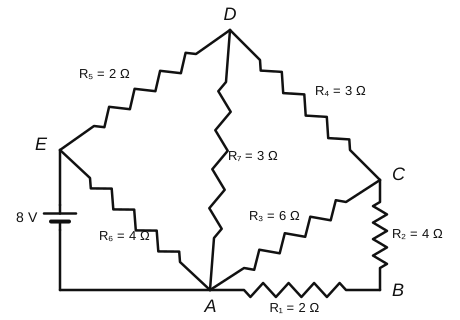
$R_6$ is directly across the cell and does not affect the rest.
Between $C$ and $A$: $R_3=6\ \Omega$ in parallel with $R_2+R_1=6\ \Omega$, i.e. $3\ \Omega$. Then $D\to C\to A$ is $3+3=6\ \Omega$, in parallel with $R_7=3\ \Omega$: $2\ \Omega$.
With $R_5$: $2+2=4\ \Omega$, so the current from $E$ is $\dfrac84=2\ \text{A}$ and $V_D-V_A=2\times2=4\ \text{V}$.
Current $D\to C\to A$: $\dfrac46=\dfrac23\ \text{A}$, which splits equally at $C$: $I_{R_2}=\dfrac13\ \text{A}$.
Solution by Sreeraj P, M.Sc Physics
Q 12-03-140JEE MainJEE Main 2023 (11 Apr, Shift 2)Easy
Two identical cells each of emf $1.5\ \text{V}$ are connected in series across a $10\ \Omega$ resistance. An ideal voltmeter connected across $10\ \Omega$ resistance reads $1.5\ \text{V}$. The internal resistance of each cell is ______ $\Omega$.
Concept. Melted and redrawn: volume constant. Length $\tfrac14$ means area $\times4$: $R\times\dfrac{1}{16}$.
Step 1. Value. $\dfrac{160}{16}=10\ \Omega$.
Answer. Option B.
Solution by Sreeraj P, M.Sc Physics
Q 12-03-142JEE MainJEE Main 2023 (12 Apr, Shift 1)Medium
The current flowing through a conductor connected across a source is $2\ \text{A}$ and $1.2\ \text{A}$ at $0^\circ\text{C}$ and $100^\circ\text{C}$ respectively. The current flowing through the conductor at $50^\circ\text{C}$ will be ______ $\times10^2$ mA.
$R\propto\dfrac1I$ and $R=R_0(1+\alpha T)$: $\dfrac{2}{1.2}=1+100\alpha\Rightarrow\alpha=\dfrac1{150}\ ^\circ\text{C}^{-1}$.
At $50^\circ\text{C}$: $R=R_0\left(1+\dfrac13\right)=\dfrac43R_0$, so $I=\dfrac{2}{4/3}=1.5\ \text{A}=15\times10^2\ \text{mA}$.
Solution by Sreeraj P, M.Sc Physics
Q 12-03-143JEE MainJEE Main 2023 (13 Apr, Shift 1)Easy
A potential $V_0$ is applied across a uniform wire of resistance $R$. The power dissipation is $P_1$. The wire is then cut into two equal halves and a potential of $V_0$ is applied across the length of each half. The total power dissipation across two wires is $P_2$. The ratio of $P_2:P_1$ is $\sqrt x:1$. The value of $x$ is ______.
Concept. At fixed voltage $P=\dfrac{V^2}{R}$. Each half has $\dfrac R2$ and gets the full $V_0$.
Step 1. Total. $2\times\dfrac{V_0^2}{R/2}=4P_1$.
Step 2. Form. $4=\sqrt{16}$.
Answer. $x=16$.
Solution by Sreeraj P, M.Sc Physics
Q 12-03-144JEE MainJEE Main 2023 (6 Apr, Shift 1)Easy
The length of a metallic wire is increased by $20\%$ and its area of cross-section is reduced by $4\%$. The percentage change in resistance of the metallic wire is ______.
Concept. $R=\dfrac{\rho l}{A}$. Use the given changes directly (the volume need not stay constant here).
Step 1. Ratio. $\dfrac{1.2}{0.96}=1.25$.
Answer. $25\%$ increase.
Solution by Sreeraj P, M.Sc Physics
Q 12-03-145JEE MainJEE Main 2023 (6 Apr, Shift 2)Medium
Figure shows a part of an electric circuit. The potentials at points $a$, $b$ and $c$ are $30\ \text{V}$, $12\ \text{V}$ and $2\ \text{V}$ respectively. The current through the $20\ \Omega$ resistor will be
The $2\ \Omega$ resistor has $3-2=1\ \text{V}$ across it, so the total current is $0.5\ \text{A}$.
Current in $5\ \Omega$: $\dfrac25=0.4\ \text{A}$; the voltmeter takes $0.1\ \text{A}$, so $R_V=\dfrac{2}{0.1}=20\ \Omega$.
Solution by Sreeraj P, M.Sc Physics
Q 12-03-147JEE MainJEE Main 2023 (8 Apr, Shift 1)Easy
A current of $2$ A flows through a wire of cross-sectional area $25.0\ \text{mm}^2$. The number of free electrons in a cubic metre are $2.0\times10^{28}$. The drift velocity of the electrons is ______ $\times10^{-6}\ \text{m s}^{-1}$ (given, charge on electron $=1.6\times10^{-19}$ C).
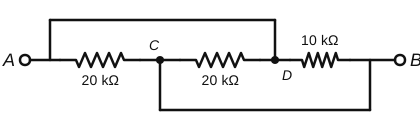
Concept. Points joined by a plain wire are at the same potential, so they are the same node. Rename the nodes, then see which resistors share the same two nodes.
Step 1. Merge nodes. The wire from $A$ to $D$ makes $D\equiv A$; the wire from $C$ to $B$ makes $C\equiv B$.
Step 2. Place each resistor. $AC$ ($20$ k$\Omega$) is between $A$ and $B$; $CD$ ($20$ k$\Omega$) is between $B$ and $A$; $DB$ ($10$ k$\Omega$) is between $A$ and $B$.
Step 3. Parallel. All three join $A$ and $B$: $\dfrac1R=\dfrac1{20}+\dfrac1{20}+\dfrac1{10}=\dfrac{4}{20}$, so $R=5$ k$\Omega$.
Answer. $5$ k$\Omega$ (Option B).
Solution by Sreeraj P, M.Sc Physics
Q 12-03-149JEE MainJEE Main 2023 (8 Apr, Shift 2)Easy
The number density of free electrons in copper is nearly $8\times10^{28}\ \text{m}^{-3}$. A copper wire has its area of cross-section $=2\times10^{-6}\ \text{m}^2$ and is carrying a current of $3.2$ A. The drift speed of the electrons is ______ $\times10^{-6}\ \text{m s}^{-1}$.
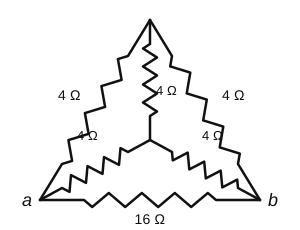
Concept. Points symmetric about the line midway between $a$ and $b$ are at the same potential, so a resistor joining two such points carries no current.
Step 1. Symmetry. The top vertex and the inner point are both placed symmetrically between $a$ and $b$, so both are at the midway potential. The $4\ \Omega$ resistor between them carries no current.
Step 3. Parallel. $\dfrac1R=\dfrac18+\dfrac18+\dfrac1{16}=\dfrac{5}{16}$, so $R=3.2\ \Omega$.
Answer. $3.2\ \Omega$ (Option B).
Solution by Sreeraj P, M.Sc Physics
Q 12-03-151JEE MainJEE Main 2023 (10 Apr, Shift 1)Easy
$10$ resistors each of resistance $10\ \Omega$ can be connected in such a way as to get maximum and minimum equivalent resistance. The ratio of maximum and minimum equivalent resistance will be ______.
Concept. A bridge is balanced when the ratios of its arms match; then the middle resistor carries no current and can be removed.
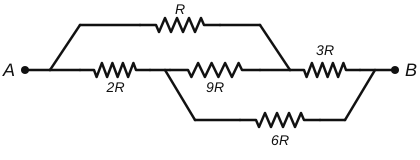
Step 1. Identify the bridge. From $A$: $2R$ to node $X$ and $R$ to node $Y$. To $B$: $6R$ from $X$ and $3R$ from $Y$. $9R$ joins $X$ and $Y$.
Step 2. Balance check. $\dfrac{2R}{6R}=\dfrac{R}{3R}=\dfrac13$, so $9R$ carries no current.
Step 3. Two paths in parallel. $(2R+6R)\parallel(R+3R)=\dfrac{8R\times4R}{12R}=\dfrac{8R}{3}$.
Answer. $\dfrac83R$ (Option D).
Solution by Sreeraj P, M.Sc Physics
Q 12-03-153JEE MainJEE Main 2023 (1 Feb, Shift 1)Easy
In an experiment to find emf of a cell using potentiometer, the length of null point for a cell of emf $1.5$ V is found to be $60$ cm. If this cell is replaced by another cell of emf $E$, the length of null point increases by $40$ cm. The value of $E$ is $\dfrac x{10}$ V. The value of $x$ is ______.
Concept. With the same potential gradient, the emf balanced is proportional to the balancing length: $\dfrac{E_1}{E_2}=\dfrac{l_1}{l_2}$.
Step 1. New length. $60+40=100$ cm.
Step 2. emf. $E=1.5\times\dfrac{100}{60}=2.5$ V $=\dfrac{25}{10}$ V.
Answer. $25$.
Solution by Sreeraj P, M.Sc Physics
Q 12-03-154JEE MainJEE Main 2023 (1 Feb, Shift 2)Easy
Given below are two statements: one is labelled as Assertion A and the other is labelled as Reason R.
Assertion A: For measuring the potential difference across a resistance of $600\ \Omega$, the voltmeter with resistance $1000\ \Omega$ will be preferred over voltmeter with resistance $4000\ \Omega$.
Reason R: Voltmeter with higher resistance will draw smaller current than voltmeter with lower resistance.
In the light of the above statements, choose the most appropriate answer from the options given below.
Concept. A voltmeter is a resistor placed in parallel. The higher its resistance compared with the resistor being measured, the less it changes the circuit, so the reading is closer to the true value.
Step 1. Assertion. Across $600\ \Omega$, the $4000\ \Omega$ voltmeter disturbs the circuit less than the $1000\ \Omega$ one, so it is preferred. The assertion is wrong.
Step 2. Reason. At the same voltage, a higher-resistance voltmeter draws a smaller current. The reason is correct.
Answer. A is not correct but R is correct (Option A).
Solution by Sreeraj P, M.Sc Physics
Q 12-03-155JEE MainJEE Main 2023 (1 Feb, Shift 2)Medium
Equivalent resistance between the adjacent corners of a regular $n$-sided polygon of uniform wire of resistance $R$ would be
Take the left wire at $0$ V. The positive plate of each cell faces right, so the middle node is at $10$ V and the right wire at $30$ V.
$I_1=I_2=\dfrac{10-0}{10}=1$ A (towards the left wire, as marked). $I_3$, marked from left to right, is $\dfrac{0-30}{10}=-3$ A. $$\left|\frac{I_1+I_3}{I_2}\right|=\left|\frac{1-3}{1}\right|=2$$
Solution by Sreeraj P, M.Sc Physics
Q 12-03-157JEE MainJEE Main 2022 (24 Jun, Shift 1)Medium
Two identical cells each of emf $1.5\ \text{V}$ are connected in parallel across a parallel combination of two resistors each of resistance $20\ \Omega$. A voltmeter connected in the circuit measures $1.2\ \text{V}$. The internal resistance of each cell is:
Two identical cells in parallel act as one cell of emf $1.5\ \text{V}$ and internal resistance $r/2$. The external resistance is $20\parallel20 = 10\ \Omega$.
Q 12-03-158JEE MainJEE Main 2022 (24 Jun, Shift 1)Easy
In a potentiometer arrangement, a cell gives a balancing point at $75\ \text{cm}$ length of wire. This cell is now replaced by another cell of unknown emf. If the ratio of the emfs of the two cells respectively is $3 : 2$, the difference in the balancing length of the potentiometer wire in the above two cases will be ______ cm.
Q 12-03-159JEE MainJEE Main 2022 (24 Jun, Shift 2)Easy
What will be the most suitable combination of three resistors $A = 2\ \Omega$, $B = 4\ \Omega$, $C = 6\ \Omega$ so that $\left(\dfrac{22}{3}\right)\Omega$ is the equivalent resistance of the combination?
Q 12-03-160JEE MainJEE Main 2022 (24 Jun, Shift 2)Medium
A potentiometer wire of length $10\ \text{m}$ and resistance $20\ \Omega$ is connected in series with a $25\ \text{V}$ battery and an external resistance $30\ \Omega$. A cell of emf $E$ in the secondary circuit is balanced by $250\ \text{cm}$ long potentiometer wire. The value of $E$ (in volt) is $\dfrac{x}{10}$. The value of $x$ is ______.
Current in the wire $= \dfrac{25}{20+30} = 0.5\ \text{A}$; potential drop across the wire $= 0.5\times20 = 10\ \text{V}$, so the gradient is $1\ \text{V m}^{-1}$. $$E = 1\times2.5 = 2.5\ \text{V} = \frac{25}{10}\ \Rightarrow\ x = 25$$
Solution by Sreeraj P, M.Sc Physics
Q 12-03-161JEE MainJEE Main 2022 (25 Jun, Shift 1)Easy
A resistor develops $300\ \text{J}$ of thermal energy in $15\ \text{s}$ when a current of $2\ \text{A}$ is passed through it. If the current increases to $3\ \text{A}$, the energy developed in $10\ \text{s}$ is ______ J.
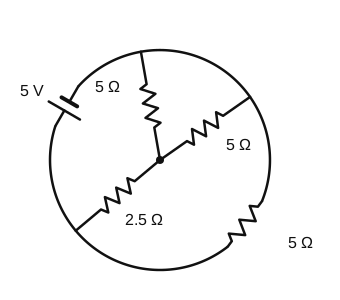
Concept. The rim is plain wire except for the cell and one $5\ \Omega$ resistor. Mark the two nodes the rim wire creates, then see which spokes run between them.
Step 1. Nodes. Call $P$ the rim from the cell's terminal round to the $5\ \Omega$ rim resistor, and $Q$ the rim beyond it, back to the cell. The two $5\ \Omega$ spokes join $P$ to the centre $O$; the $2.5\ \Omega$ spoke joins $O$ to $Q$.
Step 2. Spoke path. $(5\parallel5)+2.5=2.5+2.5=5\ \Omega$ from $P$ to $Q$.
Step 3. With the rim resistor. $5\ \Omega$ (rim) in parallel with $5\ \Omega$ (spokes): $2.5\ \Omega$.
Step 4. Current. $I=\dfrac{5}{2.5}=2$ A.
Answer. $2$.
Solution by Sreeraj P, M.Sc Physics
Q 12-03-163JEE MainJEE Main 2022 (25 Jun, Shift 2)Medium
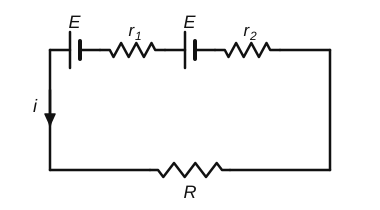
Two cells of the same emf $E$ but different internal resistances $r_1$ and $r_2$ are connected in series with an external resistance $R$ as shown in the figure. The terminal potential difference across the second cell is found to be zero. The external resistance $R$ must then be:
Current: $i = \dfrac{2E}{R + r_1 + r_2}$. Terminal voltage of the second cell: $E - ir_2 = 0\Rightarrow E = ir_2$. $$E = \frac{2Er_2}{R + r_1 + r_2}\ \Rightarrow\ R + r_1 + r_2 = 2r_2\ \Rightarrow\ R = r_2 - r_1$$
Solution by Sreeraj P, M.Sc Physics
Q 12-03-164JEE MainJEE Main 2022 (25 Jun, Shift 2)Easy
The length of a given cylindrical wire is increased to double of its original length. The percentage increase in the resistance of the wire will be ______ %.
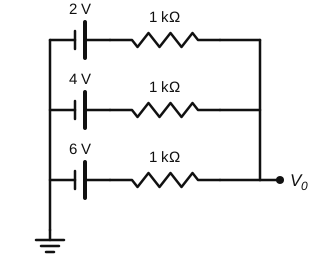
Concept. Several branches, each a cell and a resistor, joined between the same two nodes: the common voltage is $V=\dfrac{\sum E_i/R_i}{\sum 1/R_i}$ (from the junction law at the output node, with no current drawn out).
Step 1. Junction law at $V_0$. $\dfrac{2-V_0}{1}+\dfrac{4-V_0}{1}+\dfrac{6-V_0}{1}=0$ (resistances in k$\Omega$).
Step 2. Solve. $12=3V_0\Rightarrow V_0=4$ V.
Answer. $4$.
Solution by Sreeraj P, M.Sc Physics
Q 12-03-168JEE MainJEE Main 2022 (25 Jul, Shift 1)Easy
Eight copper wires of length $l$ and diameter $d$ are joined in parallel to form a single composite conductor of resistance $R$. If a single copper wire of length $2l$ has the same resistance $R$, then its diameter will be ______ $d$.
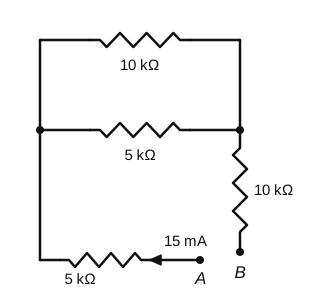
Between $A$ and $B$ the current passes through $5\ \text{k}\Omega$, then $10\parallel5 = \dfrac{10}{3}\ \text{k}\Omega$, then $10\ \text{k}\Omega$: $$R = 5 + \frac{10}{3} + 10 = \frac{55}{3}\ \text{k}\Omega,\qquad V = 15\ \text{mA}\times\frac{55}{3}\ \text{k}\Omega = 275\ \text{V}$$
Solution by Sreeraj P, M.Sc Physics
Q 12-03-170JEE MainJEE Main 2022 (25 Jul, Shift 2)Easy
In a potentiometer arrangement, a cell of emf $1.20\ \text{V}$ gives a balance point at $36\ \text{cm}$ length of wire. This cell is now replaced by another cell of emf $1.80\ \text{V}$. The difference in balancing length of potentiometer wire in the above conditions will be ______ cm.
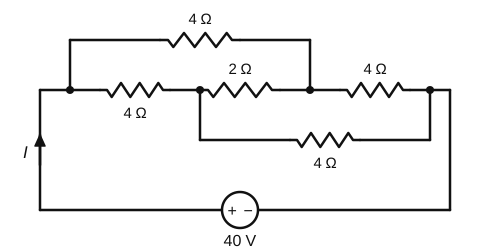
Label the nodes: left $L$, right $R$, and the two junctions $M$, $N$ on either side of the $2\ \Omega$ resistor. Then $L$–$M = 4\ \Omega$, $L$–$N = 4\ \Omega$ (top bypass), $M$–$N = 2\ \Omega$, $N$–$R = 4\ \Omega$ and $M$–$R = 4\ \Omega$ (bottom bypass).
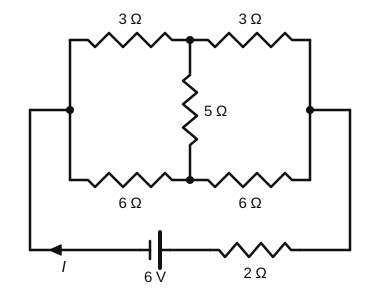
This is a balanced Wheatstone bridge ($\frac44 = \frac44$), so no current flows in the $2\ \Omega$ resistor: $$R_{eq} = (4+4)\parallel(4+4) = 4\ \Omega,\qquad I = \frac{40}{4} = 10\ \text{A}$$
Solution by Sreeraj P, M.Sc Physics
Q 12-03-172JEE MainJEE Main 2022 (26 Jul, Shift 1)Medium
Resistances are connected in a meter bridge circuit as shown in the figure. The balancing length $l_1$ is $40\ \text{cm}$. Now an unknown resistance $x$ is connected in series with $P$ and the new balancing length is found to be $80\ \text{cm}$ measured from the same end. Then the value of $x$ will be ______ $\Omega$.
The bridge is balanced ($\frac33 = \frac66$), so the $5\ \Omega$ carries no current. $$R_{\text{bridge}} = (3+3)\parallel(6+6) = \frac{6\times12}{18} = 4\ \Omega,\qquad I = \frac{6}{4 + 2} = 1\ \text{A}$$
Solution by Sreeraj P, M.Sc Physics
Q 12-03-174JEE MainJEE Main 2022 (26 Jul, Shift 2)Medium
A potentiometer wire of length $300\ \text{cm}$ is connected in series with a resistance $780\ \Omega$ and a standard cell of emf $4\ \text{V}$. A constant current flows through the potentiometer wire. The length of the null point for a cell of emf $20\ \text{mV}$ is found to be $60\ \text{cm}$. The resistance of the potentiometer wire is ______ $\Omega$.
Q 12-03-175JEE MainJEE Main 2022 (27 Jun, Shift 1)Medium
A cell, shunted by a $8\ \Omega$ resistance, is balanced across a potentiometer wire of length $3$ m. The balancing length is $2$ m when the cell is shunted by $4\ \Omega$ resistance. The value of internal resistance of the cell will be ______ $\Omega$.
Q 12-03-176JEE MainJEE Main 2022 (27 Jun, Shift 1)Easy
The current density in a cylindrical wire of radius $4$ mm is $4\times10^6\ \text{A m}^{-2}$. The current through the outer portion of the wire between radial distances $\dfrac R2$ and $R$ is ______ $\pi$ A.
Step 2. Current. $4\times10^6\times12\pi\times10^{-6}=48\pi$ A.
Answer. $48$.
Solution by Sreeraj P, M.Sc Physics
Q 12-03-177JEE MainJEE Main 2022 (27 Jun, Shift 2)Easy
The current density in a cylindrical wire of radius $r = 4.0$ mm is $1.0\times10^6\ \text{A m}^{-2}$. The current through the outer portion of the wire between radial distances $\dfrac r2$ and $r$ is $x\pi$ A; where $x$ is ______ .
Q 12-03-178JEE MainJEE Main 2022 (27 Jun, Shift 2)Medium
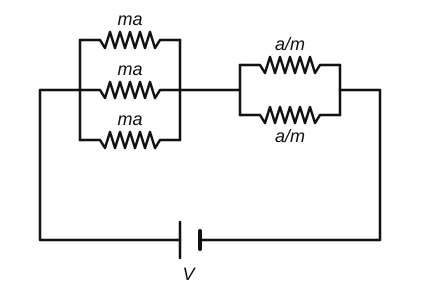
In the given circuit $'a'$ is an arbitrary constant. The value of $m$ for which the equivalent circuit resistance is minimum, will be $\sqrt{\dfrac x2}$. The value of $x$ is ______ .
Concept. Write the equivalent resistance as a function of $m$ and minimise it. A sum $pm+\dfrac qm$ is least when the two terms are equal.
Step 1. Equivalent resistance. Three $ma$ in parallel: $\dfrac{ma}{3}$. Two $\dfrac am$ in parallel: $\dfrac{a}{2m}$. So $R=\dfrac{ma}3+\dfrac{a}{2m}$.
Q 12-03-179JEE MainJEE Main 2022 (27 Jul, Shift 1)Medium
Two sources of equal emfs are connected in series. This combination is connected to an external resistance $R$. The internal resistances of the two sources are $r_1$ and $r_2$ $(r_1 > r_2)$. If the potential difference across the source of internal resistance $r_1$ is zero then the value of $R$ will be
Q 12-03-180JEE MainJEE Main 2022 (27 Jul, Shift 1)Medium
A $1$ m long copper wire carries a current of $1$ A. If the cross section of the wire is $2.0\ \text{mm}^2$ and the resistivity of copper is $1.7\times10^{-8}\ \Omega$ m. The force experienced by moving electron in the wire is ______ $\times10^{-23}$ N
$$F = eE = 1.6\times10^{-19}\times8.5\times10^{-3} = 1.36\times10^{-21} = 136\times10^{-23}\ \text{N}$$
Solution by Sreeraj P, M.Sc Physics
Q 12-03-181JEE MainJEE Main 2022 (27 Jul, Shift 1)Easy
In meter bridge experiment for measuring unknown resistance $S$, the unknown resistance $S$ is in the left gap and $R$ in the right gap. The null point is obtained at a distance $30$ cm from the left side, at point $D$. If $R$ is $5.6\ \text{k}\Omega$, then the value of unknown resistance $S$ will be ______ $\Omega$.
Q 12-03-184JEE MainJEE Main 2022 (27 Jul, Shift 2)Easy
In a meter bridge experiment with resistances $R_1$ and $R_2$ in the two gaps, the balancing length $AC$ corresponding to null deflection of the galvanometer is $40$ cm. The balancing length, if the radius of the wire $AB$ is doubled, will be ______ cm.
At balance $\dfrac{R_1}{R_2} = \dfrac{l}{100 - l}$. The wire is uniform, so this ratio of lengths does not depend on the wire's radius.
Doubling the radius changes the resistance per cm equally everywhere, so the balancing length stays $40$ cm.
Solution by Sreeraj P, M.Sc Physics
Q 12-03-185JEE MainJEE Main 2022 (28 Jul, Shift 1)Easy
A wire of resistance $R_1$ is drawn out so that its length is increased by twice of its original length. The ratio of new resistance to original resistance is:
Q 12-03-186JEE MainJEE Main 2022 (28 Jul, Shift 1)Medium
A potentiometer wire $AB$ of resistance $20\ \Omega$ and length $300$ cm is connected in series with a resistance box (R.B.) and a standard cell of emf $4$ V. For a resistance $R$ of resistance box introduced into the circuit, the null point for a cell of $20$ mV is found to be $60$ cm. The value of $R$ is ______ $\Omega$.
Potential gradient $= \dfrac{20\ \text{mV}}{60\ \text{cm}}$, so the full $300$ cm wire carries $100$ mV $= 0.1$ V.
Current in the wire: $I = \dfrac{0.1}{20} = 5\times10^{-3}$ A.
$$4 = 5\times10^{-3}(20 + R) \Rightarrow 20 + R = 800 \Rightarrow R = 780\ \Omega$$
Solution by Sreeraj P, M.Sc Physics
Q 12-03-187JEE MainJEE Main 2021 (27 Jul, Shift 1)Easy
In the given figure, a battery of emf $E$ is connected across a conductor $PQ$ of length $l$ and different area of cross-sections having radii $r_1$ and $r_2$ $(r_2 < r_1)$.
Choose the correct option as one moves from $P$ to $Q$.
Concept. In a series circuit the same current flows through every cross-section of the conductor. What changes along a tapered wire is how that current is shared over the area.
Step 1. Current. $I$ (and the electron current) is the same at every section from $P$ to $Q$.
Step 2. Drift velocity. $v_d=\dfrac{I}{neA}$. From $P$ to $Q$ the radius falls from $r_1$ to $r_2$, so $A$ falls and $v_d$ rises.
Step 3. Electric field. $E=\rho J=\dfrac{\rho I}{A}$, so $E$ also rises towards $Q$. Options B and C are false, so "all of these" is false too.
Answer. Drift velocity of electrons increases (Option A).
Solution by Sreeraj P, M.Sc Physics
Q 12-03-188JEE MainJEE Main 2021 (27 Jul, Shift 2)Easy
The resistance of a conductor at $15^\circ\text{C}$ is $16\ \Omega$ and at $100^\circ\text{C}$ is $20\ \Omega$. What will be the temperature coefficient of resistance of the conductor?
The two branches in parallel: $5\ \Omega$. Total with $1\ \Omega$: $6\ \Omega$, so $I = \dfrac{12}{6} = 2$ A, and each branch carries $1$ A.
Voltage across the $15\parallel10$ combination $= 1\times6 = 6$ V.
Solution by Sreeraj P, M.Sc Physics
Q 12-03-191JEE MainJEE Main 2021 (31 Aug, Shift 1)Easy
A square-shaped wire with a resistance of each side $3\ \Omega$ is bent to form a complete circle. The resistance between two diametrically opposite points of the circle in a unit of $\Omega$ will be ______.
Work from the left end. The plain wire at the far left shorts the $5\ \Omega$ resistor, so the left end of the first $2\ \Omega$ is connected to the bottom line.
That $2\ \Omega$ is then in parallel with the vertical $2\ \Omega$: $1\ \Omega$.
Adding the next series $2\ \Omega$: $3\ \Omega$.
The two $3\ \Omega$ resistors across $AB$ give $1.5\ \Omega$. Finally:
Q 12-03-193JEE MainJEE Main 2021 (31 Aug, Shift 2)Easy
A resistor dissipates $192$ J of energy in $1$ s when a current of $4$ A is passed through it. Now, when the current is doubled, the amount of thermal energy dissipated in $5$ s is ______ J.
$I^2R = 192 \Rightarrow R = \dfrac{192}{16} = 12\ \Omega$.
$$H = (8)^2\times12\times5 = 3840\ \text{J}$$
Solution by Sreeraj P, M.Sc Physics
Q 12-03-194JEE MainJEE Main 2021 (24 Feb, Shift 1)Easy
A current through a wire depends on time as $i = \alpha_0 t + \beta t^2$, where $\alpha_0 = 20\ \text{A s}^{-1}$ and $\beta = 8\ \text{A s}^{-2}$. Find the charge crossed through a section of the wire in 15 s.
Q 12-03-195JEE MainJEE Main 2021 (24 Feb, Shift 1)Medium
A cell $E_1$ of emf 6 V and internal resistance $2\ \Omega$ is connected with another cell $E_2$ of emf 4 V and internal resistance $8\ \Omega$ (as shown in the figure). The potential difference across points $X$ and $Y$ is:
The two cells are connected in opposition in a single loop: $$I = \frac{6 - 4}{2 + 8} = 0.2\ \text{A}$$ The larger emf $E_1$ drives the current, so the current passes through $E_2$ against its emf (charging it). The p.d. across $E_2$, i.e. between $X$ and $Y$: $$V_{XY} = E_2 + Ir_2 = 4 + 0.2\times 8 = 5.6\ \text{V}$$ (Check through $E_1$: $6 - 0.2\times2 = 5.6$ V.)
Solution by Sreeraj P, M.Sc Physics
Q 12-03-196JEE MainJEE Main 2021 (24 Feb, Shift 2)Easy
A cylindrical wire of radius 0.5 mm and conductivity $5\times10^7\ \text{S m}^{-1}$ is subjected to an electric field of 10 mV m$^{-1}$. The expected value of current in the wire will be $x^3\pi$ mA. The value of $x$ is ______.
Q 12-03-197JEE MainJEE Main 2021 (25 Feb, Shift 1)Medium
In the given circuit of potentiometer, the potential difference $E$ across $AB$ (10 m length) is larger than $E_1$ and $E_2$ as well. For key $K_1$ (closed), the jockey is adjusted to touch the wire at point $J_1$ so that there is no deflection in the galvanometer. Now the first battery $(E_1)$ is replaced by second battery $(E_2)$ for working by making $K_1$ open and $K_2$ closed. The galvanometer gives then null deflection at $J_2$. The value of $\dfrac{E_1}{E_2}$ is $\dfrac{a}{2}$, where $a$ = ______.
Concept. A folded potentiometer wire is one continuous wire: measure each balance point as the length of wire from $A$. The emfs are then in the ratio of these lengths.
Step 1. Direction of each 1 m length. Starting from $A$, the lengths run alternately left-to-right and right-to-left.
Step 2. $J_1$. It is on the 4th length, which runs right-to-left, 20 cm from its left end, i.e. 80 cm along it: $3+0.8=3.8$ m from $A$.
Step 3. $J_2$. It is on the 8th length (right-to-left), 60 cm from its right end, i.e. 60 cm along it: $7+0.6=7.6$ m from $A$.
Step 4. Ratio. $\dfrac{E_1}{E_2}=\dfrac{3.8}{7.6}=\dfrac12$, so $a=1$.
Answer. $1$.
Solution by Sreeraj P, M.Sc Physics
Q 12-03-198JEE MainJEE Main 2021 (18 Mar, Shift 2)Easy
Consider a 72 cm long wire $AB$ as shown in the figure. The galvanometer jockey is placed at $P$ on $AB$ at a distance $x$ cm from $A$. The galvanometer shows zero deflection.
The value of $x$, to the nearest integer, is ______.
Q 12-03-199JEE MainJEE Main 2021 (18 Mar, Shift 2)Medium
Two wires of same length and thickness having specific resistances $6\ \Omega$ cm and $3\ \Omega$ cm respectively are connected in parallel. The effective resistivity is $\rho\ \Omega$ cm. The value of $\rho$, to the nearest integer, is ______.
Concept. Two equal wires in parallel are equivalent to one wire of the same length and double the area. Find the resistivity that gives the same resistance.
Take the bottom wire as 0 V and let the top junction be at $V$. Kirchhoff's current law at the junction: $$\frac{140 - V}{20} + \frac{90 - V}{5} = \frac{V}{6}$$ Multiply by 60: $420 - 3V + 1080 - 12V = 10V \Rightarrow V = 60$ V.
Current in $6\ \Omega$: $\dfrac{60}{6} = 10$ A.
Solution by Sreeraj P, M.Sc Physics
Q 12-03-201JEE MainJEE Main 2021 (20 Jul, Shift 1)Medium
A current of 5 A is passing through a non-linear magnesium wire of cross-section $0.04\ \text{m}^2$. At every point the direction of current density is at an angle of $60^\circ$ with the unit vector of area of cross-section.
The magnitude of electric field at every point of the conductor is: (resistivity of magnesium $\rho = 44\times10^{-8}\ \Omega$ m)
Q 12-03-202JEE MainJEE Main 2021 (20 Jul, Shift 2)Easy
In the given figure switches $S_1$ and $S_2$ are in open condition. The resistance across $ab$ when the switches $S_1$ and $S_2$ are closed is ______ $\Omega$.
Concept. A closed switch is a plain wire: it joins the top and bottom rows into one node at each switch. The network becomes three parallel pairs in series.
Step 1. First section. $12\parallel6=\dfrac{72}{18}=4\ \Omega$.
Step 2. Second section. $4\parallel4=2\ \Omega$.
Step 3. Third section. $6\parallel12=4\ \Omega$.
Step 4. Series. $4+2+4=10\ \Omega$.
Answer. $10$.
Solution by Sreeraj P, M.Sc Physics
Q 12-03-203JEE MainJEE Main 2021 (22 Jul, Shift 1)Medium
A Copper (Cu) rod of length 25 cm and cross-sectional area $3\ \text{mm}^2$ is joined with a similar Aluminium (Al) rod as shown in figure. Find the resistance of the combination between the ends $A$ and $B$.
(Take resistivity of Copper $= 1.7\times10^{-8}\ \Omega$ m, Resistivity of aluminium $= 2.6\times10^{-8}\ \Omega$ m)
Q 12-03-204JEE MainJEE Main 2021 (22 Jul, Shift 1)Easy
In an electric circuit, a cell of certain emf provides a potential difference of 1.25 V across a load resistance of $5\ \Omega$. However, it provides a potential difference of 1 V across a load resistance of $2\ \Omega$. The emf of the cell is given by $\dfrac{x}{10}$ V. Then the value of $x$ is ______.
Concept. Look for symmetry. Points placed symmetrically with respect to the two terminals are at equal potential, and a resistor between equal potentials carries no current.
Step 1. Nodes. $B$ is joined to $C$ by a wire, so the terminals are $A$ and $C$. $A$ connects to $D$ and $E$; $D$ and $E$ each connect to $C$; $R$ also joins $D$ and $E$.
Step 2. Symmetry. The paths $A\to D\to C$ and $A\to E\to C$ are identical, so $V_D=V_E$ and the resistor $DE$ carries no current.
Step 3. Two equal paths. Each path is $R+R=2R$; two in parallel give $R$.
Answer. $R$ (Option A).
Solution by Sreeraj P, M.Sc Physics
Q 12-03-206JEE MainJEE Main 2021 (26 Feb, Shift 1)Easy
In an electrical circuit, a battery is connected to pass $20$ C of charge through it in a certain given time. The potential difference between two plates of the battery is maintained at $15$ V. The work done by the battery is ______ J
Q 12-03-207JEE MainJEE Main 2021 (26 Feb, Shift 2)Easy
A wire of $1\ \Omega$ has a length of $1$ m. It is stretched till its length increases by $25\%$. The percentage change in resistance to the nearest integer is:
When a wire is stretched its volume stays constant, so $A \propto 1/l$ and $R = \rho l/A \propto l^2$. $$\frac{R'}{R} = (1.25)^2 = 1.5625$$ Percentage change $= 56.25\% \approx 56\%$.
Solution by Sreeraj P, M.Sc Physics
Q 12-03-208JEE MainJEE Main 2021 (25 Jul, Shift 2)Medium
In the given potentiometer circuit arrangement, the balancing length $AC$ is measured to be $250$ cm. When the galvanometer connection is shifted from point (1) to point (2) in the given diagram, the balancing length becomes $400$ cm. The ratio of the emf of two cells $\frac{\varepsilon_1}{\varepsilon_2}$ is:
Concept. At point (1) the galvanometer balances $\varepsilon_1$ alone; at point (2) it balances the two cells together. Both cells point the same way, so together they give $\varepsilon_1+\varepsilon_2$.
Step 1. Two balances. $\varepsilon_1=k\times250$, $\varepsilon_1+\varepsilon_2=k\times400$.
Q 12-03-209JEE MainJEE Main 2021 (25 Jul, Shift 2)Medium
The given potentiometer has its wire of resistance $10\ \Omega$. When the sliding contact is in the middle of the potentiometer wire, the potential drop across $2\ \Omega$ resistor is:
Concept. A load connected across part of a potential divider is in parallel with that part, so it lowers that part's resistance and its share of the voltage.
Step 1. Halves of the wire. With the contact in the middle, each half is $5\ \Omega$.
Step 2. Loaded half. The $2\ \Omega$ resistor is in parallel with the half from $A$: $\dfrac{5\times2}{7}=\dfrac{10}{7}\ \Omega$.
Step 3. Current. Total $\dfrac{10}7+5=\dfrac{45}{7}\ \Omega$, so $I=\dfrac{20\times7}{45}=\dfrac{28}{9}$ A.
Step 4. Voltage across $2\ \Omega$. $V=\dfrac{28}{9}\times\dfrac{10}{7}=\dfrac{40}{9}$ V.
Answer. $\dfrac{40}{9}$ V (Option C).
Solution by Sreeraj P, M.Sc Physics
Q 12-03-210JEE MainJEE Main 2021 (25 Jul, Shift 2)Medium
A $16\ \Omega$ wire is bent to form a square loop. A $9$ V supply having an internal resistance of $1\ \Omega$ is connected across one of its sides. The potential drop across the diagonals of the square loop is ______ $\times10^{-1}$ V.
Each side is $4\ \Omega$. Across the chosen side, $4\ \Omega$ is in parallel with the other three sides ($12\ \Omega$): $R = 3\ \Omega$.
$I = \dfrac{9}{3 + 1} = 2.25$ A, so the voltage across the side is $6.75$ V.
The current in the $12\ \Omega$ path is $\dfrac{6.75}{12} = 0.5625$ A, giving $2.25$ V per side. Each diagonal spans two sides of this path: $$V_{diagonal} = 2\times2.25 = 4.5\ \text{V} = 45\times10^{-1}\ \text{V}$$
Solution by Sreeraj P, M.Sc Physics
Q 12-03-211JEE MainJEE Main 2021 (26 Aug, Shift 1)Medium
The material filled between the plates of a parallel plate capacitor has resistivity $200\ \Omega$ m. The value of capacitance of the capacitor is $2$ pF. If a potential difference of $40$ V is applied across the plates of the capacitor, then the value of leakage current flowing out of the capacitor is: (given the value of relative permittivity of material is $50$)
Concept. The same slab of material sets both the capacitance and the leakage resistance: $C=\dfrac{K\varepsilon_0A}{d}$ and $R=\dfrac{\rho d}{A}$, so $RC=\rho K\varepsilon_0$, independent of the plate size.
The left side of the rectangle is a plain wire joined to $A$ and the right side a plain wire joined to $B$, so every resistor path runs from $A$ to $B$. The two diagonals cross without touching.
Four parallel paths between $A$ and $B$: $4\ \Omega$ (top), $8\ \Omega$ (bottom), $4 + 8 = 12\ \Omega$ and $2 + 4 = 6\ \Omega$ (diagonals). $$\frac{1}{R} = \frac{1}{4} + \frac{1}{8} + \frac{1}{12} + \frac{1}{6} = \frac{15}{24} \Rightarrow R = 1.6\ \Omega$$ $I = \dfrac{2.2}{1.6 + 0.6} = 1$ A. Power dissipated in the whole circuit (including the cell) $= \varepsilon I = 2.2$ W.
Solution by Sreeraj P, M.Sc Physics
Q 12-03-213JEE MainJEE Main 2021 (26 Aug, Shift 1)Medium
What equal length of an iron wire and a copper-nickel alloy wire, each of $2$ mm diameter connected parallel to give an equivalent resistance of $3\ \Omega$? (Given resistivities of iron and copper-nickel alloy wire are $12\ \mu\Omega$ cm and $51\ \mu\Omega$ cm respectively)
Q 12-03-214JEE MainJEE Main 2021 (26 Aug, Shift 2)Easy
An electric bulb of $500$ W at $100$ V is used in a circuit having a $200$ V supply. Calculate the resistance $R$ to be connected in series with the bulb so that the power delivered by the bulb is $500$ W.
Q 12-03-215JEE MainJEE Main 2021 (26 Aug, Shift 2)Easy
If you are provided a set of resistances, $2\ \Omega$, $4\ \Omega$, $6\ \Omega$ and $8\ \Omega$. Connect these resistances to obtain an equivalent resistance of $\frac{46}{3}\ \Omega$.
Answer: (C) $2\ \Omega$ and $4\ \Omega$ are in parallel with $6\ \Omega$ and $8\ \Omega$ in series
Each option means: the first two resistors in parallel, and this combination in series with the other two.
$2\ \Omega \parallel 4\ \Omega = \dfrac{8}{6} = \dfrac{4}{3}\ \Omega$; adding $6 + 8 = 14\ \Omega$ in series: $$R = \frac{4}{3} + 14 = \frac{46}{3}\ \Omega$$ (The others give $13.5\ \Omega$, $12.4\ \Omega$ and $\frac{66}{7}\ \Omega$.)
Solution by Sreeraj P, M.Sc Physics
Q 12-03-216JEE MainJEE Main 2021 (27 Aug, Shift 1)Easy
Five identical cells each of internal resistance $1\ \Omega$ and emf $5$ V are connected in series and in parallel with an external resistance $R$. For what value of $R$, current in series and parallel combination will remain the same?
Q 12-03-217JEE MainJEE Main 2021 (27 Aug, Shift 1)Easy
First, a set of $n$ equal resistors of $10\ \Omega$ each are connected in series to a battery of E.M.F. $20$ V and internal resistance $10\ \Omega$. A current $I$ is observed to flow. Then, the $n$ resistors are connected in parallel to the same battery. It is observed that the current is increased $20$ times, then the value of $n$ is ______.
Concept. Colour code: first band = first digit, second band = second digit, third band = power of ten, fourth band = tolerance (gold 5%). Digits: black 0, brown 1, red 2, orange 3, yellow 4, green 5, blue 6, violet 7, grey 8, white 9.
Step 1. Digits. Violet $=7$, green $=5$: $75$.
Step 2. Multiplier. Red $=10^2$: $75\times100=7500\ \Omega$.
Step 3. Tolerance. Gold $=5\%$ of $7500=375\ \Omega$.
Answer. $(7500\pm375)\ \Omega$ (Option A).
Solution by Sreeraj P, M.Sc Physics
Q 12-03-219JEE MainJEE Main 2021 (27 Aug, Shift 2)Medium
The ratio of the equivalent resistance of the network (shown in figure) between the points $a$ and $b$ when switch is open and switch is closed is $x : 8$. The value of $x$ is
Switch open: two branches of $R + 2R = 3R$ in parallel: $R_{open} = \dfrac{3R}{2}$.
Switch closed: the midpoints are joined, giving $(R \parallel 2R)$ in series with $(2R \parallel R)$: $$R_{closed} = \frac{2R}{3} + \frac{2R}{3} = \frac{4R}{3}$$ $$\frac{R_{open}}{R_{closed}} = \frac{3/2}{4/3} = \frac{9}{8} \Rightarrow x = 9$$
Solution by Sreeraj P, M.Sc Physics
Q 12-03-220JEE MainJEE Main 2020 (8 Jan, Shift 2)Medium
The series combination of two batteries, both of the same emf $10$ V, but different internal resistance of $20\ \Omega$ and $5\ \Omega$, is connected to the parallel combination of two resistors $30\ \Omega$ and $x\ \Omega$. The voltage difference across the battery of internal resistance $20\ \Omega$ is zero, the value of $x$ (in $\Omega$) is ______.
Terminal voltage of the $20\ \Omega$ battery: $10 - 20I = 0$, so $I = 0.5$ A.
The total emf is $20$ V and the total internal resistance $25\ \Omega$: $$I = \frac{20}{25 + R_{\text{ext}}} = 0.5 \Rightarrow R_{\text{ext}} = 15\ \Omega$$ $$\frac{30x}{30 + x} = 15 \Rightarrow x = 30\ \Omega$$
Solution by Sreeraj P, M.Sc Physics
Q 12-03-222JEE MainJEE Main 2020 (9 Jan, Shift 2)Medium
In a metre bridge experiment $S$ is a standard resistance. $R$ is a resistance wire. It is found that the balancing length, measured from the end of the bridge wire on the side of $R$, is $l = 25$ cm. If $R$ is replaced by a wire of half length and half diameter that of $R$ of same material, then the balancing distance $l'$ (in cm) will now be ______.
Concept. Balance in a metre bridge: $\dfrac RS=\dfrac{l}{100-l}$, with $l$ measured from the end on the side of $R$. For a wire, $R=\dfrac{\rho l}{\pi d^2/4}\propto\dfrac{l}{d^2}$.
Step 1. First balance. $\dfrac RS=\dfrac{25}{75}=\dfrac13$.
Step 2. New wire. Half the length and half the diameter: $R'=R\times\dfrac{1/2}{(1/2)^2}=2R$, so $\dfrac{R'}{S}=\dfrac23$.
Step 3. New balance. $\dfrac{l'}{100-l'}=\dfrac23\Rightarrow3l'=200-2l'\Rightarrow l'=40$ cm.
Answer. $40$.
Solution by Sreeraj P, M.Sc Physics
Q 12-03-223JEE MainJEE Main 2020 (5 Sep, Shift 2)Medium
In the circuit given in the figure, the currents in different branches and the value of one resistor are shown. Then the potential at point $B$ with respect to the point $A$ is:
Concept. Find the current in the middle branch with the junction law, then walk from $A$ to $B$ adding each rise and drop in potential.
Step 1. Current in $DC$. At $C$: $1$ A arrives from $A$ (the $1$ A in branch $EA$ continues through $AC$) and $2$ A leaves towards $F$. So $1$ A comes from $D$ to $C$ through the $2\ \Omega$ resistor.
Step 2. Walk $A\to C$. The 1 V cell has its positive terminal towards $C$: rise of $1$ V.
Step 3. Walk $C\to D$. Against the $1$ A current through $2\ \Omega$: rise of $2$ V.
Step 4. Walk $D\to B$. The 2 V cell has its positive terminal towards $D$: drop of $2$ V.
Step 5. Total. $V_B-V_A=+1+2-2=+1$ V.
Answer. $+1$ V (Option D).
Solution by Sreeraj P, M.Sc Physics
Q 12-03-224JEE MainJEE Main 2020 (6 Sep, Shift 2)Hard
In the figure shown, the current in the $10$ V battery is close to:
Answer: (C) $0.21$ A from positive to negative terminal
Concept. Three branches join the same two nodes (top junction $T$ and bottom junction $M$). Find $V_{TM}$ with the junction law, then the current in the 10 V branch.
Step 1. Branches from $M$ to $T$. Left: 20 V cell (raising the potential towards $T$) with $2+5=7\ \Omega$. Middle: $10\ \Omega$. Right: 10 V cell (positive towards $T$) with $4\ \Omega$.
Step 2. Junction law at $T$. $\dfrac{20-V}{7}+\dfrac{0-V}{10}+\dfrac{10-V}{4}=0$, with $V=V_T-V_M$.
Step 3. Solve (×140). $400-20V-14V+350-35V=0\Rightarrow V=\dfrac{750}{69}\approx10.87$ V.
Step 4. 10 V branch. $I=\dfrac{10-10.87}{4}\approx-0.217$ A. The minus sign means the current flows against the cell's own push: it enters at the positive terminal, so inside the cell it flows from positive to negative (the cell is being charged). Its size, about $0.22$ A, matches $0.21$ A.
Answer. $0.21$ A from positive to negative terminal (Option C).
Solution by Sreeraj P, M.Sc Physics
Q 12-03-225JEE MainJEE Main 2020 (6 Sep, Shift 2)Easy
A circuit to verify Ohm's law uses an ammeter and a voltmeter, connected correctly to the resistor in series or parallel. In the circuit:
Answer: (C) The ammeter is always connected in series and the voltmeter in parallel
The ammeter must carry the same current as the resistor, so it is placed in series with it. The voltmeter must measure the potential difference across the resistor, so it is placed in parallel with it.
Solution by Sreeraj P, M.Sc Physics
Q 12-03-226JEE MainJEE Main 2020 (7 Jan, Shift 1)Easy
The current $I_1$ (in A) flowing through the $1\ \Omega$ resistor in the following circuit is:
The ideal $1$ V cell is connected directly across both the $2\ \Omega$ resistor and the upper branch, so each branch has $1$ V across it.
Upper branch: the two $1\ \Omega$ resistors in parallel ($0.5\ \Omega$) in series with $2\ \Omega$, total $2.5\ \Omega$. Its current is $\dfrac{1}{2.5} = 0.4$ A.
This divides equally between the two identical $1\ \Omega$ resistors: $$I_1 = 0.2\ \text{A}$$
Solution by Sreeraj P, M.Sc Physics
Q 12-03-227JEE MainJEE Main 2020 (7 Jan, Shift 2)Easy
In a building there are $15$ bulbs of $45$ W, $15$ bulbs of $100$ W, $15$ small fans of $10$ W and $2$ heaters of $1$ kW. The voltage of the electric main supply is $220$ V. The minimum fuse capacity (rated value) of the building will be:
Concept. The fuse must carry the total current when everything is on: $I=\dfrac{P_{total}}{V}$. Choose the next rating above it.
Step 1. Total power. $15\times45+15\times100+15\times10+2\times1000=675+1500+150+2000=4325$ W.
Step 2. Current. $I=\dfrac{4325}{220}\approx19.7$ A.
Step 3. Fuse. The smallest rating above 19.7 A is 20 A.
Answer. $20$ A (Option D).
Solution by Sreeraj P, M.Sc Physics
Q 12-03-228JEE MainJEE Main 2020 (7 Jan, Shift 2)Medium
The balancing length for a cell is $560$ cm in a potentiometer experiment. When an external resistance of $10\ \Omega$ is connected in parallel to the cell, the balancing length changes by $60$ cm. If the internal resistance of the cell is $\dfrac{n}{10}\ \Omega$, where $n$ is an integer, then the value of $n$ is ______.
With the shunt, the terminal voltage drops, so the new balancing length is $560 - 60 = 500$ cm. $$r = R\left(\frac{l_1}{l_2} - 1\right) = 10\left(\frac{560}{500} - 1\right) = 1.2\ \Omega = \frac{12}{10}\ \Omega$$
So $n = 12$.
Solution by Sreeraj P, M.Sc Physics
Q 12-03-229JEE MainJEE Main 2020 (8 Jan, Shift 1)Medium
The length of a potentiometer wire is $1200$ cm and it carries a current of $60$ mA. For a cell of emf $5$ V and internal resistance of $20\ \Omega$, the null point on it is found to be at $1000$ cm. The resistance of the whole wire is:
Answer. Option D. (Internal resistance plays no part at balance.)
Solution by Sreeraj P, M.Sc Physics
Q 12-03-230JEE MainJEE Main 2020 (8 Jan, Shift 1)Medium
Four resistances of $15\ \Omega$, $12\ \Omega$, $4\ \Omega$ and $10\ \Omega$ respectively, in cyclic order, form a Wheatstone's network. The resistance that is to be connected in parallel with the resistance of $10\ \Omega$ to balance the network is ______ $\Omega$.
Step 2. Shunt on $10\ \Omega$. $\dfrac{10x}{10+x}=5\Rightarrow x=10\ \Omega$.
Answer. $10$.
Solution by Sreeraj P, M.Sc Physics
Q 12-03-231JEE MainJEE Main 2020 (2 Sep, Shift 1)Easy
Consider four conducting materials copper, tungsten, mercury and aluminium with resistivity $\rho_C$, $\rho_T$, $\rho_M$ and $\rho_A$ respectively. Then:
Concept. Typical resistivities at room temperature: copper $1.7\times10^{-8}$, aluminium $2.7\times10^{-8}$, tungsten $5.6\times10^{-8}$ and mercury about $98\times10^{-8}\ \Omega$ m.
Step 1. Order. $\rho_M>\rho_T>\rho_A>\rho_C$.
Step 2. Check the options. Only $\rho_M>\rho_A>\rho_C$ agrees with this order.
Answer. $\rho_M>\rho_A>\rho_C$ (Option B).
Solution by Sreeraj P, M.Sc Physics
Q 12-03-232JEE MainJEE Main 2020 (2 Sep, Shift 2)Easy
A potentiometer wire $PQ$ of $1\ \text{m}$ length is connected to a standard cell $E_1$. Another cell $E_2$ of emf $1.02\ \text{V}$ is connected with a resistance $r$ and switch $S$ (as shown in figure). With switch $S$ open, the null position is obtained at a distance of $49\ \text{cm}$ from $Q$. The potential gradient in the potentiometer wire is:
At the null point no current flows through $E_2$, so the resistance $r$ has no effect and the balancing length corresponds to the emf $1.02$ V: $$k = \frac{1.02\ \text{V}}{49\ \text{cm}} \approx 0.02\ \text{V/cm}$$
Solution by Sreeraj P, M.Sc Physics
Q 12-03-233JEE MainJEE Main 2020 (2 Sep, Shift 2)Medium
An ideal cell of emf $10\ \text{V}$ is connected in the circuit shown in figure. Each resistance is $2\ \Omega$. The potential difference (in V) across the capacitor when it is fully charged is ______.
Concept. In steady state the capacitor branch (with $R_5$) carries no current. Find the potentials at the two ends of the capacitor from the conducting part of the circuit.
Step 1. Conducting network. Take the left node at 10 V and the right node at 0. $R_1+R_2=4\ \Omega$ is in parallel with $R_3=2\ \Omega$ (both from the left node to the middle node), then $R_4$ to the right node.
Step 2. Current. $(4\parallel2)+2=\dfrac43+2=\dfrac{10}3\ \Omega$, so $I=3$ A and the middle node is at $10-3\times\dfrac43=6$ V.
Step 3. Top node. The $R_1R_2$ path carries $\dfrac{4\ \text{V}}{4\ \Omega}=1$ A, so the node between $R_1$ and $R_2$ is at $10-1\times2=8$ V.
Step 4. Capacitor. One plate is at 8 V; the other connects through $R_5$ (no current) to the right node at 0 V. $V_C=8$ V.
Answer. $8$.
Solution by Sreeraj P, M.Sc Physics
Q 12-03-234JEE MainJEE Main 2020 (3 Sep, Shift 1)Medium
Model a torch battery of length $l$ to be made up of a thin cylindrical bar of radius $a$ and a concentric thin cylindrical shell of radius $b$, with the space in between filled with an electrolyte of resistivity $\rho$. If the battery is connected to a resistance of value $R$, the maximum Joule heating in $R$ will take place for:
Concept. The electrolyte between the bar and the shell is the battery's internal resistance, with current flowing radially. Maximum power goes to the load when $R$ equals the internal resistance.
Step 1. Internal resistance. A thin shell of radius $x$ and thickness $dx$ has $dr=\dfrac{\rho\,dx}{2\pi xl}$, so $r=\displaystyle\int_a^b\frac{\rho\,dx}{2\pi lx}=\frac{\rho}{2\pi l}\ln\frac ba$.
Step 2. Maximum power transfer. Joule heating in $R$ is greatest when $R=r$.
Q 12-03-235JEE MainJEE Main 2020 (3 Sep, Shift 2)Medium
Two resistors $400\ \Omega$ and $800\ \Omega$ are connected in series across a $6\ \text{V}$ battery. The potential difference measured by a voltmeter of $10\ \text{k}\Omega$ across $400\ \Omega$ resistor is close to:
Q 12-03-237JEE MainJEE Main 2020 (4 Sep, Shift 1)Easy
A battery of $3.0\ \text{V}$ is connected to a resistor dissipating $0.5\ \text{W}$ of power. If the terminal voltage of the battery is $2.5\ \text{V}$, the power dissipated within the internal resistance is:
The network is symmetric about the line $AC$ and also about the line $BD$, so $B$, $D$ and the centre $O$ are all at the same potential (midway between $A$ and $C$). No current flows in the two $5\ \Omega$ resistors.
The path $A \to O \to C$ is then just $4 + 4 = 8\ \Omega$ directly across the $8$ V cell: $$i_1 = \frac{8}{8} = 1\ \text{A}$$ (The other two paths, $ABC$ and $ADC$, carry $2$ A each, so the cell supplies $5$ A in all.)
Solution by Sreeraj P, M.Sc Physics
Q 12-03-239JEE MainJEE Main 2020 (4 Sep, Shift 2)Medium
Four resistances $40\ \Omega$, $60\ \Omega$, $90\ \Omega$ and $110\ \Omega$ make the arms of a quadrilateral $ABCD$ ($AB = 40\ \Omega$, $BC = 60\ \Omega$, $AD = 90\ \Omega$, $DC = 110\ \Omega$). Across $AC$ is a battery of emf $40\ \text{V}$ and internal resistance negligible. The potential difference across $BD$ in V is ______.
Concept. With the battery across $AC$, the paths $ABC$ and $ADC$ are two potential dividers. The potential difference across $BD$ is the difference of the two midpoint potentials.
Step 1. Path $ABC$. Take $V_A=40$ V, $V_C=0$: $V_B=40\times\dfrac{60}{40+60}=24$ V.
Step 2. Path $ADC$. $V_D=40\times\dfrac{110}{90+110}=22$ V.
Step 3. Difference. $V_B-V_D=2$ V.
Answer. $2$.
Solution by Sreeraj P, M.Sc Physics
Q 12-03-240JEE MainJEE Main 2020 (5 Sep, Shift 1)Medium
An electrical power line, having a total resistance of $2\ \Omega$, delivers $1\ \text{kW}$ at $220\ \text{V}$. The efficiency of the transmission line is approximately:
Q 12-03-242JEE MainJEE Main 2019 (9 Jan, Shift 2)Medium
In the given circuit the internal resistance of the $18\ \text{V}$ cell is negligible. If $R_1 = 400\ \Omega$, $R_3 = 100\ \Omega$ and $R_4 = 500\ \Omega$ and the reading of an ideal voltmeter across $R_4$ is $5\ \text{V}$, then the value of $R_2$ will be:
Concept. An ideal voltmeter across $R_4$ gives the current in the $R_3$–$R_4$ branch. That branch is in parallel with $R_2$, which gives the voltage across $R_2$, and the rest of the 18 V is across $R_1$.
Step 1. Branch current. $I_{34}=\dfrac{5}{500}=0.01$ A.
Step 2. Voltage across the parallel part. $V=0.01\times(100+500)=6$ V.
Step 3. Main current. $R_1$ takes $18-6=12$ V, so $I=\dfrac{12}{400}=0.03$ A.
Step 4. $R_2$. It carries $0.03-0.01=0.02$ A at 6 V: $R_2=\dfrac{6}{0.02}=300\ \Omega$.
Answer. $300\ \Omega$ (Option B).
Solution by Sreeraj P, M.Sc Physics
Q 12-03-243JEE MainJEE Main 2019 (10 Jan, Shift 1)Medium
In the given circuit the cells have zero internal resistance. The currents (in amperes) passing through resistance $R_1$ and $R_2$ respectively, are:
Take the top wire as $0\ \text{V}$. The left vertical wire connects it to the negative terminal of the left cell, so the junction between the two cells (bottom end of $R_1$) is at $+10\ \text{V}$.
$R_1$ has $10\ \text{V}$ across it: $I_1 = \dfrac{10}{20} = 0.5\ \text{A}$.
Going from that junction through the right cell (positive to negative) the potential falls by $10\ \text{V}$, so the bottom of $R_2$ is at $0\ \text{V}$, the same as its top. Hence $I_2 = 0$.
Solution by Sreeraj P, M.Sc Physics
Q 12-03-244JEE MainJEE Main 2019 (10 Jan, Shift 1)Easy
A uniform metallic wire has a resistance of $18\ \Omega$ and is bent into an equilateral triangle. Then, the resistance between any two vertices of the triangle is:
Each side is $6\ \Omega$. Between two vertices one side ($6\ \Omega$) is in parallel with the other two in series ($12\ \Omega$): $$R = \frac{6\times12}{6+12} = 4\ \Omega$$
Solution by Sreeraj P, M.Sc Physics
Q 12-03-245JEE MainJEE Main 2019 (10 Jan, Shift 1)Easy
A $2\ \text{W}$ carbon resistor is colour coded with green, black, red and silver respectively. The maximum current which can be passed through this resistor is:
Concept. Read the resistance from the colour code, then the power rating limits the current: $P=I^2R\Rightarrow I_{\max}=\sqrt{P/R}$.
Step 1. Resistance. Green $5$, black $0$, red $10^2$: $R=50\times100=5000\ \Omega$ (silver is the tolerance).
Step 2. Maximum current. $I_{\max}=\sqrt{\dfrac{2}{5000}}=\sqrt{4\times10^{-4}}=0.02$ A.
Answer. $20$ mA (Option C).
Solution by Sreeraj P, M.Sc Physics
Q 12-03-246JEE MainJEE Main 2019 (10 Jan, Shift 1)Medium
A potentiometer wire $AB$ having length $L$ and resistance $12r$ is joined to a cell $D$ of emf $\varepsilon$ and internal resistance $r$. A cell $C$ having emf $\varepsilon/2$ and internal resistance $3r$ is connected. The length $AJ$, at which the galvanometer, as shown in the figure, shows no deflection is
Concept. Find the potential gradient from the primary circuit. At the null point no current flows through cell $C$, so its internal resistance does not matter and the wire balances its full emf.
Q 12-03-247JEE MainJEE Main 2019 (10 Jan, Shift 2)Medium
The actual value of a resistance $R$ is $30\ \Omega$. It is measured using the standard formula $R = \dfrac VI$, where $V$ and $I$ are the readings of a voltmeter connected directly across $R$ and an ammeter connected in series with this combination and a cell. If the measured value of $R$ is $5\%$ less, then the internal resistance of the voltmeter is:
Concept. The voltmeter across $R$ takes some current, so the ammeter reads the current through $R$ and $R_V$ together. The measured value $V/I$ is $R$ in parallel with $R_V$.
Step 1. Measured value. $5\%$ less than $30\ \Omega$: $28.5\ \Omega$.
Q 12-03-248JEE MainJEE Main 2019 (10 Jan, Shift 2)Medium
The Wheatstone bridge shown in the figure below, gets balanced when the carbon resistor used as $R_1$ has the colour code (orange, red, brown). The resistors $R_2$ and $R_4$ are $80\ \Omega$ and $40\ \Omega$, respectively. Assuming that the colour code for the carbon resistors gives their accurate values, the colour code for the carbon resistor, used as $R_3$, would be
Orange $= 3$, red $= 2$, brown $= \times10$: $R_1 = 320\ \Omega$.
At balance $\dfrac{R_1}{R_2} = \dfrac{R_3}{R_4}$: $$R_3 = \frac{320\times40}{80} = 160\ \Omega = 16\times10^1\ \Omega$$ Colour code: brown $(1)$, blue $(6)$, brown $(\times10)$.
Solution by Sreeraj P, M.Sc Physics
Q 12-03-249JEE MainJEE Main 2019 (10 Jan, Shift 2)Easy
A current of $2\ \text{mA}$ was passed through an unknown resistor which dissipated a power of $4.4\ \text{W}$. Dissipated power when an ideal power supply of $11\ \text{V}$ is connected across it is:
Q 12-03-250JEE MainJEE Main 2019 (10 Apr, Shift 1)Medium
A current of $5\ \text{A}$ passes through a copper conductor (resistivity $= 1.7\times10^{-8}\ \Omega\,\text{m}$) of radius of cross-section $5\ \text{mm}$. Find the mobility of the charges if their drift velocity is $1.1\times10^{-3}\ \text{m s}^{-1}$.
Q 12-03-251JEE MainJEE Main 2019 (10 Apr, Shift 1)Medium
Two cells, each of emf $1.5\ \text{V}$ and internal resistance $r$, are connected in series with a $2\ \Omega$ resistor and a parallel combination of $15\ \Omega$ and $10\ \Omega$ resistors. An ideal voltmeter connected across the $10\ \Omega$ resistance reads $2\ \text{V}$. The internal resistance $r$ of each cell is:
Q 12-03-252JEE MainJEE Main 2019 (10 Apr, Shift 1)Easy
In an experiment, the resistance of a material is measured as a function of temperature (in some range). A graph of $\ln R(T)$ against $\dfrac{1}{T^2}$ is found to be a straight line with a negative slope. One may conclude that
Concept. A straight line of $y$ against $x$ means $y=c+mx$. Here $y=\ln R$ and $x=\dfrac{1}{T^2}$, with a negative slope.
Step 1. Equation of the line. $\ln R=\ln R_0-\dfrac{T_0^2}{T^2}$, where $-T_0^2$ is the (negative) slope.
Step 2. Take the exponential. $R=R_0\,e^{-T_0^2/T^2}$.
Answer. $R(T)=R_0e^{-T_0^2/T^2}$ (Option D).
Solution by Sreeraj P, M.Sc Physics
Q 12-03-253JEE MainJEE Main 2019 (10 Apr, Shift 1)Medium
In a meter bridge experiment, a resistance box $R$ is in the left gap and an unknown resistance $X$ in the right gap; the balance length $l$ is measured from the left end of the wire. The observations are:
Step 4. Reading 4. $1\times\dfrac{99}{1}=99\ \Omega$: far from the others.
Answer. Reading 4 (Option D).
Solution by Sreeraj P, M.Sc Physics
Q 12-03-254JEE MainJEE Main 2019 (10 Apr, Shift 2)Medium
Space between two concentric conducting spheres of radii $a$ and $b$ $(b > a)$ is filled with a medium of resistivity $\rho$. The resistance between the two spheres will be:
Concept. With the switch closed, $C$ is joined to $V=0$ through $2\ \Omega$. Apply the junction law at $C$, the only unknown node.
Step 1. Junction law at $C$. $\dfrac{20-V_C}{2}+\dfrac{10-V_C}{4}=\dfrac{V_C-0}{2}$.
Step 2. Solve (×4). $40-2V_C+10-V_C=2V_C\Rightarrow V_C=10$ V.
Step 3. Current. $i=\dfrac{10}{2}=5$ A.
Answer. $5$ A (Option B).
Solution by Sreeraj P, M.Sc Physics
Q 12-03-257JEE MainJEE Main 2019 (9 Jan, Shift 1)Easy
Drift speed of electrons, when $1.5\ \text{A}$ current flows in a copper wire of cross section $5\ \text{mm}^2$, is $v_d$. If the electron density in copper is $9\times10^{28}\ \text{m}^{-3}$ the value of $v_d$ in $\text{mm s}^{-1}$ is close to (Take charge of an electron to be $1.6\times10^{-19}\ \text{C}$)
Q 12-03-259JEE MainJEE Main 2019 (8 Apr, Shift 1)Medium
For the circuit shown, with $R_1 = 1.0\ \Omega$, $R_2 = 2.0\ \Omega$, $E_1 = 2\ \text{V}$ and $E_2 = E_3 = 4\ \text{V}$, the potential difference between the points $a$ and $b$ is approximately (in V)
Concept. All three branches run between $a$ and $b$, each with a cell and a resistance. The junction law at $a$ gives $V_{ab}=\dfrac{\sum E_i/R_i}{\sum1/R_i}$.
Step 1. Branches (from $b$ to $a$). $E_1=2$ V with $2R_1=2\ \Omega$; $E_2=4$ V with $R_2=2\ \Omega$; $E_3=4$ V with $2R_1=2\ \Omega$. All three cells have their positive terminals towards $a$.
$200\ \Omega = 20\times10^1$: bands red (2), black (0), brown ($\times10$). Replacing red by green (5) gives $50\times10 = 500\ \Omega$.
Solution by Sreeraj P, M.Sc Physics
Q 12-03-261JEE MainJEE Main 2019 (8 Apr, Shift 2)Easy
A four-wire potentiometer is made of a $400\ \text{cm}$ long wire, which extends between A and B. The resistance per unit length of the potentiometer wire is $r = 0.01\ \Omega/\text{cm}$. The wire is connected in series with a $1\ \Omega$ resistor and two cells, each of emf $1.5\ \text{V}$ and internal resistance $0.5\ \Omega$. If an ideal voltmeter is connected between end A and a jockey J placed at $50\ \text{cm}$ from end A (along the wire), the expected reading of the voltmeter will be
Concept. The potentiometer wire carries the current of the primary circuit. An ideal voltmeter across part of the wire reads the current times the resistance of that part.
Step 2. Current. Two cells in series: $E=3$ V, internal $1\ \Omega$. $I=\dfrac{3}{4+1+1}=0.5$ A.
Step 3. Reading. 50 cm of wire is $0.5\ \Omega$: $V=0.5\times0.5=0.25$ V.
Answer. $0.25$ V (Option B).
Solution by Sreeraj P, M.Sc Physics
Q 12-03-262JEE MainJEE Main 2019 (8 Apr, Shift 2)Easy
A cell of internal resistance $r$ drives current through an external resistance $R$. The power delivered by the cell to the external resistance will be maximum when
$$P = \frac{E^2R}{(R + r)^2},\quad \frac{dP}{dR} = E^2\frac{(R + r) - 2R}{(R + r)^3} = 0 \Rightarrow R = r$$ This is the maximum power transfer condition.
Solution by Sreeraj P, M.Sc Physics
Q 12-03-263JEE MainJEE Main 2019 (8 Apr, Shift 2)Easy
In the figure shown, what is the current (in ampere) drawn from the battery? You are given: $R_1 = 15\ \Omega$, $R_2 = 10\ \Omega$, $R_3 = 20\ \Omega$, $R_4 = 5\ \Omega$, $R_5 = 25\ \Omega$, $R_6 = 30\ \Omega$, $E = 15\ \text{V}$
$R_3$, $R_4$ and $R_5$ are in series: $20 + 5 + 25 = 50\ \Omega$. This is in parallel with $R_2$: $$\frac{50\times10}{60} = \frac{25}{3}\ \Omega$$ Adding $R_1$ and $R_6$ in series: $R_{eq} = 15 + \frac{25}3 + 30 = \frac{160}{3}\ \Omega$. $$I = \frac{15}{160/3} = \frac{45}{160} = \frac{9}{32}\ \text{A}$$
Solution by Sreeraj P, M.Sc Physics
Q 12-03-264JEE MainJEE Main 2019 (9 Apr, Shift 1)Easy
A wire of resistance $R$ is bent to form a square $ABCD$ as shown in the figure. The effective resistance between $E$ and $C$ is ($E$ is mid-point of arm $CD$)
Concept. Between two points on a closed loop of uniform wire, the two arcs are in parallel. If one arc is a fraction $f$ of the whole resistance $R$, the equivalent is $f(1-f)R$.
Step 1. Arc $EC$. Each side is $\dfrac R4$, and $E$ is the midpoint of $CD$, so arc $EC=\dfrac R8$.
In steady state no current flows through the capacitor branch.
$2\ \Omega$ and $10\ \Omega$ in series ($12\ \Omega$) are in parallel with $4\ \Omega$: $\dfrac{12\times4}{16} = 3\ \Omega$. Total resistance $6 + 3 = 9\ \Omega$, so $I = 72/9 = 8\ \text{A}$.
Voltage across the $4\ \Omega$ resistor: $72 - 8\times6 = 24\ \text{V}$. Current through the $2\ \Omega$–$10\ \Omega$ branch: $24/12 = 2\ \text{A}$, so the capacitor (in parallel with $10\ \Omega$) has $V = 20\ \text{V}$: $$Q = CV = 10\ \mu\text{F}\times20\ \text{V} = 200\ \mu\text{C}$$
Solution by Sreeraj P, M.Sc Physics
Q 12-03-266JEE MainJEE Main 2019 (9 Apr, Shift 2)Easy
A metal wire of resistance $3\ \Omega$ is elongated to make a uniform wire of double its previous length. This new wire is now bent and the ends joined to make a circle. If two points on this circle make an angle $60^\circ$ at the center, the equivalent resistance between these two points will be
Q 12-03-267JEE MainJEE Main 2019 (9 Apr, Shift 2)Easy
In a conductor, if the number of conduction electrons per unit volume is $8.5\times10^{28}\ \text{m}^{-3}$ and mean free time is $25\ \text{fs}$ (femto second), its approximate resistivity is ($m_e = 9.1\times10^{-31}\ \text{kg}$)
Step 3. Result. $\rho=\dfrac{9.1\times10^{-31}}{5.44\times10^{-23}}\approx1.7\times10^{-8}\ \Omega$ m, of order $10^{-8}\ \Omega$ m.
Answer. $10^{-8}\ \Omega$ m (Option D).
Solution by Sreeraj P, M.Sc Physics
Q 12-03-268JEE MainJEE Main 2019 (11 Jan, Shift 1)Easy
Two equal resistances when connected in series to a battery, consume electric power of $60$ W. If these resistances are now connected in parallel combination to the same battery, the electric power consumed will be:
Concept. Same battery: $P=\dfrac{V^2}{R_{\text{eq}}}$. Series $2R$, parallel $\dfrac R2$: four times smaller resistance.
Step 1. Power. $4\times60=240$ W.
Answer. Option B.
Solution by Sreeraj P, M.Sc Physics
Q 12-03-269JEE MainJEE Main 2019 (11 Jan, Shift 1)Medium
In a Wheatstone bridge (see figure), resistances $P$ and $Q$ are approximately equal. When $R = 400\ \Omega$, the bridge is balanced. On interchanging $P$ and $Q$, the value of $R$, for balance, is $405\ \Omega$. The value of $X$ is close to
Concept. At balance $\dfrac PQ=\dfrac RX$. Interchanging $P$ and $Q$ gives a second balance with the ratio inverted; multiplying the two equations removes the unknown ratio $\dfrac PQ$.
Step 1. First balance. $\dfrac PQ=\dfrac{400}{X}$.
Step 2. After interchanging. $\dfrac QP=\dfrac{405}{X}$.
Q 12-03-270JEE MainJEE Main 2019 (11 Jan, Shift 1)Medium
The resistance of the meter bridge AB in given figure is $4\ \Omega$. With a cell of emf $\varepsilon = 0.5$ V and rheostat resistance $R_h = 2\ \Omega$ the null point is obtained at some point J. When the cell is replaced by another one of emf $\varepsilon = \varepsilon_2$ the same null point J is found for $R_h = 6\ \Omega$. The emf $\varepsilon_2$ is:
A and B are open ends, so no current flows in the $5\ \Omega$ and $10\ \Omega$ resistors; $V_{AB} = V_{DC}$.
The three cells with equal internal-type resistances ($1\ \Omega$ each) are in parallel between D and C. With all cells facing the same way, the common voltage is $$V_{DC} = \frac{\varepsilon_1/r + \varepsilon_2/r + \varepsilon_3/r}{3/r} = \frac{1 + 2 + 3}{3} = 2\ \text{V}$$
Solution by Sreeraj P, M.Sc Physics
Q 12-03-272JEE MainJEE Main 2019 (11 Jan, Shift 2)Medium
In the experimental set up of metre bridge shown in the figure, the null point is obtained at a distance of $40$ cm from A. If a $10\ \Omega$ resistor is connected in series with $R_1$, the null point shifts by $10$ cm. The resistance that should be connected in parallel with $(R_1 + 10)\ \Omega$ such that the null point shifts back to its initial position is
Concept. Write the balance condition before and after each change; the unknowns are $R_1$ and $R_2$.
Step 1. First balance. $\dfrac{R_1}{R_2}=\dfrac{40}{60}=\dfrac23$.
Step 2. $10\ \Omega$ in series with $R_1$. The null point moves to 50 cm (a larger left arm moves it away from $A$): $\dfrac{R_1+10}{R_2}=1$.
Step 3. Solve. $R_2=R_1+10$ and $R_1=\dfrac23R_2$: $\dfrac{R_2}{3}=10\Rightarrow R_2=30\ \Omega$, $R_1=20\ \Omega$, so the left arm is now $30\ \Omega$.
Step 4. Shunt to return to 40 cm. The left arm must again be $20\ \Omega$: $\dfrac{30X}{30+X}=20\Rightarrow X=60\ \Omega$.
Answer. $60\ \Omega$ (Option C).
Solution by Sreeraj P, M.Sc Physics
Q 12-03-273JEE MainJEE Main 2019 (12 Jan, Shift 1)Easy
An ideal battery of emf $4$ V and resistance $R$ are connected in series in the primary circuit of a potentiometer of length $1$ m and resistance $5\ \Omega$. The value of $R$, to give a potential difference of $5$ mV across $10$ cm of potentiometer wire, is:
$5$ mV across $10$ cm means $50$ mV across the whole $1$ m wire, so the current is $\dfrac{0.05}{5} = 0.01$ A. $$\frac{4}{5 + R} = 0.01 \Rightarrow R = 395\ \Omega$$
Solution by Sreeraj P, M.Sc Physics
Q 12-03-274JEE MainJEE Main 2019 (12 Jan, Shift 1)Easy
Two electric bulbs, rated at $(25\ \text{W}, 220\ \text{V})$ and $(100\ \text{W}, 220\ \text{V})$, are connected in series across a $220$ V voltage source. If the $25$ W and $100$ W bulbs draw powers $P_1$ and $P_2$ respectively, then:
Concept. Ratings give resistances, $R=\dfrac{V^2}{P}$. In series the current is the same, so $P\propto R$.
Step 1. Resistances. $R_{25}=4R_{100}$.
Step 2. Current. $I=\dfrac{220}{5R_{100}}$.
Step 3. Powers. $P_{100}=I^2R_{100}=\dfrac{100}{25}=4$ W; $P_{25}=4\times4=16$ W.
Answer. Option D. (The lower-rated bulb glows brighter in series.)
Solution by Sreeraj P, M.Sc Physics
Q 12-03-275JEE MainJEE Main 2019 (12 Jan, Shift 1)Hard
In a meter bridge, the wire of length $1$ m has a non-uniform cross-section such that, the variation $\dfrac{dR}{dl}$ of its resistance $R$ with length $l$ is $\dfrac{dR}{dl} \propto \dfrac{1}{\sqrt l}$. Two equal resistances are connected as shown in the figure. The galvanometer has zero deflection when the jockey is at point P. What is the length AP?
Concept. With equal resistances in the two gaps, balance needs equal wire resistances on the two sides: $R_{AP}=R_{PB}$. For a non-uniform wire, find $R$ along the length by integrating $\dfrac{dR}{dl}$.
Step 1. Resistance up to $l$. $\dfrac{dR}{dl}=\dfrac{k}{\sqrt l}\Rightarrow R(l)=2k\sqrt l$.
Concept. Current is the rate of flow of charge, $I=\dfrac{dq}{dt}$: the slope of the $q$–$t$ graph.
Step 1. Read the graph at $t=4$ s. Between $t=2$ s and $t=6$ s the charge stays at $3\ \mu$C, so the graph is flat there.
Step 2. Slope. A flat line has zero slope, so $I=0$ at $t=4$ s.
Answer. Zero (Option C).
Solution by Sreeraj P, M.Sc Physics
Q 12-03-277JEE MainJEE Main 2019 (12 Jan, Shift 2)Medium
In the given circuit diagram, the currents, $I_1 = -0.3$ A, $I_4 = 0.8$ A and $I_5 = 0.4$ A, are flowing as shown. The currents $I_2$, $I_3$ and $I_6$, respectively, are:
Concept. Kirchhoff's junction law: at every node, current in equals current out. A negative value means the current flows opposite to the arrow.
Step 1. Node $S$. In: $I_4=0.8$ A. Out: $I_5=0.4$ A and $I_3$. So $I_3=0.4$ A.
Step 2. Node $P$. In: $I_5=0.4$ A. Out: $I_6$. So $I_6=0.4$ A.
Step 3. Node $Q$. In: $I_6+I_3=0.8$ A. Out: $I_2+I_1$, with $I_1=-0.3$ A. So $I_2=0.8+0.3=1.1$ A.
Step 4. Check at $R$. In: $I_2+I_1=1.1-0.3=0.8$ A $=I_4$. ✓
Answer. $1.1$ A, $0.4$ A, $0.4$ A (Option C).
Solution by Sreeraj P, M.Sc Physics
Q 12-03-278JEE MainJEE Main 2019 (12 Apr, Shift 1)Medium
To verify Ohm's law, a student connects the voltmeter across the battery as shown in the figure. The measured voltage is plotted as a function of the current, and the following graph is obtained. If $V_0$ is almost zero, identify the correct statement:
Answer: (A) The emf of the battery is $1.5$ V and its internal resistance is $1.5\ \Omega$
Concept. A voltmeter across a battery reads its terminal voltage, $V=E-Ir$. A graph of $V$ against $I$ is a straight line with intercept $E$ (at $I=0$) and slope $-r$.
Step 1. emf. At $I=0$, $V=1.5$ V, so $E=1.5$ V.
Step 2. Internal resistance. At $I=1000$ mA $=1$ A, $V\approx0$: $0=1.5-1\times r\Rightarrow r=1.5\ \Omega$.
Step 3. Check the other options. The graph says nothing about $R$ (the rheostat changes the current), and at 1 A the terminal voltage is about zero, not 1.5 V.
Answer. emf $1.5$ V and internal resistance $1.5\ \Omega$ (Option A).
Solution by Sreeraj P, M.Sc Physics
Q 12-03-279JEE MainJEE Main 2019 (12 Apr, Shift 1)Easy
The resistive network shown below is connected to a D.C. source of $16$ V. The power consumed by the network is $4$ Watt. The value of $R$ is:
$4R \parallel 4R = 2R$ and $6R \parallel 12R = 4R$, so the total is $2R + R + 4R + R = 8R$. $$P = \frac{V^2}{8R} = \frac{256}{8R} = 4 \Rightarrow R = 8\ \Omega$$
Solution by Sreeraj P, M.Sc Physics
Q 12-03-280JEE MainJEE Main 2018 (15 Apr, Shift 1)Easy
In a meter bridge, resistance $X$ is in the left gap and resistance $Y$ in the right gap. It is given that resistance $Y = 12.5\ \Omega$ and that the balance is obtained at a distance $39.5\ \text{cm}$ from end $A$ (the left end of the wire) by jockey $J$. After interchanging the resistances $X$ and $Y$ a new balance point is found at a distance $l_2$ from end $A$. What are the values of $X$ (in $\Omega$) and $l_2$?
Look for plain wires (no resistor). The left-middle junction, the centre junction, the bottom-middle junction and the bottom-left junction are all connected to one another by plain wires, so they are a single node.
The junction after the resistor from $A$ and the junction after the resistor from $B$ are therefore at the same potential. Every other resistor joins this node to the upper and right-hand junctions, which connect only back to the same node, so no current flows through any of them.
Only the two resistors attached to the terminals remain, in series: $$R_{AB} = R + R = 2R$$
Solution by Sreeraj P, M.Sc Physics
Q 12-03-282JEE MainJEE Main 2018 (15 Apr, Shift 2)Easy
A copper rod of cross-sectional area $A$ carries a uniform current $I$ through it. At temperature $T$, if the volume charge density of the rod is $\rho$, how long will the charges take to travel a distance $d$?
Current $I = \rho A v_d$, where $\rho$ is the charge per unit volume of the moving carriers. So $$v_d = \frac{I}{\rho A}, \qquad t = \frac{d}{v_d} = \frac{\rho dA}{I}$$
Solution by Sreeraj P, M.Sc Physics
Q 12-03-283JEE MainJEE Main 2018 (15 Apr, Shift 2)Easy
A constant voltage is applied between two ends of a metallic wire. If the length is halved and the radius of the wire is doubled, the rate of heat developed in the wire will be:
At constant voltage, $P = \dfrac{V^2}{R}$, so the rate of heating increases 8 times.
Solution by Sreeraj P, M.Sc Physics
Q 12-03-284JEE MainJEE Main 2018 (16 Apr, Shift 1)Easy
A heating element has a resistance of $100\ \Omega$ at room temperature. When it is connected to a supply of $220\ \text{V}$, a steady current of $2\ \text{A}$ passes in it and temperature is $500^\circ\text{C}$ more than the room temperature. The temperature coefficient of resistance of the heating element is
Concept. In steady state no current flows through a capacitor branch, so the resistor in series with it ($r_1$) has no drop, and the capacitor takes the voltage across the branch it is parallel to.
Step 1. Current. Only the loop through $E$, $r$ and $r_2$ carries current: $I=\dfrac{E}{r+r_2}$.
Step 2. Voltage across the capacitor branch. It is parallel to $r_2$: $V=Ir_2=\dfrac{Er_2}{r+r_2}$.
Step 3. Charge. $q=CV=CE\dfrac{r_2}{r+r_2}$.
Answer. $CE\dfrac{r_2}{r+r_2}$ (Option D).
Solution by Sreeraj P, M.Sc Physics
Q 12-03-286JEE MainJEE Main 2017 (2 Apr)Medium
In the circuit shown, the current in each resistance is:
Apply Kirchhoff's loop law to the first loop: left wire, top $2$ V cell, first $1\ \Omega$ resistor and bottom $2$ V cell. The top and bottom cells face the same way, so going round the loop one is crossed from $-$ to $+$ and the other from $+$ to $-$: their emfs cancel. Hence $$I_1(1\ \Omega) = 2 - 2 = 0 \;\Rightarrow\; I_1 = 0$$ The same argument applies to the loop through the first and second resistors, and then to the second and third: the cell emfs cancel in every loop and the resistors start with equal potential differences of zero. So the current in every resistor is $0$ A.
Answer: (C) In a balanced Wheatstone bridge if the cell and the galvanometer are exchanged, the null point is disturbed
Concept. Check each statement against the physics of Kirchhoff's laws and the Wheatstone bridge.
Step 1. A. The loop law says the sum of emfs equals the sum of drops round a loop: energy conservation. True.
Step 2. B. A Wheatstone bridge is most sensitive when all four arms are of the same order. True.
Step 3. C. The balance condition $\frac PQ=\frac RS$ is the same when the cell and galvanometer are interchanged, so the null point is not disturbed. False.
Step 4. D. A rheostat with a sliding contact can be used as a potential divider. True.
Answer. Option C is the false statement.
Solution by Sreeraj P, M.Sc Physics
Q 12-03-288JEE MainJEE Main 2017 (8 Apr)Medium
A $9$ V battery with an internal resistance of $0.5\ \Omega$ is connected across an infinite network, as shown in the figure. All ammeters $A_1$, $A_2$, $A_3$ and voltmeter $V$ are ideal. Choose the correct statement.
Concept. An infinite ladder looks the same after one section is removed, so its resistance $R_\infty$ satisfies: one section followed by $R_\infty$ equals $R_\infty$.
Step 1. Equation. Each section has $1\ \Omega$ in the top and bottom wires and a $4\ \Omega$ shunt: $R_\infty=2+\dfrac{4R_\infty}{4+R_\infty}$.
Step 3. Battery current. $I=\dfrac{9}{4+0.5}=2$ A; this is the reading of $A_1$.
Step 4. Check $V$. $V=9-2\times0.5=8$ V, so the options for $V$ are wrong.
Answer. Reading of $A_1$ is $2$ A (Option D).
Solution by Sreeraj P, M.Sc Physics
Q 12-03-289JEE MainJEE Main 2017 (8 Apr)Medium
A potentiometer $PQ$ is set up to compare two resistances, as shown in the figure. The ammeter $A$ in the circuit reads $1.0$ A when the two-way key $K_3$ is open. The balance point is at a length $l_1$ cm from $P$ when the two-way key $K_3$ is plugged in between $2$ and $1$, while the balance point is at a length $l_2$ cm from $P$ when the key $K_3$ is plugged in between $3$ and $1$. The ratio of two resistances $\dfrac{R_1}{R_2}$ is found to be:
Concept. The current through $R_1$ and $R_2$ stays the same, so the potentiometer balances voltages proportional to resistances. With $K_3$ at 2 it measures the voltage across $R_1$; at 3, across $R_1+R_2$.
Step 1. Two balances. $IR_1=kl_1$ and $I(R_1+R_2)=kl_2$.
In a meter bridge experiment resistances are connected as shown in the figure. Initially resistance $P = 4\ \Omega$ and the neutral point $N$ is at $60$ cm from $A$. Now an unknown resistance $R$ is connected in series to $P$ and the new position of the neutral point is at $80$ cm from $A$. The value of unknown resistance $R$ is:
With $R$ in series with $P$: $$\frac{4 + R}{8/3} = \frac{80}{20} = 4 \;\Rightarrow\; 4 + R = \frac{32}{3} \;\Rightarrow\; R = \frac{20}{3}\ \Omega$$
Solution by Sreeraj P, M.Sc Physics
Q 12-03-291JEE MainJEE Main 2017 (9 Apr)Easy
A uniform wire of length $l$ and radius $r$ has a resistance of $100\ \Omega$. It is recast into a wire of radius $\dfrac r2$. The resistance of new wire will be:
The volume is unchanged, so halving the radius makes the area $\frac14$ and the length $4$ times: $$R' = \rho\frac{4l}{A/4} = 16R = 1600\ \Omega$$
Solution by Sreeraj P, M.Sc Physics
Q 12-03-292JEE MainJEE Main 2017 (9 Apr)Medium
The figure shows three circuits I, II and III which are connected to a $3$ V battery. If the powers dissipated by the configurations I, II and III are $P_1$, $P_2$ and $P_3$ respectively, then:
Concept. With the same 3 V battery, $P=\dfrac{V^2}{R_{eq}}$: the smaller the equivalent resistance, the larger the power. Find $R_{eq}$ of each circuit.
Step 1. Circuit I. Name the nodes top $T$, bottom $B$ and the two middle junctions $N_1$, $N_2$. The resistors are $TN_1$, $N_1B$, $TN_2$, $N_2B$ and $N_1N_2$: a balanced bridge of equal resistors, so $N_1N_2$ carries no current and $R_I=2\parallel2=1\ \Omega$.
Step 2. Circuit II. The battery is across the top and bottom vertices. The left path ($1+1$), the right path ($1+1$) and the middle $1\ \Omega$ are in parallel: $R_{II}=2\parallel2\parallel1=0.5\ \Omega$.
Step 3. Circuit III. The diamond between its top and bottom vertices is $2\parallel2=1\ \Omega$, in series with $1\ \Omega$: $R_{III}=2\ \Omega$.
Two batteries with e.m.f. $12$ V and $13$ V are connected in parallel across a load resistor of $10\ \Omega$. The internal resistances of the two batteries are $1\ \Omega$ and $2\ \Omega$ respectively. The voltage across the load lies between:
Step 2. Load voltage. $12.33\times\dfrac{10}{10.67}=11.56$ V.
Answer. Between $11.5$ and $11.6$ V (Option C).
Solution by Sreeraj P, M.Sc Physics
Q 12-03-294JEE MainJEE Main 2018 (8 Apr)Medium
On interchanging the resistances, the balance point of a meter bridge shifts to the left by $10$ cm. The resistance of their series combination is $1\ \text{k}\Omega$. How much was the resistance on the left slot before interchanging the resistances?
Concept. Before: $\dfrac XY=\dfrac{l}{100-l}$. After swapping: the balance moves to the mirror position $100-l$. A shift of $10$ cm to the left means $100-l=l-10$.
Step 1. Balance length. $l=55$ cm.
Step 2. Ratio. $\dfrac XY=\dfrac{55}{45}$; with $X+Y=1000\ \Omega$: $X=550\ \Omega$.
Answer. Option D.
Solution by Sreeraj P, M.Sc Physics
Q 12-03-295JEE MainJEE Main 2018 (8 Apr)Easy
In a potentiometer experiment, it is found that no current passes through the galvanometer when the terminals of the cell are connected across $52$ cm of the potentiometer wire. If the cell is shunted by a resistance of $5\ \Omega$, a balance is found when the cell is connected across $40$ cm of the wire. Find the internal resistance of the cell.
Two resistors of resistance, $100\ \Omega$ and $200\ \Omega$ are connected in parallel in an electrical circuit. The ratio of the thermal energy developed in $100\ \Omega$ to that in $200\ \Omega$ in a given time is
Answer: (D) Increases for conductors but decreases for semiconductors
In a metal the number of free electrons is fixed; heating makes the ions vibrate more, so collisions are more frequent, the relaxation time falls and the resistance rises.
In a semiconductor heating breaks more covalent bonds, so the number of charge carriers rises sharply. This outweighs the extra collisions and the resistance falls.
Solution by Sreeraj P, M.Sc Physics
Q 12-03-298NEETNEET 2022Top questionEasy
A copper wire of length $10$ m and radius $\left(\dfrac{10^{-2}}{\sqrt{\pi}}\right)$ m has electrical resistance of $10\ \Omega$. The current density in the wire for an electric field strength of $10$ (V/m) is
A wheatstone bridge is used to determine the value of unknown resistance $X$ by adjusting the variable resistance $Y$ as shown in the figure. For the most precise measurement of $X$, the resistances $P$ and $Q$
Answer: (C) Should be approximately equal and are small
A Wheatstone bridge is most sensitive when all four arms have resistances of the same order. Then a small change in $Y$ near balance gives the largest galvanometer deflection, so the balance point is found most precisely.
So $P$ and $Q$ should be about equal to each other (and comparable to $X$, i.e. not very large). Of the given choices, "approximately equal and small" is the right one.
Solution by Sreeraj P, M.Sc Physics
Q 12-03-300JEE MainJEE Main 2025 (2 Apr, Shift 1)Easy
The battery of a mobile phone is rated as $4.2\ \text{V}$, $5800\ \text{mAh}$. How much energy is stored in it when fully charged?
Concept. A battery's charge capacity in ampere-hours times its voltage gives the stored energy: $W=qV$.
Step 1. Charge. $5800$ mAh $=5.8\ \text{A}\times3600\ \text{s}=20880$ C.
Step 2. Energy. $W=20880\times4.2\approx8.77\times10^4$ J.
Answer. $87.7$ kJ (Option C).
Solution by Sreeraj P, M.Sc Physics
Q 12-03-301JEE MainJEE Main 2025 (3 Apr, Shift 2)Easy
A motor operating on $100\ \text{V}$ draws a current of $1\ \text{A}$. If the efficiency of the motor is $91.6\%$, then the loss of power in units of cal/s is:
Input power $= VI = 100\ \text{W}$; useful output $= 91.6\ \text{W}$.
Power lost $= 8.4\ \text{W} = 8.4\ \text{J/s} = \dfrac{8.4}{4.2}\ \text{cal/s} = 2\ \text{cal/s}$.
Solution by Sreeraj P, M.Sc Physics
Q 12-03-302JEE MainJEE Main 2025 (3 Apr, Shift 2)Medium
Two cells of emf $1\ \text{V}$ and $2\ \text{V}$ and internal resistance $2\ \Omega$ and $1\ \Omega$, respectively, are connected in series with an external resistance of $6\ \Omega$. The total current in the circuit is $I_1$. Now the same two cells in parallel configuration are connected to the same external resistance. In this case, the total current drawn is $I_2$. The value of $\left(\dfrac{I_1}{I_2}\right)$ is $\dfrac x3$. The value of $x$ is ______.
Q 12-03-303JEE MainJEE Main 2025 (4 Apr, Shift 1)Easy
The current passing through a wire as a function of time is given as $I(t) = 0.02t + 0.01\ \text{A}$. The charge that will flow through the wire from $t = 1\ \text{s}$ to $t = 2\ \text{s}$ is:
Q 12-03-304JEE MainJEE Main 2025 (4 Apr, Shift 2)Easy
There are $n$ identical electric bulbs, each designed to draw a power $p$ independently from the mains supply. They are now joined in series across the mains supply. The total power drawn by the combination is:
Each bulb has resistance $R = \dfrac{V^2}{p}$. In series the total resistance is $nR$, so across the same supply $$P = \frac{V^2}{nR} = \frac pn$$ (assuming the resistance of each bulb does not change).
Solution by Sreeraj P, M.Sc Physics
Q 12-03-305JEE MainJEE Main 2025 (4 Apr, Shift 2)Easy
From the combination of resistors with resistance values $R_1 = R_2 = R_3 = 5\ \Omega$ and $R_4 = 10\ \Omega$, which of the combinations shown in the figure is the best circuit to get an equivalent resistance of $6\ \Omega$?
(4) all four in parallel: $\left(\tfrac15 + \tfrac15 + \tfrac15 + \tfrac1{10}\right)^{-1} \approx 1.43\ \Omega$
Circuit (1) gives $6\ \Omega$.
Solution by Sreeraj P, M.Sc Physics
Q 12-03-306JEE MainJEE Main 2025 (7 Apr, Shift 1)Medium
A wire of resistance $R$ is bent into a triangular pyramid as shown in the figure, with each segment having the same length. The resistance between points A and B is $R/n$. The value of $n$ is:
Concept. A triangular pyramid has 6 equal edges. Between two corners $A$ and $B$, the other two corners are symmetric, so they are at the same potential and the edge joining them carries no current.
Step 1. Edge resistance. The wire is cut into 6 equal edges: $r=\dfrac R6$.
Step 2. Paths from $A$ to $B$. The direct edge $r$, and two paths through the other corners, each $2r$.
Step 3. Parallel. $\dfrac1{R_{AB}}=\dfrac1r+\dfrac1{2r}+\dfrac1{2r}=\dfrac2r$, so $R_{AB}=\dfrac r2=\dfrac{R}{12}$.


 Solution by Sreeraj P, M.Sc Physics