

Q 12-03-148JEE MainJEE Main 2023 (8 Apr, Shift 2)Medium
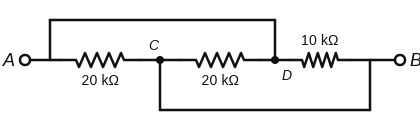
The equivalent resistance between $A$ and $B$ as shown in figure is
Answer: (B) $5\ \text{k}\Omega$
Concept. Points joined by a plain wire are at the same potential, so they are the same node. Rename the nodes, then see which resistors share the same two nodes.
Step 1. Merge nodes. The wire from $A$ to $D$ makes $D\equiv A$; the wire from $C$ to $B$ makes $C\equiv B$.
Step 2. Place each resistor. $AC$ ($20$ k$\Omega$) is between $A$ and $B$; $CD$ ($20$ k$\Omega$) is between $B$ and $A$; $DB$ ($10$ k$\Omega$) is between $A$ and $B$.
Step 3. Parallel. All three join $A$ and $B$: $\dfrac1R=\dfrac1{20}+\dfrac1{20}+\dfrac1{10}=\dfrac{4}{20}$, so $R=5$ k$\Omega$.
Answer. $5$ k$\Omega$ (Option B).
 Solution by Sreeraj P, M.Sc Physics


