

Twelve wires each having resistance $2\ \Omega$ are joined to form a cube. A battery of $6\ \text{V}$ emf is joined across points $a$ and $c$. The voltage difference between $e$ and $f$ is ______ V.
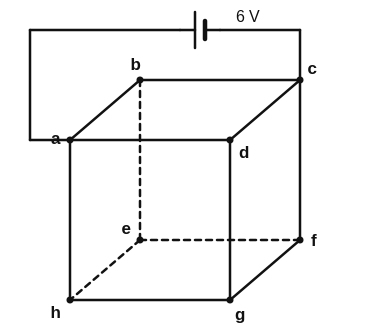
Numerical value type. Enter your answer.
Answer: 1
Concept. Use symmetry to fix the potentials of as many corners as possible, then apply Kirchhoff's junction law at one remaining corner.
Step 1. Potentials of the symmetric corners. Let $V_a=6$ V, $V_c=0$. The plane midway between $a$ and $c$ contains $b$, $d$ and the corners below them, $e$ and $g$, so $V_b=V_d=V_e=V_g=3$ V.
Step 2. Corner $h$ (below $a$). Its neighbours are $a$ (6 V), $e$ (3 V) and $g$ (3 V), all through equal resistors: $(6-V_h)+(3-V_h)+(3-V_h)=0\Rightarrow V_h=4$ V.
Step 3. Corner $f$ (below $c$). By the same symmetry (reversing the battery), $V_f=6-V_h=2$ V.
Step 4. Difference. $V_e-V_f=3-2=1$ V.
Answer. $1$.
 Solution by Sreeraj P, M.Sc Physics


