

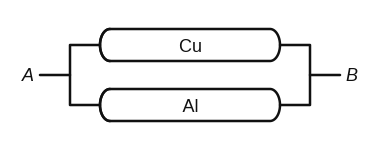
A Copper (Cu) rod of length 25 cm and cross-sectional area $3\ \text{mm}^2$ is joined with a similar Aluminium (Al) rod as shown in figure. Find the resistance of the combination between the ends $A$ and $B$.
(Take resistivity of Copper $= 1.7\times10^{-8}\ \Omega$ m, Resistivity of aluminium $= 2.6\times10^{-8}\ \Omega$ m)
Answer: (D) 0.858 m$\Omega$
Concept. The two rods share the same two ends $A$ and $B$, so they are in parallel. Each rod's resistance is $R=\dfrac{\rho l}{A}$.
Step 1. Copper. $R_{Cu}=\dfrac{1.7\times10^{-8}\times0.25}{3\times10^{-6}}=1.417\times10^{-3}\ \Omega$.
Step 2. Aluminium. $R_{Al}=\dfrac{2.6\times10^{-8}\times0.25}{3\times10^{-6}}=2.167\times10^{-3}\ \Omega$.
Step 3. Parallel. $R=\dfrac{R_{Cu}R_{Al}}{R_{Cu}+R_{Al}}=\dfrac{1.417\times2.167}{3.583}\times10^{-3}\approx0.858\times10^{-3}\ \Omega$.
Answer. $0.858$ m$\Omega$ (Option D).
 Solution by Sreeraj P, M.Sc Physics


