

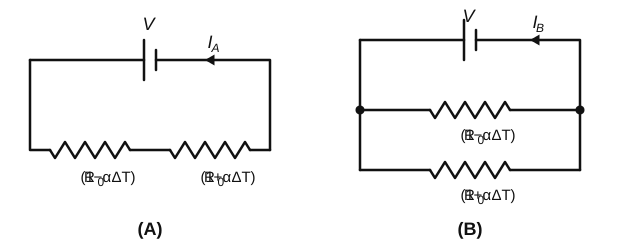
Consider two circuits, (A) and (B), each having two resistors. One of them has a positive temperature coefficient of resistance, $+\alpha$, while the other one has a negative temperature of coefficient, $-\alpha$, as shown in the figure. The current through these circuits are denoted by $I_A$ and $I_B$. At initial temperature, the resistance of the two resistors is $R_0$. As the temperature is increased, the correct option that describes the variation of current in these circuits is :
Answer: (A) $I_A$ remains constant while $I_B$ increases
Circuit (A), series:
$$R_A = R_0(1 - \alpha\Delta T) + R_0(1 + \alpha\Delta T) = 2R_0$$
This does not change, so $I_A$ remains constant.
Circuit (B), parallel:
$$R_B = \frac{R_0(1 - \alpha\Delta T)\,R_0(1 + \alpha\Delta T)}{2R_0} = \frac{R_0}{2}\left(1 - \alpha^2\Delta T^2\right)$$
This decreases as $\Delta T$ increases, so $I_B$ increases.
 Solution by Sreeraj P, M.Sc Physics