

Q 12-03-285JEE MainJEE Main 2017 (2 Apr)Medium
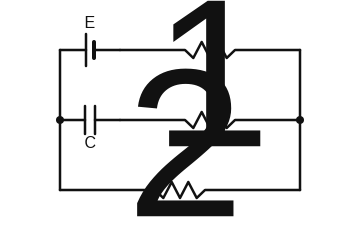
In the given circuit diagram, when the current reaches a steady-state in the circuit, the charge on the capacitor of capacitance $C$ will be:
Answer: (D) $CE\dfrac{r_2}{r + r_2}$
Concept. In steady state no current flows through a capacitor branch, so the resistor in series with it ($r_1$) has no drop, and the capacitor takes the voltage across the branch it is parallel to.
Step 1. Current. Only the loop through $E$, $r$ and $r_2$ carries current: $I=\dfrac{E}{r+r_2}$.
Step 2. Voltage across the capacitor branch. It is parallel to $r_2$: $V=Ir_2=\dfrac{Er_2}{r+r_2}$.
Step 3. Charge. $q=CV=CE\dfrac{r_2}{r+r_2}$.
Answer. $CE\dfrac{r_2}{r+r_2}$ (Option D).
 Solution by Sreeraj P, M.Sc Physics


