

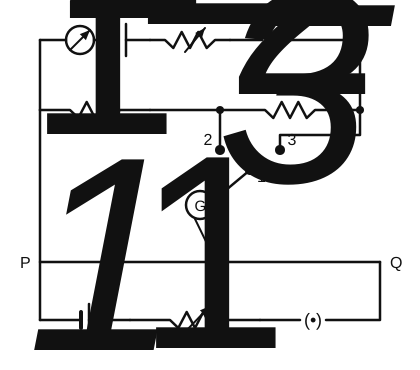
A potentiometer $PQ$ is set up to compare two resistances, as shown in the figure. The ammeter $A$ in the circuit reads $1.0$ A when the two-way key $K_3$ is open. The balance point is at a length $l_1$ cm from $P$ when the two-way key $K_3$ is plugged in between $2$ and $1$, while the balance point is at a length $l_2$ cm from $P$ when the key $K_3$ is plugged in between $3$ and $1$. The ratio of two resistances $\dfrac{R_1}{R_2}$ is found to be:
Answer: (D) $\dfrac{l_1}{l_2 - l_1}$
The same current $I$ flows through $R_1$ and $R_2$ in series, and the potentiometer wire has a fixed potential gradient $k$.
- Key between $2$ and $1$: the galvanometer compares the voltage across $R_1$: $IR_1 = kl_1$.
- Key between $3$ and $1$: it compares the voltage across $R_1 + R_2$: $I(R_1 + R_2) = kl_2$.
Subtracting, $IR_2 = k(l_2 - l_1)$, so
$$\frac{R_1}{R_2} = \frac{l_1}{l_2 - l_1}$$
 Solution by Sreeraj P, M.Sc Physics