

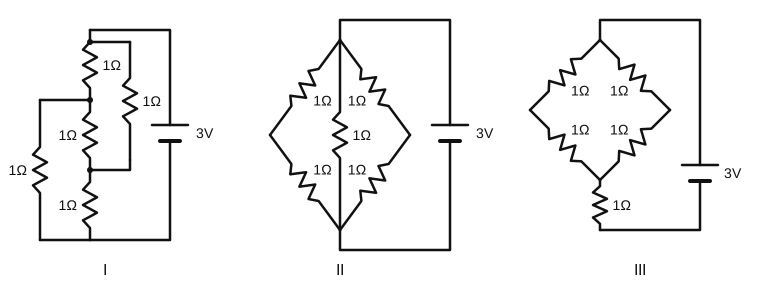
The figure shows three circuits I, II and III which are connected to a $3$ V battery. If the powers dissipated by the configurations I, II and III are $P_1$, $P_2$ and $P_3$ respectively, then:
Answer: (A) $P_2 > P_1 > P_3$
Find the equivalent resistance of each network; then $P = V^2/R$ with $V = 3$ V.
**I:** Label the battery terminals $T$ (top) and $B$ (bottom) and the two junctions on the middle column $M_1$, $M_2$. The resistors are $T$–$M_1$, $M_1$–$M_2$, $M_2$–$B$, $T$–$M_2$ and $M_1$–$B$, all $1\ \Omega$. This is a Wheatstone bridge ($T$–$M_1$–$B$ and $T$–$M_2$–$B$ with $M_1$–$M_2$ as the bridge), balanced since all arms are equal. So $R_1 = \dfrac{2\times2}{2+2} = 1\ \Omega$ and $P_1 = 9$ W.
**II:** Between the top and bottom vertices there are three parallel paths: left side ($2\ \Omega$), right side ($2\ \Omega$) and the middle resistor ($1\ \Omega$):
$$\frac{1}{R_2} = \frac12 + \frac12 + 1 \Rightarrow R_2 = 0.5\ \Omega,\quad P_2 = 18\ \text{W}$$
**III:** The diamond gives two $2\ \Omega$ paths in parallel ($1\ \Omega$), in series with $1\ \Omega$: $R_3 = 2\ \Omega$, $P_3 = 4.5$ W.
Hence $P_2 > P_1 > P_3$.
 Solution by Sreeraj P, M.Sc Physics