

Q 12-03-145JEE MainJEE Main 2023 (6 Apr, Shift 2)Medium
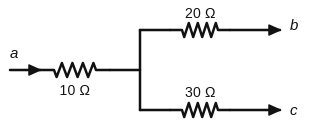
Figure shows a part of an electric circuit. The potentials at points $a$, $b$ and $c$ are $30\ \text{V}$, $12\ \text{V}$ and $2\ \text{V}$ respectively. The current through the $20\ \Omega$ resistor will be
Answer: (B) $0.4\ \text{A}$
Concept. One unknown node joined to points of known potential: by the junction law, the currents into the node add to zero.
Step 1. Junction law at the node $O$. $\dfrac{30-V}{10}+\dfrac{12-V}{20}+\dfrac{2-V}{30}=0$.
Step 2. Solve (×60). $180-6V+36-3V+4-2V=0\Rightarrow V=20$ V.
Step 3. Current in $20\ \Omega$. $\dfrac{20-12}{20}=0.4$ A (from $O$ to $b$).
Answer. $0.4$ A (Option B).
 Solution by Sreeraj P, M.Sc Physics


