

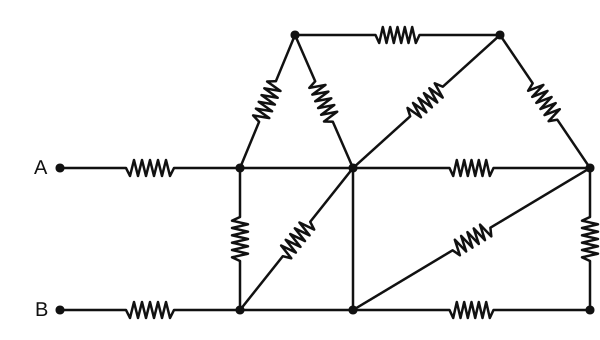
In the given circuit all resistance is of the value of $R$ ohm each. The equivalent resistance between $A$ and $B$ is:
Answer: (D) $2R$
Look for plain wires (no resistor). The left-middle junction, the centre junction, the bottom-middle junction and the bottom-left junction are all connected to one another by plain wires, so they are a single node.
The junction after the resistor from $A$ and the junction after the resistor from $B$ are therefore at the same potential. Every other resistor joins this node to the upper and right-hand junctions, which connect only back to the same node, so no current flows through any of them.
Only the two resistors attached to the terminals remain, in series:
$$R_{AB} = R + R = 2R$$
 Solution by Sreeraj P, M.Sc Physics