

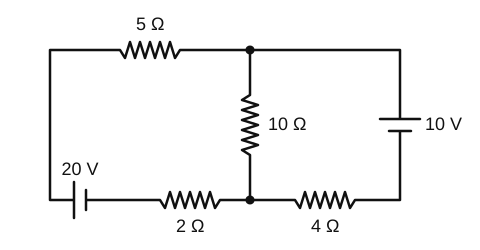
In the figure shown, the current in the $10$ V battery is close to:
Answer: (C) $0.21$ A from positive to negative terminal
Take the bottom middle junction as $0$ V and let the top middle junction be at $x$. The longer plate is positive.
**Left branch** (5 Ω, 20 V cell, 2 Ω), current $i_1$ from the top junction round to the bottom junction: $x - 5i_1 - 20 - 2i_1 = 0 \Rightarrow i_1 = \dfrac{x - 20}{7}$.
**Middle branch:** $i_2 = \dfrac{x}{10}$ downward.
**Right branch** (10 V cell with positive plate on top, then 4 Ω), current $i_3$ downward: $x - 10 - 4i_3 = 0 \Rightarrow i_3 = \dfrac{x - 10}{4}$.
Kirchhoff's current law at the top junction:
$$\frac{x-20}{7} + \frac{x}{10} + \frac{x-10}{4} = 0 \Rightarrow 20(x-20) + 14x + 35(x-10) = 0 \Rightarrow x = \frac{750}{69} \approx 10.87\ \text{V}$$
$$i_3 = \frac{10.87 - 10}{4} \approx 0.21\ \text{A}$$
This current is positive (downward), so it enters the cell at its positive terminal and leaves at the negative one: $0.21$ A from positive to negative terminal.
 Solution by Sreeraj P, M.Sc Physics