

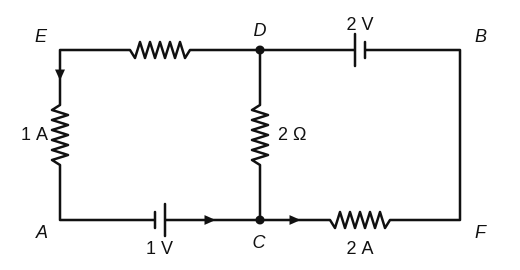
In the circuit given in the figure, the currents in different branches and the value of one resistor are shown. Then the potential at point $B$ with respect to the point $A$ is:
Answer: (D) $+1$ V
Concept. Find the current in the middle branch with the junction law, then walk from $A$ to $B$ adding each rise and drop in potential.
Step 1. Current in $DC$. At $C$: $1$ A arrives from $A$ (the $1$ A in branch $EA$ continues through $AC$) and $2$ A leaves towards $F$. So $1$ A comes from $D$ to $C$ through the $2\ \Omega$ resistor.
Step 2. Walk $A\to C$. The 1 V cell has its positive terminal towards $C$: rise of $1$ V.
Step 3. Walk $C\to D$. Against the $1$ A current through $2\ \Omega$: rise of $2$ V.
Step 4. Walk $D\to B$. The 2 V cell has its positive terminal towards $D$: drop of $2$ V.
Step 5. Total. $V_B-V_A=+1+2-2=+1$ V.
Answer. $+1$ V (Option D).
 Solution by Sreeraj P, M.Sc Physics


