

Q 12-03-275JEE MainJEE Main 2019 (12 Jan, Shift 1)Hard
In a meter bridge, the wire of length $1$ m has a non-uniform cross-section such that, the variation $\dfrac{dR}{dl}$ of its resistance $R$ with length $l$ is $\dfrac{dR}{dl} \propto \dfrac{1}{\sqrt l}$. Two equal resistances are connected as shown in the figure. The galvanometer has zero deflection when the jockey is at point P. What is the length AP?
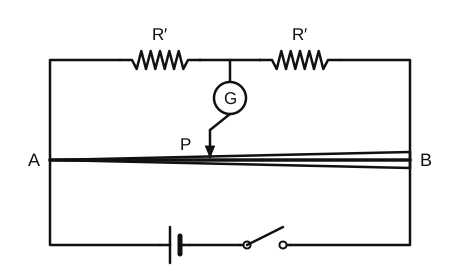
Answer: (D) $0.25$ m
Integrating $\dfrac{dR}{dl} = \dfrac{c}{\sqrt l}$: the resistance from A to a point at distance $l$ is $2c\sqrt l$, and the whole wire has $2c$.
With equal resistances in the gaps, balance needs $R_{AP} = R_{PB}$:
$$2c\sqrt l = 2c(1 - \sqrt l) \Rightarrow \sqrt l = \frac12 \Rightarrow l = 0.25\ \text{m}$$
 Solution by Sreeraj P, M.Sc Physics