

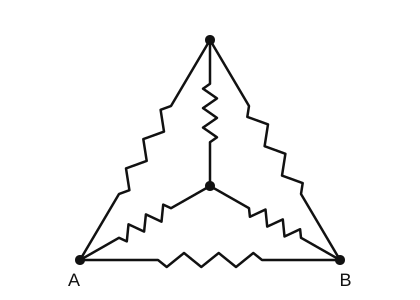
A wire of resistance $R$ is bent into a triangular pyramid as shown in the figure, with each segment having the same length. The resistance between points A and B is $R/n$. The value of $n$ is:
Answer: (D) $12$
A triangular pyramid (tetrahedron) has 6 equal edges, so each edge has resistance $r = R/6$.
Between A and B, the other two vertices (the apex and the top of the pyramid) are placed symmetrically, so they are at the same potential and the edge joining them carries no current (a balanced bridge). Remove it. What is left between A and B:
- the direct edge AB: $r$;
- the path through the apex: $2r$;
- the path through the fourth vertex: $2r$.
$$\frac{1}{R_{AB}} = \frac1r + \frac1{2r} + \frac1{2r} = \frac2r \Rightarrow R_{AB} = \frac r2 = \frac{R}{12}$$
So $n = 12$.
 Solution by Sreeraj P, M.Sc Physics