

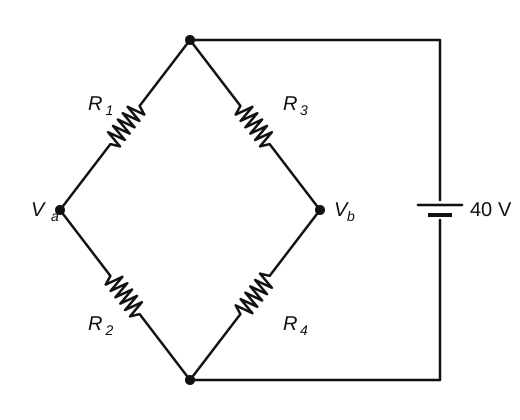
A Wheatstone bridge is initially at room temperature and all arms of the bridge have same value of resistances ($R_1 = R_2 = R_3 = R_4$). When $R_3$ resistance is heated to some temperature, its resistance value has gone up by 10%. The potential difference $(V_a - V_b)$ (after $R_3$ is heated) is ______ V.
Answer: (B) 0.95
Take the bottom corner at $0$ V and the top corner at $40$ V (positive terminal of the cell at the top). Let each resistance be $R$, and $R_3 = 1.1R$.
Left branch ($R_1$ above, $R_2$ below):
$$V_a = 40\cdot\frac{R_2}{R_1+R_2} = 20\ \text{V}$$
Right branch ($R_3$ above, $R_4$ below):
$$V_b = 40\cdot\frac{R_4}{R_3+R_4} = 40\cdot\frac{1}{2.1} = 19.05\ \text{V}$$
$$V_a - V_b = 20 - 19.05 \approx 0.95\ \text{V}$$
 Solution by Sreeraj P, M.Sc Physics