
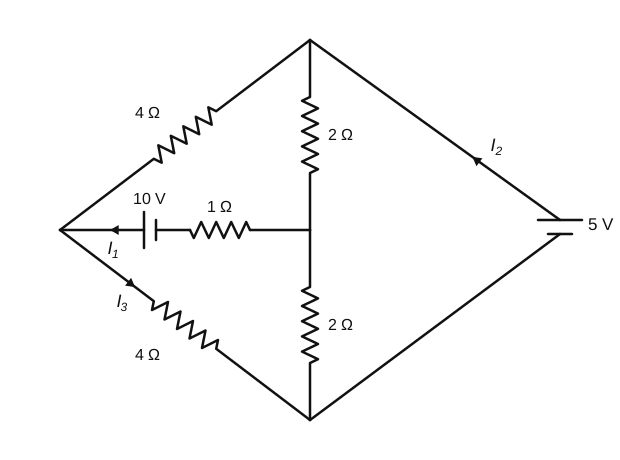
Refer to the figure given below. The values of $I_1, I_2$ and $I_3$ are ______.
Answer: (A) $I_1 = 2.5$ A, $I_2 = 1.875$ A, $I_3 = 1.875$ A
Concept. Use node potentials with Kirchhoff's junction law. The 5 V cell fixes the difference between the top and bottom corners, so the unknowns reduce to two potentials. Take the left corner as $0$ V; call the top $T$, the bottom $D$ and the centre $C$.
Step 1. Fix the cells. The 5 V cell (positive at the top) gives $V_T=V_D+5$. The 10 V cell (positive towards the left corner) with $1\ \Omega$: the current $I_1$ from $C$ to the left corner is $I_1=V_C+10$.
Step 2. Junction law at $C$. Current leaving $C$ through the two $2\ \Omega$ resistors and the cell branch is zero: $\dfrac{V_C-V_T}{2}+\dfrac{V_C-V_D}{2}+(V_C+10)=0$.
Step 3. Junction law for $T$ and $D$ together (the 5 V cell's current stays inside): $\dfrac{0-V_T}{4}+\dfrac{0-V_D}{4}+\dfrac{V_C-V_T}{2}+\dfrac{V_C-V_D}{2}=0\Rightarrow4V_C=3(V_T+V_D)$.
Step 4. Solve. Step 2 is $2V_C-\dfrac{V_T+V_D}{2}+10=0$; with $V_T+V_D=\dfrac{4V_C}{3}$ from Step 3, $2V_C-\dfrac{2V_C}{3}+10=0\Rightarrow V_C=-7.5$ V. Then $V_T+V_D=-10$ and $V_T-V_D=5$: $V_T=-2.5$ V, $V_D=-7.5$ V.
Step 5. Currents. $I_1=-7.5+10=2.5$ A. In the lower $4\ \Omega$: $I_3=\dfrac{0-(-7.5)}{4}=1.875$ A. At $T$: $\dfrac{V_T-V_C}{2}=2.5$ A leaves towards $C$ and $\dfrac{0-V_T}{4}=0.625$ A arrives from the left, so the cell branch supplies $I_2=2.5-0.625=1.875$ A.
Answer. $I_1=2.5$ A, $I_2=1.875$ A, $I_3=1.875$ A (Option A).
 Solution by Sreeraj P, M.Sc Physics