

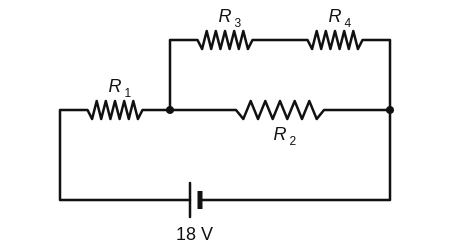
In the given circuit the internal resistance of the $18\ \text{V}$ cell is negligible. If $R_1 = 400\ \Omega$, $R_3 = 100\ \Omega$ and $R_4 = 500\ \Omega$ and the reading of an ideal voltmeter across $R_4$ is $5\ \text{V}$, then the value of $R_2$ will be:
Answer: (B) $300\ \Omega$
Concept. An ideal voltmeter across $R_4$ gives the current in the $R_3$–$R_4$ branch. That branch is in parallel with $R_2$, which gives the voltage across $R_2$, and the rest of the 18 V is across $R_1$.
Step 1. Branch current. $I_{34}=\dfrac{5}{500}=0.01$ A.
Step 2. Voltage across the parallel part. $V=0.01\times(100+500)=6$ V.
Step 3. Main current. $R_1$ takes $18-6=12$ V, so $I=\dfrac{12}{400}=0.03$ A.
Step 4. $R_2$. It carries $0.03-0.01=0.02$ A at 6 V: $R_2=\dfrac{6}{0.02}=300\ \Omega$.
Answer. $300\ \Omega$ (Option B).
 Solution by Sreeraj P, M.Sc Physics


