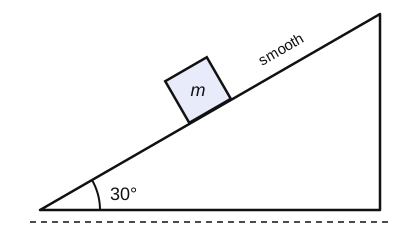
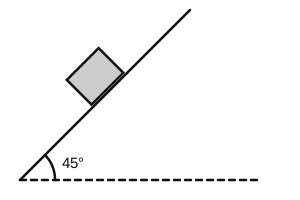
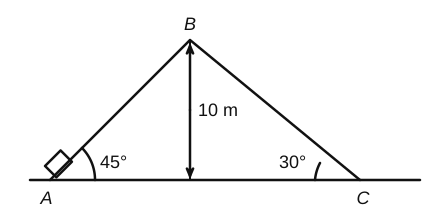
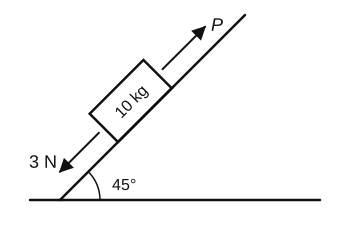
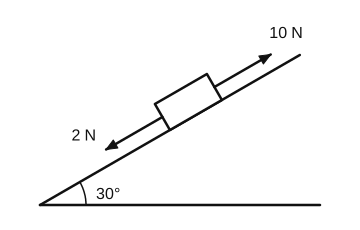
A block is released from rest on a smooth inclined plane as shown. Find the magnitude of its acceleration along the incline in $\text{m/s}^2$. (Take $g = 10\ \text{m/s}^2$.)
A car travels on a circular racetrack of radius $50$ m, which is banked at an angle $\theta$. If the car travels at a speed $10\ \text{m s}^{-1}$, then the wear and tear on its tyres is minimum. Taking the acceleration due to gravity to be $10\ \text{m s}^{-2}$, the value of $\theta$ is :
There are two inclined surfaces of equal length ($L$) and same angle of inclination $45°$ with the horizontal. One of them is rough and the other is perfectly smooth. A given body takes $2$ times as much time to slide down on rough surface than on the smooth surface. The coefficient of kinetic friction ($\mu_k$) between the object and the rough surface is close to
A ball of mass $0.5$ kg is dropped from a height of $40$ m. The ball hits the ground and rises to a height of $10$ m. The impulse imparted to the ball during its collision with the ground is (Take $g = 9.8\ \text{m/s}^2$)
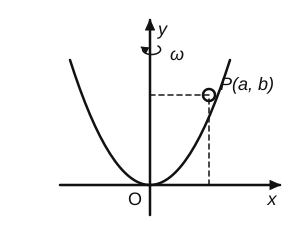
A bob is whirled in a horizontal plane by means of a string with an initial speed of $\omega$ rpm. The tension in the string is $T$. If speed becomes $2\omega$ while keeping the same radius, the tension in the string becomes :
Concept. Tension provides the centripetal force: $T = m\omega^2r$.
Step 1. Scale. Same $r$, double $\omega$: $T' = 4T$.
Answer. $4T$ (Option D).
Solution by Sreeraj P, M.Sc Physics
Q 11-04-007NEETNEET 2024Top questionEasy
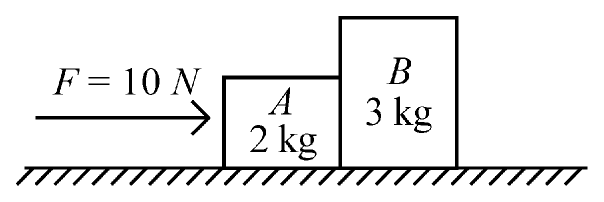
A horizontal force $10$ N is applied to a block $A$ as shown in figure. The mass of blocks $A$ and $B$ are $2$ kg and $3$ kg, respectively. The blocks slide over a frictionless surface. The force exerted by block $A$ on block $B$ is :
A football player is moving southward and suddenly turns eastward with the same speed to avoid an opponent. The force that acts on the player while turning is :
Concept. Force is along the change in momentum $\Delta\vec v = \vec v_f - \vec v_i$.
Step 1. Change. $v\hat E - v\hat S = v\hat E + v\hat N$.
Step 2. Direction. Equal east and north components: north-east.
Answer. Along north-east (Option C).
Solution by Sreeraj P, M.Sc Physics
Q 11-04-009NEETNEET 2023Top questionEasy
Calculate the maximum acceleration of a moving car so that a body lying on the floor of the car remains stationary. The coefficient of static friction between the body and the floor is $0.15$ ($g = 10\ \text{m s}^{-2}$).
A ball of mass $0.15$ kg is dropped from a height $10$ m, strikes the ground and rebounds to the same height. The magnitude of impulse imparted to the ball is ($g = 10\ \text{m/s}^2$) nearly :
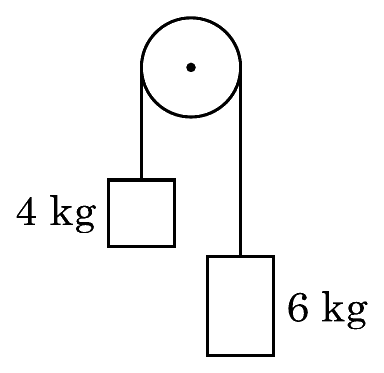
Two bodies of mass $4$ kg and $6$ kg are tied to the ends of a massless string. The string passes over a pulley which is frictionless (see figure). The acceleration of the system in terms of acceleration due to gravity (g) is :
A body of mass $8$ kg is moved by a force $F = (3x)$ N, where $x$ is the distance covered. Its initial position is $x = 2$ m and its final position is $x = 10$ m. If the body is initially at rest, its final speed is
The sum of the magnitudes of two forces acting at a point is $16$ N. If their resultant is normal to the smaller force and has a magnitude of $8$ N, then the forces are
A bus moving on a level road with a velocity $v$ can be stopped at a distance of $x$ by the application of a retarding force $F$. The load on the bus is increased by $25\%$ by boarding the passengers. Now, if the bus is moving with the same speed and if the same retarding force is applied, the distance travelled by the bus before it stops is
The maximum tension a rope can withstand is $60$ kg-wt. The ratio of the maximum accelerations with which two boys of masses $20$ kg and $30$ kg can climb up the rope at the same time is ($g = 10\ \text{m/s}^2$)
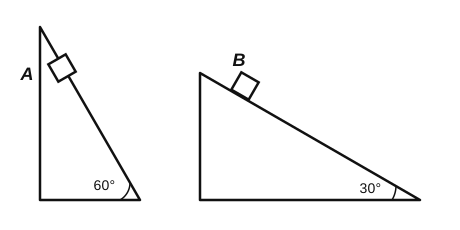
Two fixed frictionless inclined planes making angles $30°$ and $60°$ with the vertical are shown in the figure. Two blocks A and B are placed on the two planes. What is the relative vertical acceleration of A with respect to B?
Answer: (A) $4.9\ \text{m s}^{-2}$ in the vertical direction
Concept. On a smooth incline of angle $\theta$ to the horizontal, a block accelerates at $g\sin\theta$ along the slope; its vertical component is $g\sin\theta\cdot\sin\theta=g\sin^2\theta$.
Step 1. Angles with the horizontal. $30^\circ$ with the vertical means $60^\circ$ with the horizontal (A); $60^\circ$ with the vertical means $30^\circ$ (B).
A rifle of $20$ kg mass can fire $4$ bullets per second. The mass of each bullet is $35 \times 10^{-3}$ kg and its final velocity is $400\ \text{m s}^{-1}$. Then, what force must be applied on the rifle so that it does not move backwards while firing the bullets?
A particle of mass $4m$ at rest explodes into three pieces of masses $m$, $m$ and $2m$. The equal masses move along the $X$-axis and $Y$-axis with velocities $4\ \text{m s}^{-1}$ and $6\ \text{m s}^{-1}$ respectively. The magnitude of the velocity of the heavier mass is
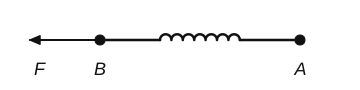
Two blocks of masses $m$ and $M$ are placed on a horizontal frictionless table and connected by a light spring. Mass $M$ is pulled to the right with a force $F$. If the acceleration of mass $m$ is $a$, then the acceleration of mass $M$ will be
A $1$ N pendulum bob is held at an angle $\theta$ from the vertical by a $2$ N horizontal force $F$. The tension in the string supporting the pendulum bob (in newton) is
A vehicle of mass $M$ is moving on a rough horizontal road with a momentum $P$. If the coefficient of friction between the tyres and the road is $\mu$, then the stopping distance is
The minimum force required to start pushing a body up a rough (frictional coefficient $\mu$) inclined plane is $F_1$ while the minimum force needed to prevent it from sliding down is $F_2$. If the inclined plane makes an angle $\theta$ with the horizontal such that $\tan\theta = 2\mu$, then the ratio $\dfrac{F_1}{F_2}$ is
The force required to move a body up a rough inclined plane is double the force required to prevent the body from sliding down the plane. The coefficient of friction when the angle of inclination of the plane is $60°$ is
A smooth block is released from rest on a $45°$ inclined plane and it slides a distance $d$. The time taken to slide is $n$ times that on a smooth inclined plane. The coefficient of friction is
Starting from rest, the time taken by a body sliding down on a rough inclined plane at $45°$ with the horizontal is twice the time taken to travel on a smooth plane of the same inclination and the same distance. Then the coefficient of kinetic friction is
The upper half of an inclined plane of inclination $\theta$ is perfectly smooth while the lower half is rough. A block starting from rest at the top of the plane will again come to rest at the bottom. The coefficient of friction between the block and the lower half of the plane is given by
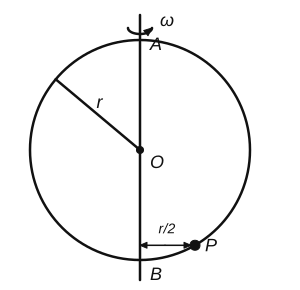
A steel wire can withstand a load up to $2940$ N. A load of $150$ kg is suspended from a rigid support. The maximum angle through which the wire can be displaced from the mean position, so that the wire does not break when the load passes through the position of equilibrium, is ($g = 9.8\ \text{m/s}^2$)
A car is travelling along a curved road of radius $r$. If the coefficient of friction between the tyres and the road is $\mu$, the car will skid if its speed exceeds
A boy of mass $50$ kg is standing on a weighing machine placed on the floor of a lift. The machine reads his weight in newtons. The reading of the machine if the lift is moving upwards with a uniform speed of $10\ \text{m s}^{-1}$ is ($g = 9.8\ \text{m/s}^2$)
Concept. Uniform velocity means zero acceleration, so $N = mg$.
Step 1. Reading. $50 \times 9.8 = 490$ N.
Answer. $490$ N (Option C).
Solution by Sreeraj P, M.Sc Physics
Q 11-04-031JEE MainAIEEE 2010Hard
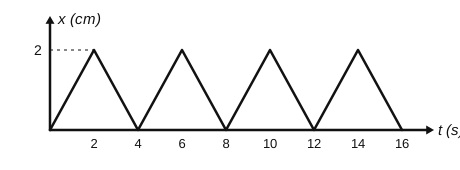
The position-time graph of a body of mass $0.04$ kg is shown in the figure. The time between two consecutive impulses received by the body and the magnitude of each impulse is
Step 1. Differentiate. $\vec F = 8t\hat i - 6t\hat j$, $|\vec F| = 10t$.
Step 2. At 2 s. $20$ N.
Answer. $20$ N (Option A).
Solution by Sreeraj P, M.Sc Physics
Q 11-04-033NEETJEE MainEasy
Three blocks of masses $2$ kg, $3$ kg and $5$ kg are placed in contact in a row on a smooth horizontal floor. A horizontal force of $50$ N pushes the $2$ kg block. The contact force between the $3$ kg and the $5$ kg blocks is
Masses of $3$ kg and $5$ kg hang at the two ends of a light string passing over a smooth, light pulley. The tension in the string is ($g = 10\ \text{m/s}^2$)
A $10$ kg block rests on a horizontal floor. The coefficients of static and kinetic friction are $0.5$ and $0.4$. A horizontal push of $30$ N is applied. The frictional force on the block is ($g = 10\ \text{m/s}^2$)
Concept. Below the limit, static friction just balances the applied force.
Step 1. Limit. $0.5 \times 100 = 50$ N $> 30$ N, so no sliding.
Step 2. Friction. $30$ N.
Answer. $30$ N (Option A).
Solution by Sreeraj P, M.Sc Physics
Q 11-04-037JEE MainMedium
A $5$ kg block rests on a horizontal floor ($\mu_s = 0.4$). A force $F$ is applied at $37°$ above the horizontal. The minimum value of $F$ that just starts the block moving is nearly (take $\sin 37° = 0.6$, $\cos 37° = 0.8$, $g = 10\ \text{m/s}^2$)
Concept. The upward component reduces the normal force: $N = mg - F\sin37°$.
Step 1. Condition. $0.8F = 0.4(50 - 0.6F)$.
Step 2. Solve. $1.04F = 20 \Rightarrow F \approx 19.2$ N.
Answer. $19.2$ N (Option B).
Solution by Sreeraj P, M.Sc Physics
Q 11-04-038NEETJEE MainEasy
A block placed on a plank just begins to slide when the plank is tilted to $30°$ with the horizontal. The coefficient of static friction between the block and the plank is
A block slides down a rough plane inclined at $37°$ to the horizontal. If $\mu_k = 0.5$, its acceleration is (take $\sin 37° = 0.6$, $g = 10\ \text{m/s}^2$)
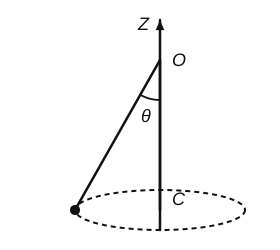
A small ball is tied to a string $1$ m long and whirled as a conical pendulum so that it moves in a horizontal circle of radius $0.6$ m. The time period of revolution is ($g = 10\ \text{m/s}^2$)
Step 2. Period. $2\pi\sqrt{\dfrac{0.8}{10}} = 2\pi\sqrt{0.08}$ s.
Answer. $2\pi\sqrt{0.08}$ s (Option A).
Solution by Sreeraj P, M.Sc Physics
Q 11-04-041NEETJEE MainEasy
A road curve of radius $160$ m is banked so that $\tan\theta = 0.25$. The speed at which a car can take the curve with no need for friction is ($g = 10\ \text{m/s}^2$)
The coefficient of static friction between the tyres and a flat road is $0.4$. The maximum speed with which a car can go round a flat curve of radius $40$ m without skidding is ($g = 10\ \text{m/s}^2$)
A $2$ kg body at rest is acted on by a force that rises uniformly from $0$ to $100$ N in $0.1$ s and then falls uniformly back to zero in the next $0.1$ s. The speed of the body afterwards is
A horizontal jet of water with cross-sectional area $2\ \text{cm}^2$ and speed $20$ m/s strikes a vertical wall and falls dead (does not rebound). The force on the wall is (density of water $= 1000\ \text{kg/m}^3$)
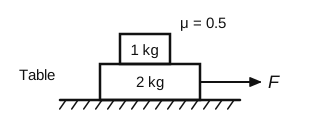
A $2$ kg block rests on an $8$ kg block, which lies on a smooth floor. The coefficient of static friction between the blocks is $0.3$. The maximum horizontal force that can be applied to the lower block so that the two move together is ($g = 10\ \text{m/s}^2$)
Concept. The top block is accelerated only by friction: $a_{\max} = \mu_sg$.
Step 1. Maximum acceleration. $3\ \text{m/s}^2$.
Step 2. Force. $(2 + 8) \times 3 = 30$ N.
Answer. $30$ N (Option C).
Solution by Sreeraj P, M.Sc Physics
Q 11-04-047NEETJEE MainMedium
A box lies on the floor of a truck. The coefficient of kinetic friction between them is $0.3$. The truck accelerates at $5\ \text{m/s}^2$, which is enough to make the box slide. The acceleration of the box relative to the truck is ($g = 10\ \text{m/s}^2$)
Step 2. Relative. $3 - 5 = -2$: $2\ \text{m/s}^2$ towards the rear.
Answer. $2\ \text{m/s}^2$ towards the rear (Option D).
Solution by Sreeraj P, M.Sc Physics
Q 11-04-048NEETJEE MainMedium
A $4$ kg block on a rough horizontal table ($\mu_k = 0.25$) is connected by a light string over a smooth pulley at the table's edge to a $2$ kg block hanging freely. The acceleration of the system is ($g = 10\ \text{m/s}^2$)
A rope can bear a maximum tension of $300$ N. With what maximum acceleration, in $\text{m/s}^2$, can a $20$ kg monkey climb up the rope? ($g = 10\ \text{m/s}^2$)
A $5$ kg block rests on a rough plane inclined at $37°$ to the horizontal ($\mu_s = 0.5$). Find the minimum force, in newtons, that must be applied along the plane (upwards) to keep the block from sliding down. (Take $\sin 37° = 0.6$, $\cos 37° = 0.8$, $g = 10\ \text{m/s}^2$.)
Concept. Friction (up the plane) cannot exceed $\mu_smg\cos\theta$; the applied force supplies the rest.
Step 1. Forces. $mg\sin\theta = 30$ N, $\mu_smg\cos\theta = 20$ N.
Step 2. Minimum force. $30 - 20 = 10$ N.
Answer. $10$.
Solution by Sreeraj P, M.Sc Physics
Q 11-04-051JEE MainJEE Main 2026 (8 Apr, Shift 2)Medium
A car moving with a speed of $54\ \text{km/h}$ takes a turn of radius $20$ m. A simple pendulum is suspended from the ceiling of the car. Determine the angle made by the string of the pendulum with the vertical during the turning. (Take $g = 10\ \text{m/s}^2$)
Concept. In the car's frame (rotating with it), the bob is at rest under its weight $mg$ downward, the centrifugal force $\dfrac{mv^2}{r}$ outward, and the tension. The string lines up with the resultant of weight and centrifugal force.
Step 1. Convert the speed. $$v=54\ \text{km h}^{-1}=54\times\frac{5}{18}=15\ \text{m s}^{-1}$$
Step 2. Balance on the bob. With the string at angle $\theta$ to the vertical: $$T\cos\theta=mg,\qquad T\sin\theta=\frac{mv^2}{r}$$
Answer. $\theta=\tan^{-1}(1.125)$, option C. The bob leans outward, away from the centre of the turn.
Solution by Sreeraj P, M.Sc Physics
Q 11-04-052JEE MainJEE Main 2026 (6 Apr, Shift 1)Hard
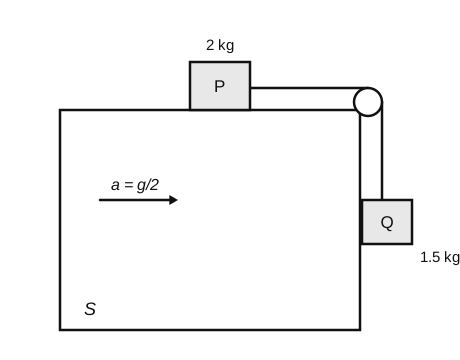
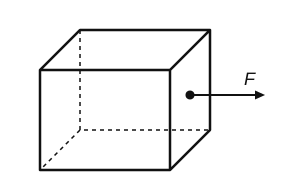
Two blocks ($P$ and $Q$) with respectively masses $2$ kg and $1.5$ kg are joined by a massless thread. These blocks are mounted on a frictionless pully which is fixed on the edge of a cube ($S$), as shown in the figure below. Block $P$ is positioned on the top surface which has no friction and block $Q$ is in contact with side-surface, having coefficient friction $\mu$. The cube ($S$) moves towards the right with acceleration of $\dfrac{g}{2}$, where $g$ is gravitational acceleration. During this movement the block $P$ and $Q$ remain stationary. The value of $\mu$ is ______ (take $g = 10\ \text{m/s}^2$)
Concept. Work in the cube's frame. It accelerates to the right at $g/2$, so each block feels a pseudo force $m\dfrac g2$ to the left. In this frame both blocks are at rest, so the forces on each balance. On $Q$ (on the right side face) the pseudo force presses it into the face and so produces the normal force, which limits friction.
Step 1. Pseudo forces. With $g=10$ m s$^{-2}$, $g/2=5$ m s$^{-2}$: $$P:\ 2\times5=10\ \text{N (left)},\qquad Q:\ 1.5\times5=7.5\ \text{N (left)}$$
Step 2. Isolate $P$ (smooth top face). Horizontal forces: tension $T$ to the right (towards the pulley) and the pseudo force to the left. $$T=10\ \text{N}$$
Step 3. Isolate $Q$, horizontally. The pseudo force ($7.5$ N, left) pushes $Q$ against the face; the face pushes back: $$N=7.5\ \text{N}$$
Step 4. Isolate $Q$, vertically. Weight $15$ N down, tension $10$ N up. The rest must come from friction, acting up: $$f=15-10=5\ \text{N}$$
Step 5. Condition for no slipping. $$f\le\mu N\ \Rightarrow\ 5\le7.5\mu\ \Rightarrow\ \mu\ge\frac23\approx0.67$$
Answer. $0.67$, option B (the least value that keeps the blocks stationary).
Solution by Sreeraj P, M.Sc Physics
Q 11-04-053JEE MainJEE Main 2026 (6 Apr, Shift 2)Medium
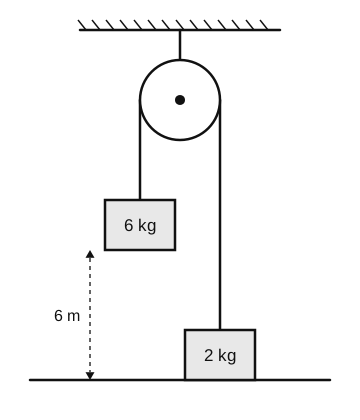
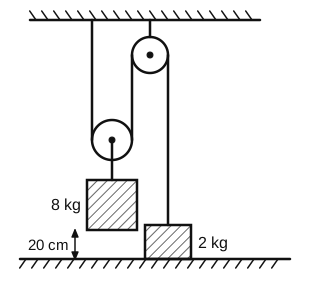
The velocity at which $6$ kg mass (shown in figure) strikes the ground when it is released from a height of $6$ m above the ground is ______ m/s. Assume pulley is massless and string is light and inextensible. (Take $g = 10\ \text{m/s}^2$)
Concept. Atwood machine: the heavier block falls with $a=\dfrac{(m_1-m_2)g}{m_1+m_2}$; then $v^2=2as$ for the fall of $6$ m.
Step 1. Acceleration. $a=\dfrac{(6-2)\times10}{8}=5$ m s$^{-2}$.
Step 2. Speed at the ground. $v=\sqrt{2\times5\times6}=\sqrt{60}=7.74$ m/s.
Answer. $7.74$ (Option A).
Solution by Sreeraj P, M.Sc Physics
Q 11-04-054JEE MainJEE Main 2026 (6 Apr, Shift 2)Medium
A block takes $t$ time to slide down a plane inclined at $45^\circ$ to the horizontal. If the surface is made smooth (frictionless), the block takes time $\dfrac{t}{2}$ to slide down the plane. The coefficient of friction between the block and the inclined plane is $\left(\dfrac{\alpha}{100}\right)$. The value of $\alpha$ is ______.
Concept. Same length from rest: $L=\tfrac12at^2$, so $t\propto\dfrac1{\sqrt a}$. Smooth: $a_s=g\sin\theta$; rough: $a_r=g(\sin\theta-\mu\cos\theta)$.
Step 1. Ratio of accelerations. $t_s=\dfrac t2\Rightarrow\dfrac{a_s}{a_r}=\left(\dfrac{t}{t/2}\right)^2=4$.
Step 2. At $45^\circ$ ($\sin=\cos$): $\dfrac{1}{1-\mu}=4\Rightarrow\mu=0.75$.
Answer. $\alpha=75$.
Solution by Sreeraj P, M.Sc Physics
Q 11-04-055JEE MainJEE Main 2026 (5 Apr, Shift 1)Medium
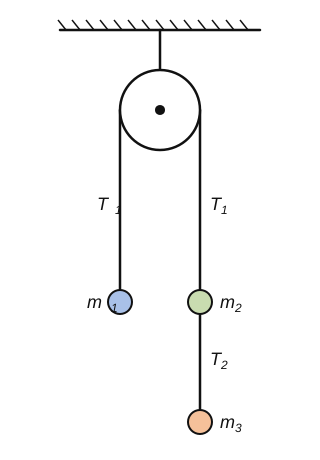
Three masses $m_1 = 4$ kg, $m_2 = 4$ kg and $m_3 = 6$ kg are suspended from a fixed smooth frictionless pully as shown in the figure below. The value of $T_1/T_2$ is ______ (take $g = 10\ \text{m/s}^2$)
Concept. All three masses move with the same acceleration magnitude: $m_1$ on one side, $m_2$ and $m_3$ (hanging one below the other) on the other. Find $a$ from the whole system, then isolate single masses to get each tension.
Step 1. Read the figure. $T_1$ is the tension in the string over the pulley (it holds $m_1$ on the left and $m_2$ on the right). $T_2$ is the tension in the short string between $m_2$ and $m_3$.
Step 2. Acceleration. Left side $4$ kg, right side $m_2+m_3=10$ kg, so the right side goes down: $$a=\frac{(10-4)g}{4+10}=\frac{60}{14}=\frac{30}{7}\ \text{m s}^{-2}$$
Answer. Option A. Check with $m_2$ (moving down, pulled up by $T_1$ and down by $T_2$ and its weight): $m_2g+T_2-T_1=40+\dfrac{240-400}{7}=\dfrac{120}{7}$, and $m_2a=4\times\dfrac{30}{7}=\dfrac{120}{7}$. Correct.
Solution by Sreeraj P, M.Sc Physics
Q 11-04-056JEE MainJEE Main 2026 (5 Apr, Shift 1)Hard
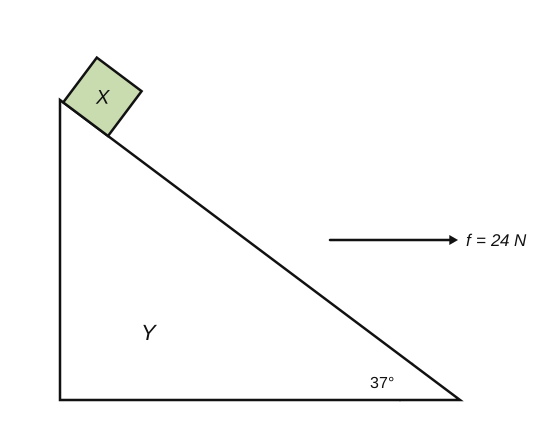
A wedge $Y$ with mass of $10$ kg and all frictionless surfaces and the inclined surface making $37^\circ$ with horizontal. A block $X$ with mass $2$ kg is placed at the highest point of the wedge as shown in figure is at rest. At $t = 0$ wedge ($Y$) is pulled toward right with constant force ($f$) of $24$ N. Taking the block $X$ at rest at $t = 0$, the time taken by it to slide down $8.8$ m on the slope, while $Y$ is on the move, is ______ s.
(take $\tan(37^\circ) = 3/4$ and $g = 10\ \text{m/s}^2$)
(An exact treatment of the block's push on the wedge gives $A \approx 1.34\ \text{m/s}^2$ and $t \approx 1.9$ s; the nearest option is still $2$ s.)
Answer. $2$ (Option A).
Solution by Sreeraj P, M.Sc Physics
Q 11-04-057JEE MainJEE Main 2026 (4 Apr, Shift 2)Easy
At $t = 0$, a body of mass $100$ g starts moving under the influence of a force $(5\hat{i} + 10\hat{j})$ N. After $2$ s its position is $(2x\hat{i} + 5y\hat{j})$ m. The ratio $x : y$ is ______.
Concept. A constant force gives a constant acceleration $\vec a=\vec F/m$. From rest at the origin the position is $\vec r=\tfrac12\vec a\,t^2$, and each component can be handled on its own.
Step 1. Find the acceleration. Convert the mass: $m=100$ g $=0.1$ kg. $$\vec a=\frac{\vec F}{m}=\frac{5\hat i+10\hat j}{0.1}=50\hat i+100\hat j\ \text{m s}^{-2}$$
Step 2. Position after 2 s. The body starts from rest ($\vec u=0$), so $$\vec r=\tfrac12\vec a\,t^2=\tfrac12(50\hat i+100\hat j)(2)^2=100\hat i+200\hat j\ \text{m}$$
Step 3. Compare with the given form. Match the components with $2x\hat i+5y\hat j$: $$2x=100\Rightarrow x=50,\qquad 5y=200\Rightarrow y=40$$
Answer. $x:y=50:40=5:4$, option D. Note that $x$ and $y$ are not the coordinates themselves; they are defined through $2x$ and $5y$.
Solution by Sreeraj P, M.Sc Physics
Q 11-04-058JEE MainJEE Main 2026 (4 Apr, Shift 1)Medium
The time taken by a block of mass $m$ to slide down from the highest point to the lowest point on a rough inclined plane is $50\%$ more compared to the time taken by the same block on identical inclined smooth plane. Both inclined planes are at $45^\circ$ with the horizontal. The coefficient of kinetic friction between the rough inclined surface and block is ______
Concept. As before, $t\propto1/\sqrt a$ for the same length. "50% more" means $t_r=1.5\,t_s$.
Step 1. Ratio. $\dfrac{a_s}{a_r}=1.5^2=\dfrac94$.
Step 2. At $45^\circ$. $1-\mu=\dfrac49\Rightarrow\mu=\dfrac59$. (General rule at $45^\circ$: $t_r=nt_s$ gives $\mu=1-\dfrac1{n^2}$.)
Answer. $\dfrac59$ (Option C).
Solution by Sreeraj P, M.Sc Physics
Q 11-04-059JEE MainJEE Main 2026 (2 Apr, Shift 2)Easy
A $0.5$ kg mass is in contact against the inner wall of a cylindrical drum of radius $4$ m rotating about its vertical axis. The minimum rotational speed of the drum to enable the mass to remain stuck to the wall (without falling) is $5$ rad/s. The coefficient of friction between the drum's inner wall surface and mass is ______. (Take $g=10\ \text{m/s}^2$)
Concept. A body pressed against the inside wall of a rotating drum moves in a horizontal circle. The wall's normal force points to the axis and supplies the centripetal force. Friction from the wall acts upward and must hold the weight, and it can be at most $\mu N$.
Step 1. Horizontal (towards the axis). $$N=m\omega^2r$$
Step 2. Vertical. For the mass not to slip down: $$mg\le\mu N=\mu m\omega^2r$$
Step 3. At the minimum speed the inequality is an equality. $$\mu=\frac{g}{\omega^2r}=\frac{10}{5^2\times4}=\frac{10}{100}=0.1$$
Answer. $0.1$, option A. The mass ($0.5$ kg) cancels and is not needed.
Solution by Sreeraj P, M.Sc Physics
Q 11-04-060JEE MainJEE Main 2026 (28 Jan, Shift 2)Hard
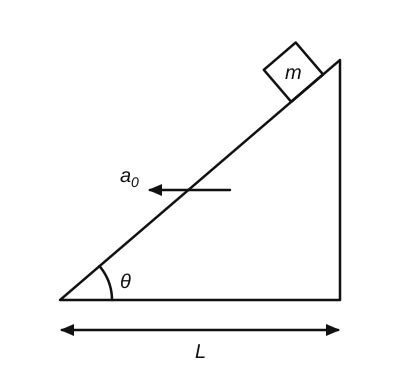
A small block of mass m slides down from the top of a frictionless inclined surface, while the inclined plane is moving towards left with constant acceleration $a_0$. The angle between the inclined plane and ground is $\theta$ and its base length is $L$. Assuming that initially the small block is at the top of the inclined plane, the time it takes to reach the lowest point of the inclined plane is ______.
Concept. Work in the frame of the incline. It accelerates to the left at $a_0$, so the block feels a pseudo force $ma_0$ to the right. In this frame the block slides along the incline from rest, so find its acceleration along the incline and use $s=\tfrac12at^2$ with the incline's length.
Step 1. Geometry. From the figure the incline rises to the right, the block starts at the top (right end), and the base is $L$. So the length along the slope is $$\ell=\frac{L}{\cos\theta}$$ "Down the incline" points to the lower left.
Step 2. Forces along the incline (down the slope positive).
Gravity: $mg\sin\theta$ down the slope.
Pseudo force $ma_0$ to the right: its component along the slope is $ma_0\cos\theta$, pointing up the slope.
Normal force: no component along the slope.
$$a_{\text{rel}}=g\sin\theta-a_0\cos\theta$$
Step 3. Time from rest. $$\frac{L}{\cos\theta}=\tfrac12(g\sin\theta-a_0\cos\theta)t^2\ \Rightarrow\ t^2=\frac{2L}{g\sin\theta\cos\theta-a_0\cos^2\theta}$$
Step 4. Match the options. Multiply top and bottom by 2 and use $2\sin\theta\cos\theta=\sin2\theta$, $2\cos^2\theta=1+\cos2\theta$: $$t=\sqrt{\frac{4L}{g\sin2\theta-a_0(1+\cos2\theta)}}$$
Answer. Option B. Option A uses $L$ as if it were the slope length.
Solution by Sreeraj P, M.Sc Physics
Q 11-04-061JEE MainJEE Main 2026 (28 Jan, Shift 1)Medium
A block of mass 5 kg is moving on an inclined plane which makes an angle of $30^\circ$ with the horizontal. Friction coefficient between the block and inclined plane surface is $\dfrac{\sqrt3}{2}$. The force to be applied on the block so that the block will move down without acceleration is ______ N.
Step 2. Applied force. $F + 25 = 37.5 \Rightarrow F = 12.5$ N down the slope.
Answer. $12.5$ (Option B).
Solution by Sreeraj P, M.Sc Physics
Q 11-04-062JEE MainJEE Main 2026 (28 Jan, Shift 1)Easy
A particle of mass $m$ falls from rest through a resistive medium having resistive force, $F = -kv$, where $v$ is the velocity of the particle and $k$ is a constant. Which of the following graphs represents velocity $(v)$ versus time $(t)$ ?
Step 2. Graph. Rises from zero with slope $g$, levelling off at $\dfrac{mg}{k}$: graph (D).
Answer. Graph (D) (Option D).
Solution by Sreeraj P, M.Sc Physics
Q 11-04-063JEE MainJEE Main 2026 (24 Jan, Shift 2)Medium
A flexible chain of mass $m$ hangs between two fixed points at the same level. The inclination of the chain with the horizontal at the two points of support is $30^\circ$. Considering the equilibrium of each half of the chain, the tension of the chain at the lowest point is ______ .
Concept. A hanging chain is in equilibrium, so the forces on any part of it balance. Take the whole chain to find the tension at the supports, then take half the chain: at the lowest point the chain is horizontal, so the tension there is horizontal.
Step 1. Whole chain. At each support the tension $T$ acts along the chain, at $30^\circ$ to the horizontal. By symmetry both are equal. The vertical components carry the weight: $$2T\sin30^\circ=mg\ \Rightarrow\ T=mg$$
Step 2. One half of the chain. Forces on it: $T$ at the support (at $30^\circ$ above the horizontal), the horizontal tension $T_0$ at the lowest point, and its weight $mg/2$ (vertical).
Step 3. Horizontal balance on the half. Only $T$ and $T_0$ have horizontal parts: $$T_0=T\cos30^\circ=mg\cdot\frac{\sqrt3}{2}=\frac{\sqrt3}{2}mg$$ (Check vertically: $T\sin30^\circ=\dfrac{mg}{2}$, which equals the half's weight.)
Answer. $\dfrac{\sqrt3}{2}mg$, option B. In general $T_0=\dfrac{mg}{2}\cot\theta$.
Solution by Sreeraj P, M.Sc Physics
Q 11-04-064JEE MainJEE Main 2026 (24 Jan, Shift 1)Hard
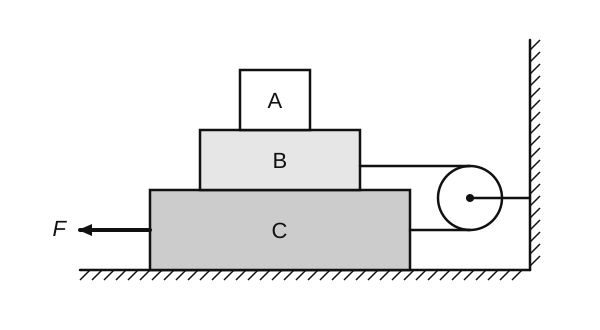
In the given figure the blocks $A, B$ and $C$ weigh $4\ \text{kg}, 6\ \text{kg}$ and 8 kg respectively. The co-efficient of sliding friction between any two surfaces is 0.5 . The force $\vec F$ required to slide the block $C$ with constant speed is ______ N . (Use $g = 10\ \text{m/s}^2$ )
Concept. Constant speed: forces balance on each block. B and C are tied over the pulley, so they move oppositely at the same speed; following the key, sliding friction acts at every contact (A stays at rest).
Q 11-04-065JEE MainJEE Main 2025 (23 Jan, Shift 2)Easy
A massless spring gets elongated by amount $x_1$ under a tension of $5\ \text{N}$. Its elongation is $x_2$ under the tension of $7\ \text{N}$. For the elongation of $(5x_1 - 2x_2)$, the tension in the spring will be
Q 11-04-066JEE MainJEE Main 2025 (24 Jan, Shift 1)Medium
A car of mass $m$ moves on a banked road having radius $r$ and banking angle $\theta$. To avoid slipping from the banked road, the maximum permissible speed of the car is $v_0$. The coefficient of friction $\mu$ between the wheels of the car and the banked road is
Concept. At the maximum speed on a banked road, friction acts down the slope. Resolving: $N\cos\theta-f\sin\theta=mg$ and $N\sin\theta+f\cos\theta=\dfrac{mv_0^2}{r}$ with $f=\mu N$, giving $v_0^2=rg\dfrac{\tan\theta+\mu}{1-\mu\tan\theta}$.
Step 1. Rearrange for $\mu$. $$v_0^2-\mu v_0^2\tan\theta=rg\tan\theta+\mu rg\ \Rightarrow\ \mu(rg+v_0^2\tan\theta)=v_0^2-rg\tan\theta$$
Q 11-04-067JEE MainJEE Main 2025 (24 Jan, Shift 2)Medium
A string of length $L$ is fixed at one end and carries a mass $M$ at the other end. The mass makes $\left(\dfrac{3}{\pi}\right)$ rotations per second about the vertical axis passing through the end of the string as shown. The tension in the string is ______ $ML$.
Concept. This is a conical pendulum: the mass moves in a horizontal circle while the string sweeps a cone. The horizontal part of the tension supplies the centripetal force. The circle's radius is $L\sin\theta$, not $L$.
Step 1. Forces on $M$. Tension $T$ along the string (at $\theta$ to the vertical) and weight $Mg$. Radius of the circle $R=L\sin\theta$.
Step 2. Horizontal (towards the axis). $$T\sin\theta=M\omega^2R=M\omega^2L\sin\theta\ \Rightarrow\ T=M\omega^2L$$ The angle cancels, so we do not need it.
Answer. $36$. The vertical equation $T\cos\theta=Mg$ would give $\theta$, but it is not needed here.
Solution by Sreeraj P, M.Sc Physics
Q 11-04-068JEE MainJEE Main 2025 (28 Jan, Shift 2)Medium
A balloon and its content having mass $M$ is moving up with an acceleration $a$. The mass that must be released from the content so that the balloon starts moving up with an acceleration $3a$ will be (Take $g$ as acceleration due to gravity)
Concept. Two forces act on the balloon system: the upthrust $U$ of the air (it depends only on the balloon's volume, so it does not change when ballast is dropped) and the weight. Write Newton's second law before and after releasing mass, then eliminate $U$.
Step 1. Before release. Mass $M$, acceleration $a$ upward: $$U-Mg=Ma\ \Rightarrow\ U=M(g+a)$$
Step 2. After releasing mass $m$. The remaining mass $M-m$ has acceleration $3a$ upward, with the same $U$: $$U-(M-m)g=(M-m)\,3a\ \Rightarrow\ U=(M-m)(g+3a)$$
Step 3. Equate the two expressions for $U$. $$M(g+a)=(M-m)(g+3a)$$ $$Mg+Ma=Mg+3Ma-m(g+3a)\ \Rightarrow\ m(g+3a)=2Ma$$ $$m=\frac{2Ma}{3a+g}$$
Answer. Option A. Check: if the new acceleration were still $a$, the formula $\dfrac{M(a'-a)}{g+a'}$ gives $m=0$, as it should.
Solution by Sreeraj P, M.Sc Physics
Q 11-04-069JEE MainJEE Main 2025 (29 Jan, Shift 2)Medium
A sand dropper drops sand of mass $m(t)$ on a conveyor belt at a rate proportional to the square root of the speed $(v)$ of the belt, i.e. $\dfrac{dm}{dt} \propto \sqrt v$. If $P$ is the power delivered to run the belt at constant speed, then which of the following relationships is true?
Concept. Sand lands on the belt with no horizontal velocity and must be brought up to the belt's speed $v$. The momentum given to the sand per second is $v\dfrac{dm}{dt}$, so this is the extra force the motor must supply to keep $v$ constant. The power is $P=Fv$.
Step 1. Force needed. $$F=\frac{d(mv)}{dt}=v\frac{dm}{dt}\quad(v\text{ constant})$$
Step 2. Use the given rate. $\dfrac{dm}{dt}\propto\sqrt v$, so $$F\propto v\cdot v^{1/2}=v^{3/2}$$
Step 4. Match the options. Squaring removes the fraction: $$P^2\propto v^5$$
Answer. Option C. Do not use $\tfrac12v^2\dfrac{dm}{dt}$ (the rate of gain of kinetic energy) for the power: the other half of $P$ is lost as heat while the sand slips on the belt.
Solution by Sreeraj P, M.Sc Physics
Q 11-04-070JEE MainJEE Main 2024 (1 Feb, Shift 1)Easy
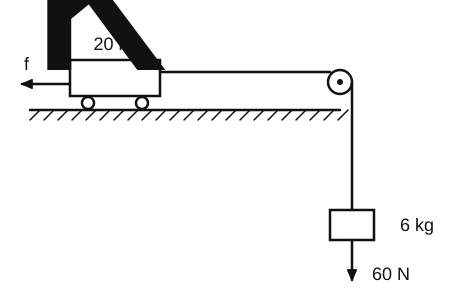
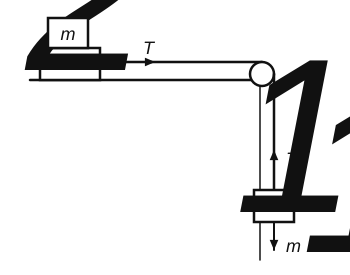
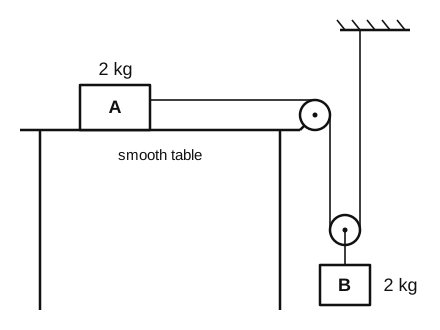
Consider the block and trolley system shown in the figure. If the coefficient of kinetic friction between the trolley and the surface is $0.04$, the acceleration of the system in $\text{m s}^{-2}$ is (the string is massless and inextensible and the pulley is massless and frictionless; take $g = 10\ \text{m s}^{-2}$)
Q 11-04-071JEE MainJEE Main 2024 (1 Feb, Shift 1)Easy
A ball of mass $0.5\ \text{kg}$ is attached to a string of length $50\ \text{cm}$. The ball is rotated on a horizontal circular path about its vertical axis. The maximum tension that the string can bear is $400\ \text{N}$. The maximum possible value of the angular velocity of the ball in $\text{rad s}^{-1}$ is
Concept. Ignoring gravity, the string tension supplies the centripetal force: $T=m\omega^2L$. The largest $\omega$ uses the breaking tension.
Step 1. Solve. $400=0.5\times\omega^2\times0.5\Rightarrow\omega^2=1600\Rightarrow\omega=40$ rad s$^{-1}$.
Answer. $40$ (Option B).
Solution by Sreeraj P, M.Sc Physics
Q 11-04-072JEE MainJEE Main 2024 (1 Feb, Shift 2)Easy
A cricket player catches a ball of mass $120\ \text{g}$ moving with a speed of $25\ \text{m s}^{-1}$. If the catching process is completed in $0.1\ \text{s}$, then the magnitude of the force exerted by the ball on the hand of the player will be (in SI units)
Concept. Impulse $=$ change of momentum; average force $=\dfrac{\Delta p}{\Delta t}$. The ball is brought to rest.
Step 1. Change of momentum. $\Delta p=0.12\times25=3$ kg m s$^{-1}$.
Step 2. Force. $F=\dfrac{3}{0.1}=30$ N.
Answer. $30$ (Option D).
Solution by Sreeraj P, M.Sc Physics
Q 11-04-073JEE MainJEE Main 2024 (1 Feb, Shift 2)Easy
A body of mass $4\ \text{kg}$ experiences two forces $\vec F_1 = 5\hat i + 8\hat j + 7\hat k$ and $\vec F_2 = 3\hat i - 4\hat j - 3\hat k$. The acceleration acting on the body is
Q 11-04-074JEE MainJEE Main 2024 (4 Apr, Shift 1)Medium
A wooden block, initially at rest on the ground, is pushed by a force which increases linearly with time $t$. Which of the following curves best describes the acceleration of the block with time?
Step 1. Shape. $a \propto t$: a straight line through the origin, graph (D).
Answer. Graph (D) (Option D).
Solution by Sreeraj P, M.Sc Physics
Q 11-04-075JEE MainJEE Main 2024 (4 Apr, Shift 2)Easy
A $2\ \text{kg}$ brick begins to slide over a surface which is inclined at an angle of $45^\circ$ with respect to the horizontal axis. The coefficient of static friction between their surfaces is
Concept. A block on an incline just starts to slide when $\tan\theta=\mu_s$ (angle of repose).
Step 1. Apply. $\mu_s=\tan45^\circ=1$. The mass does not matter.
Answer. $1$ (Option D).
Solution by Sreeraj P, M.Sc Physics
Q 11-04-076JEE MainJEE Main 2024 (5 Apr, Shift 1)Easy
A wooden block of mass $5\ \text{kg}$ rests on a soft horizontal floor. When an iron cylinder of mass $25\ \text{kg}$ is placed on top of the block, the floor yields and the block and the cylinder together go down with an acceleration of $0.1\ \text{m s}^{-2}$. The action force of the system on the floor is equal to (take $g = 9.8\ \text{m s}^{-2}$)
Concept. The block and the cylinder accelerate downward together. For the system, $Mg-N=Ma$, so the floor pushes up with $N=M(g-a)$; by the third law the system pushes the floor with the same force.
Q 11-04-077JEE MainJEE Main 2024 (5 Apr, Shift 1)Easy
Three blocks $M_1$, $M_2$, $M_3$ having masses $4\ \text{kg}$, $6\ \text{kg}$ and $10\ \text{kg}$ respectively are hanging from a smooth pulley using ropes 1, 2 and 3 as shown in the figure. The tension in rope 1, $T_1$, when they are moving upward with an acceleration of $2\ \text{m s}^{-2}$ is ______ N (take $g = 10\ \text{m/s}^2$).
Concept. Rope 1 holds all three blocks, which accelerate upward together. For that whole hanging group, $T_1-(\text{total mass})g=(\text{total mass})a$.
Step 1. Total mass below rope 1. $4+6+10=20$ kg.
Step 2. Tension. $T_1=20(g+a)=20(10+2)=240$ N.
Answer. $240$.
Solution by Sreeraj P, M.Sc Physics
Q 11-04-078JEE MainJEE Main 2024 (5 Apr, Shift 2)Medium
A particle moves in the $x$-$y$ plane under the influence of a force $\vec F$ such that its linear momentum is $\vec p(t) = \hat i\cos(kt) - \hat j\sin(kt)$. If $k$ is constant, the angle between $\vec F$ and $\vec p$ will be
Concept. $\vec F=\dfrac{d\vec p}{dt}$. When $|\vec p|$ is constant and only its direction turns, $\vec F$ is perpendicular to $\vec p$ (like circular motion).
Q 11-04-079JEE MainJEE Main 2024 (5 Apr, Shift 2)Easy
A heavy box of mass $50\ \text{kg}$ is moving on a horizontal surface. If the coefficient of kinetic friction between the box and the horizontal surface is $0.3$, then the force of kinetic friction is (take $g = 9.8\ \text{m s}^{-2}$)
Q 11-04-080JEE MainJEE Main 2024 (6 Apr, Shift 1)Medium
A light string passing over a smooth light pulley connects two blocks of masses $m_1$ and $m_2$ (where $m_2 > m_1$). If the acceleration of the system is $\dfrac{g}{\sqrt2}$, then the ratio of the masses $\dfrac{m_1}{m_2}$ is
Step 1. Set $a=g/\sqrt2$. $$\frac{m_2-m_1}{m_2+m_1}=\frac1{\sqrt2}$$
Step 2. Solve for $m_1/m_2=r$. $$\frac{1-r}{1+r}=\frac1{\sqrt2}\ \Rightarrow\ \sqrt2-\sqrt2r=1+r\ \Rightarrow\ r=\frac{\sqrt2-1}{\sqrt2+1}$$
Answer. Option B.
Solution by Sreeraj P, M.Sc Physics
Q 11-04-081JEE MainJEE Main 2024 (6 Apr, Shift 2)Easy
A body of weight $200\ \text{N}$ is suspended from a tree branch through a chain of mass $10\ \text{kg}$. The branch pulls the chain with a force equal to (take $g = 10\ \text{m/s}^2$)
Concept. The branch holds up everything below it: the chain and the body. For a heavy chain, the tension at the top equals the total weight hanging below that point.
Step 1. Weights. Body $200$ N; chain $10\times10=100$ N.
Step 2. Force from the branch. $200+100=300$ N.
Answer. $300$ N (Option C).
Solution by Sreeraj P, M.Sc Physics
Q 11-04-082JEE MainJEE Main 2024 (6 Apr, Shift 2)Medium
A car of $800\ \text{kg}$ is taking a turn on a banked road of radius $300\ \text{m}$ and angle of banking $30^\circ$. If the coefficient of static friction is $0.2$, then the maximum speed with which the car can negotiate the turn safely is ($g = 10\ \text{m/s}^2$, $\sqrt3 = 1.73$)
Concept. At the maximum safe speed the car tends to slide outward, so static friction acts down the slope at its limit $\mu N$. The normal force and friction together must give zero vertical force and the centripetal force horizontally.
Step 1. Forces on the car. Weight $mg$ down; normal $N$ perpendicular to the road; friction $\mu N$ down the slope.
Step 3. Horizontal (towards the centre). $$N\sin\theta+\mu N\cos\theta=\frac{mv^2}{r}$$
Step 4. Divide to remove $N$ and $m$. $$\frac{v^2}{rg}=\frac{\sin\theta+\mu\cos\theta}{\cos\theta-\mu\sin\theta}=\frac{\tan\theta+\mu}{1-\mu\tan\theta}$$
Answer. $51.4$ m/s, option B. The car's mass ($800$ kg) cancels. For $v_{\min}$, friction acts up the slope: change the signs of $\mu$.
Solution by Sreeraj P, M.Sc Physics
Q 11-04-083JEE MainJEE Main 2024 (27 Jan, Shift 1)Medium
A train is moving with a speed of $12\ \text{m s}^{-1}$ on rails which are $1.5\ \text{m}$ apart. To negotiate a curve of radius $400\ \text{m}$, the height by which the outer rail should be raised with respect to the inner rail is (Given, $g = 10\ \text{m s}^{-2}$):
Concept. The outer rail is raised so that the normal force from the track, tilted inward, supplies the centripetal force by itself (no sideways push on the wheel flanges). This gives $\tan\theta=\dfrac{v^2}{rg}$. For a small angle, the height difference between rails is $h=l\sin\theta\approx l\tan\theta$.
Step 1. Banking angle. Isolate the train: $N\cos\theta=mg$ vertically and $N\sin\theta=\dfrac{mv^2}{r}$ horizontally. Dividing, $$\tan\theta=\frac{v^2}{rg}=\frac{12^2}{400\times10}=\frac{144}{4000}=0.036$$
Step 2. Height of the outer rail. The rails are $l=1.5$ m apart along the tilted track, and $\theta$ is small: $$h=l\sin\theta\approx l\tan\theta=1.5\times0.036=0.054\ \text{m}$$
Answer. $5.4$ cm, option B.
Solution by Sreeraj P, M.Sc Physics
Q 11-04-084JEE MainJEE Main 2024 (27 Jan, Shift 1)Easy
A body of mass $1000\ \text{kg}$ is moving horizontally with a velocity $6\ \text{m s}^{-1}$. If $200\ \text{kg}$ extra mass is added, the final velocity (in $\text{m s}^{-1}$) is:
Answer: (B) Statement I is incorrect but Statement II is correct
Concept. The laws of friction: limiting static friction $\mu_sN$ and kinetic friction $\mu_kN$ are both independent of the area of contact (for the same normal force) and depend on the materials and condition of the surfaces.
Step 1. Statement I. It says static friction depends on area and not on materials: both parts wrong. Incorrect.
Step 2. Statement II. Independent of area, depends on materials: correct.
Answer. Statement I is incorrect but Statement II is correct (Option B).
Solution by Sreeraj P, M.Sc Physics
Q 11-04-086JEE MainJEE Main 2024 (29 Jan, Shift 1)Easy
If the radius of curvature of the path of two particles of same mass are in the ratio $3:4$, then in order to have constant centripetal force, their velocities will be in the ratio of:
Q 11-04-087JEE MainJEE Main 2024 (29 Jan, Shift 2)Medium
A stone of mass $900\ \text{g}$ is tied to a string and moved in a vertical circle of radius $1\ \text{m}$ making $10\ \text{rpm}$. The tension in the string, when the stone is at the lowest point, is (if $\pi^2 = 9.8$ and $g = 9.8\ \text{m s}^{-2}$):
Concept. At the lowest point of a vertical circle the tension must hold the weight and also supply the centripetal force: $T=mg+m\omega^2r$.
Step 1. Angular speed. $10$ rpm: $\omega=\dfrac{2\pi\times10}{60}=\dfrac\pi3$ rad s$^{-1}$.
Step 2. Centripetal force. $m\omega^2r=0.9\times\dfrac{\pi^2}{9}\times1=0.1\pi^2=0.98$ N.
Step 3. Tension. $T=0.9\times9.8+0.98=8.82+0.98=9.8$ N.
Answer. $9.8$ N (Option B).
Solution by Sreeraj P, M.Sc Physics
Q 11-04-088JEE MainJEE Main 2024 (8 Apr, Shift 1)Easy
A player caught a cricket ball of mass $150\ \text{g}$ moving at a speed of $20\ \text{m/s}$. If the catching process is completed in $0.1\ \text{s}$, the magnitude of force exerted by the ball on the hand of the player is:
Concept. Average force $=\dfrac{\text{change of momentum}}{\text{time}}$.
Step 1. Change of momentum. $0.15\times20=3$ kg m s$^{-1}$ (the ball stops).
Step 2. Force. $\dfrac{3}{0.1}=30$ N.
Answer. $30$ N (Option D).
Solution by Sreeraj P, M.Sc Physics
Q 11-04-089JEE MainJEE Main 2024 (8 Apr, Shift 2)Medium
A given object takes $n$ times the time to slide down a $45^\circ$ rough inclined plane as it takes to slide down an identical perfectly smooth $45^\circ$ inclined plane. The coefficient of kinetic friction between the object and the surface of the inclined plane is:
Q 11-04-090JEE MainJEE Main 2024 (9 Apr, Shift 1)Easy
A light unstretchable string passing over a smooth light pulley connects two blocks of masses $m_1$ and $m_2$. If the acceleration of the system is $\dfrac g8$, then the ratio of the masses $\dfrac{m_2}{m_1}$ is:
Q 11-04-091JEE MainJEE Main 2024 (9 Apr, Shift 2)Easy
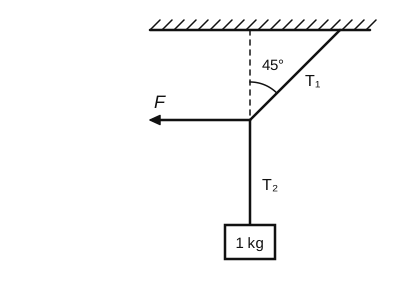
A $1\ \text{kg}$ mass is suspended from the ceiling by a rope of length $4\ \text{m}$. A horizontal force $F$ is applied at the mid point of the rope so that the rope makes an angle of $45^\circ$ with respect to the vertical axis as shown in the figure. The magnitude of $F$ is: (Assume that the system is in equilibrium and $g = 10\ \text{m/s}^2$)
Concept. The lower half of the rope is vertical, so its tension is the weight. At the midpoint, three forces balance: the upper tension at $45^\circ$, the horizontal $F$ and the lower tension.
Step 1. Lower tension. $T_2=mg=10$ N.
Step 2. Balance at the midpoint. $T_1\cos45^\circ=T_2=10$ N and $T_1\sin45^\circ=F$.
Step 3. Divide. $F=T_2\tan45^\circ=10$ N.
Answer. $10$ N (Option A). The rope length does not matter.
Solution by Sreeraj P, M.Sc Physics
Q 11-04-092JEE MainJEE Main 2024 (30 Jan, Shift 1)Medium
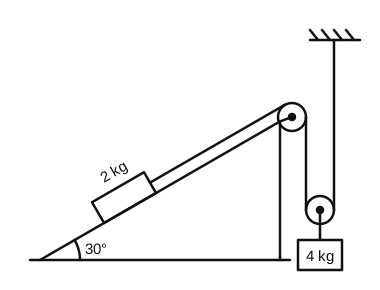
All surfaces shown in the figure are assumed to be frictionless and the pulleys and the string are light. The acceleration of the block of mass $2\ \text{kg}$ is:
Concept. The $2$ kg block on the smooth incline is pulled by the string; the other end goes over a fixed pulley and down to a movable pulley carrying the $4$ kg block, with the string's far end fixed to the ceiling. So the $4$ kg block is held by $2T$ and moves half as fast as the $2$ kg block.
Step 1. Constraint. If the $2$ kg block moves up the incline with acceleration $a$, the string feeds that length onto the two segments of the movable pulley, so the $4$ kg block descends with $a/2$.
Step 2. Isolate the $2$ kg block. Forces along the incline: $T$ up the incline, $2g\sin30^\circ=g$ down the incline ($N$ is perpendicular, and there is no friction). $$T-2g\sin30^\circ=2a\ \Rightarrow\ T=g+2a\qquad(1)$$
Step 3. Isolate the $4$ kg block with its pulley. Forces: $4g$ down, $2T$ up. Down positive: $$4g-2T=4\cdot\frac a2=2a\qquad(2)$$
Step 4. Solve. Put (1) into (2): $$4g-2g-4a=2a\ \Rightarrow\ 2g=6a\ \Rightarrow\ a=\frac g3$$
Answer. $\dfrac g3$, option B. This is the acceleration of the $2$ kg block; the $4$ kg block has $\dfrac g6$.
Solution by Sreeraj P, M.Sc Physics
Q 11-04-093JEE MainJEE Main 2024 (30 Jan, Shift 1)Medium
A spherical body of mass $100\ \text{g}$ is dropped from a height of $10\ \text{m}$ from the ground. After hitting the ground, the body rebounds to a height of $5\ \text{m}$. The impulse of force imparted by the ground to the body is given by: (given $g = 9.8\ \text{m s}^{-2}$)
Concept. Impulse equals the change in momentum, $\vec J=\Delta\vec p$. The body arrives moving down and leaves moving up, so the two momenta are in opposite directions and their magnitudes add.
Step 1. Speed just before hitting the ground. Free fall from $h_1=10$ m: $$v_1=\sqrt{2gh_1}=\sqrt{2\times9.8\times10}=\sqrt{196}=14\ \text{m s}^{-1}\ (\text{down})$$
Step 2. Speed just after the bounce. It rises to $h_2=5$ m, so $$v_2=\sqrt{2gh_2}=\sqrt{98}\approx9.9\ \text{m s}^{-1}\ (\text{up})$$
Step 3. Change in momentum. Take upward as positive: $p_i=-mv_1$, $p_f=+mv_2$. $$J=p_f-p_i=m(v_2+v_1)=0.1\times(9.9+14)=0.1\times23.9\approx2.39\ \text{kg m s}^{-1}$$
Answer. $2.39$ kg m s$^{-1}$, upward, option D. Subtracting the speeds ($0.41$) is the usual mistake: momentum is a vector.
Solution by Sreeraj P, M.Sc Physics
Q 11-04-094JEE MainJEE Main 2024 (30 Jan, Shift 2)Easy
Three blocks $A$ ($5\ \text{kg}$), $B$ ($3\ \text{kg}$) and $C$ ($2\ \text{kg}$) lie in a line on a horizontal smooth surface. $A$ is tied to $B$ by a string with tension $T_1$ and $B$ is tied to $C$ by a string with tension $T_2$. Block $C$ is pulled by a force $F = 80\ \text{N}$ directed away from the others. The tensions $T_1$ and $T_2$ in the strings are respectively:
Concept. The strings are taut, so all three blocks share one acceleration. Find it from the whole system, then isolate pieces: a string's tension is the only horizontal force on the blocks behind it, so it equals their total mass times $a$.
Step 1. Common acceleration. The surface is smooth, and the only external horizontal force is $F=80$ N: $$a=\frac{F}{m_A+m_B+m_C}=\frac{80}{5+3+2}=8\ \text{m s}^{-2}$$
Step 2. Tension $T_1$ (between $A$ and $B$). Isolate $A$. The only horizontal force on it is $T_1$: $$T_1=m_Aa=5\times8=40\ \text{N}$$
Step 3. Tension $T_2$ (between $B$ and $C$). Isolate $A$ and $B$ together. The only external horizontal force on them is $T_2$: $$T_2=(m_A+m_B)a=8\times8=64\ \text{N}$$
Step 4. Check with $C$. $F-T_2=m_Ca$: $80-64=16=2\times8$. Correct.
Answer. $40$ N and $64$ N, option A. Tension grows towards the pulling end, since each string drags more mass.
Solution by Sreeraj P, M.Sc Physics
Q 11-04-095JEE MainJEE Main 2024 (30 Jan, Shift 2)Medium
A block of mass $m$ is placed on a surface having vertical cross section given by $y = \dfrac{x^2}{4}$. If the coefficient of friction is $0.5$, the maximum height above the ground at which the block can be placed without slipping is:
Concept. On a rough curved surface a block can rest where the slope is not steeper than the angle of repose: $\tan\theta=\dfrac{dy}{dx}\le\mu$.
Step 1. Slope. $\dfrac{dy}{dx}=\dfrac x2$.
Step 2. Limit. $\dfrac x2=0.5\Rightarrow x=1$ m.
Step 3. Height. $y=\dfrac{1}{4}$ m.
Answer. $\dfrac14$ m (Option A).
Solution by Sreeraj P, M.Sc Physics
Q 11-04-096JEE MainJEE Main 2024 (31 Jan, Shift 1)Medium
In an arrangement of a doubly inclined plane, block $M$ is placed on the face inclined at $53^\circ$ and block $m$ on the face inclined at $37^\circ$. The blocks are connected by a light string passing over an ideal pulley at the top. The coefficient of friction between the surface of the plane and the blocks is $0.25$. The value of $m$ for which $M = 10\ \text{kg}$ will move down with an acceleration of $2\ \text{m s}^{-2}$ is: (take $g = 10\ \text{m s}^{-2}$ and $\tan37^\circ = \frac34$)
Concept. $M$ moves down its face and $m$ moves up its face, joined by one string over an ideal pulley (same tension, same acceleration $a$). Kinetic friction on each block acts opposite to its own motion. Isolate each block, resolve along its face, and apply Newton's law.
Step 2. Isolate $M=10$ kg (on the $53^\circ$ face, moving down). Along the face: $Mg\sin53^\circ=80$ N down, friction $\mu Mg\cos53^\circ=0.25\times60=15$ N up, tension $T$ up. $$80-15-T=10\times2\ \Rightarrow\ T=45\ \text{N}$$
Step 3. Isolate $m$ (on the $37^\circ$ face, moving up). Along the face: $T$ up; $mg\sin37^\circ=6m$ down; friction $\mu mg\cos37^\circ=0.25\times8m=2m$ down. $$T-6m-2m=m\times2\ \Rightarrow\ 45=10m$$
Step 4. Solve. $$m=4.5\ \text{kg}$$
Answer. $4.5$ kg, option B. Always fix the direction of motion first; it decides which way each friction force points.
Solution by Sreeraj P, M.Sc Physics
Q 11-04-097JEE MainJEE Main 2024 (31 Jan, Shift 1)Easy
A coin is placed on a disc. The coefficient of friction between the coin and the disc is $\mu$. If the distance of the coin from the centre of the disc is $r$, the maximum angular velocity which can be given to the disc so that the coin does not slip away is:
Concept. Static friction supplies the centripetal force, up to $\mu mg$: $m\omega^2r\le\mu mg$.
Step 1. Largest $\omega$. $\omega=\sqrt{\dfrac{\mu g}{r}}$.
Answer. Option C.
Solution by Sreeraj P, M.Sc Physics
Q 11-04-098JEE MainJEE Main 2024 (31 Jan, Shift 2)Easy
A light string passing over a smooth light fixed pulley connects two blocks of masses $m_1$ and $m_2$ hanging vertically. If the acceleration of the system is $\dfrac g8$, then the ratio of the masses $\dfrac{m_1}{m_2}$ ($m_1 > m_2$) is
Concept. In an Atwood machine the heavier mass $m_1$ goes down and $m_2$ goes up with the same acceleration (one light string). Write Newton's law for each mass and add to eliminate the tension.
Step 1. Equations of motion. $$m_1:\ m_1g-T=m_1a,\qquad m_2:\ T-m_2g=m_2a$$
Step 3. Use $a=g/8$. $$\frac{m_1-m_2}{m_1+m_2}=\frac18\ \Rightarrow\ 8m_1-8m_2=m_1+m_2\ \Rightarrow\ 7m_1=9m_2$$
Answer. $\dfrac{m_1}{m_2}=\dfrac97$, option A. General result: $a=g/n$ gives $\dfrac{m_1}{m_2}=\dfrac{n+1}{n-1}$.
Solution by Sreeraj P, M.Sc Physics
Q 11-04-099JEE MainJEE Main 2024 (31 Jan, Shift 2)Medium
A block of mass $5\ \text{kg}$ is placed on a rough plane inclined at $30^\circ$ to the horizontal, with coefficient of friction $\mu = 0.1$. If $\vec F_1$ is the force (parallel to the incline) required to just move the block up the inclined plane and $\vec F_2$ is the force required to just prevent the block from sliding down, then the value of $|\vec F_1| - |\vec F_2|$ is: [Use $g = 10\ \text{m s}^{-2}$]
Q 11-04-100JEE MainJEE Main 2023 (29 Jan, Shift 1)Easy
A car is moving on a horizontal curved road with radius $50\ \text{m}$. The approximate maximum speed of car will be, if friction between tyres and road is $0.34$. [Take $g=10\ \text{m s}^{-2}$]
Concept. On a level curve, friction supplies the centripetal force: $\dfrac{mv^2}{r}\le\mu mg$, so $v_{\max}=\sqrt{\mu rg}$.
Step 1. Substitute. $v_{\max}=\sqrt{0.34\times50\times10}=\sqrt{170}\approx13$ m s$^{-1}$.
Answer. $13\ \text{m s}^{-1}$ (Option C).
Solution by Sreeraj P, M.Sc Physics
Q 11-04-101JEE MainJEE Main 2023 (29 Jan, Shift 1)Easy
A block of mass $m$ slides down the plane inclined at angle $30^\circ$ with an acceleration $\dfrac{g}{4}$. The value of coefficient of kinetic friction will be
Q 11-04-102JEE MainJEE Main 2023 (29 Jan, Shift 2)Medium
The time taken by an object to slide down $45^\circ$ rough inclined plane is $n$ times as it takes to slide down a perfectly smooth $45^\circ$ incline plane. The coefficient of kinetic friction between the object and the incline plane is
Concept. On an incline of the same length, starting from rest, $s=\tfrac12at^2$ gives $t\propto\dfrac1{\sqrt a}$. Friction reduces the acceleration down the slope from $g\sin\theta$ to $g(\sin\theta-\mu\cos\theta)$, so comparing times compares accelerations.
Step 1. The two accelerations. Isolate the object; forces along the slope are $mg\sin\theta$ down and (on the rough plane) $\mu mg\cos\theta$ up. $$a_{\text{smooth}}=g\sin45^\circ,\qquad a_{\text{rough}}=g\sin45^\circ-\mu g\cos45^\circ$$
Step 2. Relate times. $t_{\text{rough}}=n\,t_{\text{smooth}}$ and $t\propto a^{-1/2}$, so $$\frac{a_{\text{smooth}}}{a_{\text{rough}}}=n^2$$
Answer. Option D. For a general angle the result is $\mu=\tan\theta\left(1-\dfrac1{n^2}\right)$.
Solution by Sreeraj P, M.Sc Physics
Q 11-04-103JEE MainJEE Main 2023 (29 Jan, Shift 2)Easy
Force acts for $20\ \text{s}$ on a body of mass $20\ \text{kg}$, starting from rest, after which the force ceases and then body describes $50\ \text{m}$ in the next $10\ \text{s}$. The value of force will be
Concept. After the force stops, the body moves at the constant speed it reached. That speed comes from the second stage; then the first stage gives $a$ and $F=ma$.
Step 1. Speed at removal. $50$ m in $10$ s at constant speed: $v=5$ m/s.
Step 2. Acceleration while the force acted. From rest to $5$ m/s in $20$ s: $a=0.25$ m s$^{-2}$.
Step 3. Force. $F=20\times0.25=5$ N.
Answer. $5$ N (Option B).
Solution by Sreeraj P, M.Sc Physics
Q 11-04-104JEE MainJEE Main 2023 (30 Jan, Shift 1)Medium
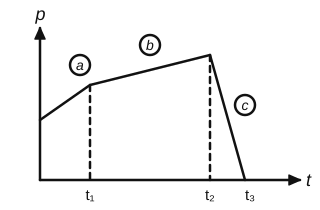
The figure represents the momentum–time ($p$–$t$) curve for a particle moving along an axis under the influence of the force. Identify the regions on the graph where the magnitude of the force is maximum and minimum respectively. (Given $t_3-t_2<t_1$)
Concept. Newton's second law in its original form is $F=\dfrac{dp}{dt}$. On a $p$–$t$ graph this is the slope, so the steepest region has the largest force and the flattest region the smallest.
Step 1. Read the regions. In the figure, region a (from $0$ to $t_1$) has $p$ rising moderately; region b (from $t_1$ to $t_2$) has $p$ rising only slightly over a long time; region c (from $t_2$ to $t_3$) has $p$ falling all the way to zero.
Step 2. Compare slopes.
Region c: the largest change in momentum (from its peak to zero) over the shortest time, since $t_3-t_2<t_1$. Steepest slope.
Region a: a smaller change over a time $t_1$. Moderate slope.
Region b: the smallest rise over the longest interval. Flattest slope.
Step 3. Convert to force. $|F|=\left|\dfrac{\Delta p}{\Delta t}\right|$ is largest in c and smallest in b. The sign of the slope only gives the direction of the force; the question asks for magnitude.
Answer. Maximum in c, minimum in b: option C.
Solution by Sreeraj P, M.Sc Physics
Q 11-04-105JEE MainJEE Main 2023 (30 Jan, Shift 2)Easy
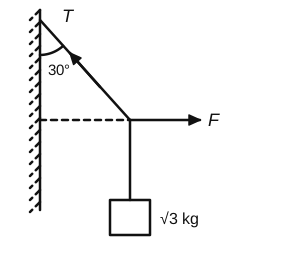
A block of $\sqrt3\ \text{kg}$ is attached to a string whose other end is attached to the wall. An unknown force $F$ is applied so that the string makes an angle of $30^\circ$ with the wall. The tension $T$ is (Given $g=10\ \text{m s}^{-2}$)
Concept. Vertical balance at the junction: $T\cos30° = mg$.
Step 1. Solve. $T = \dfrac{10\sqrt3}{\sqrt3/2} = 20$ N.
Answer. $20\ \text{N}$ (Option A).
Solution by Sreeraj P, M.Sc Physics
Q 11-04-106JEE MainJEE Main 2023 (30 Jan, Shift 2)Easy
A machine gun of mass $10\ \text{kg}$ fires $20\ \text{g}$ bullets at the rate of $180$ bullets per minute with a speed of $100\ \text{m s}^{-1}$ each. The recoil velocity of the gun is
Concept. Momentum given to bullets per second equals the gun's recoil momentum per second.
Step 1. Momentum per second. $3 \times 0.02 \times 100 = 6$ kg m/s.
Step 2. Recoil. $\dfrac{6}{10} = 0.6$ m/s.
Answer. $0.6\ \text{m s}^{-1}$ (Option D).
Solution by Sreeraj P, M.Sc Physics
Q 11-04-107JEE MainJEE Main 2023 (31 Jan, Shift 1)Easy
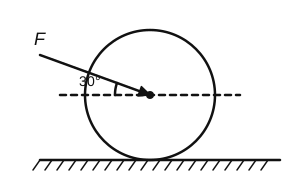
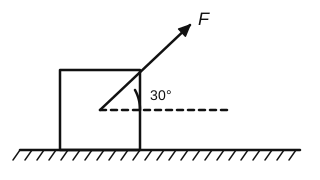
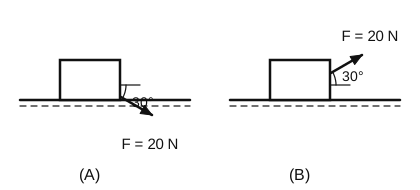
As shown in figure, a $70\ \text{kg}$ garden roller is pushed with a force of $F=200\ \text{N}$ at an angle of $30^\circ$ with horizontal. The normal reaction on the roller is (Given $g=10\ \text{m s}^{-2}$)
Concept. A push directed downward at an angle has a vertical component that presses the roller into the ground, so the normal reaction is more than the weight: $N=mg+F\sin\theta$.
Step 1. Vertical balance. $N=mg+F\sin30^\circ=700+200\times\tfrac12=800$ N.
Answer. $800$ N (Option C). (A pull at the same angle would give $700-100=600$ N.)
Solution by Sreeraj P, M.Sc Physics
Q 11-04-108JEE MainJEE Main 2023 (31 Jan, Shift 1)Easy
$100$ balls each of mass $m$ moving with speed $v$ simultaneously strike a wall normally and are reflected back with same speed, in time $t$ s. The total force exerted by the balls on the wall is
Q 11-04-109JEE MainJEE Main 2023 (31 Jan, Shift 2)Easy
A stone of mass $1\ \text{kg}$ is tied to end of a massless string of length $1\ \text{m}$. If the breaking tension of the string is $400\ \text{N}$, then maximum linear velocity, the stone can have without breaking the string, while rotating in horizontal plane, is
Concept. $T=\dfrac{mv^2}{L}$ (gravity neglected in a horizontal whirl). Set $T$ equal to the breaking tension.
Step 1. Solve. $400=\dfrac{1\times v^2}{1}\Rightarrow v=20$ m s$^{-1}$.
Answer. $20$ m s$^{-1}$ (Option A).
Solution by Sreeraj P, M.Sc Physics
Q 11-04-110JEE MainJEE Main 2023 (31 Jan, Shift 2)Easy
A body of mass $10\ \text{kg}$ is moving with an initial speed of $20\ \text{m s}^{-1}$. The body stops after $5\ \text{s}$ due to friction between body and the floor. The value of the coefficient of friction is (Take $g=10\ \text{m s}^{-2}$)
Concept. On a level floor kinetic friction gives a retardation $\mu g$.
Step 1. Retardation. $a=\dfrac{20}{5}=4$ m s$^{-2}$.
Step 2. Coefficient. $\mu=\dfrac ag=0.4$.
Answer. $0.4$ (Option D).
Solution by Sreeraj P, M.Sc Physics
Q 11-04-111JEE MainJEE Main 2023 (24 Jan, Shift 1)Medium
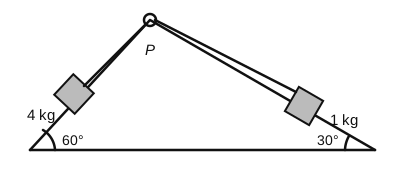
As per given figure, a weightless pulley $P$ is attached on a double inclined frictionless surface. The tension in the string (massless) will be (if $g=10\ \text{m s}^{-2}$)
Concept. Blocks on the two smooth faces of a double incline, joined over the top: the pull along each face is $mg\sin\theta$. The heavier pull wins; use the whole system for $a$, then one block for $T$.
Step 1. Pulls along the faces. $4\text{ kg at }60^\circ$: $40\times\tfrac{\sqrt3}{2}=20\sqrt3$ N; $1\text{ kg at }30^\circ$: $10\times\tfrac12=5$ N.
Step 2. Acceleration. $a=\dfrac{20\sqrt3-5}{5}=4\sqrt3-1$ m s$^{-2}$.
Step 3. Tension (1 kg block moving up its face). $$T-5=1\times a\ \Rightarrow\ T=5+4\sqrt3-1=4(\sqrt3+1)\ \text{N}$$
Answer. Option B.
Solution by Sreeraj P, M.Sc Physics
Q 11-04-112JEE MainJEE Main 2023 (24 Jan, Shift 1)Easy
Given below are two statements:
Statement I: An elevator can go up or down with uniform speed when its weight is balanced with the tension of its cable.
Statement II: Force exerted by the floor of an elevator on the foot of a person standing on it is more than his/her weight when the elevator goes down with increasing speed.
In the light of the above statements, choose the correct answer from the options given below:
Answer: (B) Statement I is true but Statement II is false
Concept. A lift's floor pushes on a person with $N=m(g+a)$, where $a$ is the lift's upward acceleration; only the acceleration matters, not the velocity.
Step 1. Statement I. Uniform speed means zero acceleration, so the cable tension equals the lift's weight. True.
Step 2. Statement II. Going down faster and faster means the acceleration is downward: $N=m(g-a)\lt mg$. The force is less than the weight, not more. False.
Answer. Statement I is true but Statement II is false (Option B).
Solution by Sreeraj P, M.Sc Physics
Q 11-04-113JEE MainJEE Main 2023 (24 Jan, Shift 2)Medium
A body of mass $200\ \text{g}$ is tied to a spring of spring constant $12.5\ \text{N m}^{-1}$, while the other end of spring is fixed at point $O$. If the body moves about $O$ in a circular path on a smooth horizontal surface with constant angular speed $5\ \text{rad s}^{-1}$, then the ratio of extension in the spring to its natural length will be
Q 11-04-114JEE MainJEE Main 2023 (25 Jan, Shift 1)Easy
A car is moving with a constant speed of $20\ \text{m s}^{-1}$ in a circular horizontal track of radius $40\ \text{m}$. A bob is suspended from the roof of the car by a massless string. The angle made by the string with the vertical will be (Take $g=10\ \text{m s}^{-2}$)
Concept. In the car's frame the bob feels gravity and an outward centrifugal force $\dfrac{mv^2}{r}$. The string lines up with their resultant: $\tan\theta=\dfrac{v^2}{rg}$.
Q 11-04-115JEE MainJEE Main 2023 (25 Jan, Shift 2)Medium
Consider a block kept on an inclined plane (inclined at $45^\circ$) as shown in the figure. If the force required to just push it up the incline is $2$ times the force required to just prevent it from sliding down, the coefficient of friction between the block and inclined plane ($\mu$) is equal to
Concept. Just pushing up: friction acts down the slope, $F_1=mg(\sin\theta+\mu\cos\theta)$. Just preventing sliding: friction acts up the slope, $F_2=mg(\sin\theta-\mu\cos\theta)$.
Step 1. Condition at $45^\circ$. $1+\mu=2(1-\mu)$.
Q 11-04-116JEE MainJEE Main 2023 (13 Apr, Shift 2)Easy
A vehicle of mass $200\ \text{kg}$ is moving along a levelled curved road of radius $70\ \text{m}$ with angular velocity of $0.2\ \text{rad s}^{-1}$. The centripetal force acting on the vehicle is
Step 1. Substitute. $F=200\times(0.2)^2\times70=200\times0.04\times70=560$ N.
Answer. $560$ N (Option A).
Solution by Sreeraj P, M.Sc Physics
Q 11-04-117JEE MainJEE Main 2023 (15 Apr, Shift 1)Easy
The position vector of a particle related to time $t$ is given by $\vec r=\left(10t\hat i+15t^2\hat j+7\hat k\right)$ m. The direction of net force experienced by the particle is
Concept. Force is along $\vec a = \dfrac{d^2\vec r}{dt^2}$.
Step 1. Differentiate. $\vec a = 30\hat j$: positive $y$-axis.
Answer. Positive $y$-axis (Option C).
Solution by Sreeraj P, M.Sc Physics
Q 11-04-118JEE MainJEE Main 2023 (11 Apr, Shift 1)Easy
A coin placed on a rotating table just slips when it is placed at a distance of $1\ \text{cm}$ from the centre. If the angular velocity of the table is halved, it will just slip when placed at a distance of ______ from the centre.
Concept. The coin moves in a circle with the table, and the centripetal force $m\omega^2r$ is supplied by static friction, which can be at most $\mu mg$. The coin just slips when the needed force equals the maximum friction.
Step 1. Slipping condition. Isolate the coin: $N=mg$ vertically, friction towards the centre horizontally. $$m\omega^2r=\mu mg\ \Rightarrow\ r=\frac{\mu g}{\omega^2}\propto\frac1{\omega^2}$$
Step 2. Halve $\omega$. $\mu$ and $g$ do not change, so $$\frac{r_2}{r_1}=\left(\frac{\omega_1}{\omega_2}\right)^2=2^2=4\ \Rightarrow\ r_2=4\times1=4\ \text{cm}$$
Answer. $4$ cm, option B. Halving $\omega$ cuts the needed force by four, so the coin can sit four times farther out.
Solution by Sreeraj P, M.Sc Physics
Q 11-04-119JEE MainJEE Main 2023 (11 Apr, Shift 1)Easy
An average force of $125\ \text{N}$ is applied on a machine gun firing bullets each of mass $10\ \text{g}$ at the speed of $250\ \text{m s}^{-1}$ to keep it in position. The number of bullets fired per second by the machine gun is
Concept. By Newton's second law the force on the bullets equals the momentum given to them per second. By the third law the bullets push back on the gun with the same force, and the person holding the gun must supply it.
Step 1. Momentum of one bullet. $$p=mv=0.01\times250=2.5\ \text{kg m s}^{-1}$$
Step 2. Momentum per second. If $n$ bullets are fired per second, the momentum given per second is $n\,mv$, so $$F=n\,mv$$
Step 3. Solve for $n$. $$n=\frac{F}{mv}=\frac{125}{2.5}=50\ \text{per second}$$
Answer. $50$, option A. Remember to convert $10$ g to $0.01$ kg; leaving it in grams gives $0.05$.
Solution by Sreeraj P, M.Sc Physics
Q 11-04-120JEE MainJEE Main 2023 (11 Apr, Shift 2)Medium
A body of mass $500\ \text{g}$ moves along $x$-axis such that its velocity varies with displacement $x$ according to the relation $v=10\sqrt x\ \text{m s}^{-1}$. The force acting on the body is
Concept. By Newton's second law $F=ma$. When the velocity is given as a function of position (not time), the acceleration is found from the chain rule $a=\dfrac{dv}{dt}=\dfrac{dv}{dx}\dfrac{dx}{dt}=v\dfrac{dv}{dx}$.
Step 1. Differentiate $v$ with respect to $x$. $$v=10\sqrt x\ \Rightarrow\ \frac{dv}{dx}=\frac{10}{2\sqrt x}=\frac{5}{\sqrt x}$$
Step 2. Acceleration. $$a=v\frac{dv}{dx}=10\sqrt x\cdot\frac{5}{\sqrt x}=50\ \text{m s}^{-2}$$ The $\sqrt x$ cancels, so the acceleration is constant.
Step 3. Force. With $m=500$ g $=0.5$ kg, $$F=ma=0.5\times50=25\ \text{N}$$
Answer. $25$ N, option B. Shortcut: $v=k\sqrt x$ is the same as $v^2=k^2x$, which is $v^2=2ax$ with $a=k^2/2$.
Solution by Sreeraj P, M.Sc Physics
Q 11-04-121JEE MainJEE Main 2023 (12 Apr, Shift 1)Easy
Three forces $F_1=10\ \text{N}$, $F_2=8\ \text{N}$, $F_3=6\ \text{N}$ are acting on a particle of mass $5\ \text{kg}$. The forces $F_2$ and $F_3$ are applied perpendicularly so that particle remains at rest. If the force $F_1$ is removed, then the acceleration of the particle is
Q 11-04-122JEE MainJEE Main 2023 (13 Apr, Shift 1)Easy
A bullet of $10\ \text{g}$ leaves the barrel of gun with a velocity of $600\ \text{m s}^{-1}$. If the barrel of gun is $50\ \text{cm}$ long and mass of gun is $3\ \text{kg}$, then value of impulse supplied to the gun will be
Concept. The impulse on the gun equals the momentum given to the bullet (momentum conservation). The barrel length is not needed.
Step 1. Bullet's momentum. $0.010\times600=6$ N s.
Answer. $6$ N s (Option A).
Solution by Sreeraj P, M.Sc Physics
Q 11-04-123JEE MainJEE Main 2023 (6 Apr, Shift 1)Medium
A small block of mass $100\ \text{g}$ is tied to a spring of spring constant $7.5\ \text{N m}^{-1}$ and length $20\ \text{cm}$. The other end of spring is fixed at a particular point $A$. If the block moves in a circular path on a smooth horizontal surface with constant angular velocity $5\ \text{rad s}^{-1}$ about point $A$, then tension in the spring is
Concept. As above, $kx=m\omega^2(l_0+x)$; the tension is $kx$.
Step 1. Extension. $7.5x=0.1\times25\,(0.2+x)=2.5(0.2+x)\Rightarrow5x=0.5\Rightarrow x=0.1$ m.
Step 2. Tension. $T=7.5\times0.1=0.75$ N. (Check: $m\omega^2r=0.1\times25\times0.3=0.75$ N.)
Answer. $0.75$ N (Option A).
Solution by Sreeraj P, M.Sc Physics
Q 11-04-124JEE MainJEE Main 2023 (6 Apr, Shift 2)Easy
A child of mass $5\ \text{kg}$ is going round a merry-go-round that makes $1$ rotation in $3.14$ s. The radius of the merry-go-round is $2\ \text{m}$. The centrifugal force on the child will be
Concept. In the rotating frame of the merry-go-round, the centrifugal force $m\omega^2r$ acts outward (equal in size to the centripetal force in the ground frame).
Step 1. Angular speed. $\omega=\dfrac{2\pi}{T}=\dfrac{2\times3.14}{3.14}=2$ rad s$^{-1}$.
Step 2. Force. $5\times4\times2=40$ N.
Answer. $40$ N (Option B).
Solution by Sreeraj P, M.Sc Physics
Q 11-04-125JEE MainJEE Main 2023 (8 Apr, Shift 1)Easy
At any instant the velocity of a particle of mass $500$ g is $\left(2t\hat i+3t^2\hat j\right)\ \text{m s}^{-1}$. If the force acting on the particle at $t=1$ s is $\left(\hat i+x\hat j\right)$ N, then the value of $x$ will be
Step 2. Force. $\vec F=0.5(2\hat i+6\hat j)=\hat i+3\hat j$ N, so $x=3$.
Answer. $3$ (Option A).
Solution by Sreeraj P, M.Sc Physics
Q 11-04-126JEE MainJEE Main 2023 (1 Feb, Shift 1)Easy
A block of mass $5$ kg is placed at rest on a table of rough surface. Now, if a force of $30$ N is applied in the direction parallel to surface of the table, the block slides through a distance of $50$ m in an interval of time $10$ s. Coefficient of kinetic friction is (given $g=10\ \text{m s}^{-2}$)
Q 11-04-127JEE MainJEE Main 2023 (1 Feb, Shift 2)Medium
As shown in the figure a block of mass $10$ kg lying on a horizontal surface is pulled by a force $F$ acting at an angle $30^\circ$ with horizontal. For $\mu_s=0.25$, the block will just start to move for the value of $F$: [Given $g=10\ \text{m s}^{-2}$]
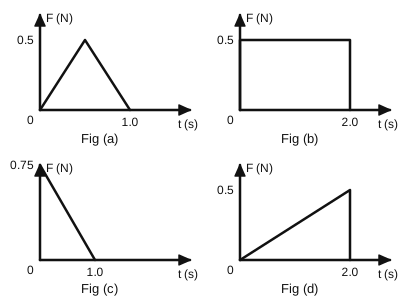
Concept. Impulse $=\displaystyle\int F\,dt$ = area under the $F$–$t$ graph.
Step 1. Areas.
(a) triangle, base $1.0$ s, height $0.5$ N: $0.25$ N s.
(b) rectangle, $0.5$ N for $2.0$ s: $1.0$ N s.
(c) triangle, base $1.0$ s, height $0.75$ N: $0.375$ N s.
(d) triangle, base $2.0$ s, height $0.5$ N: $0.5$ N s.
Step 2. Largest. Figure (b).
Answer. Option B.
Solution by Sreeraj P, M.Sc Physics
Q 11-04-129JEE MainJEE Main 2022 (24 Jun, Shift 1)Easy
A boy ties a stone of mass $100\ \text{g}$ to the end of a $2\ \text{m}$ long string and whirls it around in a horizontal plane. The string can withstand the maximum tension of $80\ \text{N}$. If the maximum speed with which the stone can revolve is $\dfrac{K}{\pi}\ \text{rev min}^{-1}$, the value of $K$ is: (Assume the string is massless and un-stretchable)
Q 11-04-130JEE MainJEE Main 2022 (24 Jun, Shift 1)Easy
A block of mass $10\ \text{kg}$ starts sliding on a surface with an initial velocity of $9.8\ \text{m s}^{-1}$. The coefficient of friction between the surface and block is $0.5$. The distance covered by the block before coming to rest is: [use $g = 9.8\ \text{m s}^{-2}$]
Q 11-04-131JEE MainJEE Main 2022 (24 Jun, Shift 2)Medium
An object of mass $5\ \text{kg}$ is thrown vertically upwards from the ground. The air resistance produces a constant retarding force of $10\ \text{N}$ throughout the motion. The ratio of time of ascent to the time of descent will be equal to: [Use $g = 10\ \text{m s}^{-2}$]
Concept. Air resistance always opposes the velocity. Going up, it acts downward together with gravity; coming down, it acts upward against gravity. So the two accelerations differ, and the same height is covered in different times.
Step 1. Acceleration due to air resistance. $$\frac{f}{m}=\frac{10}{5}=2\ \text{m s}^{-2}$$
Step 2. Ascent. Weight and drag both point down: $$a_u=g+\frac fm=10+2=12\ \text{m s}^{-2}\ (\text{retardation})$$
Step 4. Relate time to acceleration. The ascent ends at rest at height $h$ and the descent starts from rest at $h$. Reversing the ascent in time, both are motions from rest over $h$, so $h=\tfrac12at^2$ and $t=\sqrt{2h/a}\propto\dfrac{1}{\sqrt a}$. $$\frac{t_u}{t_d}=\sqrt{\frac{a_d}{a_u}}=\sqrt{\frac{8}{12}}=\sqrt{\frac23}=\frac{\sqrt2}{\sqrt3}$$
Answer. $\sqrt2:\sqrt3$, option B. With any resistance the ascent is quicker than the descent, so options with ratio $\ge1$ can be rejected at once.
Solution by Sreeraj P, M.Sc Physics
Q 11-04-132JEE MainJEE Main 2022 (24 Jun, Shift 2)Easy
A stone of mass $m$, tied to a string, is being whirled in a vertical circle with a uniform speed. The tension in the string is
Answer: (C) minimum at the highest position of the circular path.
Concept. In a vertical circle at constant speed the centripetal force $\dfrac{mv^2}{r}$ is the same everywhere. The tension makes up whatever the weight's radial part does not.
Step 1. Top. Weight points to the centre and helps: $T_{\text{top}}=\dfrac{mv^2}{r}-mg$ (smallest).
Answer. Minimum at the highest position (Option C).
Solution by Sreeraj P, M.Sc Physics
Q 11-04-133JEE MainJEE Main 2022 (25 Jun, Shift 1)Easy
A uniform chain of $6\ \text{m}$ length is placed on a table such that a part of its length is hanging over the edge of the table. The system is at rest. The coefficient of static friction between the chain and the surface of the table is $0.5$. The maximum length of the chain hanging from the table is ______ m.
Concept. The hanging part pulls the chain over the edge with its weight; friction on the part lying on the table resists. The chain stays at rest as long as the pull does not exceed the limiting friction, so the longest hanging part makes them equal.
Step 1. Set up. Let the mass per unit length be $\lambda$, the total length $L=6$ m and the hanging length $x$. The part on the table has length $L-x$ and normal force $\lambda(L-x)g$.
Answer. $2$ m. Remember: the fraction hanging is $\dfrac{\mu}{1+\mu}$, not $\mu$.
Solution by Sreeraj P, M.Sc Physics
Q 11-04-134JEE MainJEE Main 2022 (25 Jun, Shift 1)Easy
A force on an object of mass $100\ \text{g}$ is $(10\hat i + 5\hat j)\ \text{N}$. The position of that object at $t = 2\ \text{s}$ is $(a\hat i + b\hat j)\ \text{m}$ after starting from rest. The value of $\dfrac ab$ will be ______.
Concept. A constant force from rest gives $\vec r=\tfrac12\vec a t^2$, which points along $\vec a$, i.e. along $\vec F$. So the coordinates are in the ratio of the force components.
Step 1. Position. $\vec a=\vec F/m=(100\hat i+50\hat j)$ m s$^{-2}$; at $t=2$ s: $\vec r=\tfrac12(4)\vec a=200\hat i+100\hat j$ m.
Step 2. Ratio. $\dfrac ab=\dfrac{200}{100}=2$ (the same as $F_x/F_y=10/5$).
Answer. $2$.
Solution by Sreeraj P, M.Sc Physics
Q 11-04-135JEE MainJEE Main 2022 (25 Jun, Shift 2)Easy
A disc with a flat small bottom beaker placed on it at a distance $R$ from its center is revolving about an axis passing through the center and perpendicular to its plane with an angular velocity $\omega$. The coefficient of static friction between the bottom of the beaker and the surface of the disc is $\mu$. The beaker will revolve with the disc if:
Concept. The beaker turns with the disc if friction can supply $m\omega^2R$: $m\omega^2R\le\mu mg$.
Step 1. Condition. $R\le\dfrac{\mu g}{\omega^2}$.
Answer. Option B.
Solution by Sreeraj P, M.Sc Physics
Q 11-04-136JEE MainJEE Main 2022 (25 Jun, Shift 2)Easy
A curve in a level road has a radius $75\ \text{m}$. The maximum speed of a car turning this curved road can be $30\ \text{m s}^{-1}$ without skidding. If the radius of the curved road is changed to $48\ \text{m}$ and the coefficient of friction between the tyres and the road remains the same, then the maximum allowed speed would be ______ $\text{m s}^{-1}$.
Concept. $v_{\max}=\sqrt{\mu rg}\propto\sqrt r$ for the same $\mu$.
Step 1. Scale. $v_2=30\sqrt{\dfrac{48}{75}}=30\times\dfrac45=24$ m s$^{-1}$.
Answer. $24$.
Solution by Sreeraj P, M.Sc Physics
Q 11-04-137JEE MainJEE Main 2022 (25 Jun, Shift 2)Medium
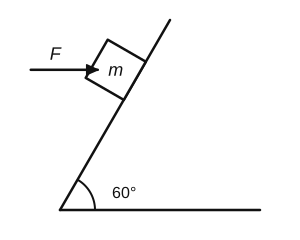
A block of mass $200\ \text{g}$ is kept stationary on a smooth inclined plane by applying a minimum horizontal force $F = \sqrt x\ \text{N}$ as shown in figure. The value of $x$ = ______.
Concept. The block is at rest on a smooth incline, so only three forces act: weight $mg$, normal force $N$ (perpendicular to the incline) and the horizontal force $F$. Resolving along the incline removes $N$ and gives $F$ directly.
Step 1. Forces and axis. The incline makes $60^\circ$ with the horizontal and $F$ pushes horizontally towards the incline. Take the axis along the incline.
Weight: component $mg\sin60^\circ$ down the incline.
$F$: component $F\cos60^\circ$ up the incline (the horizontal makes $60^\circ$ with the incline).
$N$: no component along the incline.
Step 2. Balance along the incline. $$F\cos60^\circ=mg\sin60^\circ\ \Rightarrow\ F=mg\tan60^\circ$$
Step 3. Substitute. $m=0.2$ kg, $g=10$ m s$^{-2}$: $$F=0.2\times10\times\sqrt3=2\sqrt3=\sqrt{12}\ \text{N}$$
Answer. $x=12$. On a smooth incline this horizontal force is the only one that holds the block, so "minimum" just fixes the case; the normal force is $mg\sec60^\circ=4$ N.
Solution by Sreeraj P, M.Sc Physics
Q 11-04-138JEE MainJEE Main 2022 (26 Jun, Shift 1)Easy
A person is standing in an elevator. In which situation does he experience weight loss?
Answer: (B) When the elevator moves downward with constant acceleration
Concept. Apparent weight $=N=m(g+a_{\text{up}})$. It is less than $mg$ only when the acceleration is downward.
Step 1. Check each. Upward acceleration: heavier. Uniform velocity (up or down): normal weight. Downward acceleration: lighter.
Answer. When the elevator moves downward with constant acceleration (Option B).
Solution by Sreeraj P, M.Sc Physics
Q 11-04-139JEE MainJEE Main 2022 (26 Jun, Shift 2)Medium
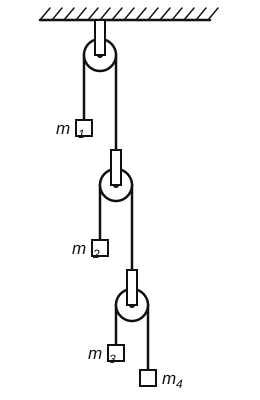
In the arrangement shown in figure, $a_1, a_2, a_3$ and $a_4$ are the accelerations of masses $m_1, m_2, m_3$ and $m_4$ respectively. Which of the following relations is true for this arrangement?
Concept. For light strings over light pulleys, string-length constraints link the accelerations. Write one constraint for each string, measuring lengths from the pulley it passes over, then eliminate the pulleys' own accelerations.
Step 1. Set up. Take downward accelerations as positive. From the figure: string 1 goes over the fixed pulley with $m_1$ on one side and pulley 2 on the other; string 2 goes over pulley 2 with $m_2$ on one side and pulley 3 on the other; string 3 goes over pulley 3 with $m_3$ and $m_4$. Let $b_2$, $b_3$ be the accelerations of pulleys 2 and 3.
Step 2. String over the fixed pulley. Its two hanging lengths add to a constant: $$a_1+b_2=0\qquad(1)$$
Step 3. String over pulley 2. Lengths are measured from pulley 2, so use accelerations relative to it: $$(a_2-b_2)+(b_3-b_2)=0\ \Rightarrow\ a_2+b_3=2b_2\qquad(2)$$
Step 4. String over pulley 3. $$(a_3-b_3)+(a_4-b_3)=0\ \Rightarrow\ b_3=\frac{a_3+a_4}{2}\qquad(3)$$
Step 5. Eliminate. From (1), $b_2=-a_1$. Put this and (3) into (2): $$a_2+\frac{a_3+a_4}{2}=-2a_1\ \Rightarrow\ 4a_1+2a_2+a_3+a_4=0$$
Answer. Option A. Shortcut (tension method): if string 3 has tension $T$, string 2 has $2T$ and string 1 has $4T$; so the masses feel $4T,2T,T,T$ and $\sum T_ia_i=0$ gives the coefficients $4,2,1,1$.
Solution by Sreeraj P, M.Sc Physics
Q 11-04-140JEE MainJEE Main 2022 (26 Jun, Shift 2)Medium
A system of $10$ balls each of mass $2\ \text{kg}$ are connected via massless and unstretchable string. The system is allowed to slip over the edge of a smooth table as shown in figure. Tension on the string between the 7th and 8th ball is ______ N when the 6th ball just leaves the table.
Concept. The balls form one connected system with a common acceleration. On a smooth table, the only driving force is the weight of the hanging balls. A string between two balls on the table pulls the balls behind it, so its tension is their mass times $a$.
Step 1. Situation at the instant. Ball 1 went over first. When the 6th ball has just left the table, balls $1$–$6$ hang and balls $7$–$10$ are on the table.
Step 2. Acceleration of the system. Driving force $=$ weight of $6$ balls; total mass $=10$ balls: $$a=\frac{6\times2\times10}{10\times2}=\frac{120}{20}=6\ \text{m s}^{-2}$$
Step 3. Isolate balls 8, 9, 10. They lie on the smooth table, and the only horizontal force on them is the tension in the string between balls 7 and 8: $$T=(3\times2)\times a=6\times6=36\ \text{N}$$
Answer. $36$ N. Count carefully which balls lie beyond the link: the string between 7 and 8 drags only 8, 9 and 10.
Solution by Sreeraj P, M.Sc Physics
Q 11-04-141JEE MainJEE Main 2022 (26 Jun, Shift 2)Easy
A batsman hits back a ball of mass $0.4\ \text{kg}$ straight in the direction of the bowler without changing its initial speed of $15\ \text{m s}^{-1}$. The impulse imparted to the ball is ______ N s.
Concept. For a point in equilibrium, the components of all forces along each axis add to zero. Choose $x$ to the right (along $F_1$) and $y$ upward (opposite to $F_2$).
Step 1. Read the figure. At $P$: $F_1$ acts to the right, $F_2$ acts downward, the $2$ N force points up and to the left at $45^\circ$ to the vertical, and the $1$ N force points up and to the right at $45^\circ$ to the vertical. So each slanted force has components of magnitude $\text{force}\times\dfrac1{\sqrt2}$ along both axes.
Step 2. Sum of $x$-components. $$F_1+\frac{1}{\sqrt2}-\frac{2}{\sqrt2}=0\ \Rightarrow\ F_1=\frac{1}{\sqrt2}\ \text{N}$$
Step 3. Sum of $y$-components. $$\frac{1}{\sqrt2}+\frac{2}{\sqrt2}-F_2=0\ \Rightarrow\ F_2=\frac{3}{\sqrt2}\ \text{N}$$
Answer. $x=3$. The $\sqrt2$ cancels, so the ratio is just $(2-1):(2+1)$.
Solution by Sreeraj P, M.Sc Physics
Q 11-04-143JEE MainJEE Main 2022 (25 Jul, Shift 2)Easy
For the free body diagram shown in the figure, the four forces are applied in the $x$ and $y$ directions. What additional force must be applied and at what angle with the positive $x$-axis so that the net acceleration of the body is zero?
Concept. For zero acceleration the net force must be zero. The extra force is minus the resultant of the four given forces.
Step 1. Resultant of the given forces. $x$: $5-6=-1$ N; $y$: $7-8=-1$ N.
Step 2. Extra force. $(+1,+1)$ N: magnitude $\sqrt2$ N at $45^\circ$ to $+x$.
Answer. $\sqrt2$ N, $45^\circ$ (Option A).
Solution by Sreeraj P, M.Sc Physics
Q 11-04-144JEE MainJEE Main 2022 (25 Jul, Shift 2)Easy
Two billiard balls of mass $0.05\ \text{kg}$ each moving in opposite directions with $10\ \text{m s}^{-1}$ collide and rebound with the same speed. If the time duration of contact is $t = 0.005\ \text{s}$, then what is the force exerted on the ball due to each other?
Concept. Each ball reverses its velocity, so its momentum changes by $2mv$. The force each exerts on the other is that change divided by the contact time.
Step 1. Change of momentum of one ball. $2\times0.05\times10=1$ kg m s$^{-1}$.
Step 2. Force. $\dfrac{1}{0.005}=200$ N.
Answer. $200$ N (Option B).
Solution by Sreeraj P, M.Sc Physics
Q 11-04-145JEE MainJEE Main 2022 (26 Jul, Shift 1)Hard
Three masses $M = 100\ \text{kg}$, $m_1 = 10\ \text{kg}$ and $m_2 = 20\ \text{kg}$ are arranged in a system as shown in figure. All the surfaces are frictionless and strings are inextensible and weightless. The pulleys are also weightless and frictionless. A force $F$ is applied on the system so that the mass $m_2$ moves upward with an acceleration of $2\ \text{m s}^{-2}$. The value of $F$ is (Take $g = 10\ \text{m s}^{-2}$)
Concept. Solve the relative motion in $M$'s frame, where each small block gets a pseudo force. Then return to the ground frame: the only external horizontal force on the whole system is $F$, so $F=\sum m_ia_{i,x}$ using ground-frame accelerations.
Step 1. Constraint and directions. Let $M$ accelerate to the right at $a$. From the figure, $m_1$ is on top of $M$ joined over the pulley at $M$'s right edge to $m_2$, which hangs against $M$'s right face and so moves horizontally with $M$. If $m_2$ rises at $2$ m s$^{-2}$ relative to $M$, then $m_1$ slides to the left (away from the pulley) at $2$ m s$^{-2}$ relative to $M$.
Step 2. Isolate $m_2$, vertically. Forces: $T$ up, $m_2g$ down; acceleration $2$ m s$^{-2}$ up (vertical motion is the same in both frames): $$T-m_2g=m_2(2)\ \Rightarrow\ T=20(10+2)=240\ \text{N}$$
Step 3. Isolate $m_1$ in $M$'s frame. Horizontal forces: pseudo force $m_1a$ to the left, tension $T$ to the right. It accelerates left at $2$ m s$^{-2}$ relative to $M$: $$m_1a-T=m_1(2)\ \Rightarrow\ 10a-240=20\ \Rightarrow\ a=26\ \text{m s}^{-2}$$
Step 5. Whole system. The floor is smooth; tension and contact forces between the bodies are internal. So $$F=100(26)+20(26)+10(24)=2600+520+240=3360\ \text{N}$$
Answer. $3360$ N, option A. The usual error is to give $m_1$ the same $26$ m s$^{-2}$, which gives $3380$ N (option B).
Solution by Sreeraj P, M.Sc Physics
Q 11-04-146JEE MainJEE Main 2022 (26 Jul, Shift 1)Easy
A monkey of mass $50\ \text{kg}$ climbs on a rope which can withstand a tension $(T)$ of $350\ \text{N}$. If the monkey initially climbs down with an acceleration of $4\ \text{m s}^{-2}$ and then climbs up with an acceleration of $5\ \text{m s}^{-2}$, choose the correct option. ($g = 10\ \text{m s}^{-2}$)
Concept. Isolate the monkey. Only two forces act on it: its weight $mg$ down and the rope's tension $T$ up. Newton's second law then gives $T$, and the sign of the acceleration (not the direction of motion) decides whether $T$ is more or less than $mg$.
Step 1. Climbing down with acceleration $4$ m s$^{-2}$ downward. Take downward as positive: $$mg-T=ma\ \Rightarrow\ T=m(g-a)=50(10-4)=300\ \text{N}$$ This is below the $350$ N limit, so the rope holds.
Step 2. Climbing up with acceleration $5$ m s$^{-2}$ upward. Take upward as positive: $$T-mg=ma\ \Rightarrow\ T=m(g+a)=50(10+5)=750\ \text{N}$$
Step 3. Compare with the breaking load. $750\ \text{N}>350\ \text{N}$, so the rope cannot supply this tension.
Answer. The rope breaks while the monkey climbs upward, option C. Options A and B quote tensions that are not what the rope would need ($750$ N and $300$ N).
Solution by Sreeraj P, M.Sc Physics
Q 11-04-147JEE MainJEE Main 2022 (26 Jul, Shift 2)Easy
Two masses $M_1$ and $M_2$ are tied together at the two ends of a light inextensible string that passes over a frictionless pulley. When the mass $M_2$ is twice that of $M_1$, the acceleration of the system is $a_1$. When the mass $M_2$ is thrice that of $M_1$, the acceleration of the system is $a_2$. The ratio $\dfrac{a_1}{a_2}$ will be
Q 11-04-148JEE MainJEE Main 2022 (26 Jul, Shift 2)Easy
A ball of mass $0.15\ \text{kg}$ hits the wall with its initial speed of $12\ \text{m s}^{-1}$ and bounces back without changing its initial speed. If the force applied by the wall on the ball during the contact is $100\ \text{N}$, calculate the time duration of the contact of the ball with the wall.
Concept. $t = \dfrac{\Delta p}{F}$ with $\Delta p = 2mv$.
Step 1. Substitute. $\dfrac{3.6}{100} = 0.036$ s.
Answer. $0.036\ \text{s}$ (Option B).
Solution by Sreeraj P, M.Sc Physics
Q 11-04-149JEE MainJEE Main 2022 (27 Jun, Shift 1)Easy
A system of two blocks of masses $m = 2$ kg and $M = 8$ kg is placed on a smooth table as shown in figure. The coefficient of static friction between two blocks is $0.5$. The maximum horizontal force $F$ that can be applied to the block of mass $M$ so that the blocks move together will be $(g = 9.8\ \text{m s}^{-2})$
Concept. The force is applied to the lower block $M$. The upper block $m$ is dragged along only by static friction from $M$, and this friction cannot exceed $\mu mg$. So $m$ (and hence the whole system, if they move together) can accelerate at most at $\mu g$.
Step 2. Whole system. Moving together on a smooth table, the only external horizontal force is $F$: $$F=(m+M)a$$
Step 3. Largest $F$. $$F_{\max}=(2+8)\times4.9=49\ \text{N}$$
Answer. $49$ N, option C. Using $\mu mg=9.8$ N as the answer is a trap: that is the friction on $m$, not the applied force.
Solution by Sreeraj P, M.Sc Physics
Q 11-04-150JEE MainJEE Main 2022 (27 Jun, Shift 2)Medium
One end of a massless spring of spring constant $k$ and natural length $l_0$ is fixed while the other end is connected to a small object of mass $m$ lying on a frictionless table. The spring remains horizontal on the table. If the object is made to rotate at an angular velocity $\omega$ about an axis passing through fixed end, then the elongation of the spring will be
Concept. The object moves in a circle on a smooth table, and the stretched spring supplies the centripetal force. Stretching the spring by $x$ makes the radius $l_0+x$, so the radius itself depends on the answer.
Step 1. Forces on the object. Horizontally, only the spring force $kx$, towards the fixed end (the centre). Vertically, weight and normal force cancel.
Step 2. Newton's second law towards the centre. $$kx=m\omega^2(l_0+x)$$
Step 3. Solve for $x$. $$kx-m\omega^2x=m\omega^2l_0\ \Rightarrow\ x=\frac{m\omega^2l_0}{k-m\omega^2}$$
Answer. Option C. Using $l_0$ as the radius gives $m\omega^2l_0/k$, which is only the small-$\omega$ approximation. If $m\omega^2\ge k$ the spring cannot hold the object.
Solution by Sreeraj P, M.Sc Physics
Q 11-04-151JEE MainJEE Main 2022 (27 Jun, Shift 2)Medium
A mass of $10$ kg is suspended vertically by a rope of length $5$ m from the roof. A force of $30$ N is applied at the middle point of rope in horizontal direction. The angle made by upper half of the rope with vertical is $\alpha = \tan^{-1}(x\times10^{-1})$. The value of $x$ is ______ .
Concept. Treat the rope as light. Then the lower half simply transmits the weight, and the point where the horizontal force acts is in equilibrium under three forces. The upper half's tension must balance the resultant of the other two.
Step 1. Lower half. It holds the $10$ kg mass at rest, so it is vertical and its tension is $$T_2=Mg=10\times10=100\ \text{N}$$ It pulls the midpoint straight down with $100$ N.
Step 2. Forces at the midpoint. Three forces: $100$ N down (lower half), $30$ N horizontal (applied), and $T_1$ along the upper half, at angle $\alpha$ to the vertical.
Answer. $x=3$. The rope length ($5$ m) and the position of the point on the rope do not matter for a light rope.
Solution by Sreeraj P, M.Sc Physics
Q 11-04-152JEE MainJEE Main 2022 (27 Jul, Shift 1)Medium
A bag is gently dropped on a conveyor belt moving at a speed of $2\ \text{m s}^{-1}$. The coefficient of friction between the conveyor belt and bag is $0.4$. Initially, the bag slips on the belt before it stops due to friction. The distance travelled by the bag on the belt during slipping motion is : [Take $g = 10\ \text{m s}^{-2}$]
Concept. The bag is dropped with no horizontal speed onto a belt moving at $v$. Kinetic friction from the belt acts forward on the bag until the bag reaches the belt's speed. The distance asked is the slip relative to the belt, which is easiest in the belt's frame (inertial, as the belt moves uniformly).
Step 1. Friction and acceleration. Isolate the bag: normal force $mg$, so friction $\mu mg$ and $$a=\mu g=0.4\times10=4\ \text{m s}^{-2}$$
Step 2. In the belt's frame. The bag starts moving backward at $2$ m s$^{-1}$, and friction slows it at $4$ m s$^{-2}$ until it is at rest on the belt.
Answer. $0.5$ m, option B. In the ground frame the bag moves $0.5$ m forward while the belt moves $1$ m in the same time ($t=0.5$ s); the difference, $0.5$ m, is the slip.
Solution by Sreeraj P, M.Sc Physics
Q 11-04-153JEE MainJEE Main 2022 (27 Jul, Shift 2)Easy
A block of mass $M$ slides down on a rough inclined plane with constant velocity. The angle made by the incline plane with horizontal is $\theta$. The magnitude of the contact force will be :
Concept. At constant velocity the net force is zero. The only forces are the weight and the contact force from the incline (normal reaction plus friction), so the contact force must be equal and opposite to the weight.
Q 11-04-154JEE MainJEE Main 2022 (27 Jul, Shift 2)Medium
A block $A$ takes $2$ s to slide down a frictionless incline of $30^\circ$ and length $l$, kept inside a lift going up with uniform velocity $v$. If the incline is changed to $45^\circ$, the time taken by the block, to slide down the incline, will be approximately:
Concept. A lift moving with uniform velocity has no acceleration, so it is an inertial frame: everything inside behaves exactly as on the ground. On a smooth incline the block slides down with $a=g\sin\theta$, and from rest $l=\tfrac12at^2$.
Step 1. Time in terms of angle. Isolate the block: along the smooth incline only $mg\sin\theta$ acts, so $a=g\sin\theta$ and $$l=\tfrac12g\sin\theta\,t^2\ \Rightarrow\ t=\sqrt{\frac{2l}{g\sin\theta}}\propto\frac1{\sqrt{\sin\theta}}$$
Step 2. Ratio for the two angles. The length $l$ is the same: $$\frac{t_2}{t_1}=\sqrt{\frac{\sin30^\circ}{\sin45^\circ}}=\sqrt{\frac{0.5}{0.707}}=\sqrt{0.707}\approx0.841$$
Step 3. New time. $$t_2=2\times0.841\approx1.68\ \text{s}$$
Answer. $1.68$ s, option C. The speed $v$ of the lift plays no part; only acceleration of the frame would.
Solution by Sreeraj P, M.Sc Physics
Q 11-04-155JEE MainJEE Main 2022 (27 Jul, Shift 2)Medium
Two inclined planes are placed as shown in figure.
A block is projected from the Point $A$ of inclined plane $AB$ along its surface with a velocity just sufficient to carry it to the top Point $B$ at a height $10$ m. After reaching the Point $B$ the block slides down on inclined plane $BC$. Time it takes to reach to the point $C$ from point $A$ is $t(\sqrt2 + 1)$ s. The value of $t$ is ______ (use $g = 10\ \text{m s}^{-2}$)
Concept. On each smooth face the acceleration is $g\sin\theta$ along the face. "Just sufficient" to reach $B$ means the block stops at $B$; for uniform retardation to rest, $s=\tfrac12v_0t$.
Step 1. Climb $AB$ ($45^\circ$). Length $10/\sin45^\circ=10\sqrt2$ m; retardation $10\sin45^\circ=5\sqrt2$ m s$^{-2}$. $$10\sqrt2=\tfrac12(5\sqrt2)t_1^2\ \Rightarrow\ t_1^2=4\ \Rightarrow\ t_1=2\ \text{s}$$ (Run the motion backwards: from rest at $B$ down to $A$.)
Step 2. Slide down $BC$ ($30^\circ$). Length $10/\sin30^\circ=20$ m; acceleration $5$ m s$^{-2}$: $$20=\tfrac12(5)t_2^2\ \Rightarrow\ t_2=2\sqrt2\ \text{s}$$
Step 3. Total. $2+2\sqrt2=2(\sqrt2+1)$ s, so $t=2$.
Answer. $2$.
Solution by Sreeraj P, M.Sc Physics
Q 11-04-156JEE MainJEE Main 2022 (28 Jul, Shift 1)Easy
A balloon has mass of $10$ g in air. The air escapes from the balloon at a uniform rate with velocity $4.5\ \text{cm s}^{-1}$. If the balloon shrinks in $5$ s completely. Then, the average force acting on that balloon will be (in dyne).
Q 11-04-157JEE MainJEE Main 2022 (28 Jul, Shift 1)Easy
In two different experiments, an object of mass $5$ kg moving with a speed of $25\ \text{m s}^{-1}$ hits two different walls and comes to rest within (i) $3$ second, (ii) $5$ seconds, respectively.
Answer: (B) Impulse will be same for both the cases but the average force will be different.
Concept. Impulse $=$ change in momentum; average force $=$ impulse/time.
Step 1. Impulse. $125$ N s in both.
Step 2. Force. $\dfrac{125}{3}$ vs $25$ N: different.
Answer. Impulse will be same for both the cases but the average force will be different (Option B).
Solution by Sreeraj P, M.Sc Physics
Q 11-04-158JEE MainJEE Main 2021 (27 Jul, Shift 2)Medium
A particle of mass $M$ originally at rest is subjected to a force whose direction is constant but magnitude varies with time according to the relation $F = F_0\left[1 - \left(\dfrac{t - T}{T}\right)^2\right]$ where $F_0$ and $T$ are constants. The force acts only for the time interval $2T$. The velocity $v$ of the particle after time $2T$ is:
Concept. For a force that varies with time, the impulse is $J=\int F\,dt$, and it equals the change in momentum. The particle starts from rest, so its final momentum is $Mv=J$.
Step 1. Write the impulse. $$J=\int_0^{2T}F_0\left[1-\left(\frac{t-T}{T}\right)^2\right]dt$$
Step 2. Substitute to simplify. Let $u=\dfrac{t-T}{T}$, so $dt=T\,du$. When $t=0$, $u=-1$; when $t=2T$, $u=1$. $$J=F_0T\int_{-1}^{1}(1-u^2)\,du=F_0T\left[u-\frac{u^3}{3}\right]_{-1}^{1}=F_0T\left(\frac23+\frac23\right)=\frac{4F_0T}{3}$$
Step 3. Final velocity. The direction of the force is fixed, so $$Mv=J\ \Rightarrow\ v=\frac{4F_0T}{3M}$$
Answer. Option C. Check: the force curve is a parabola with peak $F_0$ over a base $2T$; the area of such a parabolic arch is $\tfrac23\times$ base $\times$ height $=\tfrac23(2T)F_0$.
Solution by Sreeraj P, M.Sc Physics
Q 11-04-159JEE MainJEE Main 2021 (31 Aug, Shift 1)Medium
A car is moving on a plane inclined at $30^\circ$ to the horizontal with an acceleration of $10\ \text{m s}^{-2}$ parallel to the plane upward. A bob is suspended by a string from the roof of the car. The angle in degrees which the string makes with the vertical is ______. (Take $g = 10\ \text{m s}^{-2}$)
Concept. In the car's frame, which accelerates at $\vec a$, the bob feels a pseudo force $-m\vec a$ besides gravity. The bob hangs at rest along the effective gravity $\vec g_{\text{eff}}=\vec g-\vec a$, so the string's direction is the direction of this vector.
Step 1. Components. Take $x$ horizontal (in the direction the car moves) and $y$ vertically up. The car's acceleration is $10$ m s$^{-2}$ up the $30^\circ$ incline: $$\vec a=(10\cos30^\circ,\ 10\sin30^\circ)=(5\sqrt3,\ 5),\qquad \vec g=(0,\ -10)$$
Step 2. Effective gravity. $$\vec g_{\text{eff}}=\vec g-\vec a=(-5\sqrt3,\ -15)$$ It points down and backward.
Step 3. Angle with the vertical. $$\tan\theta=\frac{|g_{\text{eff},x}|}{|g_{\text{eff},y}|}=\frac{5\sqrt3}{15}=\frac{1}{\sqrt3}\ \Rightarrow\ \theta=30^\circ$$
Answer. $30^\circ$. Using $\tan\theta=a/g=1$ ($45^\circ$) is wrong here because $\vec a$ is not horizontal; its vertical part increases the effective gravity.
Solution by Sreeraj P, M.Sc Physics
Q 11-04-160JEE MainJEE Main 2021 (31 Aug, Shift 2)Easy
Statement I: If three forces $\vec F_1$, $\vec F_2$ and $\vec F_3$ are represented by three sides of a triangle and $\vec F_1 + \vec F_2 = -\vec F_3$, then these three forces are concurrent forces and satisfy the condition for equilibrium.
Statement II: A triangle made up of three forces $\vec F_1$, $\vec F_2$ and $\vec F_3$ as its sides taken in the same order, satisfies the condition for translatory equilibrium.
In the light of the above statements, choose the most appropriate answer from the options given below:
Answer: (A) Both Statement I and Statement II are true.
Concept. Forces drawn head to tail along the sides of a triangle, in order, add to zero (polygon law).
Step 1. Statement I. $\vec F_1+\vec F_2=-\vec F_3$ means $\vec F_1+\vec F_2+\vec F_3=0$: acting at one point (concurrent), the forces are in equilibrium. True.
Step 2. Statement II. Three forces forming a closed triangle in order have zero resultant, which is the condition for translational equilibrium. True.
Answer. Both statements are true (Option A).
Solution by Sreeraj P, M.Sc Physics
Q 11-04-161JEE MainJEE Main 2021 (24 Feb, Shift 1)Easy
The coefficient of static friction between a wooden block of mass 0.5 kg and a vertical rough wall is 0.2. The magnitude of the horizontal force that should be applied on the block to keep it adhere to the wall will be ______ N. ($g = 10\ \text{m s}^{-2}$)
Concept. Pressed against a vertical wall, the block is held up by friction; the normal force is the horizontal push $F$. It stays if $\mu F\ge mg$.
Step 1. Minimum push. $F=\dfrac{mg}{\mu}=\dfrac{0.5\times10}{0.2}=25$ N.
Answer. $25$.
Solution by Sreeraj P, M.Sc Physics
Q 11-04-162JEE MainJEE Main 2021 (24 Feb, Shift 1)Medium
An inclined plane is bent in such a way that the vertical cross-section is given by $y = \dfrac{x^2}{4}$ where $y$ is in vertical and $x$ in horizontal direction. If the upper surface of this curved plane is rough with coefficient of friction $\mu = 0.5$, the maximum height in cm at which a stationary block will not slip downward is ______ cm.
Concept. On a curved surface, each point acts like a small incline whose slope is $\tan\theta=\dfrac{dy}{dx}$. A block stays at rest where $\tan\theta\le\mu$ (the same condition as the angle of repose). The curve gets steeper with height, so the highest resting point is where $\dfrac{dy}{dx}=\mu$.
Step 1. Slope of the curve. $$y=\frac{x^2}{4}\ \Rightarrow\ \frac{dy}{dx}=\frac x2$$
Step 2. Limiting point. Isolate the block: along the surface, $mg\sin\theta$ must not exceed $\mu mg\cos\theta$, i.e. $\tan\theta\le\mu$. $$\frac x2\le0.5\ \Rightarrow\ x\le1\ \text{m}$$
Answer. $25$ cm. The question asks for height ($y$), not horizontal distance.
Solution by Sreeraj P, M.Sc Physics
Q 11-04-163JEE MainJEE Main 2021 (25 Feb, Shift 1)Medium
A small bob tied at one end of a thin string of length 1 m is describing a vertical circle so that the maximum and minimum tension in the string is in the ratio 5 : 1. The velocity of the bob at the highest position is ______ $\text{m s}^{-1}$. (Take $g = 10\ \text{m s}^{-2}$)
Concept. In a vertical circle the tension is greatest at the bottom and least at the top. At each point, the net force towards the centre equals $mv^2/l$. Energy conservation links the speeds at the top and bottom.
Step 1. Speeds. Let $v$ be the speed at the top. The bob falls $2l$ to the bottom: $$u^2=v^2+2g(2l)=v^2+4gl$$
Step 2. Tension at the top. Both $T$ and $mg$ point towards the centre (down): $$T_{\min}+mg=\frac{mv^2}{l}\ \Rightarrow\ T_{\min}=\frac{mv^2}{l}-mg$$
Step 3. Tension at the bottom. $T$ points to the centre (up), $mg$ away: $$T_{\max}-mg=\frac{mu^2}{l}\ \Rightarrow\ T_{\max}=\frac{m(v^2+4gl)}{l}+mg=\frac{mv^2}{l}+5mg$$
Step 4. Use the ratio. With $l=1$ m and $g=10$ m s$^{-2}$ (the $m$ cancels): $$\frac{v^2+50}{v^2-10}=5\ \Rightarrow\ v^2+50=5v^2-50\ \Rightarrow\ 4v^2=100\ \Rightarrow\ v^2=25$$
Answer. $v=5$ m s$^{-1}$. Check: $v^2=25>gl=10$, so the string stays taut at the top. Also $T_{\max}-T_{\min}=6mg$ always.
Solution by Sreeraj P, M.Sc Physics
Q 11-04-165JEE MainJEE Main 2021 (20 Jul, Shift 1)Easy
A steel block of 10 kg rests on a horizontal floor as shown. When three iron cylinders are placed on it as shown, the block and cylinders go down with an acceleration $0.2\ \text{m s}^{-2}$. The normal reaction $R'$ by the floor if mass of the iron cylinders are equal and of 20 kg each is (in N),
[Take $g = 10\ \text{m s}^{-2}$ and $\mu_s = 0.2$]
Q 11-04-166JEE MainJEE Main 2021 (20 Jul, Shift 2)Medium
A body of mass $m$ is launched up on a rough inclined plane making an angle of $30^\circ$ with the horizontal. The coefficient of friction between the body and plane is $\dfrac{\sqrt x}{5}$ if the time of ascent is half of the time of descent. The value of $x$ is ______.
Concept. Up the slope, gravity and friction both oppose: $a_u=g(\sin\theta+\mu\cos\theta)$. Down: $a_d=g(\sin\theta-\mu\cos\theta)$. Same distance each way, so $t\propto1/\sqrt a$.
Q 11-04-167JEE MainJEE Main 2021 (22 Jul, Shift 1)Easy
A bullet of 4 g mass is fired from a gun of mass 4 kg. If the bullet moves with the muzzle speed of $50\ \text{m s}^{-1}$, the impulse imparted to the gun and velocity of recoil of gun are
Answer: (B) $0.2\ \text{kg m s}^{-1}$, $0.05\ \text{m s}^{-1}$
Concept. Firing is internal: total momentum stays zero, so the gun gets the same impulse as the bullet, in the opposite direction.
Step 1. Bullet's momentum. $0.004\times50=0.2$ kg m s$^{-1}$; impulse on the gun $=0.2$ kg m s$^{-1}$.
Step 2. Recoil speed. $\dfrac{0.2}{4}=0.05$ m s$^{-1}$.
Answer. $0.2$ kg m s$^{-1}$, $0.05$ m s$^{-1}$ (Option B).
Solution by Sreeraj P, M.Sc Physics
Q 11-04-168JEE MainJEE Main 2021 (26 Feb, Shift 1)Easy
A particle is moving with uniform speed along the circumference of a circle of radius $R$ under the action of a central fictitious force $F$ which is inversely proportional to $R^3$. Its time period of revolution will be given by:
Q 11-04-169JEE MainJEE Main 2021 (26 Feb, Shift 1)Easy
A boy pushes a box of mass $2$ kg with a force $\vec{F} = (20\hat{i} + 10\hat{j})$ N on a frictionless surface. If the box was initially at rest, then ______ m is displacement along the $x$-axis after $10$ s.
Q 11-04-170JEE MainJEE Main 2021 (26 Feb, Shift 1)Easy
A person standing on a spring balance inside a stationary lift measures $60$ kg. The weight of that person if the lift descends with uniform downward acceleration of $1.8$ m s$^{-2}$ will be ______ N. $[g = 10\ \text{m s}^{-2}]$
Q 11-04-171JEE MainJEE Main 2021 (26 Feb, Shift 1)Medium
As shown in the figure, a block of mass $\sqrt{3}$ kg is kept on a horizontal rough surface of coefficient of friction $\frac{1}{3\sqrt{3}}$. The critical force to be applied on the vertical surface as shown at an angle $60^\circ$ with horizontal such that it does not move, will be $3x$. The value of $x$ will be ______ $\left[g = 10\ \text{m s}^{-2};\ \sin60^\circ = \frac{\sqrt{3}}{2};\ \cos60^\circ = \frac{1}{2}\right]$
Concept. The force pushes into the block and downward at $60°$; at the limit its horizontal part equals $\mu N$.
Step 1. Normal force. $N = 10\sqrt3 + \dfrac{\sqrt3}{2}F$.
Step 2. Limit. $\dfrac F2 = \dfrac{1}{3\sqrt3}N = \dfrac{10}{3} + \dfrac F6 \Rightarrow F = 10$ N.
Step 3. Compare. $3x = 10 \Rightarrow x = 3.33$.
Answer. $3.33$.
Solution by Sreeraj P, M.Sc Physics
Q 11-04-172JEE MainJEE Main 2021 (26 Feb, Shift 2)Easy
Two masses $A$ and $B$, each of mass $M$ are fixed together by a massless spring. A force acts on the mass $B$ as shown in figure. If the mass $A$ starts moving away from mass $B$ with acceleration $a$, then the acceleration of mass $B$ will be:
Concept. A spring pulls its two ends with equal and opposite forces. Block $A$ has only the spring acting on it horizontally, so its acceleration tells us the spring force. That same force then acts on $B$ in the opposite direction.
Step 1. Isolate $A$. Only the spring force $F_s$ acts horizontally. Its acceleration has magnitude $a$, so $$F_s=Ma$$ $A$ is being pulled towards $B$ (the spring is stretched as $B$ is pulled away by $F$).
Step 2. Isolate $B$. Two horizontal forces: the applied force $F$, directed away from $A$, and the spring force $Ma$, directed towards $A$.
Step 3. Newton's second law for $B$ (positive in the direction of $F$): $$F-Ma=Ma_B\ \Rightarrow\ a_B=\frac{F-Ma}{M}$$
Answer. Option D. Check with the whole system: the spring forces are internal, so $F=Ma+Ma_B$, which gives the same $a_B$. (The question's words "moving away" are loose; the spring is stretched, so $A$ is actually dragged along after $B$. Only the size $a$ of $A$'s acceleration matters.)
Solution by Sreeraj P, M.Sc Physics
Q 11-04-173JEE MainJEE Main 2021 (25 Jul, Shift 2)Easy
A force $\vec{F} = (40\hat{i} + 10\hat{j})$ N acts on a body of mass $5$ kg. If the body starts from rest, its position vector $\vec{r}$ at time $t = 10$ s will be
Step 2. Position. $50(8\hat i + 2\hat j) = 400\hat i + 100\hat j$ m.
Answer. $(400\hat i + 100\hat j)$ m (Option C).
Solution by Sreeraj P, M.Sc Physics
Q 11-04-174JEE MainJEE Main 2021 (26 Aug, Shift 1)Medium
The initial mass of a rocket is $1000$ kg. Calculate at what rate the fuel should be burnt so that the rocket is given an acceleration of $20$ m s$^{-2}$. The gases come out at a relative speed of $500$ m s$^{-1}$, with respect to the rocket: [Use $g = 10$ m s$^{-2}$]
Concept. The exhaust gases leave at speed $u$ relative to the rocket, so they push the rocket forward with a thrust $u\dfrac{dm}{dt}$ (rate of momentum given to the gas). Isolate the rocket: thrust up, weight down, and apply Newton's second law with the current mass.
Step 1. Forces on the rocket at the start. Mass $m=1000$ kg, upward thrust $u\dfrac{dm}{dt}$, weight $mg$ down.
Step 2. Newton's second law (upward positive). $$u\frac{dm}{dt}-mg=ma$$
Step 3. Solve for the burn rate. $$\frac{dm}{dt}=\frac{m(g+a)}{u}=\frac{1000\times(10+20)}{500}=60\ \text{kg s}^{-1}$$
Answer. $60$ kg s$^{-1}$, option B. Forgetting gravity gives $40$ kg s$^{-1}$, which is not offered, a hint that $g$ must be included.
Solution by Sreeraj P, M.Sc Physics
Q 11-04-175JEE MainJEE Main 2021 (26 Aug, Shift 2)Easy
A particle of mass $m$ is suspended from a ceiling through a string of length $L$. The particle moves in a horizontal circle of radius $r$ such that $r = \frac{L}{\sqrt{2}}$. The speed of particle will be:
Q 11-04-176JEE MainJEE Main 2021 (26 Aug, Shift 2)Easy
The coefficient of static friction between two blocks is $0.5$ and the table is smooth. The maximum horizontal force that can be applied to move the blocks together is ______ N (take $g = 10$ m s$^{-2}$)
Concept. The force acts on the lower block; the upper block moves only because of friction, which can give it at most $a=\mu g$. The table is smooth.
Step 1. Largest common acceleration. $a_{\max}=0.5\times10=5$ m s$^{-2}$.
Step 2. Largest force. $F=(1+2)\times5=15$ N.
Answer. $15$.
Solution by Sreeraj P, M.Sc Physics
Q 11-04-177JEE MainJEE Main 2021 (27 Aug, Shift 2)Medium
The boxes of masses $2$ kg and $8$ kg are connected by a massless string passing over smooth pulleys. Calculate the time taken by box of mass $8$ kg to strike the ground starting from rest. $(g = 10\ \text{m s}^{-2})$
Concept. The $8$ kg box hangs from a movable pulley held by two segments of the string, so it is supported by $2T$ and moves half as far as the free end. The free end carries the $2$ kg box. Write the constraint first, then Newton's law for each box.
Step 1. Constraint. From the figure the string runs from the ceiling, under the movable pulley, over the fixed pulley, to the $2$ kg box. If the $8$ kg box goes down by $x$, both segments on the movable pulley lengthen by $x$, so the $2$ kg box rises by $2x$. Hence if the $8$ kg box has acceleration $a$ down, the $2$ kg box has $2a$ up.
Step 2. Isolate the $8$ kg box (with its pulley). Forces: $80$ N down, $2T$ up. Down positive: $$80-2T=8a\qquad(1)$$
Step 3. Isolate the $2$ kg box. Forces: $T$ up, $20$ N down. Up positive: $$T-20=2(2a)=4a\qquad(2)$$
Step 4. Solve. Multiply (2) by 2 and add to (1): $$80-40=8a+8a\ \Rightarrow\ a=2.5\ \text{m s}^{-2},\qquad T=30\ \text{N}$$
Step 5. Time to fall $20$ cm from rest. $$0.2=\tfrac12(2.5)t^2\ \Rightarrow\ t^2=0.16\ \Rightarrow\ t=0.4\ \text{s}$$
Answer. $0.4$ s, option D. Forgetting the factor 2 in the constraint is the usual slip.
Solution by Sreeraj P, M.Sc Physics
Q 11-04-178JEE MainJEE Main 2020 (9 Jan, Shift 2)Medium
A spring mass system (mass $m$, spring constant $k$ and natural length $l$) rests in equilibrium on a horizontal disc. The free end of the spring is fixed at the centre of the disc. If the disc together with spring mass system rotates about its axis with an angular velocity $\omega$, $(k \gg m\omega^2)$ the relative change in the length of the spring is best given by the option:
Q 11-04-179JEE MainJEE Main 2020 (5 Sep, Shift 2)Medium
A spaceship in space sweeps stationary interplanetary dust. As a result, its mass increases at a rate $\dfrac{dM(t)}{dt} = bv^2(t)$, where $v(t)$ is its instantaneous velocity. The instantaneous acceleration of the spaceship is:
Q 11-04-180JEE MainJEE Main 2020 (6 Sep, Shift 1)Medium
An insect is at the bottom of a hemispherical ditch of radius $1$ m. It crawls up the ditch but starts slipping after it is at height $h$ from the bottom. If the coefficient of friction between the ground and the insect is $0.75$, then $h$ is: ($g = 10\ \text{m s}^{-2}$)
Q 11-04-181JEE MainJEE Main 2020 (6 Sep, Shift 2)Hard
A particle moving in the $xy$-plane experiences a velocity dependent force $\vec F = k(v_y\hat i + v_x\hat j)$, where $v_x$ and $v_y$ are the $x$ and $y$ components of its velocity $\vec v$. If $\vec a$ is the acceleration of the particle, then which of the following statements is true for the particle?
Step 2. $\vec v\times\vec a$ ($z$ component): $$v_xa_y-v_ya_x=\frac km\left(v_x^2-v_y^2\right),\qquad\frac{d}{dt}\left(v_x^2-v_y^2\right)=2v_xa_x-2v_ya_y=\frac{2k}{m}(v_xv_y-v_yv_x)=0$$ So $\vec v\times\vec a$ is constant. A is true.
Step 3. Others.
Kinetic energy: $\dfrac{d}{dt}\tfrac12mv^2=\vec F\cdot\vec v=2kv_xv_y\ne0$ in general. C false.
A magnetic force is $\perp\vec v$, but here $\vec F\cdot\vec v\ne0$. B false.
$\vec v\cdot\vec a=\dfrac{2k}{m}v_xv_y$ changes with time. D false.
Answer. Option A.
Solution by Sreeraj P, M.Sc Physics
Q 11-04-182JEE MainJEE Main 2020 (7 Jan, Shift 2)Easy
A mass of $10$ kg is suspended by a rope of length $4$ m from the ceiling. A force $F$ is applied horizontally at the mid-point of the rope such that the top half of the rope makes an angle of $45^\circ$ with the vertical. Then $F$ equals: (Take $g = 10\ \text{m s}^{-2}$ and the rope to be massless)
Concept. As in any rope pulled sideways at its midpoint: the lower half hangs vertically with tension $mg$, and at the midpoint $F=mg\tan\theta$ where $\theta$ is the upper half's angle with the vertical.
Step 1. Substitute. $F=10\times10\times\tan45^\circ=100$ N.
Answer. $100$ N (Option A).
Solution by Sreeraj P, M.Sc Physics
Q 11-04-183JEE MainJEE Main 2020 (7 Jan, Shift 2)Hard
Consider a uniform cubical box of side $a$ on a rough floor that is to be moved by applying the minimum possible force $F$ at a point $b$ above its centre of mass (see figure). If the coefficient of friction is $\mu = 0.4$, the maximum possible value of $100\times\dfrac ba$ for the box not to topple before moving is ______.
Concept. The least horizontal force that moves the box is $F=\mu mg$. The box must not tip about its front lower edge before that: the torque of $F$ about that edge must not exceed the torque of the weight.
Step 1. Torques about the front edge. $F$ acts at height $\tfrac a2+b$; the weight acts at a lever arm $\tfrac a2$: $$F\left(\frac a2+b\right)\le mg\frac a2$$
Step 2. Put $F=\mu mg$. $$0.4\left(\frac12+\frac ba\right)\le\frac12\ \Rightarrow\ \frac ba\le\frac{0.5}{0.4}-0.5=0.75$$
Answer. $100\times\dfrac ba=75$.
Solution by Sreeraj P, M.Sc Physics
Q 11-04-184JEE MainJEE Main 2020 (8 Jan, Shift 1)Easy
A particle of mass $m$ is fixed to one end of a light spring having force constant $k$ and unstretched length $l$. The other end is fixed. The system is given an angular speed $\omega$ about the fixed end of the spring such that it rotates in a circle in gravity free space. Then the stretch in the spring is:
Q 11-04-185JEE MainJEE Main 2020 (2 Sep, Shift 1)Medium
A bead of mass $m$ stays at point $P(a, b)$ on a wire bent in the shape of a parabola $y = 4Cx^{2}$ and rotating with angular speed $\omega$ about the $y$-axis (see figure). The value of $\omega$ is (neglect friction)
Concept. In the frame rotating with the wire, the bead at rest feels $mg$ down and the centrifugal force $m\omega^2x$ outward. With no friction, their resultant must be along the normal to the wire, i.e. the wire's slope must satisfy $\tan\phi=\dfrac{\omega^2x}{g}$.
Step 1. Slope of the wire. $y=4Cx^2\Rightarrow\dfrac{dy}{dx}=8Cx$.
Step 3. Result. $\omega=2\sqrt{2gC}$, the same at every point of this parabola.
Answer. Option A.
Solution by Sreeraj P, M.Sc Physics
Q 11-04-186JEE MainJEE Main 2020 (3 Sep, Shift 2)Medium
A block starts moving up an inclined plane of inclination $30^\circ$ with an initial velocity of $v_0$. It comes back to its initial position with velocity $\dfrac{v_0}{2}$. The value of the coefficient of kinetic friction between the block and the inclined plane is close to $\dfrac{I}{1000}$. The nearest integer to $I$ is ______.
Concept. The block goes up and comes back over the same distance $d$, but friction always opposes its motion: it adds to $g\sin\theta$ going up and subtracts coming down. Use $v^2=2as$ for each leg and compare.
Step 1. Accelerations. Isolate the block; along the incline: $$\text{up (retardation): } a_1=g(\sin\theta+\mu\cos\theta),\qquad\text{down: } a_2=g(\sin\theta-\mu\cos\theta)$$
Step 2. Each leg over the same $d$. Going up, $v_0$ falls to zero; coming down, the block starts from rest and reaches $v_0/2$: $$v_0^2=2a_1d,\qquad \frac{v_0^2}{4}=2a_2d\ \Rightarrow\ a_1=4a_2$$
Answer. $\mu\approx\dfrac{346}{1000}$, so $I=346$. General result: returning with $v_0/n$ gives $\mu=\tan\theta\,\dfrac{n^2-1}{n^2+1}$; here $n=2$ gives $\tfrac35\tan\theta$.
Solution by Sreeraj P, M.Sc Physics
Q 11-04-187JEE MainJEE Main 2019 (9 Jan, Shift 2)Easy
A mass of $10\ \text{kg}$ is suspended vertically by a rope from the roof. When a horizontal force is applied on the rope at some point, the rope deviated at an angle of $45^\circ$ at the roof point. If the suspended mass is at equilibrium, the magnitude of the force applied is $(g = 10\ \text{m s}^{-2})$
Q 11-04-188JEE MainJEE Main 2019 (10 Apr, Shift 2)Medium
Two blocks $A$ and $B$ of masses $m_A = 1\ \text{kg}$ and $m_B = 3\ \text{kg}$ are kept on a table, with $A$ resting on top of $B$. The coefficient of friction between $A$ and $B$ is $0.2$ and between $B$ and the surface of the table is also $0.2$. The maximum force $F$ that can be applied on $B$ horizontally, so that the block $A$ does not slide over the block $B$ is: [Take $g = 10\ \text{m/s}^2$]
Concept. As in the smooth-floor case, $A$ is accelerated only by friction from $B$, so it can have at most $\mu_1 g$. Now the floor is rough, so $B$ also feels kinetic friction from the table, which the force $F$ must overcome.
Step 1. Isolate $A$. The only horizontal force is friction from $B$: $$m_Aa\le\mu_1m_Ag\ \Rightarrow\ a_{\max}=\mu_1g=0.2\times10=2\ \text{m s}^{-2}$$
Step 2. Friction from the table on $B$. The table supports both blocks, so its normal force is $(m_A+m_B)g=40$ N: $$f_2=\mu_2(m_A+m_B)g=0.2\times40=8\ \text{N}$$
Answer. $16$ N, option A. Shortcut: $F_{\max}=(\mu_1+\mu_2)(m_A+m_B)g=0.4\times40$.
Solution by Sreeraj P, M.Sc Physics
Q 11-04-189JEE MainJEE Main 2019 (9 Jan, Shift 1)Medium
A block of mass $10\ \text{kg}$ is kept on a rough inclined plane as shown in the figure. A force of $3\ \text{N}$ is applied on the block. The coefficient of static friction between the plane and the block is $0.6$. What should be the minimum value of force $P$, such that the block does not move downward? (take $g = 10\ \text{m s}^{-2}$)
Concept. At minimum $P$ the block is about to slide down, so limiting friction acts up the slope.
Step 1. Down-slope forces. $70.7 + 3 = 73.7$ N.
Step 2. Friction. $0.6 \times 70.7 \approx 42.4$ N.
Step 3. $P$. $73.7 - 42.4 \approx 31.3$ N, i.e. about $32$ N.
Answer. $32\ \text{N}$ (Option D).
Solution by Sreeraj P, M.Sc Physics
Q 11-04-190JEE MainJEE Main 2019 (11 Jan, Shift 1)Medium
A liquid of density $\rho$ is coming out of a hose pipe of radius $a$ with horizontal speed $v$ and hits a mesh. $50\%$ of the liquid passes through the mesh unaffected. $25\%$ loses all of its momentum and $25\%$ comes back with the same speed. The resultant pressure on the mesh will be:
Concept. The force on the mesh equals the rate of change of momentum of the liquid that hits it. Different fractions of the liquid have different momentum changes, so add their contributions. Pressure is then force divided by area.
Step 1. Mass arriving per second. In one second a column of length $v$ and cross-section $A=\pi a^2$ leaves the pipe: $$\frac{dm}{dt}=\rho Av$$
Step 2. Momentum change per unit mass for each part. Each kilogram arrives with momentum $v$.
$50\%$ passes through unaffected: change $0$.
$25\%$ stops: change $v$.
$25\%$ comes back with speed $v$: change $v-(-v)=2v$.
Step 3. Force on the mesh. $$F=0.25\,\rho Av\cdot v+0.25\,\rho Av\cdot2v=0.75\,\rho Av^2=\frac34\rho Av^2$$
Step 4. Pressure. $$P=\frac FA=\frac34\rho v^2$$
Answer. Option B. A rebounding fraction counts twice as much as a stopped fraction.
Solution by Sreeraj P, M.Sc Physics
Q 11-04-191JEE MainJEE Main 2019 (11 Jan, Shift 2)Easy
A particle of mass $m$ is moving in a straight line with momentum $p$. Starting at time $t = 0$, a force $F = kt$ acts in the same direction on the moving particle during time interval $T$ so that its momentum changes from $p$ to $3p$. Here $k$ is a constant. The value of $T$ is
Q 11-04-192JEE MainJEE Main 2019 (12 Jan, Shift 2)Medium
A block kept on a rough inclined plane, as shown in the figure, remains at rest up to a maximum force $2$ N down the inclined plane. The maximum external force up the inclined plane that does not move the block is $10$ N. The coefficient of static friction between the block and the plane is: [Take $g = 10\ \text{m/s}^2$]
Concept. Static friction can act either way along the incline, up to a maximum $f_L=\mu mg\cos\theta$. At the largest push down the incline friction is at its limit and acts up; at the largest push up it is at its limit and acts down. Two equations, two unknowns ($mg$ and $\mu$).
Step 1. Largest force down the incline, $2$ N. The block tends to slide down, so friction acts up the incline at its limit: $$2+mg\sin30^\circ=f_L\qquad(1)$$
Step 2. Largest force up the incline, $10$ N. The block tends to slide up, so friction acts down: $$10=mg\sin30^\circ+f_L\qquad(2)$$
Step 3. Solve. Subtract (1) from (2): $$8=2mg\sin30^\circ=mg\ \Rightarrow\ mg=8\ \text{N}$$ Add (1) and (2): $12=2f_L$, so $f_L=6$ N.
Step 4. Coefficient of friction. $$\mu=\frac{f_L}{mg\cos30^\circ}=\frac{6}{8\times\frac{\sqrt3}{2}}=\frac{6}{4\sqrt3}=\frac{\sqrt3}{2}$$
Answer. $\dfrac{\sqrt3}{2}$, option D. Pattern: $F_{\text{up}}+F_{\text{down}}=2f_L$ and $F_{\text{up}}-F_{\text{down}}=2mg\sin\theta$.
Solution by Sreeraj P, M.Sc Physics
Q 11-04-193JEE MainJEE Main 2019 (12 Apr, Shift 1)Easy
A man (mass $= 50$ kg) and his son (mass $= 20$ kg) are standing on a frictionless surface facing each other. The man pushes his son so that he starts moving at a speed of $0.70\ \text{m s}^{-1}$ with respect to the man. The speed of the man with respect to the surface is:
Q 11-04-194JEE MainJEE Main 2019 (12 Apr, Shift 2)Medium
A block of mass $5$ kg is (i) pushed in case (A) and (ii) pulled in case (B), by a force $F = 20$ N, making an angle of $30^\circ$ with the horizontal, as shown in the figures. The coefficient of friction between the block and floor is $\mu = 0.2$. The difference between the accelerations of the block, in case (B) and case (A) will be: ($g = 10\ \text{m s}^{-2}$)
Concept. Kinetic friction is $\mu N$, and $N$ depends on the vertical part of the applied force. Pushing at an angle below the horizontal presses the block into the floor (larger $N$, more friction); pulling at an angle above lifts it (smaller $N$, less friction). The horizontal part of $F$ is the same in both cases.
Step 1. Components of $F$. $$F\cos30^\circ=20\times0.866=17.32\ \text{N},\qquad F\sin30^\circ=10\ \text{N}$$ Weight $mg=50$ N.
Step 2. Case (A), pushed. Vertically: $N_A=mg+F\sin30^\circ=60$ N, so friction $=0.2\times60=12$ N. $$a_A=\frac{17.32-12}{5}=1.06\ \text{m s}^{-2}$$
Step 3. Case (B), pulled. Vertically: $N_B=mg-F\sin30^\circ=40$ N, so friction $=0.2\times40=8$ N. $$a_B=\frac{17.32-8}{5}=1.86\ \text{m s}^{-2}$$
Answer. $0.8$ m s$^{-2}$, option C. Quick route: only the friction differs, by $\mu\cdot2F\sin30^\circ=0.2\times20=4$ N, giving $4/5=0.8$.
Solution by Sreeraj P, M.Sc Physics
Q 11-04-195JEE MainJEE Main 2019 (12 Apr, Shift 2)Medium
A smooth wire of length $2\pi r$ is bent into a circle and kept in a vertical plane. A bead can slide smoothly on the wire. When the circle is rotating with angular speed $\omega$ about the vertical diameter AB, as shown in figure, the bead is at rest with respect to the circular ring at position P as shown. Then the value of $\omega^2$ is equal to:
Concept. The bead moves in a horizontal circle about the vertical axis AB. The smooth wire can only push along the radius of the ring, so the normal force points from P towards the centre O. Its vertical part balances gravity and its horizontal part supplies the centripetal force.
Step 1. Geometry. From the figure, P is below O at a horizontal distance $\dfrac r2$ from the axis. Let OP make angle $\theta$ with the downward vertical. Then the radius of the bead's circle is $$\rho=r\sin\theta=\frac r2\ \Rightarrow\ \sin\theta=\frac12,\ \theta=30^\circ$$
Step 2. Forces on the bead. Weight $mg$ down; normal $N$ along PO, which points up and towards the axis.
Step 3. Vertical balance. $$N\cos\theta=mg$$
Step 4. Horizontal (towards the axis). $$N\sin\theta=m\omega^2(r\sin\theta)\ \Rightarrow\ N=m\omega^2r$$
Answer. Option C. The bead can sit off the bottom only if $\omega^2>g/r$; here $\omega^2=1.15\,g/r$, which satisfies this.
Solution by Sreeraj P, M.Sc Physics
Q 11-04-196JEE MainJEE Main 2018 (15 Apr, Shift 1)Medium
A given object takes $n$ times more time to slide down a $45^\circ$ rough inclined plane as it takes to slide down a perfectly smooth $45^\circ$ incline. The coefficient of kinetic friction between the object and the incline is:
Q 11-04-197JEE MainJEE Main 2018 (15 Apr, Shift 2)Medium
A body of mass $2\ \text{kg}$ slides down with an acceleration of $3\ \text{m/s}^2$ on a rough inclined plane having a slope of $30^\circ$. The external force required to take the same body up the plane with the same acceleration will be: $(g = 10\ \text{m/s}^2)$
Concept. Find friction from the downward motion, then reverse its direction for upward motion.
Step 1. Friction. $10 - f = 6 \Rightarrow f = 4$ N.
Step 2. Upward force. $F = 10 + 4 + 6 = 20$ N.
Answer. $20\ \text{N}$ (Option D).
Solution by Sreeraj P, M.Sc Physics
Q 11-04-198JEE MainJEE Main 2018 (15 Apr, Shift 2)Easy
A disc rotates about its axis of symmetry in a horizontal plane at a steady rate of $3.5$ revolutions per second. A coin placed at a distance of $1.25\ \text{cm}$ from the axis of rotation remains at rest on the disc. The coefficient of friction between the coin and the disc is $(g = 10\ \text{m/s}^2)$
Q 11-04-199JEE MainJEE Main 2018 (16 Apr, Shift 1)Medium
Two particles of the same mass $m$ are moving in circular orbits because of force, given by $F(r) = -\dfrac{16}{r} - r^3$. The first particle is at a distance $r = 1$, and the second, at $r = 4$. The best estimate for the ratio of kinetic energies of the first and the second particle is closest to
A body of mass $m = 10^{-2}$ kg is moving in a medium and experiences a frictional force $F = -kv^2$. Its initial speed is $v_0 = 10\ \text{m s}^{-1}$. After $10$ s its kinetic energy is $\frac18 mv_0^2$. Then the value of $k$ will be:
Concept. The only force along the motion is the resistance $F=-kv^2$, so Newton's second law gives a differential equation $m\dfrac{dv}{dt}=-kv^2$. Separate the variables and integrate. The kinetic energy condition gives the final speed.
Step 1. Speed after 10 s. $$\tfrac12mv^2=\tfrac18mv_0^2\ \Rightarrow\ v^2=\frac{v_0^2}{4}\ \Rightarrow\ v=\frac{v_0}{2}=5\ \text{m s}^{-1}$$
Step 2. Set up and separate. $$m\frac{dv}{dt}=-kv^2\ \Rightarrow\ \frac{dv}{v^2}=-\frac km\,dt$$
Step 3. Integrate from $v_0$ at $t=0$ to $v$ at $t$. $$\int_{v_0}^{v}\frac{dv}{v^2}=-\frac km\int_0^t dt\ \Rightarrow\ -\frac1v+\frac1{v_0}=-\frac km t\ \Rightarrow\ \frac1v-\frac1{v_0}=\frac km t$$
Step 5. Unit. $kv^2$ is a force, so $[k]=\dfrac{\text{kg m s}^{-2}}{\text{m}^2\text{s}^{-2}}=\text{kg m}^{-1}$.
Answer. $k=10^{-4}$ kg m$^{-1}$, option D. The unit alone rules out options A and C.
Solution by Sreeraj P, M.Sc Physics
Q 11-04-201JEE MainJEE Main 2017 (9 Apr)Easy
A conical pendulum of length $l$ makes an angle $\theta = 45^\circ$ with respect to $Z$-axis and moves in a circle in the $XY$ plane. The radius of the circle is $0.4$ m and its center is vertically below $O$. The speed of the pendulum, in its circular path, will be (Take $g = 10\ \text{m s}^{-2}$):
Concept. Conical pendulum: $v^2=rg\tan\theta$, with $\theta$ the angle of the string with the vertical.
Step 1. Substitute. $v^2=0.4\times10\times\tan45^\circ=4\Rightarrow v=2$ m s$^{-1}$.
Answer. $2\ \text{m s}^{-1}$ (Option C).
Solution by Sreeraj P, M.Sc Physics
Q 11-04-202JEE MainJEE Main 2018 (8 Apr)Medium
Two masses $m_1 = 5$ kg and $m_2 = 10$ kg, connected by an inextensible string over a frictionless pulley, are moving as shown in the figure. The coefficient of friction of horizontal surface is $0.15$. The minimum weight $m$ that should be put on top of $m_2$ to stop the motion is:
Concept. To stop the motion, kinetic friction on $m_2 + m$ must exceed $m_1g$.
Step 1. Condition. $0.15(10 + m) > 5 \Rightarrow m > 23.3$ kg.
Step 2. Options. The smallest option that works is $27.3$ kg.
Answer. $27.3$ kg (Option C).
Solution by Sreeraj P, M.Sc Physics
Q 11-04-203NEETNEET 2022Top questionMedium
A shell of mass $m$ is at rest initially. It explodes into three fragments having mass in the ratio $2 : 2 : 1$. If the fragments having equal mass fly off along mutually perpendicular directions with speed $v$, the speed of the third (lighter) fragment is
Q 11-04-204JEE MainJEE Main 2025 (2 Apr, Shift 2)Easy
A body of mass $1\ \text{kg}$ is suspended with the help of two strings making angles as shown in the figure. The magnitudes of tensions $T_1$ and $T_2$, respectively, are (in N): (take $g = 10\ \text{m/s}^2$)
Concept. The body is in equilibrium under three concurrent forces: $T_1$, $T_2$ and $mg$. Resolve them horizontally and vertically and set each sum to zero.
Step 1. Read the angles. From the figure, $T_1$ (left string) makes $60^\circ$ with the horizontal and $T_2$ (right string) makes $30^\circ$. The angle between the strings is $180^\circ-60^\circ-30^\circ=90^\circ$, so they are perpendicular.
Step 4. Back-substitute. $T_1=\sqrt3\times5=5\sqrt3$ N.
Answer. $5\sqrt3$ N and $5$ N, option B. Shortcut for perpendicular strings: each tension is $mg\cos(\text{its angle with the vertical})$: $T_1=10\cos30^\circ$, $T_2=10\cos60^\circ$. The steeper string carries more.
Solution by Sreeraj P, M.Sc Physics
Q 11-04-205JEE MainJEE Main 2025 (4 Apr, Shift 1)Medium
A body of mass $m$ is suspended by two strings making angles $\theta_1$ and $\theta_2$ with the horizontal ceiling, with tensions $T_1$ and $T_2$ respectively. $T_1$ and $T_2$ are related by $T_1 = \sqrt3\,T_2$. The angles $\theta_1$ and $\theta_2$ are:
Q 11-04-206JEE MainJEE Main 2025 (7 Apr, Shift 1)Easy
A cubic block of mass $m$ is sliding down an inclined plane at $60^\circ$ with an acceleration of $\dfrac g2$. The value of the coefficient of kinetic friction is:
Q 11-04-208JEE MainJEE Main 2025 (8 Apr, Shift 2)Easy
A body of mass $2\ \text{kg}$ moving with velocity $\vec v_{in} = 3\hat i + 4\hat j\ \text{m s}^{-1}$ enters into a constant force field of $6\ \text{N}$ directed along the positive $z$-axis. If the body remains in the field for a period of $\dfrac53$ seconds, then the velocity of the body when it emerges from the force field is:
Concept. $\vec v = \vec u + \vec at$ with $\vec a = 3\hat k$.
Step 1. Velocity. $3\hat i + 4\hat j + 3 \times \dfrac53\hat k = 3\hat i + 4\hat j + 5\hat k$.
Answer. $3\hat i + 4\hat j + 5\hat k$ (Option B).
Solution by Sreeraj P, M.Sc Physics
Q 11-04-209JEE MainMedium
Given below are two statements:
Statement I: A block lies on the rough floor of a lift that is falling freely. If the block is given a horizontal push, it moves with constant velocity relative to the lift.
Statement II: In a frame moving with acceleration $\vec a$, every body of mass $m$ experiences a pseudo force $m\vec a$ in the direction of $\vec a$.
In the light of the above statements, choose the correct answer from the options given below:
Answer: (B) Statement I is true but Statement II is false
Concept. In an accelerating frame a pseudo force $-m\vec a$ acts on each body, opposite to the frame's acceleration. Friction depends on the normal force.
Step 1. Statement I. In the lift frame the block feels $mg$ down and a pseudo force $mg$ up, so the floor pushes with $N = 0$. Kinetic friction $\mu N = 0$, and no other horizontal force acts, so the block moves with constant velocity relative to the lift. True.
Step 2. Statement II. The pseudo force is $-m\vec a$, opposite to the frame's acceleration, not along it. False.
Answer. Statement I is true but Statement II is false (Option B).
Solution by Sreeraj P, M.Sc Physics
Q 11-04-210JEE MainMedium
In the arrangement shown, block $A$ of mass $2$ kg lies on a smooth horizontal table. The string from $A$ passes over a fixed pulley, goes round a movable pulley that carries block $B$ of mass $2$ kg, and its other end is fixed to a rigid support. The strings and pulleys are light and frictionless. The tension in the string is ($g = 10\ \text{m/s}^2$)
Answer. $8$ N (Option C). Ignoring the constraint ($a_A = a_B$) gives the trap answers.
Solution by Sreeraj P, M.Sc Physics
Q 11-04-211JEE MainHard
A block $A$ of mass $2$ kg rests on a block $B$ of mass $4$ kg, which lies on a smooth horizontal floor. The coefficient of friction between $A$ and $B$ is $0.4$ (take the static and kinetic values equal). A horizontal force of $18$ N is applied to $A$. The accelerations of $A$ and $B$ are, respectively, ($g = 10\ \text{m/s}^2$)
Answer: (A) $5\ \text{m/s}^2$ and $2\ \text{m/s}^2$
Concept. First assume the blocks move together and check whether the friction needed is within the limit. If not, they slip and kinetic friction $\mu m_Ag$ acts.
Step 1. Assume no slipping. $a = \dfrac{18}{6} = 3\ \text{m/s}^2$. Friction needed to drive $B$: $4 \times 3 = 12$ N.
Step 2. Compare with the limit. $f_{\max} = 0.4 \times 2 \times 10 = 8$ N $< 12$ N, so $A$ slides on $B$.
Answer. $5\ \text{m/s}^2$ and $2\ \text{m/s}^2$ (Option A). Option B is the trap of assuming common motion.
Solution by Sreeraj P, M.Sc Physics
Q 11-04-212JEE MainMedium
A circular track of radius $20$ m is banked at an angle of $37^\circ$. The coefficient of friction between the tyres and the road is $0.5$. The maximum speed with which a car can go round the track without skidding is ______ m/s. (Take $g = 10\ \text{m/s}^2$ and $\tan37^\circ = \dfrac34$)
Concept. At the maximum speed the car tends to slide up the slope, so friction acts down the slope. Resolving gives $$v_{\max}^2 = rg\,\frac{\tan\theta + \mu}{1 - \mu\tan\theta}$$


 Solution by Sreeraj P, M.Sc Physics