
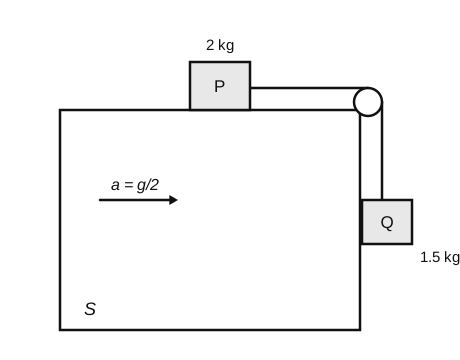
Two blocks ($P$ and $Q$) with respectively masses $2$ kg and $1.5$ kg are joined by a massless thread. These blocks are mounted on a frictionless pully which is fixed on the edge of a cube ($S$), as shown in the figure below. Block $P$ is positioned on the top surface which has no friction and block $Q$ is in contact with side-surface, having coefficient friction $\mu$. The cube ($S$) moves towards the right with acceleration of $\dfrac{g}{2}$, where $g$ is gravitational acceleration. During this movement the block $P$ and $Q$ remain stationary. The value of $\mu$ is ______ (take $g = 10\ \text{m/s}^2$)
Answer: (B) $0.67$
Concept. Work in the cube's frame. It accelerates to the right at $g/2$, so each block feels a pseudo force $m\dfrac g2$ to the left. In this frame both blocks are at rest, so the forces on each balance. On $Q$ (on the right side face) the pseudo force presses it into the face and so produces the normal force, which limits friction.
Step 1. Pseudo forces. With $g=10$ m s$^{-2}$, $g/2=5$ m s$^{-2}$:
$$P:\ 2\times5=10\ \text{N (left)},\qquad Q:\ 1.5\times5=7.5\ \text{N (left)}$$
Step 2. Isolate $P$ (smooth top face). Horizontal forces: tension $T$ to the right (towards the pulley) and the pseudo force to the left.
$$T=10\ \text{N}$$
Step 3. Isolate $Q$, horizontally. The pseudo force ($7.5$ N, left) pushes $Q$ against the face; the face pushes back:
$$N=7.5\ \text{N}$$
Step 4. Isolate $Q$, vertically. Weight $15$ N down, tension $10$ N up. The rest must come from friction, acting up:
$$f=15-10=5\ \text{N}$$
Step 5. Condition for no slipping.
$$f\le\mu N\ \Rightarrow\ 5\le7.5\mu\ \Rightarrow\ \mu\ge\frac23\approx0.67$$
Answer. $0.67$, option B (the least value that keeps the blocks stationary).
 Solution by Sreeraj P, M.Sc Physics