

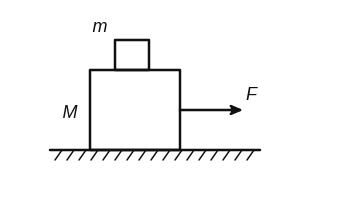
A system of two blocks of masses $m = 2$ kg and $M = 8$ kg is placed on a smooth table as shown in figure. The coefficient of static friction between two blocks is $0.5$. The maximum horizontal force $F$ that can be applied to the block of mass $M$ so that the blocks move together will be $(g = 9.8\ \text{m s}^{-2})$
Answer: (C) $49$ N
Concept. The force is applied to the lower block $M$. The upper block $m$ is dragged along only by static friction from $M$, and this friction cannot exceed $\mu mg$. So $m$ (and hence the whole system, if they move together) can accelerate at most at $\mu g$.
Step 1. Isolate the upper block $m$. Horizontal force: friction $f$ forward. Vertical: $N=mg$.
$$f=ma\le\mu mg\ \Rightarrow\ a\le\mu g=0.5\times9.8=4.9\ \text{m s}^{-2}$$
Step 2. Whole system. Moving together on a smooth table, the only external horizontal force is $F$:
$$F=(m+M)a$$
Step 3. Largest $F$.
$$F_{\max}=(2+8)\times4.9=49\ \text{N}$$
Answer. $49$ N, option C. Using $\mu mg=9.8$ N as the answer is a trap: that is the friction on $m$, not the applied force.
 Solution by Sreeraj P, M.Sc Physics


