

Two masses $A$ and $B$, each of mass $M$ are fixed together by a massless spring. A force acts on the mass $B$ as shown in figure. If the mass $A$ starts moving away from mass $B$ with acceleration $a$, then the acceleration of mass $B$ will be:
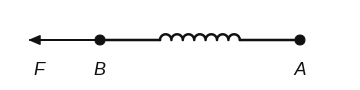
Answer: (D) $\frac{F-Ma}{M}$
Concept. A spring pulls its two ends with equal and opposite forces. Block $A$ has only the spring acting on it horizontally, so its acceleration tells us the spring force. That same force then acts on $B$ in the opposite direction.
Step 1. Isolate $A$. Only the spring force $F_s$ acts horizontally. Its acceleration has magnitude $a$, so
$$F_s=Ma$$
$A$ is being pulled towards $B$ (the spring is stretched as $B$ is pulled away by $F$).
Step 2. Isolate $B$. Two horizontal forces: the applied force $F$, directed away from $A$, and the spring force $Ma$, directed towards $A$.
Step 3. Newton's second law for $B$ (positive in the direction of $F$):
$$F-Ma=Ma_B\ \Rightarrow\ a_B=\frac{F-Ma}{M}$$
Answer. Option D. Check with the whole system: the spring forces are internal, so $F=Ma+Ma_B$, which gives the same $a_B$. (The question's words "moving away" are loose; the spring is stretched, so $A$ is actually dragged along after $B$. Only the size $a$ of $A$'s acceleration matters.)
 Solution by Sreeraj P, M.Sc Physics


