
PiTheory

PiTheory JEE Physics Practice & Revision Pack · Class 11 · Chapter 4 · JEE Main

Laws of Motion

Chapter-wise practice and revision for JEE Main: concise notes on the major equations and methods, concept figures, and 50 selected previous-year JEE Main questions covering the major concepts and question patterns, each with a step-by-step solution.

50 selected questions7 topics13 concept figuresFree sample · complete chapter

How to study this chapter

  1. Look at the topic's figures, then read its notes (5 to 10 minutes). They give the major equations and methods the questions use.
  2. Solve the topic's questions with a timer: 2 minutes for Easy, 3 to 4 for Medium and Hard.
  3. Check the solution. Read the Point to note line even if you were right: it is the idea you will reuse.
  4. Mark each question Got it or Revise. Come back to the Revise list after two days.

Where the marks come from

Main idea of each of the 161 previous-year JEE questions in the PiTheory bank

Friction38
Circular34
Momentum25
Newton's laws24
Pulleys17
Equilibrium14
Pseudo force9
01

Topic 1 · Q1–Q6

Newton's laws and force analysis

24 of the 161 JEE PYQs in the bank test this as their main idea

Look first

θmgNfmg sin θmg cos θ
Draw every free-body diagram like this: weight first, then each contact force.

Quick notes

$$\vec F_{\text{net}}=\frac{d\vec p}{dt}=m\vec a,\qquad a=\frac{dv}{dt}=v\frac{dv}{dx}$$

Use $v\,\dfrac{dv}{dx}$ whenever $v$ is given as a function of $x$. If $v=k\sqrt x$, then $a=\dfrac{k^2}{2}$ is constant.

  • First law: a body stays at rest or in uniform motion unless a net force acts on it. Inertia is measured by mass. A frame moving with constant velocity is inertial, so physics inside it is the same as on the ground.
  • Third law: action and reaction are equal, opposite, act on different bodies, and are the same kind of force. They never cancel. Pseudo forces have no reaction partner.
  • Free-body diagram: isolate one body. Draw weight, then every contact force: normal $N$ (perpendicular to the surface), friction $f$ (along it), tension $T$ (along the string, away from the body), spring force $kx$. Add $-m\vec a_0$ only if you work in an accelerating frame.
  • Constant force from rest: $\vec v=\dfrac{\vec F}{m}t$, $\vec r=\dfrac12\dfrac{\vec F}{m}t^2$. Treat each axis on its own. If $\vec r(t)$ is given, $\vec F=m\dfrac{d^2\vec r}{dt^2}$ and only the $t^2$ terms matter.
  • Rope, lift, climber: $T=m(g+a)$ when the acceleration is up (moving up faster, or moving down and slowing), $T=m(g-a)$ when it is down. The direction of acceleration decides this, not the direction of motion.
  • Yielding floor: block sinking with acceleration $a$: $N=m(g-a)$. A weighing machine reads $N$.
  • Balloon: upthrust $U$ stays the same when ballast is dropped. Going up with $a$: $U=M(g+a)$. To change $a\to a'$, drop $\Delta m=\dfrac{M(a'-a)}{g+a'}$.
  • Spring vs string: a string's tension can change at once; a spring's force cannot (its length needs time to change). When a string or support is cut, the spring force just after is the same as just before.
  • Heavy rope of mass $m$, length $L$, holding $M$: tension at height $x$ above the bottom is $\left(M+\dfrac{mx}{L}\right)g$.
Resistive forceResult
Constant drag $f$, thrown up$a_{\text{up}}=g+\dfrac fm$, $a_{\text{down}}=g-\dfrac fm$; $\dfrac{t_{\text{up}}}{t_{\text{down}}}=\sqrt{\dfrac{g-f/m}{g+f/m}}\lt 1$
$F=-kv$, moving horizontally$v=v_0e^{-kt/m}$, stops after $x=\dfrac{mv_0}{k}$
$F=-kv$, falling from rest$v=v_T\left(1-e^{-kt/m}\right)$, terminal speed $v_T=\dfrac{mg}{k}$
$F=-kv^2$$\dfrac1v-\dfrac1{v_0}=\dfrac{k}{m}t$, $\;v=v_0e^{-kx/m}$
Traps. Do not add action and reaction in one FBD. Units: 1 kgf $=9.8$ N, 1 N $=10^5$ dyne. "Uniform velocity" anywhere (lift, train) means no change from the ground case.
More standard resultsResult
$F(x)$ given (e.g. $F=3x$)use $\tfrac12mv^2-\tfrac12mu^2=\int F\,dx$
$F(t)=F_0e^{-bt}$ from rest$v=\dfrac{F_0}{mb}\left(1-e^{-bt}\right)$, approaches $\dfrac{F_0}{mb}$
Same retarding force, mass increasedstopping distance $s=\dfrac{mv^2}{2F}\propto m$ (25% more load → $1.25x$)
Climber on a rope with breaking load $T_0$$a_{\max}=\dfrac{T_0}{m}-g$ (lighter climbers can go faster)

Practice: 6 questions

Q1JEE Main 2026 (4 Apr, Shift 2)Easy

At $t = 0$, a body of mass $100$ g starts moving under the influence of a force $(5\hat{i} + 10\hat{j})$ N. After $2$ s its position is $(2x\hat{i} + 5y\hat{j})$ m. The ratio $x : y$ is ______.

  1. A$1 : 2$
  2. B$2 : 5$
  3. C$5 : 2$
  4. D$5 : 4$
Answer and solution

Answer: Option D: $5 : 4$

Concept. A constant force gives a constant acceleration $\vec a=\vec F/m$. From rest at the origin the position is $\vec r=\tfrac12\vec a\,t^2$, and each component can be handled on its own.

Step 1. Find the acceleration. Convert the mass: $m=100$ g $=0.1$ kg. $$\vec a=\frac{\vec F}{m}=\frac{5\hat i+10\hat j}{0.1}=50\hat i+100\hat j\ \text{m s}^{-2}$$

Step 2. Position after 2 s. The body starts from rest ($\vec u=0$), so $$\vec r=\tfrac12\vec a\,t^2=\tfrac12(50\hat i+100\hat j)(2)^2=100\hat i+200\hat j\ \text{m}$$

Step 3. Compare with the given form. Match the components with $2x\hat i+5y\hat j$: $$2x=100\Rightarrow x=50,\qquad 5y=200\Rightarrow y=40$$

Answer. $x:y=50:40=5:4$, option D. Note that $x$ and $y$ are not the coordinates themselves; they are defined through $2x$ and $5y$.

Point to note. A constant force from rest gives $\vec r=\tfrac12(\vec F/m)t^2$. Work each component separately.
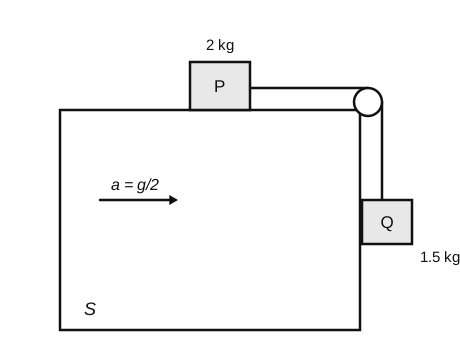
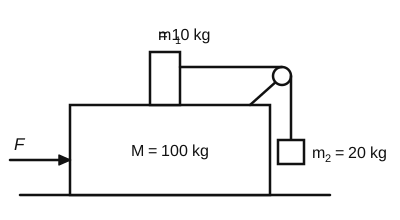
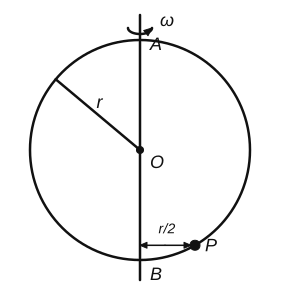
Q2JEE Main 2023 (11 Apr, Shift 2)Medium

A body of mass $500\ \text{g}$ moves along $x$-axis such that its velocity varies with displacement $x$ according to the relation $v=10\sqrt x\ \text{m s}^{-1}$. The force acting on the body is

  1. A$125\ \text{N}$
  2. B$25\ \text{N}$
  3. C$166\ \text{N}$
  4. D$5\ \text{N}$
Answer and solution

Answer: Option B: $25\ \text{N}$

Concept. By Newton's second law $F=ma$. When the velocity is given as a function of position (not time), the acceleration is found from the chain rule $a=\dfrac{dv}{dt}=\dfrac{dv}{dx}\dfrac{dx}{dt}=v\dfrac{dv}{dx}$.

Step 1. Differentiate $v$ with respect to $x$. $$v=10\sqrt x\ \Rightarrow\ \frac{dv}{dx}=\frac{10}{2\sqrt x}=\frac{5}{\sqrt x}$$

Step 2. Acceleration. $$a=v\frac{dv}{dx}=10\sqrt x\cdot\frac{5}{\sqrt x}=50\ \text{m s}^{-2}$$ The $\sqrt x$ cancels, so the acceleration is constant.

Step 3. Force. With $m=500$ g $=0.5$ kg, $$F=ma=0.5\times50=25\ \text{N}$$

Answer. $25$ N, option B. Shortcut: $v=k\sqrt x$ is the same as $v^2=k^2x$, which is $v^2=2ax$ with $a=k^2/2$.

Point to note. $v$ given in terms of $x$ means $a=v\,dv/dx$. For $v=k\sqrt x$, $a=k^2/2$ is constant (here $k=10$, $a=50$). The same pattern came again in 2025 with $v=4\sqrt x$.

Q3JEE Main 2022 (26 Jul, Shift 1)Easy

A monkey of mass $50\ \text{kg}$ climbs on a rope which can withstand a tension $(T)$ of $350\ \text{N}$. If the monkey initially climbs down with an acceleration of $4\ \text{m s}^{-2}$ and then climbs up with an acceleration of $5\ \text{m s}^{-2}$, choose the correct option. ($g = 10\ \text{m s}^{-2}$)

  1. A$T = 700\ \text{N}$ while climbing upward
  2. B$T = 350\ \text{N}$ while going downward
  3. CRope will break while climbing upward
  4. DRope will break while going downward
Answer and solution

Answer: Option C: Rope will break while climbing upward

Concept. Isolate the monkey. Only two forces act on it: its weight $mg$ down and the rope's tension $T$ up. Newton's second law then gives $T$, and the sign of the acceleration (not the direction of motion) decides whether $T$ is more or less than $mg$.

Step 1. Climbing down with acceleration $4$ m s$^{-2}$ downward. Take downward as positive: $$mg-T=ma\ \Rightarrow\ T=m(g-a)=50(10-4)=300\ \text{N}$$ This is below the $350$ N limit, so the rope holds.

Step 2. Climbing up with acceleration $5$ m s$^{-2}$ upward. Take upward as positive: $$T-mg=ma\ \Rightarrow\ T=m(g+a)=50(10+5)=750\ \text{N}$$

Step 3. Compare with the breaking load. $750\ \text{N}>350\ \text{N}$, so the rope cannot supply this tension.

Answer. The rope breaks while the monkey climbs upward, option C. Options A and B quote tensions that are not what the rope would need ($750$ N and $300$ N).

Point to note. Tension depends on the direction of acceleration: $T=m(g+a)$ up, $m(g-a)$ down. Compare with the breaking load.

Q4JEE Main 2025 (28 Jan, Shift 2)Medium

A balloon and its content having mass $M$ is moving up with an acceleration $a$. The mass that must be released from the content so that the balloon starts moving up with an acceleration $3a$ will be (Take $g$ as acceleration due to gravity)

  1. A$\dfrac{2Ma}{3a+g}$
  2. B$\dfrac{3Ma}{2a-g}$
  3. C$\dfrac{3Ma}{2a+g}$
  4. D$\dfrac{2Ma}{3a-g}$
Answer and solution

Answer: Option A: $\dfrac{2Ma}{3a+g}$

Concept. Two forces act on the balloon system: the upthrust $U$ of the air (it depends only on the balloon's volume, so it does not change when ballast is dropped) and the weight. Write Newton's second law before and after releasing mass, then eliminate $U$.

Step 1. Before release. Mass $M$, acceleration $a$ upward: $$U-Mg=Ma\ \Rightarrow\ U=M(g+a)$$

Step 2. After releasing mass $m$. The remaining mass $M-m$ has acceleration $3a$ upward, with the same $U$: $$U-(M-m)g=(M-m)\,3a\ \Rightarrow\ U=(M-m)(g+3a)$$

Step 3. Equate the two expressions for $U$. $$M(g+a)=(M-m)(g+3a)$$ $$Mg+Ma=Mg+3Ma-m(g+3a)\ \Rightarrow\ m(g+3a)=2Ma$$ $$m=\frac{2Ma}{3a+g}$$

Answer. Option A. Check: if the new acceleration were still $a$, the formula $\dfrac{M(a'-a)}{g+a'}$ gives $m=0$, as it should.

Point to note. Upthrust is unchanged when ballast is released. Write the equation before and after and eliminate $U$.

Q5JEE Main 2022 (24 Jun, Shift 2)Medium

An object of mass $5\ \text{kg}$ is thrown vertically upwards from the ground. The air resistance produces a constant retarding force of $10\ \text{N}$ throughout the motion. The ratio of time of ascent to the time of descent will be equal to: [Use $g = 10\ \text{m s}^{-2}$]

  1. A$1 : 1$
  2. B$\sqrt2 : \sqrt3$
  3. C$\sqrt3 : \sqrt2$
  4. D$2 : 3$
Answer and solution

Answer: Option B: $\sqrt2 : \sqrt3$

Concept. Air resistance always opposes the velocity. Going up, it acts downward together with gravity; coming down, it acts upward against gravity. So the two accelerations differ, and the same height is covered in different times.

Step 1. Acceleration due to air resistance. $$\frac{f}{m}=\frac{10}{5}=2\ \text{m s}^{-2}$$

Step 2. Ascent. Weight and drag both point down: $$a_u=g+\frac fm=10+2=12\ \text{m s}^{-2}\ (\text{retardation})$$

Step 3. Descent. Weight down, drag up: $$a_d=g-\frac fm=10-2=8\ \text{m s}^{-2}$$

Step 4. Relate time to acceleration. The ascent ends at rest at height $h$ and the descent starts from rest at $h$. Reversing the ascent in time, both are motions from rest over $h$, so $h=\tfrac12at^2$ and $t=\sqrt{2h/a}\propto\dfrac{1}{\sqrt a}$. $$\frac{t_u}{t_d}=\sqrt{\frac{a_d}{a_u}}=\sqrt{\frac{8}{12}}=\sqrt{\frac23}=\frac{\sqrt2}{\sqrt3}$$

Answer. $\sqrt2:\sqrt3$, option B. With any resistance the ascent is quicker than the descent, so options with ratio $\ge1$ can be rejected at once.

Point to note. Drag always opposes velocity, so it adds to $g$ going up and subtracts coming down. Ascent is always quicker than descent.

Q6JEE Main 2017 (2 Apr)Medium

A body of mass $m = 10^{-2}$ kg is moving in a medium and experiences a frictional force $F = -kv^2$. Its initial speed is $v_0 = 10\ \text{m s}^{-1}$. After $10$ s its kinetic energy is $\frac18 mv_0^2$. Then the value of $k$ will be:

  1. A$10^{-1}\ \text{kg m}^{-1}\text{s}^{-1}$
  2. B$10^{-3}\ \text{kg m}^{-1}$
  3. C$10^{-3}\ \text{kg s}^{-1}$
  4. D$10^{-4}\ \text{kg m}^{-1}$
Answer and solution

Answer: Option D: $10^{-4}\ \text{kg m}^{-1}$

Concept. The only force along the motion is the resistance $F=-kv^2$, so Newton's second law gives a differential equation $m\dfrac{dv}{dt}=-kv^2$. Separate the variables and integrate. The kinetic energy condition gives the final speed.

Step 1. Speed after 10 s. $$\tfrac12mv^2=\tfrac18mv_0^2\ \Rightarrow\ v^2=\frac{v_0^2}{4}\ \Rightarrow\ v=\frac{v_0}{2}=5\ \text{m s}^{-1}$$

Step 2. Set up and separate. $$m\frac{dv}{dt}=-kv^2\ \Rightarrow\ \frac{dv}{v^2}=-\frac km\,dt$$

Step 3. Integrate from $v_0$ at $t=0$ to $v$ at $t$. $$\int_{v_0}^{v}\frac{dv}{v^2}=-\frac km\int_0^t dt\ \Rightarrow\ -\frac1v+\frac1{v_0}=-\frac km t\ \Rightarrow\ \frac1v-\frac1{v_0}=\frac km t$$

Step 4. Substitute. $m=10^{-2}$ kg, $t=10$ s: $$\frac15-\frac1{10}=\frac{k}{10^{-2}}\times10\ \Rightarrow\ 0.1=1000\,k\ \Rightarrow\ k=10^{-4}$$

Step 5. Unit. $kv^2$ is a force, so $[k]=\dfrac{\text{kg m s}^{-2}}{\text{m}^2\text{s}^{-2}}=\text{kg m}^{-1}$.

Answer. $k=10^{-4}$ kg m$^{-1}$, option D. The unit alone rules out options A and C.

Point to note. Separate variables: $\int dv/v^2=-(k/m)\int dt$. Also remember $F=-kv\Rightarrow v=v_0e^{-kt/m}$.

02

Topic 2 · Q7–Q13

Momentum, impulse and variable mass

25 of the 161 JEE PYQs in the bank test this as their main idea

Look first

tFarea = impulse J = ΔpFavgcontact time Δt
Impulse is the area under the F–t graph. A longer contact time means a smaller average force.

Quick notes

$$\vec J=\int\vec F\,dt=\Delta\vec p=\vec F_{\text{avg}}\,\Delta t$$

Impulse is the area under the $F$–$t$ graph. Force is the slope of the $p$–$t$ graph. Same $\Delta p$ over a longer time gives a smaller average force (catching with hands drawn back, airbags).

Collision with a wall or ground$|\Delta\vec p|$
Stops / rebounds with the same speed$mv$ / $2mv$
Hits at $v_1$, rebounds at $v_2$ (dropped from $h_1$, rises to $h_2$)$m(v_1+v_2)=m\left(\sqrt{2gh_1}+\sqrt{2gh_2}\right)$
Hits at angle $\theta$ with the wall, same speed$2mv\sin\theta$, normal to the wall
Uniform circular motion through angle $\theta$$2mv\sin\dfrac\theta2$
Streams and variable massForce
Gun firing $n$ bullets per second$F=nmv$ (force needed to hold the gun)
Jet (density $\rho$, area $A$) stops / rebounds$\rho Av^2$ / $2\rho Av^2$; pressure $=F/A$
Sand falling on a belt moving at $v$$F=v\dfrac{dm}{dt}$, $P=Fv=v^2\dfrac{dm}{dt}$
Ship sweeping up dust at rest$m\dfrac{dv}{dt}=-v\dfrac{dm}{dt}$
Rocket (exhaust speed $u$ relative)thrust $u\dfrac{dm}{dt}$; $\;u\dfrac{dm}{dt}-mg=ma$; $\;v=u\ln\dfrac{m_0}{m}-gt$
$$\sum\vec F_{\text{ext}}=0\ \Rightarrow\ \vec p_{\text{total}}=\text{constant}$$

Recoil: $MV=mv$. Push-off with relative speed $v_r$: $v_1=\dfrac{m_2v_r}{m_1+m_2}$. Body at rest explodes into three: the third momentum is equal and opposite to the vector sum of the other two.

  • If $|\vec p|$ is constant but its direction changes (for example $\vec p=\cos kt\,\hat i-\sin kt\,\hat j$), then $\vec F\perp\vec p$.
  • Impulse is the same whatever the stopping time; only the average force changes.
Traps. Momentum is a vector: a rebound adds speeds. On the belt the force is $v\,dm/dt$, not $\tfrac12v\,dm/dt$; half the power goes into heat. Use the rocket equation with $g$ only when the question has gravity.
More standard resultsResult
Water from a hose, flow rate $Q$, area $A$$F=\rho Qv=\dfrac{\rho Q^2}{A}$; doubling $Q$ needs $4\times$ the force
Flow turning through a 90° bend$F=\sqrt2\,\rho Av^2$
Plate moving at $v_1$ into a jet of speed $v$use relative speed $v+v_1$ for both the mass rate and the momentum change
Chain falling onto a table, length $y$ already fallenforce on table $=\dfrac{3Mgy}{L}$ (three times the weight already on it)
Shell explodes at the top of its pathconserve horizontal momentum: $Mu\cos\theta=m_1v_1+m_2v_2$
Block slides down a smooth wedge (base $b$) on a smooth floorwedge moves back $\dfrac{mb}{M+m}$

Practice: 7 questions

Q7JEE Main 2023 (30 Jan, Shift 1)Medium

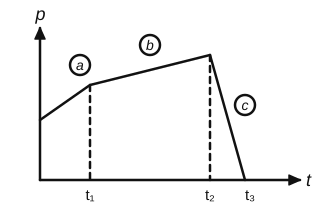
The figure represents the momentum–time ($p$–$t$) curve for a particle moving along an axis under the influence of the force. Identify the regions on the graph where the magnitude of the force is maximum and minimum respectively. (Given $t_3-t_2<t_1$)

p-t graph: region a rises steeply from 0 to t1, region b rises gently from t1 to t2, region c falls steeply to zero from t2 to t3
  1. Ac and a
  2. Bb and c
  3. Cc and b
  4. Da and b
Answer and solution

Answer: Option C: c and b

Concept. Newton's second law in its original form is $F=\dfrac{dp}{dt}$. On a $p$–$t$ graph this is the slope, so the steepest region has the largest force and the flattest region the smallest.

Step 1. Read the regions. In the figure, region a (from $0$ to $t_1$) has $p$ rising moderately; region b (from $t_1$ to $t_2$) has $p$ rising only slightly over a long time; region c (from $t_2$ to $t_3$) has $p$ falling all the way to zero.

Step 2. Compare slopes.

  • Region c: the largest change in momentum (from its peak to zero) over the shortest time, since $t_3-t_2<t_1$. Steepest slope.
  • Region a: a smaller change over a time $t_1$. Moderate slope.
  • Region b: the smallest rise over the longest interval. Flattest slope.

Step 3. Convert to force. $|F|=\left|\dfrac{\Delta p}{\Delta t}\right|$ is largest in c and smallest in b. The sign of the slope only gives the direction of the force; the question asks for magnitude.

Answer. Maximum in c, minimum in b: option C.

Point to note. $F=dp/dt$ is the slope of the $p$–$t$ graph; impulse is the area under the $F$–$t$ graph.

Q8JEE Main 2023 (11 Apr, Shift 1)Easy

An average force of $125\ \text{N}$ is applied on a machine gun firing bullets each of mass $10\ \text{g}$ at the speed of $250\ \text{m s}^{-1}$ to keep it in position. The number of bullets fired per second by the machine gun is

  1. A50
  2. B25
  3. C100
  4. D5
Answer and solution

Answer: Option A: 50

Concept. By Newton's second law the force on the bullets equals the momentum given to them per second. By the third law the bullets push back on the gun with the same force, and the person holding the gun must supply it.

Step 1. Momentum of one bullet. $$p=mv=0.01\times250=2.5\ \text{kg m s}^{-1}$$

Step 2. Momentum per second. If $n$ bullets are fired per second, the momentum given per second is $n\,mv$, so $$F=n\,mv$$

Step 3. Solve for $n$. $$n=\frac{F}{mv}=\frac{125}{2.5}=50\ \text{per second}$$

Answer. $50$, option A. Remember to convert $10$ g to $0.01$ kg; leaving it in grams gives $0.05$.

Point to note. Force on a gun $=$ momentum given to bullets per second $=nmv$.

Q9JEE Main 2024 (30 Jan, Shift 1)Medium

A spherical body of mass $100\ \text{g}$ is dropped from a height of $10\ \text{m}$ from the ground. After hitting the ground, the body rebounds to a height of $5\ \text{m}$. The impulse of force imparted by the ground to the body is given by: (given $g = 9.8\ \text{m s}^{-2}$)

  1. A$4.32\ \text{kg m s}^{-1}$
  2. B$43.2\ \text{kg m s}^{-1}$
  3. C$23.9\ \text{kg m s}^{-1}$
  4. D$2.39\ \text{kg m s}^{-1}$
Answer and solution

Answer: Option D: $2.39\ \text{kg m s}^{-1}$

Concept. Impulse equals the change in momentum, $\vec J=\Delta\vec p$. The body arrives moving down and leaves moving up, so the two momenta are in opposite directions and their magnitudes add.

Step 1. Speed just before hitting the ground. Free fall from $h_1=10$ m: $$v_1=\sqrt{2gh_1}=\sqrt{2\times9.8\times10}=\sqrt{196}=14\ \text{m s}^{-1}\ (\text{down})$$

Step 2. Speed just after the bounce. It rises to $h_2=5$ m, so $$v_2=\sqrt{2gh_2}=\sqrt{98}\approx9.9\ \text{m s}^{-1}\ (\text{up})$$

Step 3. Change in momentum. Take upward as positive: $p_i=-mv_1$, $p_f=+mv_2$. $$J=p_f-p_i=m(v_2+v_1)=0.1\times(9.9+14)=0.1\times23.9\approx2.39\ \text{kg m s}^{-1}$$

Answer. $2.39$ kg m s$^{-1}$, upward, option D. Subtracting the speeds ($0.41$) is the usual mistake: momentum is a vector.

Point to note. Speeds before and after are opposite, so $|\Delta p|=m(v_1+v_2)$ with $v=\sqrt{2gh}$ each way.

Q10JEE Main 2021 (27 Jul, Shift 2)Medium

A particle of mass $M$ originally at rest is subjected to a force whose direction is constant but magnitude varies with time according to the relation $F = F_0\left[1 - \left(\dfrac{t - T}{T}\right)^2\right]$ where $F_0$ and $T$ are constants. The force acts only for the time interval $2T$. The velocity $v$ of the particle after time $2T$ is:

  1. A$\dfrac{2F_0T}{M}$
  2. B$\dfrac{F_0T}{2M}$
  3. C$\dfrac{4F_0T}{3M}$
  4. D$\dfrac{F_0T}{3M}$
Answer and solution

Answer: Option C: $\dfrac{4F_0T}{3M}$

Concept. For a force that varies with time, the impulse is $J=\int F\,dt$, and it equals the change in momentum. The particle starts from rest, so its final momentum is $Mv=J$.

Step 1. Write the impulse. $$J=\int_0^{2T}F_0\left[1-\left(\frac{t-T}{T}\right)^2\right]dt$$

Step 2. Substitute to simplify. Let $u=\dfrac{t-T}{T}$, so $dt=T\,du$. When $t=0$, $u=-1$; when $t=2T$, $u=1$. $$J=F_0T\int_{-1}^{1}(1-u^2)\,du=F_0T\left[u-\frac{u^3}{3}\right]_{-1}^{1}=F_0T\left(\frac23+\frac23\right)=\frac{4F_0T}{3}$$

Step 3. Final velocity. The direction of the force is fixed, so $$Mv=J\ \Rightarrow\ v=\frac{4F_0T}{3M}$$

Answer. Option C. Check: the force curve is a parabola with peak $F_0$ over a base $2T$; the area of such a parabolic arch is $\tfrac23\times$ base $\times$ height $=\tfrac23(2T)F_0$.

Point to note. Impulse is $\int F\,dt$; from rest, $v=J/M$. A substitution keeps the integral short.

Q11JEE Main 2019 (11 Jan, Shift 1)Medium

A liquid of density $\rho$ is coming out of a hose pipe of radius $a$ with horizontal speed $v$ and hits a mesh. $50\%$ of the liquid passes through the mesh unaffected. $25\%$ loses all of its momentum and $25\%$ comes back with the same speed. The resultant pressure on the mesh will be:

  1. A$\dfrac14\rho v^2$
  2. B$\dfrac34\rho v^2$
  3. C$\dfrac12\rho v^2$
  4. D$\rho v^2$
Answer and solution

Answer: Option B: $\dfrac34\rho v^2$

Concept. The force on the mesh equals the rate of change of momentum of the liquid that hits it. Different fractions of the liquid have different momentum changes, so add their contributions. Pressure is then force divided by area.

Step 1. Mass arriving per second. In one second a column of length $v$ and cross-section $A=\pi a^2$ leaves the pipe: $$\frac{dm}{dt}=\rho Av$$

Step 2. Momentum change per unit mass for each part. Each kilogram arrives with momentum $v$.

  • $50\%$ passes through unaffected: change $0$.
  • $25\%$ stops: change $v$.
  • $25\%$ comes back with speed $v$: change $v-(-v)=2v$.

Step 3. Force on the mesh. $$F=0.25\,\rho Av\cdot v+0.25\,\rho Av\cdot2v=0.75\,\rho Av^2=\frac34\rho Av^2$$

Step 4. Pressure. $$P=\frac FA=\frac34\rho v^2$$

Answer. Option B. A rebounding fraction counts twice as much as a stopped fraction.

Point to note. Force of a jet $=$ momentum change per second. Stopped part counts $\rho Av^2$, reflected part $2\rho Av^2$, passing part zero.

Q12JEE Main 2025 (29 Jan, Shift 2)Medium

A sand dropper drops sand of mass $m(t)$ on a conveyor belt at a rate proportional to the square root of the speed $(v)$ of the belt, i.e. $\dfrac{dm}{dt} \propto \sqrt v$. If $P$ is the power delivered to run the belt at constant speed, then which of the following relationships is true?

  1. A$P \propto \sqrt v$
  2. B$P \propto v$
  3. C$P^2 \propto v^5$
  4. D$P^2 \propto v^3$
Answer and solution

Answer: Option C: $P^2 \propto v^5$

Concept. Sand lands on the belt with no horizontal velocity and must be brought up to the belt's speed $v$. The momentum given to the sand per second is $v\dfrac{dm}{dt}$, so this is the extra force the motor must supply to keep $v$ constant. The power is $P=Fv$.

Step 1. Force needed. $$F=\frac{d(mv)}{dt}=v\frac{dm}{dt}\quad(v\text{ constant})$$

Step 2. Use the given rate. $\dfrac{dm}{dt}\propto\sqrt v$, so $$F\propto v\cdot v^{1/2}=v^{3/2}$$

Step 3. Power. $$P=Fv\propto v^{3/2}\cdot v=v^{5/2}$$

Step 4. Match the options. Squaring removes the fraction: $$P^2\propto v^5$$

Answer. Option C. Do not use $\tfrac12v^2\dfrac{dm}{dt}$ (the rate of gain of kinetic energy) for the power: the other half of $P$ is lost as heat while the sand slips on the belt.

Point to note. Keeping the belt at constant speed needs $F=v\,dm/dt$, and $P=Fv$. Then apply the given proportionality.

Q13JEE Main 2021 (26 Aug, Shift 1)Medium

The initial mass of a rocket is $1000$ kg. Calculate at what rate the fuel should be burnt so that the rocket is given an acceleration of $20$ m s$^{-2}$. The gases come out at a relative speed of $500$ m s$^{-1}$, with respect to the rocket: [Use $g = 10$ m s$^{-2}$]

  1. A$10$ kg s$^{-1}$
  2. B$60$ kg s$^{-1}$
  3. C$500$ kg s$^{-1}$
  4. D$6.0\times10^2$ kg s$^{-1}$
Answer and solution

Answer: Option B: $60$ kg s$^{-1}$

Concept. The exhaust gases leave at speed $u$ relative to the rocket, so they push the rocket forward with a thrust $u\dfrac{dm}{dt}$ (rate of momentum given to the gas). Isolate the rocket: thrust up, weight down, and apply Newton's second law with the current mass.

Step 1. Forces on the rocket at the start. Mass $m=1000$ kg, upward thrust $u\dfrac{dm}{dt}$, weight $mg$ down.

Step 2. Newton's second law (upward positive). $$u\frac{dm}{dt}-mg=ma$$

Step 3. Solve for the burn rate. $$\frac{dm}{dt}=\frac{m(g+a)}{u}=\frac{1000\times(10+20)}{500}=60\ \text{kg s}^{-1}$$

Answer. $60$ kg s$^{-1}$, option B. Forgetting gravity gives $40$ kg s$^{-1}$, which is not offered, a hint that $g$ must be included.

Point to note. Thrust $u\,dm/dt$ must beat gravity and also supply $ma$. Use the mass at that instant.

03

Topic 3 · Q14–Q18

Equilibrium of concurrent forces

14 of the 161 JEE PYQs in the bank test this as their main idea

Look first

F₁F₂F₃γαβF₁F₂F₃closed triangleF₁/sin α = F₂/sin β = F₃/sin γ
Three forces in equilibrium close a triangle; Lami's theorem uses the angle between the other two forces.

Quick notes

$$\sum F_x=0,\quad \sum F_y=0,\qquad \frac{F_1}{\sin\alpha}=\frac{F_2}{\sin\beta}=\frac{F_3}{\sin\gamma}$$

Lami's theorem: three concurrent forces in equilibrium, each angle measured between the other two forces. Three such forces, taken in order, form a closed triangle.

Standard set-upResult
Two strings at $\theta_1$, $\theta_2$ to the ceiling$T_1=\dfrac{mg\cos\theta_2}{\sin(\theta_1+\theta_2)}$, $T_2=\dfrac{mg\cos\theta_1}{\sin(\theta_1+\theta_2)}$; the steeper string has more tension
Bob held at $\theta$ by a horizontal force$F=mg\tan\theta$, $T=\sqrt{F^2+(mg)^2}=mg\sec\theta$
Horizontal $F$ at a point of a light rope holding $M$upper part: $\tan\alpha=\dfrac{F}{Mg}$ (the point's position on the rope does not matter)
Block on a smooth incline held by horizontal $F$$F=mg\tan\theta$, $N=mg\sec\theta$
Held by a force along the incline$F=mg\sin\theta$, $N=mg\cos\theta$
Chain hanging between two supports at $\theta$ to the horizontalat support $T=\dfrac{mg}{2\sin\theta}$; at the lowest point $T_0=\dfrac{mg}{2}\cot\theta$
Body hanging by a chain of mass $m$pull at the top $=(M+m)g$
Traps. Read whether an angle is given from the vertical or the horizontal. If two strings are perpendicular, $T_1=mg\cos(\text{its angle with the vertical})$. A rope can never be pulled perfectly straight while holding a weight (it would need infinite tension).
More standard resultsResult
Two forces with sum $S$, resultant $R$ perpendicular to the smaller$F_2^2-F_1^2=R^2$ with $F_1+F_2=S$
Removing one force from a balanced setthe rest add up to a force equal and opposite to it: $a=F_{\text{removed}}/m$
Person wedged between two vertical wallseach wall: $N=\dfrac{mg}{2\mu}$ (at the limit)

Practice: 5 questions

Q14JEE Main 2025 (2 Apr, Shift 2)Easy

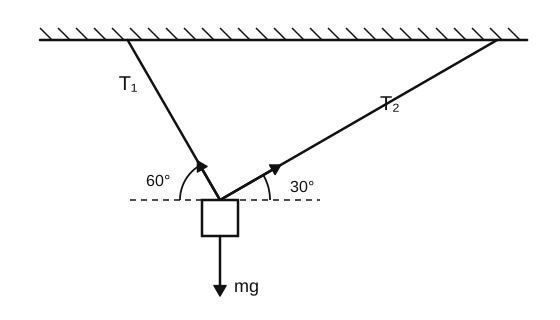
A body of mass $1\ \text{kg}$ is suspended with the help of two strings making angles as shown in the figure. The magnitudes of tensions $T_1$ and $T_2$, respectively, are (in N): (take $g = 10\ \text{m/s}^2$)

Block hanging from a ceiling by two strings: T1 on the left at 60 degrees to the horizontal and T2 on the right at 30 degrees, weight mg downward
  1. A$5,\ 5\sqrt3$
  2. B$5\sqrt3,\ 5$
  3. C$5\sqrt3,\ 5\sqrt3$
  4. D$5,\ 5$
Answer and solution

Answer: Option B: $5\sqrt3,\ 5$

Concept. The body is in equilibrium under three concurrent forces: $T_1$, $T_2$ and $mg$. Resolve them horizontally and vertically and set each sum to zero.

Step 1. Read the angles. From the figure, $T_1$ (left string) makes $60^\circ$ with the horizontal and $T_2$ (right string) makes $30^\circ$. The angle between the strings is $180^\circ-60^\circ-30^\circ=90^\circ$, so they are perpendicular.

Step 2. Horizontal balance. $$T_1\cos60^\circ=T_2\cos30^\circ\ \Rightarrow\ \frac{T_1}{2}=\frac{\sqrt3\,T_2}{2}\ \Rightarrow\ T_1=\sqrt3\,T_2$$

Step 3. Vertical balance. $mg=1\times10=10$ N: $$T_1\sin60^\circ+T_2\sin30^\circ=10$$ $$\sqrt3T_2\cdot\frac{\sqrt3}{2}+\frac{T_2}{2}=\frac{3T_2}{2}+\frac{T_2}{2}=2T_2=10\ \Rightarrow\ T_2=5\ \text{N}$$

Step 4. Back-substitute. $T_1=\sqrt3\times5=5\sqrt3$ N.

Answer. $5\sqrt3$ N and $5$ N, option B. Shortcut for perpendicular strings: each tension is $mg\cos(\text{its angle with the vertical})$: $T_1=10\cos30^\circ$, $T_2=10\cos60^\circ$. The steeper string carries more.

Point to note. When two strings are perpendicular, the tensions are simply $mg\cos$ of each string's angle with the vertical.

Q15JEE Main 2022 (25 Jun, Shift 2)Medium

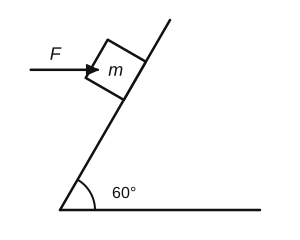
A block of mass $200\ \text{g}$ is kept stationary on a smooth inclined plane by applying a minimum horizontal force $F = \sqrt x\ \text{N}$ as shown in figure. The value of $x$ = ______.

A block of mass m on a smooth incline of angle 60 degrees, pushed by a horizontal force F towards the incline

Numerical answer type

Answer and solution

Answer: 12

Concept. The block is at rest on a smooth incline, so only three forces act: weight $mg$, normal force $N$ (perpendicular to the incline) and the horizontal force $F$. Resolving along the incline removes $N$ and gives $F$ directly.

Step 1. Forces and axis. The incline makes $60^\circ$ with the horizontal and $F$ pushes horizontally towards the incline. Take the axis along the incline.

  • Weight: component $mg\sin60^\circ$ down the incline.
  • $F$: component $F\cos60^\circ$ up the incline (the horizontal makes $60^\circ$ with the incline).
  • $N$: no component along the incline.

Step 2. Balance along the incline. $$F\cos60^\circ=mg\sin60^\circ\ \Rightarrow\ F=mg\tan60^\circ$$

Step 3. Substitute. $m=0.2$ kg, $g=10$ m s$^{-2}$: $$F=0.2\times10\times\sqrt3=2\sqrt3=\sqrt{12}\ \text{N}$$

Answer. $x=12$. On a smooth incline this horizontal force is the only one that holds the block, so "minimum" just fixes the case; the normal force is $mg\sec60^\circ=4$ N.

Point to note. Horizontal force holding a block on a smooth incline: $F=mg\tan\theta$, $N=mg\sec\theta$.

Q16JEE Main 2022 (25 Jul, Shift 1)Medium

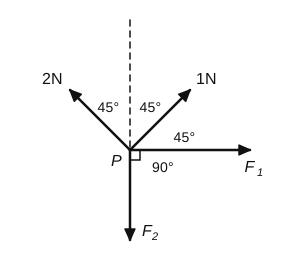
Four forces are acting at a point $P$ in equilibrium as shown in figure. The ratio of force $F_1$ to $F_2$ is $1 : x$ where $x$ = ______.

At point P: a 2 N force up and to the left at 45 degrees to the vertical, a 1 N force up and to the right at 45 degrees, F1 along the positive x direction and F2 vertically downward

Numerical answer type

Answer and solution

Answer: 3

Concept. For a point in equilibrium, the components of all forces along each axis add to zero. Choose $x$ to the right (along $F_1$) and $y$ upward (opposite to $F_2$).

Step 1. Read the figure. At $P$: $F_1$ acts to the right, $F_2$ acts downward, the $2$ N force points up and to the left at $45^\circ$ to the vertical, and the $1$ N force points up and to the right at $45^\circ$ to the vertical. So each slanted force has components of magnitude $\text{force}\times\dfrac1{\sqrt2}$ along both axes.

Step 2. Sum of $x$-components. $$F_1+\frac{1}{\sqrt2}-\frac{2}{\sqrt2}=0\ \Rightarrow\ F_1=\frac{1}{\sqrt2}\ \text{N}$$

Step 3. Sum of $y$-components. $$\frac{1}{\sqrt2}+\frac{2}{\sqrt2}-F_2=0\ \Rightarrow\ F_2=\frac{3}{\sqrt2}\ \text{N}$$

Step 4. Ratio. $$F_1:F_2=\frac{1}{\sqrt2}:\frac{3}{\sqrt2}=1:3$$

Answer. $x=3$. The $\sqrt2$ cancels, so the ratio is just $(2-1):(2+1)$.

Point to note. Resolve every force along $x$ and $y$ and set each sum to zero. Take angles carefully from the figure.

Q17JEE Main 2022 (27 Jun, Shift 2)Medium

A mass of $10$ kg is suspended vertically by a rope of length $5$ m from the roof. A force of $30$ N is applied at the middle point of rope in horizontal direction. The angle made by upper half of the rope with vertical is $\alpha = \tan^{-1}(x\times10^{-1})$. The value of $x$ is ______ .

(Given, $g = 10\ \text{m s}^{-2}$)

Numerical answer type

Answer and solution

Answer: 3

Concept. Treat the rope as light. Then the lower half simply transmits the weight, and the point where the horizontal force acts is in equilibrium under three forces. The upper half's tension must balance the resultant of the other two.

Step 1. Lower half. It holds the $10$ kg mass at rest, so it is vertical and its tension is $$T_2=Mg=10\times10=100\ \text{N}$$ It pulls the midpoint straight down with $100$ N.

Step 2. Forces at the midpoint. Three forces: $100$ N down (lower half), $30$ N horizontal (applied), and $T_1$ along the upper half, at angle $\alpha$ to the vertical.

Step 3. Resolve. $$T_1\sin\alpha=30,\qquad T_1\cos\alpha=100$$ Dividing, $$\tan\alpha=\frac{30}{100}=0.3=3\times10^{-1}$$

Answer. $x=3$. The rope length ($5$ m) and the position of the point on the rope do not matter for a light rope.

Point to note. For a light rope, $\tan\alpha=F/(Mg)$. Where the horizontal force is applied does not matter.

Q18JEE Main 2026 (24 Jan, Shift 2)Medium

A flexible chain of mass $m$ hangs between two fixed points at the same level. The inclination of the chain with the horizontal at the two points of support is $30^\circ$. Considering the equilibrium of each half of the chain, the tension of the chain at the lowest point is ______ .

  1. A$m\text{g}$
  2. B$\dfrac{\sqrt3}{2}mg$
  3. C$\dfrac12mg$
  4. D$\sqrt3m\text{g}$
Answer and solution

Answer: Option B: $\dfrac{\sqrt3}{2}mg$

Concept. A hanging chain is in equilibrium, so the forces on any part of it balance. Take the whole chain to find the tension at the supports, then take half the chain: at the lowest point the chain is horizontal, so the tension there is horizontal.

Step 1. Whole chain. At each support the tension $T$ acts along the chain, at $30^\circ$ to the horizontal. By symmetry both are equal. The vertical components carry the weight: $$2T\sin30^\circ=mg\ \Rightarrow\ T=mg$$

Step 2. One half of the chain. Forces on it: $T$ at the support (at $30^\circ$ above the horizontal), the horizontal tension $T_0$ at the lowest point, and its weight $mg/2$ (vertical).

Step 3. Horizontal balance on the half. Only $T$ and $T_0$ have horizontal parts: $$T_0=T\cos30^\circ=mg\cdot\frac{\sqrt3}{2}=\frac{\sqrt3}{2}mg$$ (Check vertically: $T\sin30^\circ=\dfrac{mg}{2}$, which equals the half's weight.)

Answer. $\dfrac{\sqrt3}{2}mg$, option B. In general $T_0=\dfrac{mg}{2}\cot\theta$.

Point to note. Take the whole chain for the support tension, then half the chain: tension at the lowest point is horizontal.

04

Topic 4 · Q19–Q26

Connected bodies, pulleys and constraints

17 of the 161 JEE PYQs in the bank test this as their main idea

Look first

m₁m₂aaTTAtwood machineMmTTTx2xmovable pulley: M moves x, m moves 2x
Fixed pulley: equal and opposite accelerations. Movable pulley: half the displacement, twice the tension.

Quick notes

$$a=\frac{\text{net driving force}}{\text{total mass}},\qquad T=(\text{mass it pulls})\times a$$

Blocks on a smooth floor pulled by $F$: $a=\dfrac{F}{\sum m}$; the tension (or contact force, when pushed) in any link equals the mass beyond that link times $a$. Then check with one FBD.

System (light, smooth pulley)$a$$T$
Atwood machine, $m_1>m_2$$\dfrac{(m_1-m_2)g}{m_1+m_2}$$\dfrac{2m_1m_2g}{m_1+m_2}$
$m_1$ on smooth table, $m_2$ hanging$\dfrac{m_2g}{m_1+m_2}$$\dfrac{m_1m_2g}{m_1+m_2}$
$m_1$ on incline $\theta$, $m_2$ hanging$\dfrac{(m_2-m_1\sin\theta)g}{m_1+m_2}$$\dfrac{m_1m_2g(1+\sin\theta)}{m_1+m_2}$
Double incline $\alpha$ ($m_1$), $\beta$ ($m_2$)$\dfrac{(m_2\sin\beta-m_1\sin\alpha)g}{m_1+m_2}$$\dfrac{m_1m_2g(\sin\alpha+\sin\beta)}{m_1+m_2}$
Chain or balls sliding off a smooth table, length $x$ hanging$\dfrac{x}{L}g$at any link: mass still on the table beyond it $\times a$

Atwood shortcuts: $a=\dfrac g8\Rightarrow\dfrac{m_1}{m_2}=\dfrac97$; $\;a=\dfrac gn\Rightarrow\dfrac{m_1}{m_2}=\dfrac{n+1}{n-1}$. Force on the pulley's clamp $=2T\cos\dfrac\phi2$ where $\phi$ is the angle between the two string segments ($2T$ for parallel strings).

Three ways to write constraints

  • String length: the total length is constant, so the rates of change of all segment lengths add to zero. A body hanging from a movable pulley moves half as fast as the free end of the string ($a_{\text{free}}=2a_{\text{pulley}}$), and the pulley is held up by $2T$.
  • Tension (virtual work) method, fastest for multi-pulley systems: for light strings and pulleys, $\sum T_i\,\vec a_i\cdot\hat u_i=0$ over every point where a string pulls a body. Find each body's tension as a multiple of one $T$ (each movable pulley doubles it), and those multiples are the coefficients.
  • Contact (wedge): two bodies in contact have equal velocity and acceleration components along the common normal. A block sliding on a wedge that moves with $A$: the block's acceleration relative to the wedge is along the incline.
$$\text{Spring between }A\text{ and }B,\ F\text{ on }B:\quad kx=m_Aa_A,\qquad a_B=\frac{F-m_Aa_A}{m_B}$$

Read the spring force from the body on which only the spring acts.

Traps. Tension is the same on both sides only for a light, smooth pulley and a light string. Taking the wrong ratio in the Atwood formula (asked $m_2/m_1$, not $m_1/m_2$) is the most common slip. When a pulley is accelerated upward at $a_0$, replace $g$ by $g+a_0$.
More standard resultsResult
$m_1$ on one side, movable pulley carrying $m_2$ and $m_3$ on the other; $m_1$ at rest$m_1=\dfrac{4m_2m_3}{m_2+m_3}$
Man (mass $M$) in a box ($m$) holds it still by pulling a rope over a pulleyscale reads $\dfrac{(M-m)g}{2}$
Rod sliding with ends on floor ($A$) and wall ($B$), angle $\theta$ with floor$v_A\cos\theta=v_B\sin\theta$
$n$ equal blocks hanging in a chain over a pulleyfind $a$ from the whole system, tension $=$ mass below $\times(g\mp a)$

Practice: 8 questions

Q19JEE Main 2024 (30 Jan, Shift 2)Easy

Three blocks $A$ ($5\ \text{kg}$), $B$ ($3\ \text{kg}$) and $C$ ($2\ \text{kg}$) lie in a line on a horizontal smooth surface. $A$ is tied to $B$ by a string with tension $T_1$ and $B$ is tied to $C$ by a string with tension $T_2$. Block $C$ is pulled by a force $F = 80\ \text{N}$ directed away from the others. The tensions $T_1$ and $T_2$ in the strings are respectively:

  1. A$40\ \text{N},\ 64\ \text{N}$
  2. B$60\ \text{N},\ 80\ \text{N}$
  3. C$88\ \text{N},\ 96\ \text{N}$
  4. D$80\ \text{N},\ 100\ \text{N}$
Answer and solution

Answer: Option A: $40\ \text{N},\ 64\ \text{N}$

Concept. The strings are taut, so all three blocks share one acceleration. Find it from the whole system, then isolate pieces: a string's tension is the only horizontal force on the blocks behind it, so it equals their total mass times $a$.

Step 1. Common acceleration. The surface is smooth, and the only external horizontal force is $F=80$ N: $$a=\frac{F}{m_A+m_B+m_C}=\frac{80}{5+3+2}=8\ \text{m s}^{-2}$$

Step 2. Tension $T_1$ (between $A$ and $B$). Isolate $A$. The only horizontal force on it is $T_1$: $$T_1=m_Aa=5\times8=40\ \text{N}$$

Step 3. Tension $T_2$ (between $B$ and $C$). Isolate $A$ and $B$ together. The only external horizontal force on them is $T_2$: $$T_2=(m_A+m_B)a=8\times8=64\ \text{N}$$

Step 4. Check with $C$. $F-T_2=m_Ca$: $80-64=16=2\times8$. Correct.

Answer. $40$ N and $64$ N, option A. Tension grows towards the pulling end, since each string drags more mass.

Point to note. Tension in a link $=$ mass it drags $\times\,a$. Check: $40$ N drags $5$ kg, $64$ N drags $8$ kg.

Q20JEE Main 2021 (26 Feb, Shift 2)Easy

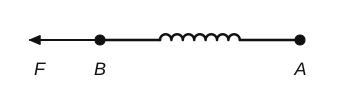
Two masses $A$ and $B$, each of mass $M$ are fixed together by a massless spring. A force acts on the mass $B$ as shown in figure. If the mass $A$ starts moving away from mass $B$ with acceleration $a$, then the acceleration of mass $B$ will be:

Masses B and A joined by a spring; force F acts on B pointing away from A
  1. A$\dfrac{MF}{F+Ma}$
  2. B$\dfrac{F+Ma}{M}$
  3. C$\dfrac{Ma-F}{M}$
  4. D$\dfrac{F-Ma}{M}$
Answer and solution

Answer: Option D: $\dfrac{F-Ma}{M}$

Concept. A spring pulls its two ends with equal and opposite forces. Block $A$ has only the spring acting on it horizontally, so its acceleration tells us the spring force. That same force then acts on $B$ in the opposite direction.

Step 1. Isolate $A$. Only the spring force $F_s$ acts horizontally. Its acceleration has magnitude $a$, so $$F_s=Ma$$ $A$ is being pulled towards $B$ (the spring is stretched as $B$ is pulled away by $F$).

Step 2. Isolate $B$. Two horizontal forces: the applied force $F$, directed away from $A$, and the spring force $Ma$, directed towards $A$.

Step 3. Newton's second law for $B$ (positive in the direction of $F$): $$F-Ma=Ma_B\ \Rightarrow\ a_B=\frac{F-Ma}{M}$$

Answer. Option D. Check with the whole system: the spring forces are internal, so $F=Ma+Ma_B$, which gives the same $a_B$. (The question's words "moving away" are loose; the spring is stretched, so $A$ is actually dragged along after $B$. Only the size $a$ of $A$'s acceleration matters.)

Point to note. Find the spring force from block $A$ (only the spring acts on it), then apply it to $B$.

Q21JEE Main 2024 (31 Jan, Shift 2)Easy

A light string passing over a smooth light fixed pulley connects two blocks of masses $m_1$ and $m_2$ hanging vertically. If the acceleration of the system is $\dfrac g8$, then the ratio of the masses $\dfrac{m_1}{m_2}$ ($m_1 > m_2$) is

  1. A$\dfrac97$
  2. B$\dfrac81$
  3. C$\dfrac43$
  4. D$\dfrac53$
Answer and solution

Answer: Option A: $\dfrac97$

Concept. In an Atwood machine the heavier mass $m_1$ goes down and $m_2$ goes up with the same acceleration (one light string). Write Newton's law for each mass and add to eliminate the tension.

Step 1. Equations of motion. $$m_1:\ m_1g-T=m_1a,\qquad m_2:\ T-m_2g=m_2a$$

Step 2. Add them. $T$ cancels: $$(m_1-m_2)g=(m_1+m_2)a\ \Rightarrow\ a=\frac{(m_1-m_2)g}{m_1+m_2}$$

Step 3. Use $a=g/8$. $$\frac{m_1-m_2}{m_1+m_2}=\frac18\ \Rightarrow\ 8m_1-8m_2=m_1+m_2\ \Rightarrow\ 7m_1=9m_2$$

Answer. $\dfrac{m_1}{m_2}=\dfrac97$, option A. General result: $a=g/n$ gives $\dfrac{m_1}{m_2}=\dfrac{n+1}{n-1}$.

Point to note. Atwood: $a=g/n\Rightarrow m_1/m_2=(n+1)/(n-1)$. Watch which ratio is asked.

Q22JEE Main 2026 (5 Apr, Shift 1)Medium

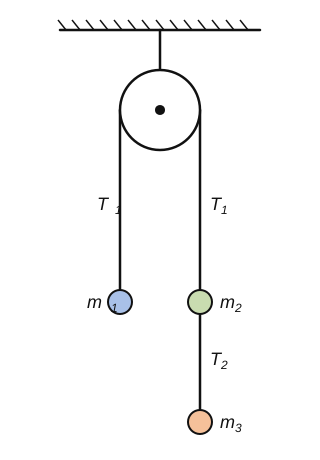
Three masses $m_1 = 4$ kg, $m_2 = 4$ kg and $m_3 = 6$ kg are suspended from a fixed smooth frictionless pully as shown in the figure below. The value of $T_1/T_2$ is ______ (take $g = 10\ \text{m/s}^2$)

Fixed pulley with m1 on the left string and m2 on the right string, with m3 hanging from m2 by a second string
  1. A$5/3$
  2. B$2/3$
  3. C$3/5$
  4. D$2/5$
Answer and solution

Answer: Option A: $5/3$

Concept. All three masses move with the same acceleration magnitude: $m_1$ on one side, $m_2$ and $m_3$ (hanging one below the other) on the other. Find $a$ from the whole system, then isolate single masses to get each tension.

Step 1. Read the figure. $T_1$ is the tension in the string over the pulley (it holds $m_1$ on the left and $m_2$ on the right). $T_2$ is the tension in the short string between $m_2$ and $m_3$.

Step 2. Acceleration. Left side $4$ kg, right side $m_2+m_3=10$ kg, so the right side goes down: $$a=\frac{(10-4)g}{4+10}=\frac{60}{14}=\frac{30}{7}\ \text{m s}^{-2}$$

Step 3. Isolate $m_1$ (accelerating up). Forces: $T_1$ up, $m_1g$ down: $$T_1-m_1g=m_1a\ \Rightarrow\ T_1=4\left(10+\frac{30}{7}\right)=4\times\frac{100}{7}=\frac{400}{7}\ \text{N}$$

Step 4. Isolate $m_3$ (accelerating down). Forces: $T_2$ up, $m_3g$ down: $$m_3g-T_2=m_3a\ \Rightarrow\ T_2=6\left(10-\frac{30}{7}\right)=6\times\frac{40}{7}=\frac{240}{7}\ \text{N}$$

Step 5. Ratio. $$\frac{T_1}{T_2}=\frac{400}{240}=\frac53$$

Answer. Option A. Check with $m_2$ (moving down, pulled up by $T_1$ and down by $T_2$ and its weight): $m_2g+T_2-T_1=40+\dfrac{240-400}{7}=\dfrac{120}{7}$, and $m_2a=4\times\dfrac{30}{7}=\dfrac{120}{7}$. Correct.

Point to note. Get $a$ from the whole system, then use the FBD of a single block for each tension.

Q23JEE Main 2022 (26 Jun, Shift 2)Medium

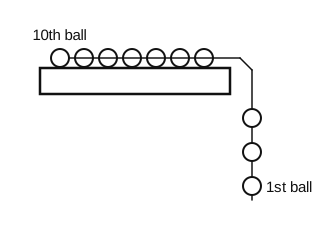
A system of $10$ balls each of mass $2\ \text{kg}$ are connected via massless and unstretchable string. The system is allowed to slip over the edge of a smooth table as shown in figure. Tension on the string between the 7th and 8th ball is ______ N when the 6th ball just leaves the table.

A chain of ten balls joined by a string: some lie on a smooth table top and the rest hang over the edge, the 1st ball lowest and the 10th ball at the far end of the table

Numerical answer type

Answer and solution

Answer: 36

Concept. The balls form one connected system with a common acceleration. On a smooth table, the only driving force is the weight of the hanging balls. A string between two balls on the table pulls the balls behind it, so its tension is their mass times $a$.

Step 1. Situation at the instant. Ball 1 went over first. When the 6th ball has just left the table, balls $1$–$6$ hang and balls $7$–$10$ are on the table.

Step 2. Acceleration of the system. Driving force $=$ weight of $6$ balls; total mass $=10$ balls: $$a=\frac{6\times2\times10}{10\times2}=\frac{120}{20}=6\ \text{m s}^{-2}$$

Step 3. Isolate balls 8, 9, 10. They lie on the smooth table, and the only horizontal force on them is the tension in the string between balls 7 and 8: $$T=(3\times2)\times a=6\times6=36\ \text{N}$$

Answer. $36$ N. Count carefully which balls lie beyond the link: the string between 7 and 8 drags only 8, 9 and 10.

Point to note. Driving force $=$ weight of the hanging part; tension at a link $=$ mass still on the table beyond it $\times\,a$.

Q24JEE Main 2021 (27 Aug, Shift 2)Medium

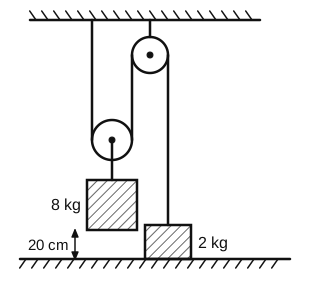
The boxes of masses $2$ kg and $8$ kg are connected by a massless string passing over smooth pulleys. Calculate the time taken by box of mass $8$ kg to strike the ground starting from rest. $(g = 10\ \text{m s}^{-2})$

An 8 kg box hanging from a movable pulley, 20 cm above the ground; the string goes from the ceiling under the movable pulley, over a fixed pulley, down to a 2 kg box resting on the ground
  1. A$0.25$ s
  2. B$0.34$ s
  3. C$0.2$ s
  4. D$0.4$ s
Answer and solution

Answer: Option D: $0.4$ s

Concept. The $8$ kg box hangs from a movable pulley held by two segments of the string, so it is supported by $2T$ and moves half as far as the free end. The free end carries the $2$ kg box. Write the constraint first, then Newton's law for each box.

Step 1. Constraint. From the figure the string runs from the ceiling, under the movable pulley, over the fixed pulley, to the $2$ kg box. If the $8$ kg box goes down by $x$, both segments on the movable pulley lengthen by $x$, so the $2$ kg box rises by $2x$. Hence if the $8$ kg box has acceleration $a$ down, the $2$ kg box has $2a$ up.

Step 2. Isolate the $8$ kg box (with its pulley). Forces: $80$ N down, $2T$ up. Down positive: $$80-2T=8a\qquad(1)$$

Step 3. Isolate the $2$ kg box. Forces: $T$ up, $20$ N down. Up positive: $$T-20=2(2a)=4a\qquad(2)$$

Step 4. Solve. Multiply (2) by 2 and add to (1): $$80-40=8a+8a\ \Rightarrow\ a=2.5\ \text{m s}^{-2},\qquad T=30\ \text{N}$$

Step 5. Time to fall $20$ cm from rest. $$0.2=\tfrac12(2.5)t^2\ \Rightarrow\ t^2=0.16\ \Rightarrow\ t=0.4\ \text{s}$$

Answer. $0.4$ s, option D. Forgetting the factor 2 in the constraint is the usual slip.

Point to note. A block on a movable pulley moves half as fast as the free end, and is held by $2T$.

Q25JEE Main 2024 (30 Jan, Shift 1)Medium

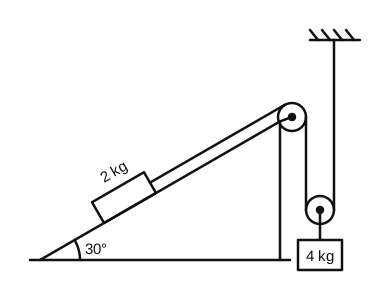
All surfaces shown in the figure are assumed to be frictionless and the pulleys and the string are light. The acceleration of the block of mass $2\ \text{kg}$ is:

A 2 kg block on a smooth 30° incline is tied to a string that runs over a fixed pulley at the top, down under a movable pulley carrying a 4 kg block, and up to the ceiling
  1. A$g$
  2. B$\dfrac g3$
  3. C$\dfrac g2$
  4. D$\dfrac g4$
Answer and solution

Answer: Option B: $\dfrac g3$

Concept. The $2$ kg block on the smooth incline is pulled by the string; the other end goes over a fixed pulley and down to a movable pulley carrying the $4$ kg block, with the string's far end fixed to the ceiling. So the $4$ kg block is held by $2T$ and moves half as fast as the $2$ kg block.

Step 1. Constraint. If the $2$ kg block moves up the incline with acceleration $a$, the string feeds that length onto the two segments of the movable pulley, so the $4$ kg block descends with $a/2$.

Step 2. Isolate the $2$ kg block. Forces along the incline: $T$ up the incline, $2g\sin30^\circ=g$ down the incline ($N$ is perpendicular, and there is no friction). $$T-2g\sin30^\circ=2a\ \Rightarrow\ T=g+2a\qquad(1)$$

Step 3. Isolate the $4$ kg block with its pulley. Forces: $4g$ down, $2T$ up. Down positive: $$4g-2T=4\cdot\frac a2=2a\qquad(2)$$

Step 4. Solve. Put (1) into (2): $$4g-2g-4a=2a\ \Rightarrow\ 2g=6a\ \Rightarrow\ a=\frac g3$$

Answer. $\dfrac g3$, option B. This is the acceleration of the $2$ kg block; the $4$ kg block has $\dfrac g6$.

Point to note. Same movable-pulley constraint as above, now with an incline. Write $a$ and $a/2$ before writing equations.

Q26JEE Main 2022 (26 Jun, Shift 2)Medium

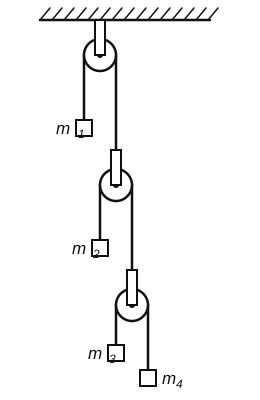
In the arrangement shown in figure, $a_1, a_2, a_3$ and $a_4$ are the accelerations of masses $m_1, m_2, m_3$ and $m_4$ respectively. Which of the following relations is true for this arrangement?

A fixed pulley holding m1 on one side and a second movable pulley on the other; the second pulley holds m2 and a third movable pulley, which holds m3 and m4
  1. A$4a_1 + 2a_2 + a_3 + a_4 = 0$
  2. B$a_1 + 4a_2 + 3a_3 + a_4 = 0$
  3. C$a_1 + 4a_2 + 3a_3 + 2a_4 = 0$
  4. D$2a_1 + 2a_2 + 3a_3 + a_4 = 0$
Answer and solution

Answer: Option A: $4a_1 + 2a_2 + a_3 + a_4 = 0$

Concept. For light strings over light pulleys, string-length constraints link the accelerations. Write one constraint for each string, measuring lengths from the pulley it passes over, then eliminate the pulleys' own accelerations.

Step 1. Set up. Take downward accelerations as positive. From the figure: string 1 goes over the fixed pulley with $m_1$ on one side and pulley 2 on the other; string 2 goes over pulley 2 with $m_2$ on one side and pulley 3 on the other; string 3 goes over pulley 3 with $m_3$ and $m_4$. Let $b_2$, $b_3$ be the accelerations of pulleys 2 and 3.

Step 2. String over the fixed pulley. Its two hanging lengths add to a constant: $$a_1+b_2=0\qquad(1)$$

Step 3. String over pulley 2. Lengths are measured from pulley 2, so use accelerations relative to it: $$(a_2-b_2)+(b_3-b_2)=0\ \Rightarrow\ a_2+b_3=2b_2\qquad(2)$$

Step 4. String over pulley 3. $$(a_3-b_3)+(a_4-b_3)=0\ \Rightarrow\ b_3=\frac{a_3+a_4}{2}\qquad(3)$$

Step 5. Eliminate. From (1), $b_2=-a_1$. Put this and (3) into (2): $$a_2+\frac{a_3+a_4}{2}=-2a_1\ \Rightarrow\ 4a_1+2a_2+a_3+a_4=0$$

Answer. Option A. Shortcut (tension method): if string 3 has tension $T$, string 2 has $2T$ and string 1 has $4T$; so the masses feel $4T,2T,T,T$ and $\sum T_ia_i=0$ gives the coefficients $4,2,1,1$.

Point to note. Fastest route: tensions on $m_1, m_2, m_3, m_4$ are $4T, 2T, T, T$ and $\sum T_ia_i=0$ gives the coefficients $4, 2, 1, 1$ directly.

05

Topic 5 · Q27–Q36

Friction

38 of the 161 JEE PYQs in the bank test this as their main idea

Look first

applied force Ffriction fstatic: f = FμₛN (limiting)kinetic μₖNno motionsliding
Static friction grows with the push, up to the limit; then kinetic friction takes over.
mF (pull)N = mg − F sin θmF (push)N = mg + F sin θθθ
The vertical part of an angled force changes N, and with it the friction.
MmFf on mf on Msmooth floor: together only while F ≤ μg(m + M)
Friction is the only force that drags the top block along.

Quick notes

$$0\le f_s\le\mu_sN,\qquad f_k=\mu_kN,\qquad \mu_s>\mu_k$$

Static friction is self-adjusting: it equals the applied push until it reaches $\mu_sN$. Both kinds are independent of contact area and depend on the two surfaces. Angle of friction $\tan\lambda=\mu_s$ = angle of repose. Contact force $=\sqrt{N^2+f^2}=N\sqrt{1+\mu^2}$ at limiting friction.

Friction graph: as the applied force grows, $f$ rises along $f=F$ (no motion) to $\mu_sN$, then drops to $\mu_kN$ once sliding starts.

Horizontal surfaceResult
Sliding to rest from $u$$a=-\mu g$, $s=\dfrac{u^2}{2\mu g}$, $t=\dfrac{u}{\mu g}$; with momentum $p$: $s=\dfrac{p^2}{2\mu m^2g}$
Pull at $\theta$ above horizontal$N=mg-F\sin\theta$; starts moving at $F=\dfrac{\mu mg}{\cos\theta+\mu\sin\theta}$
Push at $\theta$ below horizontal$N=mg+F\sin\theta$; $F=\dfrac{\mu mg}{\cos\theta-\mu\sin\theta}$ (pulling is easier)
Least force to move a block$F_{\min}=\dfrac{\mu mg}{\sqrt{1+\mu^2}}=mg\sin\lambda$, at $\theta=\lambda$ above horizontal
Block pressed on a vertical wall$F_{\min}=\dfrac{mg}{\mu}$
Chain on a table, longest hanging part$\dfrac{l}{L}=\dfrac{\mu}{1+\mu}$
Block on a curve $y=f(x)$ / insect in a bowl of radius $R$slips where $\dfrac{dy}{dx}=\mu$ / $h=R\left(1-\dfrac{1}{\sqrt{1+\mu^2}}\right)$
Object dropped on a belt moving at $v$slips for $t=\dfrac{v}{\mu g}$; slide relative to belt $=\dfrac{v^2}{2\mu g}$
$$a_{\text{down}}=g(\sin\theta-\mu\cos\theta),\qquad a_{\text{up (retarding)}}=g(\sin\theta+\mu\cos\theta)$$

Block stays at rest if $\tan\theta\le\mu_s$; then friction $=mg\sin\theta$, not $\mu mg\cos\theta$. Sliding at constant velocity means $\mu_k=\tan\theta$ and the contact force is exactly $mg$.

Incline caseResult
Force to just push up / just stop sliding down$F_1=mg(\sin\theta+\mu\cos\theta)$, $F_2=mg(\sin\theta-\mu\cos\theta)$; $F_1-F_2=2\mu mg\cos\theta$
Range of external force along the incline with no motionfrom $mg\sin\theta-f_L$ (down, if negative) to $mg\sin\theta+f_L$ (up), $f_L=\mu mg\cos\theta$
Rough takes $n$ times the smooth time$\mu=\tan\theta\left(1-\dfrac1{n^2}\right)$; at $45^\circ$: $\mu=1-\dfrac1{n^2}$
Projected up, returns with $v_0/n$$\dfrac{a_{\text{up}}}{a_{\text{down}}}=n^2\Rightarrow\mu=\tan\theta\,\dfrac{n^2-1}{n^2+1}$
Time up $=\frac1n\times$ time down$\mu=\tan\theta\,\dfrac{n^2-1}{n^2+1}$
Upper half smooth, lower half rough, stops at the bottom$\mu=2\tan\theta$

Two blocks, one on top of the other

  • Method: assume they move together, find the friction needed on the top block ($m_{\text{top}}a$), compare with $\mu N$. If more is needed, they slip, and kinetic friction acts on both.
  • Lower block pulled, smooth floor: together while $F\le\mu g(m+M)$. The top block's acceleration can never exceed $\mu g$.
  • Lower block pulled, floor friction $\mu_2$: $F_{\max}=(\mu_1+\mu_2)(m+M)g$.
  • Upper block (mass $m$) pulled, smooth floor: together while $F\le\mu mg\,\dfrac{m+M}{M}$.
Traps. Friction opposes relative sliding, not motion: on a belt, a truck floor or a lower block, it is the force that drags things along. Do not write $\mu N$ for static friction unless the question says "just", "about to" or "maximum". Pulling at an angle reduces $N$; pushing increases it.
More standard resultsResult
Force $F=kt$ on a block at restfriction $=kt$ until $t_0=\dfrac{\mu_smg}{k}$; after that $a=\dfrac{kt-\mu_kmg}{m}$
Same block, applied force doubled$a'=2a+\mu g$
Box on a truck floor, distance $d$ from the open endstays if $a\le\mu g$; else falls off after $t=\sqrt{\dfrac{2d}{a-\mu_kg}}$
Incline with $\mu=kx$ (from the top)speed is greatest at $x=\dfrac{\tan\theta}{k}$, block stops at $x=\dfrac{2\tan\theta}{k}$
Two touching blocks on an incline, $\mu_1$ (lower) $>\mu_2$move together: $a=g\sin\theta-\dfrac{(\mu_1m_1+\mu_2m_2)g\cos\theta}{m_1+m_2}$
Pushing a block up a wall with $P$ at $\theta$ above horizontalto stop it slipping: $P=\dfrac{mg}{\sin\theta+\mu\cos\theta}$; to move it up: $P=\dfrac{mg}{\sin\theta-\mu\cos\theta}$

Practice: 10 questions

Q27JEE Main 2019 (12 Apr, Shift 2)Medium

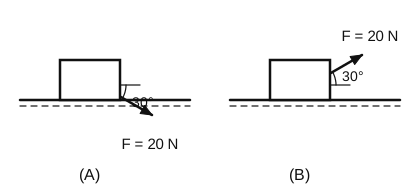
A block of mass $5$ kg is (i) pushed in case (A) and (ii) pulled in case (B), by a force $F = 20$ N, making an angle of $30^\circ$ with the horizontal, as shown in the figures. The coefficient of friction between the block and floor is $\mu = 0.2$. The difference between the accelerations of the block, in case (B) and case (A) will be: ($g = 10\ \text{m s}^{-2}$)

(A) A block pushed by F = 20 N directed 30° below the horizontal; (B) the same block pulled by F = 20 N directed 30° above the horizontal.
  1. A$3.2\ \text{m s}^{-2}$
  2. B$0\ \text{m s}^{-2}$
  3. C$0.8\ \text{m s}^{-2}$
  4. D$0.4\ \text{m s}^{-2}$
Answer and solution

Answer: Option C: $0.8\ \text{m s}^{-2}$

Concept. Kinetic friction is $\mu N$, and $N$ depends on the vertical part of the applied force. Pushing at an angle below the horizontal presses the block into the floor (larger $N$, more friction); pulling at an angle above lifts it (smaller $N$, less friction). The horizontal part of $F$ is the same in both cases.

Step 1. Components of $F$. $$F\cos30^\circ=20\times0.866=17.32\ \text{N},\qquad F\sin30^\circ=10\ \text{N}$$ Weight $mg=50$ N.

Step 2. Case (A), pushed. Vertically: $N_A=mg+F\sin30^\circ=60$ N, so friction $=0.2\times60=12$ N. $$a_A=\frac{17.32-12}{5}=1.06\ \text{m s}^{-2}$$

Step 3. Case (B), pulled. Vertically: $N_B=mg-F\sin30^\circ=40$ N, so friction $=0.2\times40=8$ N. $$a_B=\frac{17.32-8}{5}=1.86\ \text{m s}^{-2}$$

Step 4. Difference. $$a_B-a_A=\frac{12-8}{5}=0.8\ \text{m s}^{-2}$$

Answer. $0.8$ m s$^{-2}$, option C. Quick route: only the friction differs, by $\mu\cdot2F\sin30^\circ=0.2\times20=4$ N, giving $4/5=0.8$.

Point to note. The vertical part of $F$ changes $N$: pushing down raises friction, pulling up lowers it. Difference in $a$ $=2\mu F\sin\theta/m$.

Q28JEE Main 2019 (12 Jan, Shift 2)Medium

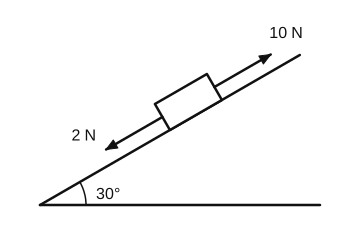
A block kept on a rough inclined plane, as shown in the figure, remains at rest up to a maximum force $2$ N down the inclined plane. The maximum external force up the inclined plane that does not move the block is $10$ N. The coefficient of static friction between the block and the plane is: [Take $g = 10\ \text{m/s}^2$]

Block on a 30° rough incline with a 10 N force up the slope and a 2 N force down the slope.
  1. A$\dfrac{\sqrt3}{4}$
  2. B$\dfrac23$
  3. C$\dfrac12$
  4. D$\dfrac{\sqrt3}{2}$
Answer and solution

Answer: Option D: $\dfrac{\sqrt3}{2}$

Concept. Static friction can act either way along the incline, up to a maximum $f_L=\mu mg\cos\theta$. At the largest push down the incline friction is at its limit and acts up; at the largest push up it is at its limit and acts down. Two equations, two unknowns ($mg$ and $\mu$).

Step 1. Largest force down the incline, $2$ N. The block tends to slide down, so friction acts up the incline at its limit: $$2+mg\sin30^\circ=f_L\qquad(1)$$

Step 2. Largest force up the incline, $10$ N. The block tends to slide up, so friction acts down: $$10=mg\sin30^\circ+f_L\qquad(2)$$

Step 3. Solve. Subtract (1) from (2): $$8=2mg\sin30^\circ=mg\ \Rightarrow\ mg=8\ \text{N}$$ Add (1) and (2): $12=2f_L$, so $f_L=6$ N.

Step 4. Coefficient of friction. $$\mu=\frac{f_L}{mg\cos30^\circ}=\frac{6}{8\times\frac{\sqrt3}{2}}=\frac{6}{4\sqrt3}=\frac{\sqrt3}{2}$$

Answer. $\dfrac{\sqrt3}{2}$, option D. Pattern: $F_{\text{up}}+F_{\text{down}}=2f_L$ and $F_{\text{up}}-F_{\text{down}}=2mg\sin\theta$.

Point to note. The two limiting forces give two equations: $F_{\text{up}}=mg\sin\theta+f_L$ and $F_{\text{down}}=f_L-mg\sin\theta$. Add and subtract.

Q29JEE Main 2023 (29 Jan, Shift 2)Medium

The time taken by an object to slide down $45^\circ$ rough inclined plane is $n$ times as it takes to slide down a perfectly smooth $45^\circ$ incline plane. The coefficient of kinetic friction between the object and the incline plane is

  1. A$\sqrt{\dfrac{1}{1-n^2}}$
  2. B$\sqrt{1-\dfrac{1}{n^2}}$
  3. C$1+\dfrac{1}{n^2}$
  4. D$1-\dfrac{1}{n^2}$
Answer and solution

Answer: Option D: $1-\dfrac{1}{n^2}$

Concept. On an incline of the same length, starting from rest, $s=\tfrac12at^2$ gives $t\propto\dfrac1{\sqrt a}$. Friction reduces the acceleration down the slope from $g\sin\theta$ to $g(\sin\theta-\mu\cos\theta)$, so comparing times compares accelerations.

Step 1. The two accelerations. Isolate the object; forces along the slope are $mg\sin\theta$ down and (on the rough plane) $\mu mg\cos\theta$ up. $$a_{\text{smooth}}=g\sin45^\circ,\qquad a_{\text{rough}}=g\sin45^\circ-\mu g\cos45^\circ$$

Step 2. Relate times. $t_{\text{rough}}=n\,t_{\text{smooth}}$ and $t\propto a^{-1/2}$, so $$\frac{a_{\text{smooth}}}{a_{\text{rough}}}=n^2$$

Step 3. Substitute. $\sin45^\circ=\cos45^\circ$ cancels: $$\frac{g\sin45^\circ}{g\sin45^\circ(1-\mu)}=n^2\ \Rightarrow\ \frac1{1-\mu}=n^2\ \Rightarrow\ \mu=1-\frac1{n^2}$$

Answer. Option D. For a general angle the result is $\mu=\tan\theta\left(1-\dfrac1{n^2}\right)$.

Point to note. This exact result has come up in at least five JEE papers: $\mu=\tan\theta\,(1-1/n^2)$, which is $1-1/n^2$ at $45^\circ$.

Q30JEE Main 2020 (3 Sep, Shift 2)Medium

A block starts moving up an inclined plane of inclination $30^\circ$ with an initial velocity of $v_0$. It comes back to its initial position with velocity $\dfrac{v_0}{2}$. The value of the coefficient of kinetic friction between the block and the inclined plane is close to $\dfrac{I}{1000}$. The nearest integer to $I$ is ______.

Numerical answer type

Answer and solution

Answer: 346

Concept. The block goes up and comes back over the same distance $d$, but friction always opposes its motion: it adds to $g\sin\theta$ going up and subtracts coming down. Use $v^2=2as$ for each leg and compare.

Step 1. Accelerations. Isolate the block; along the incline: $$\text{up (retardation): } a_1=g(\sin\theta+\mu\cos\theta),\qquad\text{down: } a_2=g(\sin\theta-\mu\cos\theta)$$

Step 2. Each leg over the same $d$. Going up, $v_0$ falls to zero; coming down, the block starts from rest and reaches $v_0/2$: $$v_0^2=2a_1d,\qquad \frac{v_0^2}{4}=2a_2d\ \Rightarrow\ a_1=4a_2$$

Step 3. Solve for $\mu$. $$\sin\theta+\mu\cos\theta=4\sin\theta-4\mu\cos\theta\ \Rightarrow\ 5\mu\cos\theta=3\sin\theta\ \Rightarrow\ \mu=\frac35\tan30^\circ$$ $$\mu=\frac{3}{5\sqrt3}=\frac{\sqrt3}{5}\approx0.346$$

Answer. $\mu\approx\dfrac{346}{1000}$, so $I=346$. General result: returning with $v_0/n$ gives $\mu=\tan\theta\,\dfrac{n^2-1}{n^2+1}$; here $n=2$ gives $\tfrac35\tan\theta$.

Point to note. Same distance up and down: $a_{\text{up}}/a_{\text{down}}=(v_0/v)^2$. Then $\mu=\tan\theta\,\frac{n^2-1}{n^2+1}$ with $n=2$.

Q31JEE Main 2022 (25 Jun, Shift 1)Easy

A uniform chain of $6\ \text{m}$ length is placed on a table such that a part of its length is hanging over the edge of the table. The system is at rest. The coefficient of static friction between the chain and the surface of the table is $0.5$. The maximum length of the chain hanging from the table is ______ m.

Numerical answer type

Answer and solution

Answer: 2

Concept. The hanging part pulls the chain over the edge with its weight; friction on the part lying on the table resists. The chain stays at rest as long as the pull does not exceed the limiting friction, so the longest hanging part makes them equal.

Step 1. Set up. Let the mass per unit length be $\lambda$, the total length $L=6$ m and the hanging length $x$. The part on the table has length $L-x$ and normal force $\lambda(L-x)g$.

Step 2. Limiting condition. $$\lambda xg=\mu\lambda(L-x)g\ \Rightarrow\ x=\mu(L-x)$$

Step 3. Solve. $$x(1+\mu)=\mu L\ \Rightarrow\ x=\frac{\mu L}{1+\mu}=\frac{0.5\times6}{1.5}=2\ \text{m}$$

Answer. $2$ m. Remember: the fraction hanging is $\dfrac{\mu}{1+\mu}$, not $\mu$.

Point to note. Weight of the hanging part $=$ limiting friction on the rest: $l/L=\mu/(1+\mu)$.

Q32JEE Main 2021 (24 Feb, Shift 1)Medium

An inclined plane is bent in such a way that the vertical cross-section is given by $y = \dfrac{x^2}{4}$ where $y$ is in vertical and $x$ in horizontal direction. If the upper surface of this curved plane is rough with coefficient of friction $\mu = 0.5$, the maximum height in cm at which a stationary block will not slip downward is ______ cm.

Numerical answer type

Answer and solution

Answer: 25

Concept. On a curved surface, each point acts like a small incline whose slope is $\tan\theta=\dfrac{dy}{dx}$. A block stays at rest where $\tan\theta\le\mu$ (the same condition as the angle of repose). The curve gets steeper with height, so the highest resting point is where $\dfrac{dy}{dx}=\mu$.

Step 1. Slope of the curve. $$y=\frac{x^2}{4}\ \Rightarrow\ \frac{dy}{dx}=\frac x2$$

Step 2. Limiting point. Isolate the block: along the surface, $mg\sin\theta$ must not exceed $\mu mg\cos\theta$, i.e. $\tan\theta\le\mu$. $$\frac x2\le0.5\ \Rightarrow\ x\le1\ \text{m}$$

Step 3. Height there. $$y_{\max}=\frac{1^2}{4}=0.25\ \text{m}=25\ \text{cm}$$

Answer. $25$ cm. The question asks for height ($y$), not horizontal distance.

Point to note. On a curved surface, the local slope $dy/dx$ plays the role of $\tan\theta$. Rest is possible while $dy/dx\le\mu$. JEE Main 2014 asked the same idea with $y=x^3/6$: slope $x^2/2=0.5$ gives $x=1$, $y=\tfrac16$ m.

Q33JEE Main 2022 (27 Jul, Shift 1)Medium

A bag is gently dropped on a conveyor belt moving at a speed of $2\ \text{m s}^{-1}$. The coefficient of friction between the conveyor belt and bag is $0.4$. Initially, the bag slips on the belt before it stops due to friction. The distance travelled by the bag on the belt during slipping motion is : [Take $g = 10\ \text{m s}^{-2}$]

  1. A$2$ m
  2. B$0.5$ m
  3. C$3.2$ m
  4. D$0.8$ m
Answer and solution

Answer: Option B: $0.5$ m

Concept. The bag is dropped with no horizontal speed onto a belt moving at $v$. Kinetic friction from the belt acts forward on the bag until the bag reaches the belt's speed. The distance asked is the slip relative to the belt, which is easiest in the belt's frame (inertial, as the belt moves uniformly).

Step 1. Friction and acceleration. Isolate the bag: normal force $mg$, so friction $\mu mg$ and $$a=\mu g=0.4\times10=4\ \text{m s}^{-2}$$

Step 2. In the belt's frame. The bag starts moving backward at $2$ m s$^{-1}$, and friction slows it at $4$ m s$^{-2}$ until it is at rest on the belt.

Step 3. Slip distance. $$s=\frac{u^2}{2a}=\frac{2^2}{2\times4}=0.5\ \text{m}$$

Answer. $0.5$ m, option B. In the ground frame the bag moves $0.5$ m forward while the belt moves $1$ m in the same time ($t=0.5$ s); the difference, $0.5$ m, is the slip.

Point to note. Friction is what speeds the bag up. Work in the belt's frame: relative speed $v$ decays at $\mu g$, so slip $=v^2/2\mu g$.

Q34JEE Main 2022 (27 Jun, Shift 1)Easy

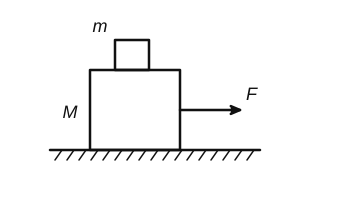
A system of two blocks of masses $m = 2$ kg and $M = 8$ kg is placed on a smooth table as shown in figure. The coefficient of static friction between two blocks is $0.5$. The maximum horizontal force $F$ that can be applied to the block of mass $M$ so that the blocks move together will be $(g = 9.8\ \text{m s}^{-2})$

Small block m resting on a larger block M on a smooth table; horizontal force F pulls M to the right
  1. A$9.8$ N
  2. B$39.2$ N
  3. C$49$ N
  4. D$78.4$ N
Answer and solution

Answer: Option C: $49$ N

Concept. The force is applied to the lower block $M$. The upper block $m$ is dragged along only by static friction from $M$, and this friction cannot exceed $\mu mg$. So $m$ (and hence the whole system, if they move together) can accelerate at most at $\mu g$.

Step 1. Isolate the upper block $m$. Horizontal force: friction $f$ forward. Vertical: $N=mg$. $$f=ma\le\mu mg\ \Rightarrow\ a\le\mu g=0.5\times9.8=4.9\ \text{m s}^{-2}$$

Step 2. Whole system. Moving together on a smooth table, the only external horizontal force is $F$: $$F=(m+M)a$$

Step 3. Largest $F$. $$F_{\max}=(2+8)\times4.9=49\ \text{N}$$

Answer. $49$ N, option C. Using $\mu mg=9.8$ N as the answer is a trap: that is the friction on $m$, not the applied force.

Point to note. The top block can only get $\mu g$ from friction, so the whole system can have at most $a=\mu g$.

Q35JEE Main 2019 (10 Apr, Shift 2)Medium

Two blocks $A$ and $B$ of masses $m_A = 1\ \text{kg}$ and $m_B = 3\ \text{kg}$ are kept on a table, with $A$ resting on top of $B$. The coefficient of friction between $A$ and $B$ is $0.2$ and between $B$ and the surface of the table is also $0.2$. The maximum force $F$ that can be applied on $B$ horizontally, so that the block $A$ does not slide over the block $B$ is: [Take $g = 10\ \text{m/s}^2$]

  1. A$16\ \text{N}$
  2. B$12\ \text{N}$
  3. C$40\ \text{N}$
  4. D$8\ \text{N}$
Answer and solution

Answer: Option A: $16\ \text{N}$

Concept. As in the smooth-floor case, $A$ is accelerated only by friction from $B$, so it can have at most $\mu_1 g$. Now the floor is rough, so $B$ also feels kinetic friction from the table, which the force $F$ must overcome.

Step 1. Isolate $A$. The only horizontal force is friction from $B$: $$m_Aa\le\mu_1m_Ag\ \Rightarrow\ a_{\max}=\mu_1g=0.2\times10=2\ \text{m s}^{-2}$$

Step 2. Friction from the table on $B$. The table supports both blocks, so its normal force is $(m_A+m_B)g=40$ N: $$f_2=\mu_2(m_A+m_B)g=0.2\times40=8\ \text{N}$$

Step 3. Both blocks together. External horizontal forces: $F$ forward, $f_2$ backward: $$F-f_2=(m_A+m_B)a_{\max}\ \Rightarrow\ F-8=4\times2\ \Rightarrow\ F=16\ \text{N}$$

Answer. $16$ N, option A. Shortcut: $F_{\max}=(\mu_1+\mu_2)(m_A+m_B)g=0.4\times40$.

Point to note. Same as the previous question, plus the floor friction $\mu_2(m_A+m_B)g$ on the lower block.

Q36JEE Main 2024 (31 Jan, Shift 1)Medium

In an arrangement of a doubly inclined plane, block $M$ is placed on the face inclined at $53^\circ$ and block $m$ on the face inclined at $37^\circ$. The blocks are connected by a light string passing over an ideal pulley at the top. The coefficient of friction between the surface of the plane and the blocks is $0.25$. The value of $m$ for which $M = 10\ \text{kg}$ will move down with an acceleration of $2\ \text{m s}^{-2}$ is: (take $g = 10\ \text{m s}^{-2}$ and $\tan37^\circ = \frac34$)

  1. A$9\ \text{kg}$
  2. B$4.5\ \text{kg}$
  3. C$6.5\ \text{kg}$
  4. D$2.25\ \text{kg}$
Answer and solution

Answer: Option B: $4.5\ \text{kg}$

Concept. $M$ moves down its face and $m$ moves up its face, joined by one string over an ideal pulley (same tension, same acceleration $a$). Kinetic friction on each block acts opposite to its own motion. Isolate each block, resolve along its face, and apply Newton's law.

Step 1. Trigonometric values. $\sin53^\circ=\cos37^\circ=0.8$, $\cos53^\circ=\sin37^\circ=0.6$.

Step 2. Isolate $M=10$ kg (on the $53^\circ$ face, moving down). Along the face: $Mg\sin53^\circ=80$ N down, friction $\mu Mg\cos53^\circ=0.25\times60=15$ N up, tension $T$ up. $$80-15-T=10\times2\ \Rightarrow\ T=45\ \text{N}$$

Step 3. Isolate $m$ (on the $37^\circ$ face, moving up). Along the face: $T$ up; $mg\sin37^\circ=6m$ down; friction $\mu mg\cos37^\circ=0.25\times8m=2m$ down. $$T-6m-2m=m\times2\ \Rightarrow\ 45=10m$$

Step 4. Solve. $$m=4.5\ \text{kg}$$

Answer. $4.5$ kg, option B. Always fix the direction of motion first; it decides which way each friction force points.

Point to note. Assume the direction of motion first, then friction on each block acts opposite to its own motion.

06

Topic 6 · Q37–Q41

Accelerated frames: lifts, wedges and pseudo force

9 of the 161 JEE PYQs in the bank test this as their main idea

Look first

Na ↑N = m(g + a)heavierNv constantN = mgnormalNa ↓N = m(g − a)lighter
A weighing machine reads N. Only the acceleration matters, never the velocity.
θamgmatan θ = a / g, string lies along g_eff
In the car's frame, add a pseudo force opposite to the car's acceleration.
a₀ma₀mgin the wedge's frame add −ma₀, then resolve along the incline
Same idea for a wedge: work in its frame and add −ma₀.

Quick notes

$$\vec F_{\text{pseudo}}=-m\vec a_{\text{frame}},\qquad \vec g_{\text{eff}}=\vec g-\vec a_{\text{frame}}$$

Inside an accelerating box, everything behaves as if gravity were $\vec g_{\text{eff}}$: a plumb line hangs along it, a pendulum's period uses $|\vec g_{\text{eff}}|$, and a block slides on an incline with $g_{\text{eff}}$ in place of $g$.

CaseResult
Lift accelerating up at $a$ (or moving down and slowing)apparent weight $m(g+a)$
Lift accelerating down at $a$ (or moving up and slowing)$m(g-a)$; free fall: $0$
Lift with uniform velocityno change at all (inertial frame)
Smooth incline in a lift (up at $a_0$)$a_{\text{rel}}=(g+a_0)\sin\theta$
Bob in a car with horizontal acceleration $a$$\tan\theta=\dfrac ag$, $T=m\sqrt{g^2+a^2}$
Bob in a car accelerating up an incline $\alpha$ at $a$$\tan\theta=\dfrac{a\cos\alpha}{g+a\sin\alpha}$ with the vertical
Block at rest on a smooth wedge pushed horizontally$a=g\tan\theta$, $F=(M+m)g\tan\theta$, $N=mg\sec\theta$
Wedge accelerating at $a_0$ horizontally$a_{\text{rel}}=g\sin\theta\mp a_0\cos\theta$, $N=m(g\cos\theta\pm a_0\sin\theta)$; upper signs when the wedge accelerates toward the side the block slides to
Block loses contact with a wedge pulled away$a_0\ge g\cot\theta$
  • Pseudo force is not an interaction: it has no reaction partner. Use it only for bodies you describe from the accelerating frame.
  • Good routine: find the frame's acceleration from the ground frame first, then solve relative motion in the frame, then come back to the ground frame for the external force ($F=\sum m_i\vec a_i$).
  • In a rotating frame the pseudo force is the centrifugal force $m\omega^2r$, outward.
Traps. The pseudo force points opposite to the frame's acceleration. Weightlessness depends on acceleration, not on velocity. A pseudo force pressing a block on a vertical face acts as its normal force.
More standard resultsResult
Apparent weights $W_1$ (up at $a$) and $W_2$ (down at $a$)true weight $\dfrac{W_1+W_2}{2}$, $a=g\,\dfrac{W_1-W_2}{W_1+W_2}$
Wedge acceleration so a block slides up at $g$ relative to it$a=g(\sec\theta+\tan\theta)$
Blocks on two fixed smooth inclines ($\alpha$ with horizontal)vertical acceleration $g\sin^2\alpha$ each; subtract for the relative value
Incline of base $L$ in a lift going up at $a_0$$t=\sqrt{\dfrac{2L}{(g+a_0)\sin\theta\cos\theta}}$

Practice: 5 questions

Q37JEE Main 2022 (27 Jul, Shift 2)Medium

A block $A$ takes $2$ s to slide down a frictionless incline of $30^\circ$ and length $l$, kept inside a lift going up with uniform velocity $v$. If the incline is changed to $45^\circ$, the time taken by the block, to slide down the incline, will be approximately:

  1. A$2.66$ s
  2. B$0.83$ s
  3. C$1.68$ s
  4. D$0.70$ s
Answer and solution

Answer: Option C: $1.68$ s

Concept. A lift moving with uniform velocity has no acceleration, so it is an inertial frame: everything inside behaves exactly as on the ground. On a smooth incline the block slides down with $a=g\sin\theta$, and from rest $l=\tfrac12at^2$.

Step 1. Time in terms of angle. Isolate the block: along the smooth incline only $mg\sin\theta$ acts, so $a=g\sin\theta$ and $$l=\tfrac12g\sin\theta\,t^2\ \Rightarrow\ t=\sqrt{\frac{2l}{g\sin\theta}}\propto\frac1{\sqrt{\sin\theta}}$$

Step 2. Ratio for the two angles. The length $l$ is the same: $$\frac{t_2}{t_1}=\sqrt{\frac{\sin30^\circ}{\sin45^\circ}}=\sqrt{\frac{0.5}{0.707}}=\sqrt{0.707}\approx0.841$$

Step 3. New time. $$t_2=2\times0.841\approx1.68\ \text{s}$$

Answer. $1.68$ s, option C. The speed $v$ of the lift plays no part; only acceleration of the frame would.

Point to note. A lift moving with uniform velocity is an inertial frame: just compare $l=\tfrac12g\sin\theta\,t^2$ for the two angles.

Q38JEE Main 2021 (31 Aug, Shift 1)Medium

A car is moving on a plane inclined at $30^\circ$ to the horizontal with an acceleration of $10\ \text{m s}^{-2}$ parallel to the plane upward. A bob is suspended by a string from the roof of the car. The angle in degrees which the string makes with the vertical is ______. (Take $g = 10\ \text{m s}^{-2}$)

Numerical answer type

Answer and solution

Answer: 30

Concept. In the car's frame, which accelerates at $\vec a$, the bob feels a pseudo force $-m\vec a$ besides gravity. The bob hangs at rest along the effective gravity $\vec g_{\text{eff}}=\vec g-\vec a$, so the string's direction is the direction of this vector.

Step 1. Components. Take $x$ horizontal (in the direction the car moves) and $y$ vertically up. The car's acceleration is $10$ m s$^{-2}$ up the $30^\circ$ incline: $$\vec a=(10\cos30^\circ,\ 10\sin30^\circ)=(5\sqrt3,\ 5),\qquad \vec g=(0,\ -10)$$

Step 2. Effective gravity. $$\vec g_{\text{eff}}=\vec g-\vec a=(-5\sqrt3,\ -15)$$ It points down and backward.

Step 3. Angle with the vertical. $$\tan\theta=\frac{|g_{\text{eff},x}|}{|g_{\text{eff},y}|}=\frac{5\sqrt3}{15}=\frac{1}{\sqrt3}\ \Rightarrow\ \theta=30^\circ$$

Answer. $30^\circ$. Using $\tan\theta=a/g=1$ ($45^\circ$) is wrong here because $\vec a$ is not horizontal; its vertical part increases the effective gravity.

Point to note. The string lines up with $\vec g_{\text{eff}}=\vec g-\vec a$. Add the vectors; do not just use $\tan\theta=a/g$.

Q39JEE Main 2026 (28 Jan, Shift 2)Hard

A small block of mass **m** slides down from the top of a frictionless inclined surface, while the inclined plane is moving towards left with constant acceleration $a_0$. The angle between the inclined plane and ground is $\theta$ and its base length is $L$. Assuming that initially the small block is at the top of the inclined plane, the time it takes to reach the lowest point of the inclined plane is ______.

Wedge with incline rising to the right at angle theta, base length L, block m at the top, wedge accelerating to the left with a0
  1. A$\sqrt{\dfrac{2L}{g\sin\theta - a_0\cos\theta}}$
  2. B$\sqrt{\dfrac{4L}{g\sin2\theta - a_0(1+\cos2\theta)}}$
  3. C$\sqrt{\dfrac{2L}{g\sin2\theta - a_0(1+\cos2\theta)}}$
  4. D$\sqrt{\dfrac{4L}{g\cos^2\theta - a_0\sin\theta\cos\theta}}$
Answer and solution

Answer: Option B: $\sqrt{\dfrac{4L}{g\sin2\theta - a_0(1+\cos2\theta)}}$

Concept. Work in the frame of the incline. It accelerates to the left at $a_0$, so the block feels a pseudo force $ma_0$ to the right. In this frame the block slides along the incline from rest, so find its acceleration along the incline and use $s=\tfrac12at^2$ with the incline's length.

Step 1. Geometry. From the figure the incline rises to the right, the block starts at the top (right end), and the base is $L$. So the length along the slope is $$\ell=\frac{L}{\cos\theta}$$ "Down the incline" points to the lower left.

Step 2. Forces along the incline (down the slope positive).

  • Gravity: $mg\sin\theta$ down the slope.
  • Pseudo force $ma_0$ to the right: its component along the slope is $ma_0\cos\theta$, pointing up the slope.
  • Normal force: no component along the slope.

$$a_{\text{rel}}=g\sin\theta-a_0\cos\theta$$

Step 3. Time from rest. $$\frac{L}{\cos\theta}=\tfrac12(g\sin\theta-a_0\cos\theta)t^2\ \Rightarrow\ t^2=\frac{2L}{g\sin\theta\cos\theta-a_0\cos^2\theta}$$

Step 4. Match the options. Multiply top and bottom by 2 and use $2\sin\theta\cos\theta=\sin2\theta$, $2\cos^2\theta=1+\cos2\theta$: $$t=\sqrt{\frac{4L}{g\sin2\theta-a_0(1+\cos2\theta)}}$$

Answer. Option B. Option A uses $L$ as if it were the slope length.

Point to note. In the wedge's frame add $-m\vec a_0$, resolve along the incline, and use the incline length $L/\cos\theta$, not $L$.

Q40JEE Main 2026 (6 Apr, Shift 1)Hard

Two blocks ($P$ and $Q$) with respectively masses $2$ kg and $1.5$ kg are joined by a massless thread. These blocks are mounted on a frictionless pully which is fixed on the edge of a cube ($S$), as shown in the figure below. Block $P$ is positioned on the top surface which has no friction and block $Q$ is in contact with side-surface, having coefficient friction $\mu$. The cube ($S$) moves towards the right with acceleration of $\dfrac{g}{2}$, where $g$ is gravitational acceleration. During this movement the block $P$ and $Q$ remain stationary. The value of $\mu$ is ______ (take $g = 10\ \text{m/s}^2$)

Block P on the smooth top of cube S, thread over a pulley at the top right edge to block Q hanging against the right face; S accelerates right at g/2
  1. A$0.33$
  2. B$0.67$
  3. C$1$
  4. D$0.5$
Answer and solution

Answer: Option B: $0.67$

Concept. Work in the cube's frame. It accelerates to the right at $g/2$, so each block feels a pseudo force $m\dfrac g2$ to the left. In this frame both blocks are at rest, so the forces on each balance. On $Q$ (on the right side face) the pseudo force presses it into the face and so produces the normal force, which limits friction.

Step 1. Pseudo forces. With $g=10$ m s$^{-2}$, $g/2=5$ m s$^{-2}$: $$P:\ 2\times5=10\ \text{N (left)},\qquad Q:\ 1.5\times5=7.5\ \text{N (left)}$$

Step 2. Isolate $P$ (smooth top face). Horizontal forces: tension $T$ to the right (towards the pulley) and the pseudo force to the left. $$T=10\ \text{N}$$

Step 3. Isolate $Q$, horizontally. The pseudo force ($7.5$ N, left) pushes $Q$ against the face; the face pushes back: $$N=7.5\ \text{N}$$

Step 4. Isolate $Q$, vertically. Weight $15$ N down, tension $10$ N up. The rest must come from friction, acting up: $$f=15-10=5\ \text{N}$$

Step 5. Condition for no slipping. $$f\le\mu N\ \Rightarrow\ 5\le7.5\mu\ \Rightarrow\ \mu\ge\frac23\approx0.67$$

Answer. $0.67$, option B (the least value that keeps the blocks stationary).

Point to note. In the cube's frame each block gets a pseudo force. On $Q$ it presses the block against the face and so becomes the normal force.

Q41JEE Main 2022 (26 Jul, Shift 1)Hard

Three masses $M = 100\ \text{kg}$, $m_1 = 10\ \text{kg}$ and $m_2 = 20\ \text{kg}$ are arranged in a system as shown in figure. All the surfaces are frictionless and strings are inextensible and weightless. The pulleys are also weightless and frictionless. A force $F$ is applied on the system so that the mass $m_2$ moves upward with an acceleration of $2\ \text{m s}^{-2}$. The value of $F$ is (Take $g = 10\ \text{m s}^{-2}$)

A large block M on a smooth floor pushed by force F; block m1 rests on top of M and is tied by a string over a pulley at M's top corner to block m2 hanging beside M
  1. A$3360\ \text{N}$
  2. B$3380\ \text{N}$
  3. C$3120\ \text{N}$
  4. D$3240\ \text{N}$
Answer and solution

Answer: Option A: $3360\ \text{N}$

Concept. Solve the relative motion in $M$'s frame, where each small block gets a pseudo force. Then return to the ground frame: the only external horizontal force on the whole system is $F$, so $F=\sum m_ia_{i,x}$ using ground-frame accelerations.

Step 1. Constraint and directions. Let $M$ accelerate to the right at $a$. From the figure, $m_1$ is on top of $M$ joined over the pulley at $M$'s right edge to $m_2$, which hangs against $M$'s right face and so moves horizontally with $M$. If $m_2$ rises at $2$ m s$^{-2}$ relative to $M$, then $m_1$ slides to the left (away from the pulley) at $2$ m s$^{-2}$ relative to $M$.

Step 2. Isolate $m_2$, vertically. Forces: $T$ up, $m_2g$ down; acceleration $2$ m s$^{-2}$ up (vertical motion is the same in both frames): $$T-m_2g=m_2(2)\ \Rightarrow\ T=20(10+2)=240\ \text{N}$$

Step 3. Isolate $m_1$ in $M$'s frame. Horizontal forces: pseudo force $m_1a$ to the left, tension $T$ to the right. It accelerates left at $2$ m s$^{-2}$ relative to $M$: $$m_1a-T=m_1(2)\ \Rightarrow\ 10a-240=20\ \Rightarrow\ a=26\ \text{m s}^{-2}$$

Step 4. Ground-frame horizontal accelerations. $$M:\ 26,\qquad m_2:\ 26,\qquad m_1:\ 26-2=24\ \text{m s}^{-2}$$

Step 5. Whole system. The floor is smooth; tension and contact forces between the bodies are internal. So $$F=100(26)+20(26)+10(24)=2600+520+240=3360\ \text{N}$$

Answer. $3360$ N, option A. The usual error is to give $m_1$ the same $26$ m s$^{-2}$, which gives $3380$ N (option B).

Point to note. Solve relative motion in $M$'s frame to get $a$, then write $F=\sum m_i a_i$ with ground-frame accelerations.

07

Topic 7 · Q42–Q50

Dynamics of circular motion

34 of the 161 JEE PYQs in the bank test this as their main idea

Look first

θNmgf (fast car)to centre of turn
On a banked road, N leans toward the centre and supplies part of the centripetal force.
r = L sin θLθTmgT cos θ = mg, T sin θ = mω²r ⇒ T = mω²L
Conical pendulum: the vertical part of T balances mg; the horizontal part turns the bob.
T + mgT − mgtop: T + mg = mv²/lneeds v ≥ √(gl)bottom: T − mg = mu²/lneeds u ≥ √(5gl)T(bottom) − T(top) = 6mg
Vertical circle: tension is greatest at the bottom and least at the top.

Quick notes

$$F_c=\frac{mv^2}{r}=m\omega^2r\quad(\text{net force toward the centre})$$

Centripetal force is not a new force: tension, friction, normal force or a spring supplies it. It does no work. In the rotating frame, replace it with the centrifugal force $m\omega^2r$ outward and use equilibrium.

SituationCondition / result
Car on a flat curve, coin on a turntable$v_{\max}=\sqrt{\mu rg}$; $\;\omega_{\max}=\sqrt{\dfrac{\mu g}{r}}$, so $r\propto\dfrac1{\omega^2}$
Rotor / drum (body on the inner wall)$N=m\omega^2r$, $\mu N\ge mg\Rightarrow\omega_{\min}=\sqrt{\dfrac{g}{\mu r}}$; death well $v_{\min}=\sqrt{\dfrac{rg}{\mu}}$
Banking without friction, cyclist's lean, bob in a turning car$\tan\theta=\dfrac{v^2}{rg}$
Railway track (gauge $l$, outer rail raised by $h$)$h\approx l\tan\theta=\dfrac{lv^2}{rg}$
Conical pendulum, string $L$ at $\theta$$T\cos\theta=mg$, $T\sin\theta=m\omega^2L\sin\theta\Rightarrow T=m\omega^2L$; $\tan\theta=\dfrac{v^2}{rg}$; period $2\pi\sqrt{\dfrac{L\cos\theta}{g}}$
Spring (natural length $l_0$) rotating on a smooth table$kx=m\omega^2(l_0+x)\Rightarrow x=\dfrac{m\omega^2l_0}{k-m\omega^2}$
Bead on a smooth ring rotating about its vertical diameter$\cos\theta=\dfrac{g}{\omega^2r}$ ($\theta$ from the lowest point); off the bottom only if $\omega^2>\dfrac gr$
Bead on a rotating wire $y=f(x)$$\dfrac{dy}{dx}=\dfrac{\omega^2x}{g}$; for $y=kx^2$, $\omega=\sqrt{2gk}$
Central force $F\propto r^n$$v^2\propto r^{n+1}$, period $T\propto r^{(1-n)/2}$
$$v_{\max}=\sqrt{rg\,\frac{\tan\theta+\mu}{1-\mu\tan\theta}},\qquad v_{\min}=\sqrt{rg\,\frac{\tan\theta-\mu}{1+\mu\tan\theta}}$$

Banked road with friction. Faster than $\sqrt{rg\tan\theta}$: friction acts down the slope. Slower: up the slope. At $v_{\max}$, $N=\dfrac{mg}{\cos\theta-\mu\sin\theta}$.

$$\text{Vertical circle (string, length }l):\quad T=\frac{mv^2}{l}+mg\cos\theta,\quad u^2=v_{\text{top}}^2+4gl$$

$\theta$ measured from the lowest point. $T_{\text{bottom}}-T_{\text{top}}=6mg$; to complete the loop $u\ge\sqrt{5gl}$, $v_{\text{top}}\ge\sqrt{gl}$. With uniform speed, $T$ is least at the top. Convex bridge: $N=mg-\dfrac{mv^2}{r}$, leaves the road at $v=\sqrt{gr}$.

Traps. Use the radius of the circle, not the string length, in $mv^2/r$ for a conical pendulum. Convert rpm and km/h first. Friction on a turntable or a flat road points toward the centre.
More standard resultsResult
Speed changing on a circle (e.g. $s=t^3+5$)$a_t=\dfrac{dv}{dt}$, $a_c=\dfrac{v^2}{r}$, $a=\sqrt{a_t^2+a_c^2}$
Same period, different radii$a_c=\omega^2r\propto r$
Friction needed on a banked road at speed $v$$f=m\left(\dfrac{v^2}{r}\cos\theta-g\sin\theta\right)$ (positive means down the slope)
Car overturning on a flat curve (track width $2d$, centre of mass height $h$)outer wheels take more load; topples above $v=\sqrt{\dfrac{grd}{h}}$

Practice: 9 questions

Q42JEE Main 2023 (11 Apr, Shift 1)Easy

A coin placed on a rotating table just slips when it is placed at a distance of $1\ \text{cm}$ from the centre. If the angular velocity of the table is halved, it will just slip when placed at a distance of ______ from the centre.

  1. A$8\ \text{cm}$
  2. B$4\ \text{cm}$
  3. C$1\ \text{cm}$
  4. D$2\ \text{cm}$
Answer and solution

Answer: Option B: $4\ \text{cm}$

Concept. The coin moves in a circle with the table, and the centripetal force $m\omega^2r$ is supplied by static friction, which can be at most $\mu mg$. The coin just slips when the needed force equals the maximum friction.

Step 1. Slipping condition. Isolate the coin: $N=mg$ vertically, friction towards the centre horizontally. $$m\omega^2r=\mu mg\ \Rightarrow\ r=\frac{\mu g}{\omega^2}\propto\frac1{\omega^2}$$

Step 2. Halve $\omega$. $\mu$ and $g$ do not change, so $$\frac{r_2}{r_1}=\left(\frac{\omega_1}{\omega_2}\right)^2=2^2=4\ \Rightarrow\ r_2=4\times1=4\ \text{cm}$$

Answer. $4$ cm, option B. Halving $\omega$ cuts the needed force by four, so the coin can sit four times farther out.

Point to note. Coin on a disc: $r\omega^2\le\mu g$, so $r_{\max}\propto1/\omega^2$.

Q43JEE Main 2026 (2 Apr, Shift 2)Easy

A $0.5$ kg mass is in contact against the inner wall of a cylindrical drum of radius $4$ m rotating about its vertical axis. The minimum rotational speed of the drum to enable the mass to remain stuck to the wall (without falling) is $5$ rad/s. The coefficient of friction between the drum's inner wall surface and mass is ______. (Take $g=10\ \text{m/s}^2$)

  1. A$0.1$
  2. B$0.5$
  3. C$0.7$
  4. D$0.3$
Answer and solution

Answer: Option A: $0.1$

Concept. A body pressed against the inside wall of a rotating drum moves in a horizontal circle. The wall's normal force points to the axis and supplies the centripetal force. Friction from the wall acts upward and must hold the weight, and it can be at most $\mu N$.

Step 1. Horizontal (towards the axis). $$N=m\omega^2r$$

Step 2. Vertical. For the mass not to slip down: $$mg\le\mu N=\mu m\omega^2r$$

Step 3. At the minimum speed the inequality is an equality. $$\mu=\frac{g}{\omega^2r}=\frac{10}{5^2\times4}=\frac{10}{100}=0.1$$

Answer. $0.1$, option A. The mass ($0.5$ kg) cancels and is not needed.

Point to note. The wall's normal force gives the centripetal force; friction holds the weight: $\mu m\omega^2r\ge mg$.

Q44JEE Main 2024 (27 Jan, Shift 1)Medium

A train is moving with a speed of $12\ \text{m s}^{-1}$ on rails which are $1.5\ \text{m}$ apart. To negotiate a curve of radius $400\ \text{m}$, the height by which the outer rail should be raised with respect to the inner rail is (Given, $g = 10\ \text{m s}^{-2}$):

  1. A$6.0\ \text{cm}$
  2. B$5.4\ \text{cm}$
  3. C$4.8\ \text{cm}$
  4. D$4.2\ \text{cm}$
Answer and solution

Answer: Option B: $5.4\ \text{cm}$

Concept. The outer rail is raised so that the normal force from the track, tilted inward, supplies the centripetal force by itself (no sideways push on the wheel flanges). This gives $\tan\theta=\dfrac{v^2}{rg}$. For a small angle, the height difference between rails is $h=l\sin\theta\approx l\tan\theta$.

Step 1. Banking angle. Isolate the train: $N\cos\theta=mg$ vertically and $N\sin\theta=\dfrac{mv^2}{r}$ horizontally. Dividing, $$\tan\theta=\frac{v^2}{rg}=\frac{12^2}{400\times10}=\frac{144}{4000}=0.036$$

Step 2. Height of the outer rail. The rails are $l=1.5$ m apart along the tilted track, and $\theta$ is small: $$h=l\sin\theta\approx l\tan\theta=1.5\times0.036=0.054\ \text{m}$$

Answer. $5.4$ cm, option B.

Point to note. Banking angle from $\tan\theta=v^2/rg$; for small angles $h=l\tan\theta$.

Q45JEE Main 2024 (6 Apr, Shift 2)Medium

A car of $800\ \text{kg}$ is taking a turn on a banked road of radius $300\ \text{m}$ and angle of banking $30^\circ$. If the coefficient of static friction is $0.2$, then the maximum speed with which the car can negotiate the turn safely is ($g = 10\ \text{m/s}^2$, $\sqrt3 = 1.73$)

  1. A$264\ \text{m/s}$
  2. B$51.4\ \text{m/s}$
  3. C$70.4\ \text{m/s}$
  4. D$102.8\ \text{m/s}$
Answer and solution

Answer: Option B: $51.4\ \text{m/s}$

Concept. At the maximum safe speed the car tends to slide outward, so static friction acts down the slope at its limit $\mu N$. The normal force and friction together must give zero vertical force and the centripetal force horizontally.

Step 1. Forces on the car. Weight $mg$ down; normal $N$ perpendicular to the road; friction $\mu N$ down the slope.

Step 2. Vertical balance. $$N\cos\theta-\mu N\sin\theta=mg$$

Step 3. Horizontal (towards the centre). $$N\sin\theta+\mu N\cos\theta=\frac{mv^2}{r}$$

Step 4. Divide to remove $N$ and $m$. $$\frac{v^2}{rg}=\frac{\sin\theta+\mu\cos\theta}{\cos\theta-\mu\sin\theta}=\frac{\tan\theta+\mu}{1-\mu\tan\theta}$$

Step 5. Substitute. $\tan30^\circ=\dfrac{1}{1.73}=0.578$: $$v^2=300\times10\times\frac{0.578+0.2}{1-0.2\times0.578}=3000\times\frac{0.778}{0.884}\approx2639$$ $$v\approx51.4\ \text{m s}^{-1}$$

Answer. $51.4$ m/s, option B. The car's mass ($800$ kg) cancels. For $v_{\min}$, friction acts up the slope: change the signs of $\mu$.

Point to note. Standard $v_{\max}$ formula with friction. Learn $v_{\min}$ too (swap the signs).

Q46JEE Main 2025 (24 Jan, Shift 2)Medium

A string of length $L$ is fixed at one end and carries a mass $M$ at the other end. The mass makes $\left(\dfrac{3}{\pi}\right)$ rotations per second about the vertical axis passing through the end of the string as shown. The tension in the string is ______ $ML$.

Conical pendulum: string of length L from a fixed support making angle theta with the vertical, mass M moving in a horizontal circle of radius R

Numerical answer type

Answer and solution

Answer: 36

Concept. This is a conical pendulum: the mass moves in a horizontal circle while the string sweeps a cone. The horizontal part of the tension supplies the centripetal force. The circle's radius is $L\sin\theta$, not $L$.

Step 1. Forces on $M$. Tension $T$ along the string (at $\theta$ to the vertical) and weight $Mg$. Radius of the circle $R=L\sin\theta$.

Step 2. Horizontal (towards the axis). $$T\sin\theta=M\omega^2R=M\omega^2L\sin\theta\ \Rightarrow\ T=M\omega^2L$$ The angle cancels, so we do not need it.

Step 3. Angular speed. $f=\dfrac3\pi$ rotations per second: $$\omega=2\pi f=2\pi\times\frac3\pi=6\ \text{rad s}^{-1}$$

Step 4. Tension. $$T=M(6)^2L=36\,ML$$

Answer. $36$. The vertical equation $T\cos\theta=Mg$ would give $\theta$, but it is not needed here.

Point to note. For a conical pendulum $T=m\omega^2L$, independent of the angle. $\omega=2\pi f$.

Q47JEE Main 2026 (8 Apr, Shift 2)Medium

A car moving with a speed of $54\ \text{km/h}$ takes a turn of radius $20$ m. A simple pendulum is suspended from the ceiling of the car. Determine the angle made by the string of the pendulum with the vertical during the turning. (Take $g = 10\ \text{m/s}^2$)

  1. A$\tan^{-1}(0.5)$
  2. B$\tan^{-1}(0.75)$
  3. C$\tan^{-1}(1.125)$
  4. D$\tan^{-1}(0.25)$
Answer and solution

Answer: Option C: $\tan^{-1}(1.125)$

Concept. In the car's frame (rotating with it), the bob is at rest under its weight $mg$ downward, the centrifugal force $\dfrac{mv^2}{r}$ outward, and the tension. The string lines up with the resultant of weight and centrifugal force.

Step 1. Convert the speed. $$v=54\ \text{km h}^{-1}=54\times\frac{5}{18}=15\ \text{m s}^{-1}$$

Step 2. Balance on the bob. With the string at angle $\theta$ to the vertical: $$T\cos\theta=mg,\qquad T\sin\theta=\frac{mv^2}{r}$$

Step 3. Divide. $$\tan\theta=\frac{v^2}{rg}=\frac{15^2}{20\times10}=\frac{225}{200}=1.125$$

Answer. $\theta=\tan^{-1}(1.125)$, option C. The bob leans outward, away from the centre of the turn.

Point to note. In the car's frame: weight down, centrifugal force outward; the string lies along their resultant.

Q48JEE Main 2022 (27 Jun, Shift 2)Medium

One end of a massless spring of spring constant $k$ and natural length $l_0$ is fixed while the other end is connected to a small object of mass $m$ lying on a frictionless table. The spring remains horizontal on the table. If the object is made to rotate at an angular velocity $\omega$ about an axis passing through fixed end, then the elongation of the spring will be

  1. A$\dfrac{k - m\omega^2 l_0}{m\omega^2}$
  2. B$\dfrac{m\omega^2 l_0}{k + m\omega^2}$
  3. C$\dfrac{m\omega^2 l_0}{k - m\omega^2}$
  4. D$\dfrac{k + m\omega^2 l_0}{m\omega^2}$
Answer and solution

Answer: Option C: $\dfrac{m\omega^2 l_0}{k - m\omega^2}$

Concept. The object moves in a circle on a smooth table, and the stretched spring supplies the centripetal force. Stretching the spring by $x$ makes the radius $l_0+x$, so the radius itself depends on the answer.

Step 1. Forces on the object. Horizontally, only the spring force $kx$, towards the fixed end (the centre). Vertically, weight and normal force cancel.

Step 2. Newton's second law towards the centre. $$kx=m\omega^2(l_0+x)$$

Step 3. Solve for $x$. $$kx-m\omega^2x=m\omega^2l_0\ \Rightarrow\ x=\frac{m\omega^2l_0}{k-m\omega^2}$$

Answer. Option C. Using $l_0$ as the radius gives $m\omega^2l_0/k$, which is only the small-$\omega$ approximation. If $m\omega^2\ge k$ the spring cannot hold the object.

Point to note. The radius of the circle is $l_0+x$, not $l_0$. Solve $kx=m\omega^2(l_0+x)$.

Q49JEE Main 2019 (12 Apr, Shift 2)Medium

A smooth wire of length $2\pi r$ is bent into a circle and kept in a vertical plane. A bead can slide smoothly on the wire. When the circle is rotating with angular speed $\omega$ about the vertical diameter AB, as shown in figure, the bead is at rest with respect to the circular ring at position P as shown. Then the value of $\omega^2$ is equal to:

Vertical circular wire of radius r rotating about its vertical diameter AB; the bead P is below the centre O at a horizontal distance r/2 from the axis.
  1. A$\dfrac{2g}{r}$
  2. B$\dfrac{\sqrt3g}{2r}$
  3. C$\dfrac{2g}{r\sqrt3}$
  4. D$\dfrac{g\sqrt3}{r}$
Answer and solution

Answer: Option C: $\dfrac{2g}{r\sqrt3}$

Concept. The bead moves in a horizontal circle about the vertical axis AB. The smooth wire can only push along the radius of the ring, so the normal force points from P towards the centre O. Its vertical part balances gravity and its horizontal part supplies the centripetal force.

Step 1. Geometry. From the figure, P is below O at a horizontal distance $\dfrac r2$ from the axis. Let OP make angle $\theta$ with the downward vertical. Then the radius of the bead's circle is $$\rho=r\sin\theta=\frac r2\ \Rightarrow\ \sin\theta=\frac12,\ \theta=30^\circ$$

Step 2. Forces on the bead. Weight $mg$ down; normal $N$ along PO, which points up and towards the axis.

Step 3. Vertical balance. $$N\cos\theta=mg$$

Step 4. Horizontal (towards the axis). $$N\sin\theta=m\omega^2(r\sin\theta)\ \Rightarrow\ N=m\omega^2r$$

Step 5. Combine. $$m\omega^2r\cos\theta=mg\ \Rightarrow\ \omega^2=\frac{g}{r\cos30^\circ}=\frac{2g}{\sqrt3\,r}$$

Answer. Option C. The bead can sit off the bottom only if $\omega^2>g/r$; here $\omega^2=1.15\,g/r$, which satisfies this.

Point to note. The normal force points to the centre of the ring; only its horizontal part supplies $m\omega^2(r\sin\theta)$. Result $\omega^2=g/(r\cos\theta)$.

Q50JEE Main 2021 (25 Feb, Shift 1)Medium

A small bob tied at one end of a thin string of length 1 m is describing a vertical circle so that the maximum and minimum tension in the string is in the ratio 5 : 1. The velocity of the bob at the highest position is ______ $\text{m s}^{-1}$. (Take $g = 10\ \text{m s}^{-2}$)

Numerical answer type

Answer and solution

Answer: 5

Concept. In a vertical circle the tension is greatest at the bottom and least at the top. At each point, the net force towards the centre equals $mv^2/l$. Energy conservation links the speeds at the top and bottom.

Step 1. Speeds. Let $v$ be the speed at the top. The bob falls $2l$ to the bottom: $$u^2=v^2+2g(2l)=v^2+4gl$$

Step 2. Tension at the top. Both $T$ and $mg$ point towards the centre (down): $$T_{\min}+mg=\frac{mv^2}{l}\ \Rightarrow\ T_{\min}=\frac{mv^2}{l}-mg$$

Step 3. Tension at the bottom. $T$ points to the centre (up), $mg$ away: $$T_{\max}-mg=\frac{mu^2}{l}\ \Rightarrow\ T_{\max}=\frac{m(v^2+4gl)}{l}+mg=\frac{mv^2}{l}+5mg$$

Step 4. Use the ratio. With $l=1$ m and $g=10$ m s$^{-2}$ (the $m$ cancels): $$\frac{v^2+50}{v^2-10}=5\ \Rightarrow\ v^2+50=5v^2-50\ \Rightarrow\ 4v^2=100\ \Rightarrow\ v^2=25$$

Answer. $v=5$ m s$^{-1}$. Check: $v^2=25>gl=10$, so the string stays taut at the top. Also $T_{\max}-T_{\min}=6mg$ always.

Point to note. Use $T_{\text{bottom}}=mv_{\text{top}}^2/l+5mg$ and $T_{\text{top}}=mv_{\text{top}}^2/l-mg$, then the given ratio.

Before the exam

Last-day checklist

  1. Draw an FBD for every body before writing any equation. Count forces: weight, every contact (N, f, T, spring), and a pseudo force only in an accelerating frame.
  2. Acceleration direction decides tension and apparent weight: $m(g+a)$ up, $m(g-a)$ down. Uniform velocity changes nothing.
  3. $v(x)$ given → $a=v\,dv/dx$. $\vec r(t)$ given → differentiate twice. $F(t)$ given → integrate for impulse.
  4. Impulse $=$ area of $F$–$t$; force $=$ slope of $p$–$t$; bounce gives $m(v_1+v_2)$.
  5. Streams: gun $nmv$, jet $\rho Av^2$ (stop) or $2\rho Av^2$ (rebound), belt $v\,dm/dt$, rocket $u\,dm/dt-mg=ma$.
  6. Atwood: $a=\dfrac{(m_1-m_2)g}{m_1+m_2}$, $T=\dfrac{2m_1m_2g}{m_1+m_2}$; $a=g/n\Rightarrow m_1/m_2=(n+1)/(n-1)$.
  7. Movable pulley: half the displacement, twice the tension. Many pulleys: $\sum T_ia_i=0$.
  8. Static friction is only as large as needed. Use $\mu N$ only at "just", "about to" or "maximum".
  9. Incline: $g(\sin\theta\mp\mu\cos\theta)$. Rest if $\tan\theta\le\mu$. $n$ times smooth time: $\mu=\tan\theta(1-1/n^2)$.
  10. Pulling at an angle lowers $N$; least force $\mu mg/\sqrt{1+\mu^2}$ at the angle of friction.
  11. Block on block: the friction-driven block can accelerate at most $\mu g$.
  12. In an accelerating box use $\vec g_{\text{eff}}=\vec g-\vec a$; a hanging string lies along it.
  13. Flat turn $v=\sqrt{\mu rg}$; banking $\tan\theta=v^2/rg$; with friction use the $v_{\max}$, $v_{\min}$ formulas.
  14. Conical pendulum $T=m\omega^2L$; rotating spring $kx=m\omega^2(l_0+x)$; rotor $\omega_{\min}=\sqrt{g/\mu r}$.
  15. Vertical circle: $T_{\text{bottom}}-T_{\text{top}}=6mg$, $u_{\min}=\sqrt{5gl}$ at the bottom.

Free sample · complete chapter

Every chapter, in this same format

This chapter is free. The PiTheory JEE Physics Practice & Revision Pack has all 14 Class 11 chapters like this, with notes, selected JEE Main questions and step-by-step solutions, as a PDF on WhatsApp.

Class 11 Pack

All 14 Class 11 chapters: kinematics to waves.

₹399₹299
  • 14 chapters, all included
  • 651 selected JEE Main questions (up to 50 per chapter)
  • Concept notes, equations and methods
  • Step-by-step solutions, answer keys, difficulty levels, checklists
Best value

Complete Pack

Class 11 + Class 12: all 28 chapters in one organised package.

₹799₹449
  • 28 chapters, all included
  • 1,346 selected JEE Main questions (up to 50 per chapter)
  • Concept notes, equations and methods
  • Step-by-step solutions, answer keys, difficulty levels, checklists
  • Save ₹149 on buying both class packs
  1. Tap Buy on WhatsAppYour message opens with the pack you chose. Send it.
  2. Get the payment detailsSreeraj Sir replies with the UPI details on WhatsApp.
  3. Pay and share the screenshotAny UPI app works: GPay, PhonePe, Paytm.
  4. Receive your PDFYour personal copy, with your name on it, comes on WhatsApp.