

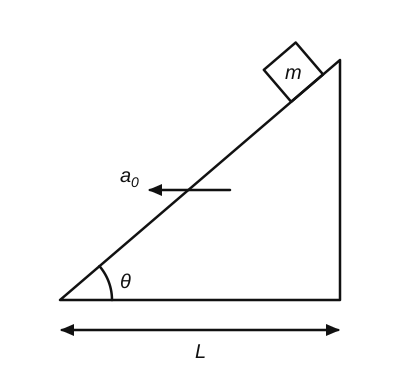
A small block of mass **m** slides down from the top of a frictionless inclined surface, while the inclined plane is moving towards left with constant acceleration $a_0$. The angle between the inclined plane and ground is $\theta$ and its base length is $L$. Assuming that initially the small block is at the top of the inclined plane, the time it takes to reach the lowest point of the inclined plane is ______.
Answer: (B) $\sqrt{\dfrac{4L}{g\sin2\theta - a_0(1+\cos2\theta)}}$
Work in the frame of the incline. It accelerates to the left, so the block feels a pseudo force $ma_0$ to the **right**.
The incline rises to the right, so 'down the incline' points to the lower left. Along the incline (downwards):
- gravity gives $g\sin\theta$,
- the pseudo force gives $-a_0\cos\theta$ (it has a component up the incline).
$$a_{\text{rel}} = g\sin\theta - a_0\cos\theta$$
Length of the incline: $\ell = \dfrac{L}{\cos\theta}$. Starting from rest, $\ell = \frac12 a_{\text{rel}} t^2$:
$$t = \sqrt{\frac{2L}{\cos\theta\,(g\sin\theta - a_0\cos\theta)}} = \sqrt{\frac{2L}{g\sin\theta\cos\theta - a_0\cos^2\theta}}$$
Using $2\sin\theta\cos\theta = \sin2\theta$ and $2\cos^2\theta = 1+\cos2\theta$:
$$t = \sqrt{\frac{4L}{g\sin2\theta - a_0(1+\cos2\theta)}}$$
 Solution by Sreeraj P, M.Sc Physics