

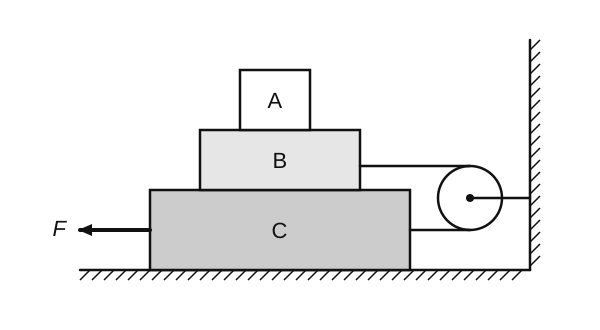
In the given figure the blocks $A, B$ and $C$ weigh $4\ \text{kg}, 6\ \text{kg}$ and 8 kg respectively. The co-efficient of sliding friction between any two surfaces is 0.5 . The force $\vec F$ required to slide the block $C$ with constant speed is ______ N . (Use $g = 10\ \text{m/s}^2$ )
Numerical value type. Enter your answer.
Answer: 210
The string from $B$ goes round the fixed pulley to $C$, so when $C$ moves left, $B$ moves right with the same speed. Following the answer key, sliding friction acts at every surface in contact (block $A$ is taken to stay at rest while $B$ slides under it).
Friction forces ($\mu = 0.5$, $g = 10$):
- $A$–$B$: $0.5\times4\times10 = 20$ N
- $B$–$C$: $0.5\times(4+6)\times10 = 50$ N
- $C$–floor: $0.5\times(4+6+8)\times10 = 90$ N
Block $B$ (constant speed, moving right): the string tension balances both frictions on it:
$$T = 20 + 50 = 70\ \text{N}$$
Block $C$ (constant speed, moving left): $F$ balances the floor friction, the friction from $B$ and the string tension, all acting to the right:
$$F = 90 + 50 + 70 = 210\ \text{N}$$
 Solution by Sreeraj P, M.Sc Physics