

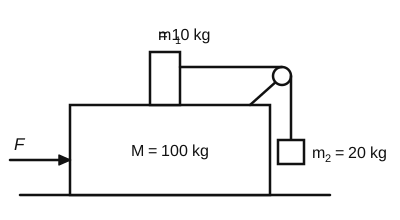
Three masses $M = 100\ \text{kg}$, $m_1 = 10\ \text{kg}$ and $m_2 = 20\ \text{kg}$ are arranged in a system as shown in figure. All the surfaces are frictionless and strings are inextensible and weightless. The pulleys are also weightless and frictionless. A force $F$ is applied on the system so that the mass $m_2$ moves upward with an acceleration of $2\ \text{m s}^{-2}$. The value of $F$ is (Take $g = 10\ \text{m s}^{-2}$)
Answer: (A) $3360\ \text{N}$
Let $a$ be the acceleration of $M$ (and of $m_2$ horizontally). Relative to $M$, $m_2$ rises at $2\ \text{m s}^{-2}$ and $m_1$ slides back at $2\ \text{m s}^{-2}$.
$m_2$ (vertical): $T - m_2g = m_2(2)\Rightarrow T = 20\times12 = 240\ \text{N}$.
$m_1$ in the frame of $M$ (pseudo force $m_1a$ backwards): $m_1a - T = m_1(2)\Rightarrow 10a = 260\Rightarrow a = 26\ \text{m s}^{-2}$.
Ground-frame accelerations: $M$ and $m_2$ have $26\ \text{m s}^{-2}$, $m_1$ has $26 - 2 = 24\ \text{m s}^{-2}$. For the whole system:
$$F = 100(26) + 20(26) + 10(24) = 2600 + 520 + 240 = 3360\ \text{N}$$
 Solution by Sreeraj P, M.Sc Physics