

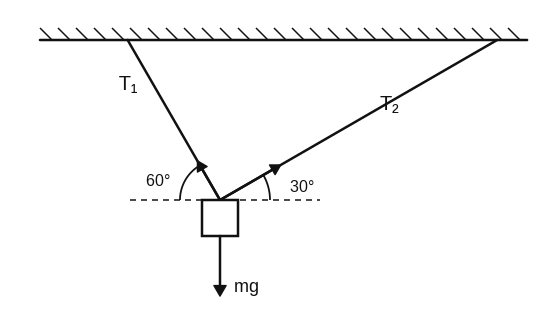
A body of mass $1\ \text{kg}$ is suspended with the help of two strings making angles as shown in the figure. The magnitudes of tensions $T_1$ and $T_2$, respectively, are (in N): (take $g = 10\ \text{m/s}^2$)
Answer: (B) $5\sqrt3,\ 5$
Concept. The body is in equilibrium under three concurrent forces: $T_1$, $T_2$ and $mg$. Resolve them horizontally and vertically and set each sum to zero.
Step 1. Read the angles. From the figure, $T_1$ (left string) makes $60^\circ$ with the horizontal and $T_2$ (right string) makes $30^\circ$. The angle between the strings is $180^\circ-60^\circ-30^\circ=90^\circ$, so they are perpendicular.
Step 2. Horizontal balance.
$$T_1\cos60^\circ=T_2\cos30^\circ\ \Rightarrow\ \frac{T_1}{2}=\frac{\sqrt3\,T_2}{2}\ \Rightarrow\ T_1=\sqrt3\,T_2$$
Step 3. Vertical balance. $mg=1\times10=10$ N:
$$T_1\sin60^\circ+T_2\sin30^\circ=10$$
$$\sqrt3T_2\cdot\frac{\sqrt3}{2}+\frac{T_2}{2}=\frac{3T_2}{2}+\frac{T_2}{2}=2T_2=10\ \Rightarrow\ T_2=5\ \text{N}$$
Step 4. Back-substitute. $T_1=\sqrt3\times5=5\sqrt3$ N.
Answer. $5\sqrt3$ N and $5$ N, option B. Shortcut for perpendicular strings: each tension is $mg\cos(\text{its angle with the vertical})$: $T_1=10\cos30^\circ$, $T_2=10\cos60^\circ$. The steeper string carries more.
 Solution by Sreeraj P, M.Sc Physics


