

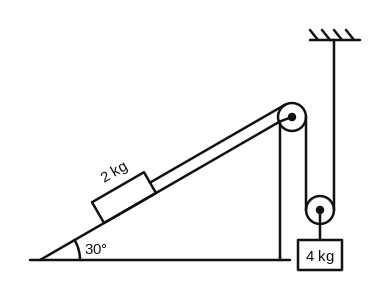
All surfaces shown in the figure are assumed to be frictionless and the pulleys and the string are light. The acceleration of the block of mass $2\ \text{kg}$ is:
Answer: (B) $\dfrac g3$
Concept. The $2$ kg block on the smooth incline is pulled by the string; the other end goes over a fixed pulley and down to a movable pulley carrying the $4$ kg block, with the string's far end fixed to the ceiling. So the $4$ kg block is held by $2T$ and moves half as fast as the $2$ kg block.
Step 1. Constraint. If the $2$ kg block moves up the incline with acceleration $a$, the string feeds that length onto the two segments of the movable pulley, so the $4$ kg block descends with $a/2$.
Step 2. Isolate the $2$ kg block. Forces along the incline: $T$ up the incline, $2g\sin30^\circ=g$ down the incline ($N$ is perpendicular, and there is no friction).
$$T-2g\sin30^\circ=2a\ \Rightarrow\ T=g+2a\qquad(1)$$
Step 3. Isolate the $4$ kg block with its pulley. Forces: $4g$ down, $2T$ up. Down positive:
$$4g-2T=4\cdot\frac a2=2a\qquad(2)$$
Step 4. Solve. Put (1) into (2):
$$4g-2g-4a=2a\ \Rightarrow\ 2g=6a\ \Rightarrow\ a=\frac g3$$
Answer. $\dfrac g3$, option B. This is the acceleration of the $2$ kg block; the $4$ kg block has $\dfrac g6$.
 Solution by Sreeraj P, M.Sc Physics


