

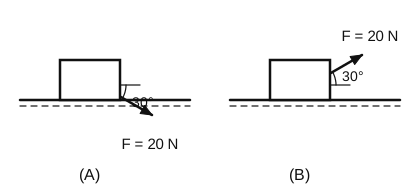
A block of mass $5$ kg is (i) pushed in case (A) and (ii) pulled in case (B), by a force $F = 20$ N, making an angle of $30^\circ$ with the horizontal, as shown in the figures. The coefficient of friction between the block and floor is $\mu = 0.2$. The difference between the accelerations of the block, in case (B) and case (A) will be: ($g = 10\ \text{m s}^{-2}$)
Answer: (C) $0.8\ \text{m s}^{-2}$
Horizontal component in both cases: $F\cos30^\circ = 17.32$ N. Vertical component $F\sin30^\circ = 10$ N.
(A) Pushing down: $N = 50 + 10 = 60$ N, friction $12$ N:
$$a_A = \frac{17.32 - 12}{5} = 1.06\ \text{m/s}^2$$
(B) Pulling up: $N = 50 - 10 = 40$ N, friction $8$ N:
$$a_B = \frac{17.32 - 8}{5} = 1.86\ \text{m/s}^2$$
$a_B - a_A = 0.8\ \text{m/s}^2$ (equivalently, $\mu\times2F\sin30^\circ/m = 0.2\times20/5$).
 Solution by Sreeraj P, M.Sc Physics