

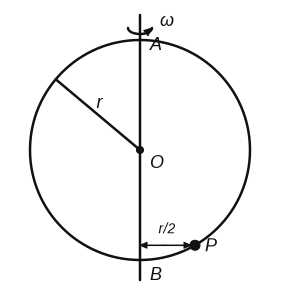
A smooth wire of length $2\pi r$ is bent into a circle and kept in a vertical plane. A bead can slide smoothly on the wire. When the circle is rotating with angular speed $\omega$ about the vertical diameter AB, as shown in figure, the bead is at rest with respect to the circular ring at position P as shown. Then the value of $\omega^2$ is equal to:
Answer: (C) $\dfrac{2g}{r\sqrt3}$
Concept. The bead moves in a horizontal circle about the vertical axis AB. The smooth wire can only push along the radius of the ring, so the normal force points from P towards the centre O. Its vertical part balances gravity and its horizontal part supplies the centripetal force.
Step 1. Geometry. From the figure, P is below O at a horizontal distance $\dfrac r2$ from the axis. Let OP make angle $\theta$ with the downward vertical. Then the radius of the bead's circle is
$$\rho=r\sin\theta=\frac r2\ \Rightarrow\ \sin\theta=\frac12,\ \theta=30^\circ$$
Step 2. Forces on the bead. Weight $mg$ down; normal $N$ along PO, which points up and towards the axis.
Step 3. Vertical balance.
$$N\cos\theta=mg$$
Step 4. Horizontal (towards the axis).
$$N\sin\theta=m\omega^2(r\sin\theta)\ \Rightarrow\ N=m\omega^2r$$
Step 5. Combine.
$$m\omega^2r\cos\theta=mg\ \Rightarrow\ \omega^2=\frac{g}{r\cos30^\circ}=\frac{2g}{\sqrt3\,r}$$
Answer. Option C. The bead can sit off the bottom only if $\omega^2>g/r$; here $\omega^2=1.15\,g/r$, which satisfies this.
 Solution by Sreeraj P, M.Sc Physics


