

A wedge $Y$ with mass of $10$ kg and all frictionless surfaces and the inclined surface making $37^\circ$ with horizontal. A block $X$ with mass $2$ kg is placed at the highest point of the wedge as shown in figure is at rest. At $t = 0$ wedge ($Y$) is pulled toward right with constant force ($f$) of $24$ N. Taking the block $X$ at rest at $t = 0$, the time taken by it to slide down $8.8$ m on the slope, while $Y$ is on the move, is ______ s.
(take $\tan(37^\circ) = 3/4$ and $g = 10\ \text{m/s}^2$)
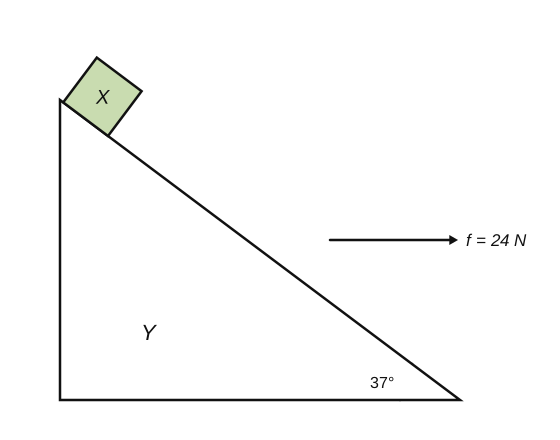
Answer: (A) $2$
The official answer takes the wedge's acceleration as that of the whole system: $A = \dfrac{f}{M + m} = \dfrac{24}{12} = 2\ \text{m/s}^2$ to the right.
In the wedge's frame the block feels a pseudo-force $mA$ to the left, which has a component $mA\cos 37^\circ$ up the slope. Its acceleration along the slope is
$$a = g\sin 37^\circ - A\cos 37^\circ = 6 - 1.6 = 4.4\ \text{m/s}^2$$
$s = \dfrac{1}{2}at^2$: $t = \sqrt{\dfrac{2 \times 8.8}{4.4}} = 2$ s.
Note: treating the block and wedge exactly (the block's push on the smooth wedge), $24 - N\sin 37^\circ = 10A$ with $N = m(g\cos 37^\circ + A\sin 37^\circ)$ gives $A \approx 1.34\ \text{m/s}^2$, $a \approx 4.93\ \text{m/s}^2$ and $t \approx 1.9$ s. The nearest option is still $2$ s.
 Solution by Sreeraj P, M.Sc Physics