

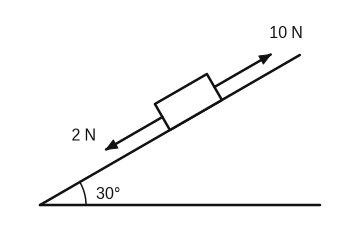
A block kept on a rough inclined plane, as shown in the figure, remains at rest up to a maximum force $2$ N down the inclined plane. The maximum external force up the inclined plane that does not move the block is $10$ N. The coefficient of static friction between the block and the plane is: [Take $g = 10\ \text{m/s}^2$]
Answer: (D) $\dfrac{\sqrt3}{2}$
Concept. Static friction can act either way along the incline, up to a maximum $f_L=\mu mg\cos\theta$. At the largest push down the incline friction is at its limit and acts up; at the largest push up it is at its limit and acts down. Two equations, two unknowns ($mg$ and $\mu$).
Step 1. Largest force down the incline, $2$ N. The block tends to slide down, so friction acts up the incline at its limit:
$$2+mg\sin30^\circ=f_L\qquad(1)$$
Step 2. Largest force up the incline, $10$ N. The block tends to slide up, so friction acts down:
$$10=mg\sin30^\circ+f_L\qquad(2)$$
Step 3. Solve. Subtract (1) from (2):
$$8=2mg\sin30^\circ=mg\ \Rightarrow\ mg=8\ \text{N}$$
Add (1) and (2): $12=2f_L$, so $f_L=6$ N.
Step 4. Coefficient of friction.
$$\mu=\frac{f_L}{mg\cos30^\circ}=\frac{6}{8\times\frac{\sqrt3}{2}}=\frac{6}{4\sqrt3}=\frac{\sqrt3}{2}$$
Answer. $\dfrac{\sqrt3}{2}$, option D. Pattern: $F_{\text{up}}+F_{\text{down}}=2f_L$ and $F_{\text{up}}-F_{\text{down}}=2mg\sin\theta$.
 Solution by Sreeraj P, M.Sc Physics


