

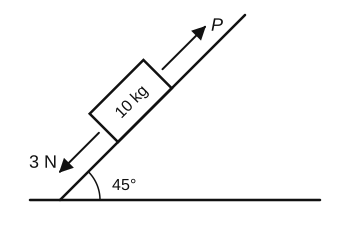
A block of mass $10\ \text{kg}$ is kept on a rough inclined plane as shown in the figure. A force of $3\ \text{N}$ is applied on the block. The coefficient of static friction between the plane and the block is $0.6$. What should be the minimum value of force $P$, such that the block does not move downward? (take $g = 10\ \text{m s}^{-2}$)
Answer: (D) $32\ \text{N}$
Along the incline ($\theta = 45^\circ$), the forces pulling the block down the slope are
$$mg\sin 45^\circ + 3 = \frac{100}{\sqrt 2} + 3 \approx 70.7 + 3 = 73.7\ \text{N}$$
When $P$ is at its minimum, the block is about to slide down, so static friction acts up the slope at its limiting value:
$$f = \mu mg\cos 45^\circ = 0.6 \times 70.7 \approx 42.4\ \text{N}$$
Balance along the slope:
$$P + f = 73.7 \Rightarrow P \approx 31.3\ \text{N}$$
So $P$ must be about $32\ \text{N}$.
 Solution by Sreeraj P, M.Sc Physics