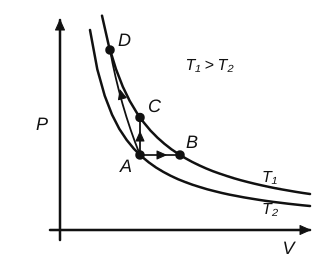
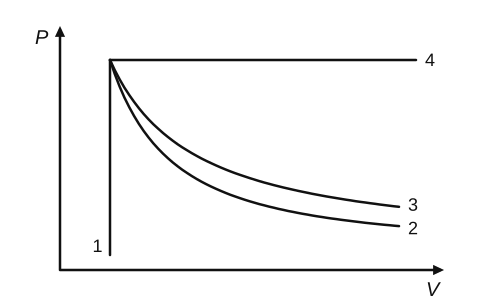
In an adiabatic expansion, the temperature of one mole of an ideal monatomic gas ($\gamma = 5/3$) decreases from $60$ K to $50$ K. The work done by the gas in the process is :
(Take the universal gas constant as $R = 8.3\ \text{J mol}^{-1}\text{K}^{-1}$)
Two gases $A$ and $B$ are filled at the same pressure in separate cylinders with movable pistons of radius $r_A$ and $r_B$, respectively. On supplying an equal amount of heat to both the systems reversibly under constant pressure, the pistons of gas $A$ and $B$ are displaced by $16$ cm and $9$ cm, respectively. If the change in their internal energy is the same, then the ratio $r_A/r_B$ is equal to
Two cylinders A and B of equal capacity are connected to each other via a stop cock. A contains an ideal gas at standard temperature and pressure. B is completely evacuated. The entire system is thermally insulated. The stop cock is suddenly opened. The process is :
Concept. A thermally insulated system exchanges no heat.
Step 1. Heat. $Q = 0$: adiabatic (a free expansion).
Step 2. Others ruled out. $W = 0$ and $\Delta U = 0$, so the final $T$ equals the initial, but the process is sudden, not quasi-static isothermal; the volume doubles and the pressure halves.
Answer. Adiabatic (Option B).
Solution by Sreeraj P, M.Sc Physics
Q 11-11-008JEE MainEAMCET 2012 (Engineering)Hard
The work done to increase the temperature of one mole of an ideal gas by $30°$C, if it is expanding under the condition $V \propto T^{2/3}$, is ($R = 8.314$ J/mol K)
Concept. Per mole, $C_P-C_V=R$ (Mayer's relation). Specific heats per unit mass are molar values divided by the molar mass $M$, so $c_P-c_V=\dfrac RM$.
Step 1. Molar mass of nitrogen. $N_2$: $M=28$.
Answer. $c_P-c_V=\dfrac{R}{28}$ (Option A).
Solution by Sreeraj P, M.Sc Physics
Q 11-11-010JEE MainAIEEE 2007Easy
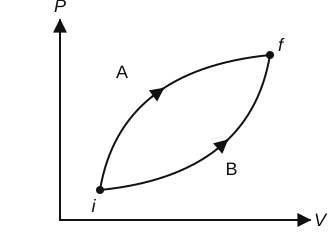
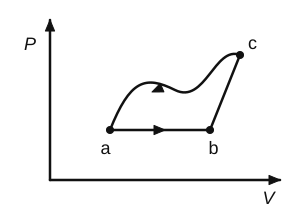
When a system is taken from state $i$ to state $f$ along the path $iaf$, it is found that $Q = 50$ cal and $W = 20$ cal. Along the path $ibf$, $Q = 36$ cal. $W$ along the path $ibf$ is
Concept. Internal energy is a state function: its change between $i$ and $f$ is the same along every path. Heat and work depend on the path, but $\Delta U=Q-W$ does not.
Step 1. $\Delta U$ from path $iaf$. $\Delta U=50-20=30$ cal.
Step 2. Path $ibf$. Same $\Delta U$, so $W=Q-\Delta U=36-30=6$ cal.
Five moles of hydrogen initially at STP are compressed adiabatically so that its temperature becomes $673$ K. The increase in internal energy of the gas, in kilojoule, is ($R = 8.3$ J/mol K; $\gamma = 1.4$ for diatomic gas)
The volume of one mole of a gas is changed from $V$ to $2V$ at constant pressure $p$. If $\gamma$ is the ratio of specific heats of the gas, the change in internal energy of the gas is
Three moles of an ideal monatomic gas undergo a cyclic process 1 → 2 → 3 → 4 → 1. In processes 1 → 2 and 3 → 4 the pressure is proportional to the volume, while processes 2 → 3 and 4 → 1 are at constant pressure. The temperatures in states 1, 2, 3 and 4 are $400$ K, $700$ K, $2500$ K and $1100$ K respectively. The work done by the gas in the cycle is ($R$ = universal gas constant)
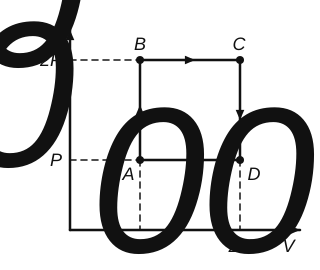
Three moles of an ideal monatomic gas perform a cycle ABCDA. Processes AB and CD are at constant volume, and BC and DA are at constant pressure. The gas temperatures are $T_A = 400$ K, $T_B = 800$ K, $T_C = 2400$ K and $T_D = 1200$ K. The work done by the gas is approximately ($R = 8.314$ J/mol K)
One mole of an ideal gas undergoes an isothermal change at temperature $T$ so that its volume $V$ is doubled. $R$ is the molar gas constant. The work done by the gas during this change is
A thermally insulated vessel contains an ideal gas of molecular mass $M$ and ratio of specific heats $\gamma$. It is moving with speed $v$ and is suddenly brought to rest. Assuming no heat is lost to the surroundings, its temperature increases by
Concept. When the vessel stops, the ordered KE of the gas becomes internal energy (insulated, no work). Per mole: $\tfrac12Mv^2=C_V\Delta T$ with $C_V=\dfrac{R}{\gamma-1}$.
$100$ g of water is heated from $30°$C to $50°$C. Ignoring the slight expansion of the water, the change in its internal energy is (specific heat of water is $4184$ J/kg K)
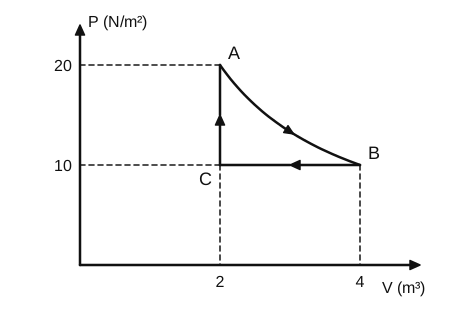
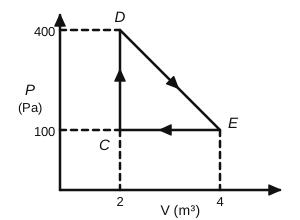
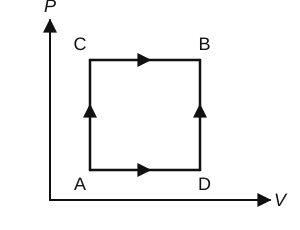
An ideal gas is taken round the cycle shown by a rectangle on the P-V diagram with sides $\Delta P = 2 \times 10^5$ Pa and $\Delta V = 3 \times 10^{-3}\ \text{m}^3$, traversed clockwise. The net heat absorbed by the gas in one cycle is
The efficiency of a Carnot engine is $\dfrac{1}{4}$. When the temperature of its sink is lowered by $50$ K, the efficiency becomes $\dfrac{1}{3}$. The temperature of the source is
An engine absorbs $1000$ J of heat from a source at $500$ K in each cycle and rejects heat to a sink at $300$ K. The maximum work it can do per cycle is
Find the work done, in joules, when $2$ mol of an ideal gas expand isothermally at $300$ K from $10$ L to $20$ L. ($R = 8.3$ J/mol K, $\ln 2 = 0.693$; give the answer to the nearest whole number)
Q 11-11-034JEE MainJEE Main 2026 (8 Apr, Shift 2)Hard
One mole of diatomic gas having rotational modes only is kept in a cylinder with a piston system. The cross-section area of the cylinder is $4\ \text{cm}^2$. The gas is heated slowly to raise the temperature by $1.2^\circ\text{C}$ during which the piston moves by $25$ mm. The amount of heat supplied to the gas is ______ J.
(Atmospheric pressure $= 100\ \text{kPa}$, $R = 8.3\ \text{J/mol.K}$) (Neglect mass of the piston)
Concept. First law $Q = \Delta U + W$; the massless piston means the gas pushes against atmospheric pressure.
Step 1. Work. $W = pA\Delta x = 10^5 \times 4 \times 10^{-4} \times 0.025 = 1.0$ J.
Step 2. Internal energy. The official answer counts only the two rotational modes ("rotational modes only"), $f = 2$: $$\Delta U = n\frac{f}{2}R\Delta T = 8.3 \times 1.2 = 9.96\ \text{J}$$
Step 3. Heat. $Q = 9.96 + 1.0 = 10.96$ J.
(With the usual 5 degrees of freedom, $\Delta U = 24.9$ J, which matches no option. The data are also not fully consistent: at constant pressure $p\Delta V$ should equal $nR\Delta T = 9.96$ J.)
Answer. $10.96$ (Option B).
Solution by Sreeraj P, M.Sc Physics
Q 11-11-035JEE MainJEE Main 2026 (8 Apr, Shift 2)Medium
Initial pressure and volume of a monoatomic ideal gas are $P$ and $V$. The change in internal energy of this gas in adiabatic expansion to volume $V_{\text{final}} = 27V$ is ______ J.
Q 11-11-036JEE MainJEE Main 2026 (6 Apr, Shift 1)Medium
A certain gas is isothermally compressed to $\left(\dfrac{1}{3}\right)^{\text{rd}}$ of its initial volume ($V_0 = 3$ litre) by applying required pressure. If the bulk modulus of the gas is $3 \times 10^5\ \text{N/m}^2$, the magnitude of work done on the gas is ______ J.
Concept. For a gas compressed isothermally, the bulk modulus equals the pressure ($K=P$). The work on the gas is $W=P_1V_1\ln\dfrac{V_1}{V_2}$.
Step 1. Initial pressure. $P_1=K=3\times10^5$ Pa.
Step 2. Work. $W=3\times10^5\times3\times10^{-3}\times\ln3=900\times1.0986=989$ J.
Answer. $989$.
Solution by Sreeraj P, M.Sc Physics
Q 11-11-037JEE MainJEE Main 2026 (6 Apr, Shift 2)Medium
A cylinder with adiabatic walls is closed at both ends and is divided into two compartments by a frictionless adiabatic piston. Ideal gas is filled in both (left and right) the compartments at same $P, V, T$. Heating is started from left side until pressure changes to $27P/8$. If initial volume of each compartment was $9$ litres then the final volume in right-hand side compartment is ______ litres. (for this ideal gas $C_P/C_V = 1.5$)
Q 11-11-038JEE MainJEE Main 2026 (5 Apr, Shift 1)Easy
Given below are two statements: one is labelled as Assertion A and the other is labelled as Reason R
Statement I : Change in internal energy of a system containing $n$ mole of ideal gas can be written as $\Delta U = nC_v(T_f - T_i) = \dfrac{nR}{\gamma - 1}(T_f - T_i)$, where $\gamma = \dfrac{C_p}{C_v}$, $T_i =$ initial temperature, $T_f =$ final temperature.
Statement II : Relation between degree of freedom $f$ and $\gamma\ (= C_p/C_v)$ is $\left(\gamma = 1 + \dfrac{2}{f}\right)$
Choose the correct answer from the options given below
Concept. Zeroth law → temperature; first law → internal energy. Extensive variables scale with the amount of matter; intensive ones do not.
Step 1. Check each.
A: true.
B: true.
C: in an isothermal process of an ideal gas $\Delta U=0$, so $\Delta Q=\Delta W$. False.
D: intensive $\times$ extensive is extensive (e.g. $P\times V$ doubles when the system doubles). True.
E: extensive $\div$ mass is intensive (e.g. specific heat). False.
Answer. A, B and D only (Option C).
Solution by Sreeraj P, M.Sc Physics
Q 11-11-040JEE MainJEE Main 2026 (4 Apr, Shift 1)Hard
An ideal gas undergoes a process maintaining relation between pressure $(P)$ and volume $(V)$ as $P = P_0\left(1 + \left(\dfrac{V_0}{V}\right)^2\right)^{-1}$, where $P_0$ and $V_0$ are constants. If two samples $A$ and $B$ (two moles each) with initial volumes $V_0$ and $3V_0$ respectively undergo above mentioned process and attain same pressure, then the difference at the temperatures of these samples, $T_B - T_A$ is ______.
Concept. At constant pressure $Q=nC_P\Delta T$, $\Delta U=nC_V\Delta T$, $W=nR\Delta T$: ratio $C_P:C_V:R$. Diatomic: $\tfrac72:\tfrac52:1$.
Answer. $7:5:2$ (Option D).
Solution by Sreeraj P, M.Sc Physics
Q 11-11-042JEE MainJEE Main 2026 (2 Apr, Shift 1)Medium
A vessel contains $0.15\ \text{m}^3$ of a gas at pressure $8$ bar and temperature $140\ ^\circ$C with $c_p=3R$ and $c_v=2R$. It is expanded adiabatically till pressure falls to $1$ bar. The work done during this process is ______ kJ. ($R$ is gas constant)
Concept. Adiabatic work $W=\dfrac{P_1V_1-P_2V_2}{\gamma-1}$, with $\gamma=\dfrac{3R}{2R}=1.5$.
Step 1. Final volume. $V_2=V_1\left(\dfrac{P_1}{P_2}\right)^{1/\gamma}=0.15\times8^{2/3}=0.6$ m$^3$.
Step 2. Work. $\dfrac{8\times10^5\times0.15-10^5\times0.6}{0.5}=\dfrac{1.2\times10^5-0.6\times10^5}{0.5}=1.2\times10^5$ J.
Answer. $120$ kJ.
Solution by Sreeraj P, M.Sc Physics
Q 11-11-043JEE MainJEE Main 2026 (2 Apr, Shift 2)Easy
$5$ moles of unknown gas is heated at constant volume from $10^\circ$C to $20^\circ$C. The molar specific heat of this gas at constant pressure $c_p=8$ cal/mol.°C and $R=8.36$ J/mol.°C. The change in the internal energy of the gas is ______ calorie.
Concept. At constant volume $\Delta U=Q=nC_V\Delta T$, with $C_V=C_P-R$. Work in calories: $R=\dfrac{8.36}{4.18}=2$ cal/mol °C.
Step 1. $C_V$. $8-2=6$ cal/mol °C.
Step 2. $\Delta U$. $5\times6\times10=300$ cal.
Answer. $300$.
Solution by Sreeraj P, M.Sc Physics
Q 11-11-044JEE MainJEE Main 2026 (28 Jan, Shift 2)Easy
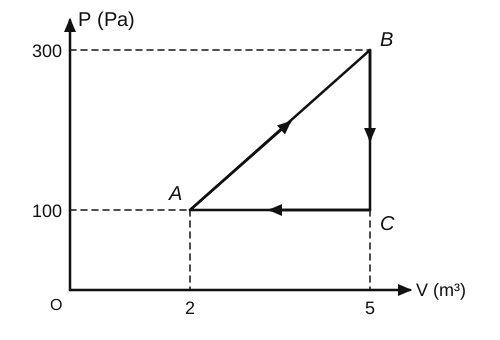
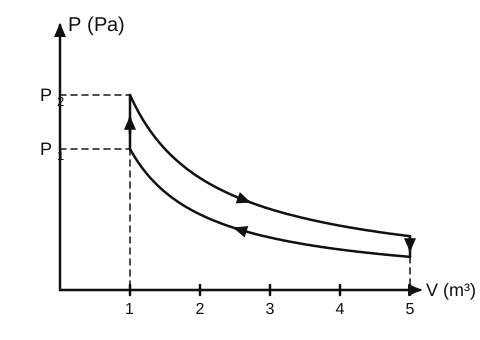
A thermodynamic system is taken through the cyclic process $ABC$ as shown in the figure. The total work done by the system during the cycle $ABC$ is ______ J.
Concept. Net work in a cycle $=$ area enclosed on the $P$–$V$ diagram; positive if traversed clockwise.
Step 1. Shape. From the figure, $A(2,100)$, $B(5,300)$, $C(5,100)$: a right triangle with base $3$ m$^3$ and height $200$ Pa.
Step 2. Area. $\tfrac12\times3\times200=300$ J, clockwise, so positive.
Answer. $300$.
Solution by Sreeraj P, M.Sc Physics
Q 11-11-045JEE MainJEE Main 2026 (28 Jan, Shift 1)Hard
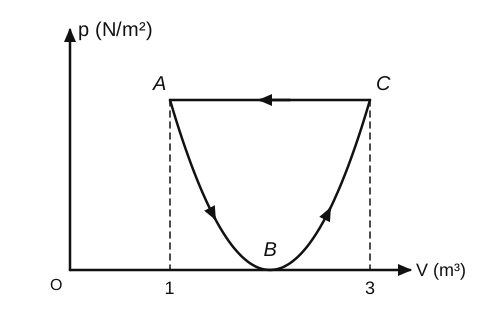
In the following $p - V$ diagram the equation of state along the curved path is given by $(V-2)^2 = 4ap$ where $a$ is a constant. The total work done in the closed path is
Concept. Net work $=$ area enclosed, negative when the cycle runs anticlockwise. From the figure the gas expands along the parabola (low pressure) from A to C and is compressed along the line $p=\dfrac1{4a}$ from C back to A.
Step 1. Endpoints. At $V=1$ and $V=3$: $p=\dfrac{1}{4a}$.
Step 3. Sign. Expansion at lower pressure, compression at higher pressure: net work negative.
Answer. $-\dfrac1{3a}$ (Option D).
Solution by Sreeraj P, M.Sc Physics
Q 11-11-046JEE MainJEE Main 2026 (24 Jan, Shift 2)Medium
10 mole of an ideal gas is undergoing the process shown in the figure. The heat involved in the process from $P_1$ to $P_2$ is $\alpha$ Joule ( $P_1 = 21.7$ Pa and $P_2 = 30\ \text{Pa}, \text{C}_v = 21\ \text{J/K.mol}, R = 8.3\ \text{J/mol.K}$). The value of $\alpha$ is ______ .
Concept. From the figure, $P_1\to P_2$ is a vertical line (constant volume $V=1$ m$^3$): $W=0$ and $Q=nC_V\Delta T=\dfrac{C_V}{R}V\Delta P$ (using $nR\Delta T=V\Delta P$).
Step 1. Substitute. $Q=\dfrac{21}{8.3}\times1\times(30-21.7)=\dfrac{21\times8.3}{8.3}=21$ J.
Answer. Option A.
Solution by Sreeraj P, M.Sc Physics
Q 11-11-047JEE MainJEE Main 2026 (24 Jan, Shift 1)Medium
Density of water at $4^\circ\text{C}$ and $20^\circ\text{C}$ are $1000\ \text{kg/m}^3$ and $998\ \text{kg/m}^3$ respectively. The increase in internal energy of 4 kg of water when it is heated from $4^\circ\text{C}$ to $20^\circ\text{C}$ is ______ J.
(specific heat capacity of water $= 4.2\ \text{J/kg}$. and 1 atmospheric pressure $= 10^5\ \text{Pa}$ )
Concept. $\Delta U = Q - W$, with $W = P\Delta V$ for the slight expansion. (The specific heat is $4200$ J/kg °C; the unit in the statement is a misprint.)
Concept. $P\propto1/V$: isothermal. Heat split between $\Delta U$ and work: isobaric. No heat: adiabatic. No work: isochoric.
Answer. A-III, B-IV, C-I, D-II (Option A).
Solution by Sreeraj P, M.Sc Physics
Q 11-11-050JEE MainJEE Main 2025 (23 Jan, Shift 1)Easy
An ideal gas initially at $0^\circ\text{C}$ temperature is compressed suddenly to one fourth of its volume. If the ratio of specific heat at constant pressure to that at constant volume is $3/2$, the change in temperature due to the thermodynamic process is ______ K.
Concept. "Suddenly" means adiabatic: $TV^{\gamma-1}=$ constant.
Step 1. Final temperature. $T_2=273\times4^{0.5}=546$ K.
Step 2. Change. $546-273=273$ K.
Answer. $273$.
Solution by Sreeraj P, M.Sc Physics
Q 11-11-051JEE MainJEE Main 2025 (23 Jan, Shift 2)Easy
Water of mass $m$ gram is slowly heated to increase the temperature from $T_1$ to $T_2$. The change in entropy of the water, given specific heat of water is $1\ \text{J kg}^{-1}\text{K}^{-1}$, is
Concept. $P\propto T$ for a fixed mass of ideal gas means $V$ is constant (isochoric): no work, $Q=\Delta U$.
Step 1. Check. A true; B false; C false; D true (pressure and so $T$ rise); E true.
Answer. A, D, E only (Option C).
Solution by Sreeraj P, M.Sc Physics
Q 11-11-053JEE MainJEE Main 2025 (24 Jan, Shift 1)Easy
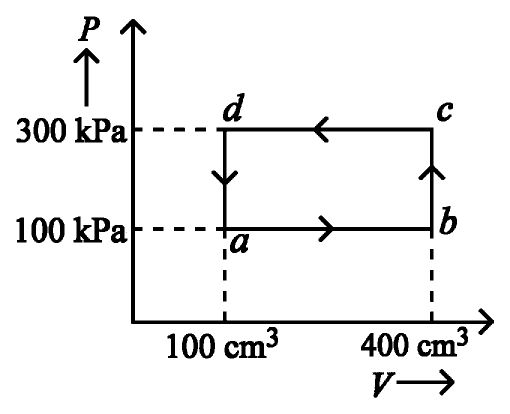
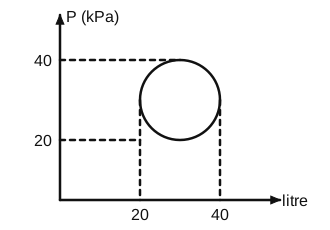
The temperature of 1 mole of an ideal monoatomic gas is increased by $50^\circ\text{C}$ at constant pressure. The total heat added and change in internal energy are $E_1$ and $E_2$, respectively. If $\dfrac{E_1}{E_2} = \dfrac{x}{9}$, then the value of $x$ is ______.
Concept. In a cycle $\Delta U=0$, so the heat exchanged equals the net work, i.e. the area enclosed.
Step 1. Shape. From the figure the path goes along the upper half of a circle and back along its horizontal diameter: a half "circle" with radii $100$ cc $=10^{-4}$ m$^3$ and $100$ kPa $=10^5$ Pa (an ellipse in SI units).
Step 2. Area. $\tfrac12\pi ab=\tfrac12\pi(10^{-4})(10^5)=5\pi$ J.
Answer. Option A.
Solution by Sreeraj P, M.Sc Physics
Q 11-11-055JEE MainJEE Main 2025 (24 Jan, Shift 2)Easy
Given below are two statements. One is labelled as Assertion (A) and the other is labelled as Reason (R).
Assertion (A): In an insulated container, a gas is adiabatically shrunk to half of its initial volume. The temperature of the gas decreases.
Reason (R): Free expansion of an ideal gas is an irreversible and an adiabatic process.
In the light of the above statements, choose the correct answer from the options given below:
Concept. Adiabatic compression raises the temperature ($TV^{\gamma-1}$ constant): the Assertion is false. Free expansion of an ideal gas is adiabatic ($Q=0$) and irreversible: the Reason is true.
Answer. Option B.
Solution by Sreeraj P, M.Sc Physics
Q 11-11-056JEE MainJEE Main 2025 (28 Jan, Shift 1)Medium
A Carnot engine $(E)$ is working between two temperatures $473\ \text{K}$ and $273\ \text{K}$. In a new system, two engines are used: engine $E_1$ works between $473\ \text{K}$ and $373\ \text{K}$, and engine $E_2$ works between $373\ \text{K}$ and $273\ \text{K}$. If $\eta_{12}$, $\eta_1$ and $\eta_2$ are the efficiencies of the engines $E$, $E_1$ and $E_2$, respectively, then
Concept. Adiabatic: $Q=0$, so $W=-\Delta U=-nC_V\Delta T$: it depends only on the temperature change.
Answer. Option A.
Solution by Sreeraj P, M.Sc Physics
Q 11-11-058JEE MainJEE Main 2025 (29 Jan, Shift 2)Medium
Given below are two statements. One is labelled as Assertion (A) and the other is labelled as Reason (R).
Assertion (A): With the increase in the pressure of an ideal gas, the volume falls off more rapidly in an isothermal process in comparison to the adiabatic process.
Reason (R): In an isothermal process, $PV$ = constant, while in an adiabatic process $PV^\gamma$ = constant. Here $\gamma$ is the ratio of specific heats, $P$ is the pressure and $V$ is the volume of the ideal gas.
In the light of the above statements, choose the correct answer from the options given below:
Answer: (A) Both (A) and (R) are true and (R) is the correct explanation of (A)
Concept. Slopes: isothermal $\dfrac{dP}{dV}=-\dfrac PV$, adiabatic $-\gamma\dfrac PV$. So $\left|\dfrac{dV}{dP}\right|$ is $\gamma$ times larger on the isotherm: the volume falls faster with pressure in the isothermal case. This follows directly from $PV$ and $PV^\gamma$ constant.
Answer. Both true and R is the correct explanation (Option A).
Solution by Sreeraj P, M.Sc Physics
Q 11-11-059JEE MainJEE Main 2025 (29 Jan, Shift 2)Medium
A polyatomic gas ($C_V = 3R$, $C_P = 4R$, where $R$ is the gas constant) goes from phase space point A ($P_A = 10^5\ \text{Pa}$, $V_A = 4\times10^{-6}\ \text{m}^3$) to point B ($P_B = 5\times10^4\ \text{Pa}$, $V_B = 6\times10^{-6}\ \text{m}^3$) to point C ($P_C = 10^4\ \text{Pa}$, $V_C = 8\times10^{-6}\ \text{m}^3$), as shown in the figure. A to B is an adiabatic path and B to C is an isothermal path at $450\ \text{K}$. The net heat absorbed per unit mole by the system is
Concept. Adiabatic: $Q = 0$; isothermal: $Q = W = RT\ln\dfrac{V_2}{V_1}$ per mole.
Step 1. A → B. $Q_{AB} = 0$.
Step 2. B → C. $Q_{BC} = 450R\ln\dfrac86 = 450R(\ln4 - \ln3)$.
Answer. $450R(\ln4 - \ln3)$ (Option B).
Solution by Sreeraj P, M.Sc Physics
Q 11-11-060JEE MainJEE Main 2024 (1 Feb, Shift 1)Medium
The pressure and volume of an ideal gas are related as $PV^{3/2} = K$ (constant). The work done when the gas is taken from state $A(P_1, V_1, T_1)$ to state $B(P_2, V_2, T_2)$ is
Step 1. Substitute. $Q=200\times\dfrac{1.4}{0.4}=700$ J.
Answer. Option D.
Solution by Sreeraj P, M.Sc Physics
Q 11-11-062JEE MainJEE Main 2024 (4 Apr, Shift 2)Medium
A sample of gas at temperature $T$ is adiabatically expanded to double its volume. The adiabatic constant for the gas is $\gamma = 3/2$. The work done by the gas in the process is ($\mu = 1$ mole)
Concept. In an adiabatic process $TV^{\gamma-1}$ is constant, and the work done by the gas equals the fall in internal energy: $W=\dfrac{nR(T_1-T_2)}{\gamma-1}$.
Step 1. Final temperature. $T_2=T\left(\dfrac12\right)^{1/2}=\dfrac{T}{\sqrt2}$.
Step 2. Work ($n=1$, $\gamma-1=\tfrac12$): $$W=2R\left(T-\frac{T}{\sqrt2}\right)=RT(2-\sqrt2)$$
Answer. Option C.
Solution by Sreeraj P, M.Sc Physics
Q 11-11-063JEE MainJEE Main 2024 (5 Apr, Shift 1)Medium
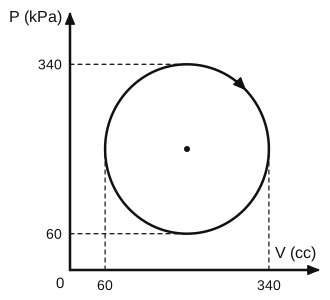
The heat absorbed by a system in going through the cyclic process shown (pressure in kPa, volume in cc) is
Concept. Heat absorbed in a cycle $=$ work $=$ area enclosed. A "circle" on unequal axes has area $\pi\times$ (radius in pressure) $\times$ (radius in volume).
Step 1. Radii. $\dfrac{340-60}{2}=140$ on each axis: $140$ kPa and $140$ cc.
Step 2. Area. $\pi\times140\times10^3\times140\times10^{-6}=61.6$ J.
Answer. Option B.
Solution by Sreeraj P, M.Sc Physics
Q 11-11-064JEE MainJEE Main 2024 (5 Apr, Shift 2)Medium
During an adiabatic process, if the pressure of a gas is found to be proportional to the cube of its absolute temperature, then the ratio $\dfrac{C_P}{C_V}$ for the gas is
Concept. Rewrite the adiabatic law in $P$ and $T$: from $PV^\gamma=$ constant and $V\propto\dfrac TP$, we get $P^{1-\gamma}T^\gamma=$ constant, i.e. $P\propto T^{\gamma/(\gamma-1)}$.
Step 1. Match the power. $\dfrac{\gamma}{\gamma-1}=3$.
Concept. At constant pressure, $C_P=C_V+P\left(\dfrac{\partial V}{\partial T}\right)_P$ (heat for $\Delta U$ plus heat for the work). Find $\dfrac{dV}{dT}$ from the given equation of state.
Step 1. Differentiate at constant $P$. $PV^2=RT\Rightarrow2PV\,dV=R\,dT\Rightarrow P\dfrac{dV}{dT}=\dfrac{R}{2V}$.
Step 2. Heat capacity. $C_P=C_V+\dfrac{R}{2V}$.
Answer. Option C. For an ideal gas ($PV=RT$) the same steps give $C_P=C_V+R$.
Solution by Sreeraj P, M.Sc Physics
Q 11-11-066JEE MainJEE Main 2024 (6 Apr, Shift 2)Easy
A total of $48\ \text{J}$ of heat is given to one mole of helium kept in a cylinder. The temperature of the helium increases by $2^\circ\text{C}$. The work done by the gas is (Given $R = 8.3\ \text{J K}^{-1}\text{mol}^{-1}$)
Concept. First law: $Q=\Delta U+W$. For an ideal gas $\Delta U=nC_V\Delta T$ in any process. Helium is monatomic: $C_V=\tfrac32R$.
Step 1. Change in internal energy. $\Delta U=1\times\tfrac32\times8.3\times2=24.9$ J.
Step 2. Work. $W=Q-\Delta U=48-24.9=23.1$ J.
Answer. Option D.
Solution by Sreeraj P, M.Sc Physics
Q 11-11-067JEE MainJEE Main 2024 (27 Jan, Shift 1)Easy
$0.08\ \text{kg}$ air is heated at constant volume through $5\,{}^\circ\text{C}$. The specific heat of air at constant volume is $0.17\ \text{kcal kg}^{-1}\,{}^\circ\text{C}^{-1}$ and $J = 4.18\ \text{joule cal}^{-1}$. The change in its internal energy is approximately:
Step 2. In joules. $68 \times 4.18 \approx 284$ J.
Answer. $284$ J (Option C).
Solution by Sreeraj P, M.Sc Physics
Q 11-11-068JEE MainJEE Main 2024 (27 Jan, Shift 2)Medium
During an adiabatic process, the pressure of a gas is found to be proportional to the cube of its absolute temperature. The ratio of $\dfrac{C_p}{C_v}$ for the gas is:
Q 11-11-069JEE MainJEE Main 2024 (29 Jan, Shift 1)Medium
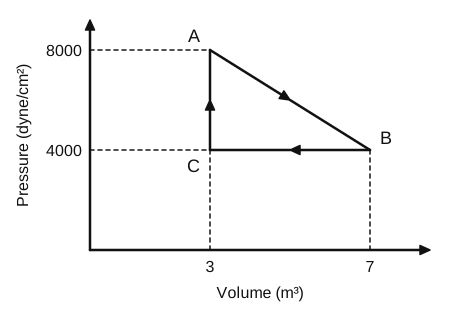
A thermodynamic system is taken from an original state $A$ to an intermediate state $B$ by a linear process as shown in the figure. Its volume is then reduced to the original value from $B$ to $C$ by an isobaric process. The total work done by the gas from $A$ to $B$ and $B$ to $C$ would be:
Concept. Work $=$ area under each leg (positive for expansion). Convert dyne/cm$^2$ to Pa ($\times0.1$).
Step 1. A→B (trapezium). $\dfrac{800+400}{2}\times4=2400$ J.
Step 2. B→C (compression at $400$ Pa). $-400\times4=-1600$ J.
Step 3. Total. $800$ J (the triangle's area).
Answer. Option D.
Solution by Sreeraj P, M.Sc Physics
Q 11-11-070JEE MainJEE Main 2024 (8 Apr, Shift 1)Medium
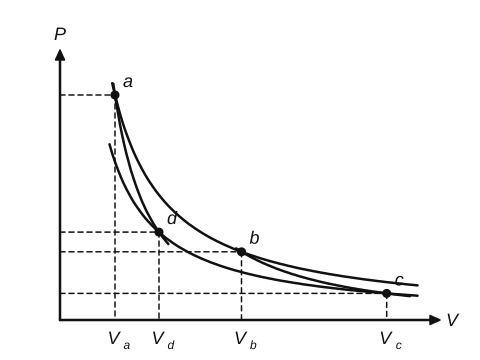
Two different adiabatic paths for the same gas intersect two isothermal curves as shown in the P–V diagram. The relation between the ratio $\dfrac{V_a}{V_d}$ and the ratio $\dfrac{V_b}{V_c}$ is:
Q 11-11-072JEE MainJEE Main 2024 (9 Apr, Shift 1)Medium
A sample of 1 mole gas at temperature $T$ is adiabatically expanded to double its volume. If adiabatic constant for the gas is $\gamma = \dfrac32$, then the work done by the gas in the process is:
Q 11-11-074JEE MainJEE Main 2024 (9 Apr, Shift 2)Hard
A real gas within a closed chamber at $27\,{}^\circ\text{C}$ undergoes the cyclic process as shown in the figure. The gas obeys the $PV^3 = RT$ equation for the path $A$ to $B$. The net work done in the complete cycle is (assuming $R = 8\ \text{J/mol K}$):
Step 2. B → C. $10 \times (2 - 4) = -20$ J; C → A isochoric: $0$.
Step 3. Net. $205$ J.
Answer. $205$ J (Option B).
Solution by Sreeraj P, M.Sc Physics
Q 11-11-075JEE MainJEE Main 2024 (30 Jan, Shift 1)Medium
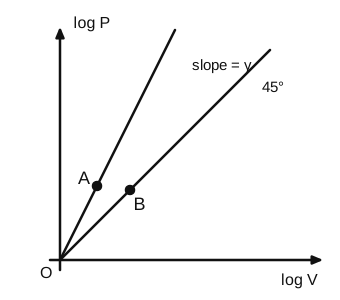
Two thermodynamic processes $A$ and $B$ are shown in the figure as straight lines through the origin on a $\log P$ versus $\log V$ graph. Line $A$ has slope $\gamma$ and line $B$ makes $45^\circ$ with the $\log V$ axis. The molar heat capacities for processes $A$ and $B$ are $C_A$ and $C_B$. The molar heat capacities at constant pressure and constant volume are $C_P$ and $C_V$ respectively. Choose the correct statement.
Concept. A straight line through the origin on a $\log P$–$\log V$ graph means $P\propto V^k$, i.e. $PV^x=$ const with $x=-k$. Molar heat capacity $C=C_V+\dfrac{R}{1-x}$.
Step 1. Line B (slope $+1$, so $x=-1$). $C_B=C_V+\dfrac R2$: between $C_V$ and $C_P=C_V+R$.
Step 2. Line A (slope $+\gamma$, so $x=-\gamma$). $C_A=C_V+\dfrac{R}{1+\gamma}$, also between $C_V$ and $C_P$; neither is $0$ or $\infty$.
Step 3. Choose. $C_P>C_B>C_V$.
Answer. Option A.
Solution by Sreeraj P, M.Sc Physics
Q 11-11-076JEE MainJEE Main 2024 (30 Jan, Shift 2)Medium
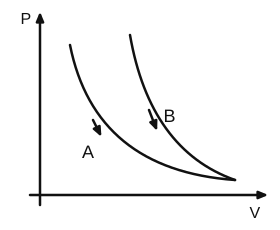
Choose the correct statement for processes $A$ and $B$ shown in the figure.
Answer: (A) $PV^\gamma = k$ for process $B$ and $PV = k$ for process $A$.
Concept. From the same point, an adiabat (slope $-\gamma\dfrac{P}{V}$) is steeper than an isotherm (slope $-\dfrac{P}{V}$).
Step 1. Identify. B (steeper) is adiabatic, $PV^\gamma = k$; A is isothermal, $PV = k$.
Answer. $PV^\gamma = k$ for process $B$ and $PV = k$ for process $A$ (Option A).
Solution by Sreeraj P, M.Sc Physics
Q 11-11-077JEE MainJEE Main 2023 (29 Jan, Shift 1)Easy
Given below are two statements. One is labelled as Assertion A and the other is labelled as Reason R.
Assertion A: If $dQ$ and $dW$ represent the heat supplied to the system and the work done on the system respectively, then according to the first law of thermodynamics $dQ=dU-dW$.
Reason R: First law of thermodynamics is based on law of conservation of energy.
In the light of the above statements, choose the correct answer from the options given below:
Answer: (C) Both A and R are correct and R is the correct explanation of A
Concept. First law: heat supplied $=$ rise in $U$ $+$ work done *by* the system. With $dW$ the work done *on* the system, the work by it is $-dW$, so $dQ=dU-dW$. It is energy conservation.
Answer. Both correct and R is the correct explanation of A (Option C).
Solution by Sreeraj P, M.Sc Physics
Q 11-11-078JEE MainJEE Main 2023 (30 Jan, Shift 1)Easy
Heat is given to an ideal gas in an isothermal process.
A. Internal energy of the gas will decrease.
B. Internal energy of the gas will increase.
C. Internal energy of the gas will not change.
D. The gas will do positive work.
E. The gas will do negative work.
Choose the correct answer from the options given below:
Concept. Isothermal ideal gas: $\Delta U=0$, so the heat given is all turned into work done by the gas ($W=Q>0$).
Answer. C and D only (Option D).
Solution by Sreeraj P, M.Sc Physics
Q 11-11-079JEE MainJEE Main 2023 (30 Jan, Shift 2)Easy
Given below are two statements: one is labelled as Assertion A and the other is labelled as Reason R.
Assertion A: Efficiency of a reversible heat engine will be highest at $-273^\circ\text{C}$ temperature of cold reservoir.
Reason R: The efficiency of Carnot's engine depends not only on temperature of cold reservoir but it depends on the temperature of hot reservoir too and is given as $\eta=\left(1-\dfrac{T_2}{T_1}\right)$.
In the light of the above statements, choose the correct answer from the options given below:
Answer: (D) Both A and R are true and R is the correct explanation of A
Concept. $\eta=1-\dfrac{T_2}{T_1}$ grows as $T_2$ falls, reaching 1 at $T_2=0$ K ($-273^\circ$C), the ideal (unattainable) limit. R gives the formula that shows it.
Answer. Option D.
Solution by Sreeraj P, M.Sc Physics
Q 11-11-081JEE MainJEE Main 2023 (31 Jan, Shift 2)Medium
Heat energy of $735\ \text{J}$ is given to a diatomic gas allowing the gas to expand at constant pressure. Each gas molecule rotates around an internal axis but does not oscillate. The increase in the internal energy of the gas will be
Step 1. Substitute. $735 \times \dfrac57 = 525$ J.
Answer. $525$ J (Option A).
Solution by Sreeraj P, M.Sc Physics
Q 11-11-082JEE MainJEE Main 2023 (31 Jan, Shift 2)Medium
A hypothetical gas expands adiabatically such that its volume changes from $8$ litres to $27$ litres. If the ratio of final pressure of the gas to initial pressure of the gas is $\dfrac{16}{81}$, then the ratio of $\dfrac{C_p}{C_v}$ will be
Q 11-11-083JEE MainJEE Main 2023 (24 Jan, Shift 1)Medium
$1\ \text{g}$ of a liquid is converted to vapour at $3\times10^5\ \text{Pa}$ pressure. If $10\%$ of the heat supplied is used for increasing the volume by $1600\ \text{cm}^3$ during this phase change, then the increase in internal energy in the process will be
Concept. Isotherms are hyperbolas $PV=nRT$; a higher temperature gives a curve further from the axes.
Step 1. Choose. Hyperbolas with $T_3$ outermost.
Answer. Option D.
Solution by Sreeraj P, M.Sc Physics
Q 11-11-085JEE MainJEE Main 2023 (25 Jan, Shift 1)Easy
A Carnot engine with efficiency $50\%$ takes heat from a source at $600\ \text{K}$. In order to increase the efficiency to $70\%$, keeping the temperature of sink same, the new temperature of the source will be
Concept. Isothermal: $\Delta U=0$. Adiabatic: work by the gas comes from $U$. Isochoric: no work. Isobaric: heat splits between $\Delta U$ and work.
Answer. A-II, B-I, C-IV, D-III (Option B).
Solution by Sreeraj P, M.Sc Physics
Q 11-11-087JEE MainJEE Main 2023 (13 Apr, Shift 2)Easy
The initial pressure and volume of an ideal gas are $P_0$ and $V_0$. The final pressure of the gas when the gas is suddenly compressed to volume $\dfrac{V_0}{4}$ will be (Given $\gamma$ = ratio of specific heats at constant pressure and at constant volume)
Answer: (B) There is no change in the internal energy
Concept. Adiabatic compression: $Q = 0$, work done on the gas raises $U$ and $T$.
Step 1. False statement. "No change in internal energy".
Answer. There is no change in the internal energy (Option B).
Solution by Sreeraj P, M.Sc Physics
Q 11-11-090JEE MainJEE Main 2023 (11 Apr, Shift 1)Easy
$1\ \text{kg}$ of water at $100^\circ\text{C}$ is converted into steam at $100^\circ\text{C}$ by boiling at atmospheric pressure. The volume of water changes from $1.00\times10^{-3}\ \text{m}^3$ as a liquid to $1.671\ \text{m}^3$ as steam. The change in internal energy of the system during the process will be (Given latent heat of vaporisation $=2257\ \text{kJ kg}^{-1}$, atmospheric pressure $=1\times10^5\ \text{Pa}$)
Concept. Boiling at constant pressure: the latent heat supplied goes partly into pushing back the atmosphere ($W=P\Delta V$) and the rest into internal energy.
Step 1. Heat supplied. $Q=mL=2257$ kJ.
Step 2. Work against the atmosphere. $W=10^5\times(1.671-0.001)=1.67\times10^5$ J $=167$ kJ.
Concept. No engine between two reservoirs beats the Carnot engine, $\eta_C=26.8\%$ here. A real engine has a lower efficiency, so less than $27\%$.
Answer. B and D only (Option C).
Solution by Sreeraj P, M.Sc Physics
Q 11-11-093JEE MainJEE Main 2023 (6 Apr, Shift 1)Easy
A source supplies heat to a system at the rate of $1000\ \text{W}$. If the system performs work at a rate of $200\ \text{W}$, the rate at which internal energy of the system increases is
Answer: (D) Statement I is false but Statement II is true
Concept. $Q=\Delta U+W$: heat can go entirely into work (isothermal) or even raise $U$ less than zero. Work by a gas $\int P\,dV$ is positive only if $V$ increases.
Step 1. Statement I. False (e.g. isothermal expansion, or melting).
Step 2. Statement II. True.
Answer. Option D.
Solution by Sreeraj P, M.Sc Physics
Q 11-11-095JEE MainJEE Main 2023 (8 Apr, Shift 2)Easy
Work done by a Carnot engine operating between temperatures $127^\circ\text{C}$ and $27^\circ\text{C}$ is $2$ kJ. The amount of heat transferred to the engine by the reservoir is
Q 11-11-096JEE MainJEE Main 2023 (10 Apr, Shift 1)Medium
Consider two containers $A$ and $B$ containing monoatomic gases at the same pressure $P$, volume $V$ and temperature $T$. The gas in $A$ is compressed isothermally to $\dfrac18$ of its original volume while the gas in $B$ is compressed adiabatically to $\dfrac18$ of its original volume. The ratio of final pressure of gas in $B$ to that of gas in $A$ is
Concept. Isothermal: $PV=$ constant. Adiabatic: $PV^\gamma=$ constant. For the same compression ratio the adiabatic pressure rises more, because the gas also heats up.
Q 11-11-098JEE MainJEE Main 2023 (1 Feb, Shift 2)Medium
A Carnot engine operating between two reservoirs has efficiency $\dfrac13$. When the temperature of cold reservoir is raised by $x$, its efficiency decreases to $\dfrac16$. The value of $x$, if the temperature of hot reservoir is $99^\circ\text{C}$, will be
Concept. $T_2=(1-\eta)T_1$ before and after; $T_1=372$ K.
Step 1. Sinks. $\tfrac23\times372=248$ K; $\tfrac56\times372=310$ K.
Step 2. Rise. $x=62$ K.
Answer. Option D.
Solution by Sreeraj P, M.Sc Physics
Q 11-11-099JEE MainJEE Main 2022 (24 Jun, Shift 1)Medium
A Carnot engine whose heat sink is at $27^\circ\text{C}$ has an efficiency of $25\%$. By how many degrees should the temperature of the source be changed to increase the efficiency by $100\%$ of the original efficiency?
Concept. $T_1=\dfrac{T_2}{1-\eta}$. "Increase by $100\%$ of the original" doubles the efficiency to $50\%$.
Step 1. Sources. $\dfrac{300}{0.75}=400$ K; $\dfrac{300}{0.5}=600$ K.
Step 2. Change. $+200^\circ$C.
Answer. Option B.
Solution by Sreeraj P, M.Sc Physics
Q 11-11-100JEE MainJEE Main 2022 (24 Jun, Shift 2)Easy
A Carnot engine takes $5000\ \text{kcal}$ of heat from a reservoir at $727^\circ\text{C}$ and gives heat to a sink at $127^\circ\text{C}$. The work done by the engine is
Concept. Carnot: $W=Q_1\left(1-\dfrac{T_2}{T_1}\right)$ in kelvin.
Step 1. Efficiency. $1-\dfrac{400}{1000}=0.6$.
Step 2. Work. $0.6\times5000\times4200=1.26\times10^7$ J.
Answer. Option D.
Solution by Sreeraj P, M.Sc Physics
Q 11-11-101JEE MainJEE Main 2022 (24 Jun, Shift 2)Medium
A monoatomic gas performs a work of $\dfrac Q4$ where $Q$ is the heat supplied to it. The molar heat capacity of the gas will be ______ $R$ during this transformation, where $R$ is the gas constant.
Concept. $\eta=1-\dfrac{T_2}{T_1}$ with $T_1=373$ K, $T_2=273$ K.
Step 1. Value. $\dfrac{100}{373}=26.81\%$.
Answer. Option A.
Solution by Sreeraj P, M.Sc Physics
Q 11-11-103JEE MainJEE Main 2022 (26 Jun, Shift 2)Medium
A heat engine operates with the cold reservoir at temperature $324\ \text{K}$. The minimum temperature of the hot reservoir, if the heat engine takes $300\ \text{J}$ heat from the hot reservoir and delivers $180\ \text{J}$ heat to the cold reservoir per cycle, is ______ K.
Concept. No engine can beat Carnot: $1-\dfrac{Q_2}{Q_1}\le1-\dfrac{T_2}{T_1}$. So the least possible $T_1$ is when the engine is reversible: $\dfrac{Q_2}{Q_1}=\dfrac{T_2}{T_1}$.
Step 1. Apply. $\dfrac{180}{300}=\dfrac{324}{T_1}\Rightarrow T_1=540$ K.
Answer. $540$.
Solution by Sreeraj P, M.Sc Physics
Q 11-11-104JEE MainJEE Main 2022 (25 Jul, Shift 1)Medium
A certain amount of gas of volume $V$ at $27^\circ\text{C}$ temperature and pressure $2\times10^7\ \text{N m}^{-2}$ expands isothermally until its volume gets doubled. Later it expands adiabatically until its volume gets redoubled. The final pressure of the gas will be (Use $\gamma = 1.5$)
Q 11-11-105JEE MainJEE Main 2022 (25 Jul, Shift 2)Medium
Let $\eta_1$ be the efficiency of an engine at $T_1 = 447^\circ\text{C}$ and $T_2 = 147^\circ\text{C}$ while $\eta_2$ is the efficiency at $T_1 = 947^\circ\text{C}$ and $T_2 = 47^\circ\text{C}$. The ratio $\dfrac{\eta_1}{\eta_2}$ will be
Q 11-11-106JEE MainJEE Main 2022 (26 Jul, Shift 1)Easy
$7$ moles of a certain monoatomic ideal gas undergo a temperature increase of $40\ \text{K}$ at constant pressure. The increase in the internal energy of the gas in this process is (Given $R = 8.3\ \text{J K}^{-1}\text{mol}^{-1}$)
Q 11-11-107JEE MainJEE Main 2022 (26 Jul, Shift 1)Easy
A monoatomic gas at pressure $P$ and volume $V$ is suddenly compressed to one eighth of its original volume. The final pressure at constant entropy will be
Step 1. Substitute. $P' = P \times 8^{5/3} = 32P$.
Answer. $32P$ (Option C).
Solution by Sreeraj P, M.Sc Physics
Q 11-11-108JEE MainJEE Main 2022 (27 Jun, Shift 1)Easy
In a carnot engine, the temperature of reservoir is $527^\circ$C and that of sink is $200$ K. If the workdone by the engine when it transfers heat from reservoir to sink is $12000$ kJ, the quantity of heat absorbed by the engine from reservoir is ______ $\times10^6$ J.
Concept. At constant pressure, $W=nR\Delta T$ and $Q=nC_P\Delta T$, so $\dfrac QW=\dfrac{C_P}{R}=\dfrac{\gamma}{\gamma-1}$.
Step 1. Ratio. $\dfrac{1.4}{0.4}=3.5$.
Step 2. Heat. $Q=3.5\times400=1400$ J.
Answer. $1400$.
Solution by Sreeraj P, M.Sc Physics
Q 11-11-110JEE MainJEE Main 2022 (27 Jul, Shift 2)Easy
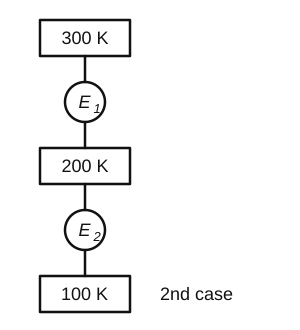
In $1^{\text{st}}$ case, Carnot engine operates between temperatures $300$ K and $100$ K. In $2^{\text{nd}}$ case, as shown in the figure, a combination of two engines is used. The efficiency of this combination (in $2^{\text{nd}}$ case) will be :
Step 2. Efficiency. $1 - \dfrac{Q_3}{Q_1} = \dfrac23$, the same as one engine between 300 K and 100 K.
Answer. Same as the $1^{\text{st}}$ case (Option A).
Solution by Sreeraj P, M.Sc Physics
Q 11-11-111JEE MainJEE Main 2022 (28 Jul, Shift 1)Medium
A Carnot engine has efficiency of $50\%$. If the temperature of sink is reduced by $40^\circ$C, its efficiency increases by $30\%$. The temperature of the source will be :
Concept. Carnot efficiency $\eta=1-\dfrac{T_2}{T_1}$. "Increases by $30\%$" means $30\%$ of the original: $0.5\to0.65$.
Step 1. First state. $T_2=0.5T_1$.
Step 2. Second state. $1-\dfrac{T_2-40}{T_1}=0.65\Rightarrow T_2-40=0.35T_1$.
Step 3. Solve. $0.5T_1-40=0.35T_1\Rightarrow T_1=266.7$ K.
Answer. Option C.
Solution by Sreeraj P, M.Sc Physics
Q 11-11-112JEE MainJEE Main 2021 (27 Jul, Shift 1)Medium
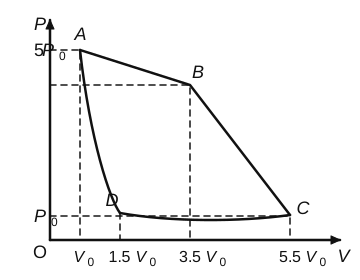
In the reported figure, there is a cyclic process $ABCDA$ on a sample of $1$ mol of a diatomic gas. The temperature of the gas during the process $A \to B$ and $C \to D$ are $T_1$ and $T_2$ $(T_1 > T_2)$ respectively.
Choose the correct option out of the following for work done if processes $BC$ and $DA$ are adiabatic.
Concept. On the adiabats $Q=0$, so $W=-\Delta U=nC_V\times$(temperature drop). $BC$ falls from $T_1$ to $T_2$; $DA$ rises from $T_2$ to $T_1$.
Step 1. Works. $W_{BC}=nC_V(T_1-T_2)$; $W_{DA}=nC_V(T_2-T_1)$, so $W_{AD}=-W_{DA}=nC_V(T_1-T_2)=W_{BC}$.
Step 2. Others. $W_{BC}+W_{DA}=0$; the isothermal works differ because the volume ratios differ ($1.5V_0/V_0$ vs $5.5/3.5$) and the temperatures differ.
Answer. Option B.
Solution by Sreeraj P, M.Sc Physics
Q 11-11-113JEE MainJEE Main 2021 (27 Jul, Shift 2)Medium
Two Carnot engines $A$ and $B$ operate in series such that engine $A$ absorbs heat at $T_1$ and rejects heat to a sink at temperature $T$. Engine $B$ absorbs half of the heat rejected by engine $A$ and rejects heat to the sink at $T_3$. When work done in both the cases is equal, the value of $T$ is:
Q 11-11-114JEE MainJEE Main 2021 (31 Aug, Shift 1)Easy
A reversible engine has an efficiency of $\dfrac14$. If the temperature of the sink is reduced by $58^\circ\text{C}$, its efficiency becomes double. Calculate the temperature of the sink:
Q 11-11-115JEE MainJEE Main 2021 (31 Aug, Shift 2)Medium
A sample of gas with $\gamma = 1.5$ is taken through an adiabatic process in which the volume is compressed from $1200\ \text{cm}^3$ to $300\ \text{cm}^3$. If the initial pressure is $200$ kPa, the absolute value of the work done by the gas in the process $=$ ______ J.
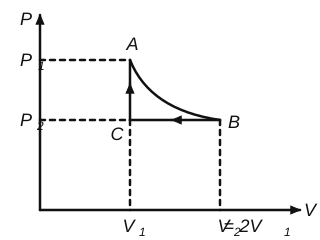
Step 2. $B\to C$ (isobaric compression at $P_2$). $W=P_2(V_1-V_2)=-P_2V_1$. Since $P_2V_2=nRT$ and $V_2=2V_1$: $P_2V_1=\dfrac{nRT}{2}$.
Step 3. $C\to A$. $W=0$.
Step 4. Total. $nRT\left(\ln2-\dfrac12\right)$.
Answer. Option A.
Solution by Sreeraj P, M.Sc Physics
Q 11-11-118JEE MainJEE Main 2021 (24 Feb, Shift 2)Medium
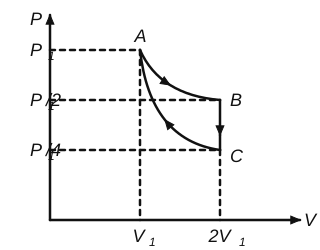
If one mole of an ideal gas at $(P_1, V_1)$ is allowed to expand reversibly and isothermally ($A$ to $B$) its pressure is reduced to one-half of the original pressure (see figure). This is followed by a constant volume cooling till its pressure is reduced to one-fourth of the initial value ($B \to C$). Then it is restored to its initial state by a reversible adiabatic compression ($C$ to $A$). The net workdone by the gas is equal to:
Q 11-11-120JEE MainJEE Main 2021 (25 Feb, Shift 1)Medium
In a certain thermodynamical process, the pressure of a gas depends on its volume as $kV^3$. The work done when the temperature changes from 100 °C to 300 °C will be $xnR$ where $n$ denotes number of moles of a gas. Find $x$.
Concept. $P=kV^3$ is a polytropic process $PV^{-3}=$ constant (index $x=-3$). For $PV^x=$ constant, $W=\dfrac{nR(T_1-T_2)}{x-1}=\dfrac{nR\Delta T}{1-x}$.
Step 1. Apply with $x=-3$, $\Delta T=200$ K: $$W=\frac{nR\times200}{1-(-3)}=50nR$$
Answer. $x=50$.
Solution by Sreeraj P, M.Sc Physics
Q 11-11-121JEE MainJEE Main 2021 (18 Mar, Shift 2)Easy
For an adiabatic expansion of an ideal gas, the fractional change in its pressure is equal to (where $\gamma$ is the ratio of specific heats):
Q 11-11-122JEE MainJEE Main 2021 (18 Mar, Shift 2)Easy
An ideal gas in a cylinder is separated by a piston in such a way that the entropy of one part is $S_1$ and that of the other part is $S_2$. Given that $S_1 > S_2$. If the piston is removed then the total entropy of the system will be:
Concept. Entropy is extensive (old-syllabus topic): the entropy of a system is the sum over its parts. Removing a piston between two parts of the same ideal gas in equilibrium changes nothing else.
Answer. $S_1+S_2$ (Option D).
Solution by Sreeraj P, M.Sc Physics
Q 11-11-123JEE MainJEE Main 2021 (20 Jul, Shift 1)Easy
The amount of heat needed to raise the temperature of 4 moles of a rigid diatomic gas from 0 °C to 50 °C when no work is done is ______ ($R$ is the universal gas constant)
Concept. In a cycle $\Delta U=0$, so heat absorbed $=$ net work $=$ area enclosed. A circle on $P$–$V$ has area $\pi\times$(pressure radius)$\times$(volume radius).
Step 1. Radii. $10$ kPa and $10$ L $=10^{-2}$ m$^3$.
Step 2. Area. $\pi\times10^4\times10^{-2}=100\pi$ J.
Answer. $100$.
Solution by Sreeraj P, M.Sc Physics
Q 11-11-126JEE MainJEE Main 2021 (26 Feb, Shift 2)Medium
$1$ mole of rigid diatomic gas performs a work of $\frac{Q}{5}$ when heat $Q$ is supplied to it. The molar heat capacity of the gas during this transformation is $\frac{xR}{8}$. The value of $x$ is [$R$ universal gas constant]
Q 11-11-127JEE MainJEE Main 2021 (26 Feb, Shift 2)Medium
The volume $V$ of a given mass of monoatomic gas changes with temperature $T$ according to the relation $V = KT^{\frac{2}{3}}$. The work done when temperature changes by $90$ K will be $xR$. The value of $x$ is [$R$ universal gas constant]
Step 2. Work (one mole): $dW=\dfrac{RT}{V}dV=RT\cdot\dfrac23\dfrac{dT}{T}=\dfrac23R\,dT$, so $W=\dfrac23R\times90=60R$.
Answer. $x=60$.
Solution by Sreeraj P, M.Sc Physics
Q 11-11-128JEE MainJEE Main 2021 (25 Jul, Shift 2)Medium
A heat engine has an efficiency of $\frac{1}{6}$. When the temperature of sink is reduced by $62^\circ$C, its efficiency gets doubled. The temperature of the source is:
Step 2. Solve. $\tfrac16T_1=62\Rightarrow T_1=372$ K $=99^\circ$C.
Answer. Option D.
Solution by Sreeraj P, M.Sc Physics
Q 11-11-129JEE MainJEE Main 2021 (26 Aug, Shift 1)Easy
An electric appliance supplies $6000$ J min$^{-1}$, heat to the system. If the system delivers a power of $90$ W. How long it would take to increase the internal energy by $2.5\times10^3$ J?
Concept. First law as rates: (heat in per second) $=$ (rise of $U$ per second) $+$ (power delivered).
Step 1. Net rate. Heat in $=\dfrac{6000}{60}=100$ W; $\dfrac{dU}{dt}=100-90=10$ W.
Step 2. Time. $\dfrac{2.5\times10^3}{10}=250$ s.
Answer. Option B.
Solution by Sreeraj P, M.Sc Physics
Q 11-11-130JEE MainJEE Main 2021 (26 Aug, Shift 2)Medium
A refrigerator consumes an average $35$ W power to operate between temperature $-10^\circ$C to $25^\circ$C. If there is no loss of energy then how much average heat per second does it transfer?
Step 2. Heat per second. $35\times\dfrac{263}{35}=263$ J s$^{-1}$ (heat removed from the cold side).
Answer. Option C.
Solution by Sreeraj P, M.Sc Physics
Q 11-11-131JEE MainJEE Main 2021 (27 Aug, Shift 2)Easy
A heat engine operates between a cold reservoir at temperature $T_2 = 400$ K and a hot reservoir at temperature $T_1$. It takes $300$ J of heat from the hot reservoir and delivers $240$ J of heat to the cold reservoir in a cycle. The minimum temperature of the hot reservoir has to be ______ K
Concept. Actual efficiency $\le$ Carnot efficiency.
Step 1. Actual. $\dfrac{300-240}{300}=0.2$.
Step 2. Condition. $1-\dfrac{400}{T_1}\ge0.2\Rightarrow T_1\ge500$ K.
Answer. $500$.
Solution by Sreeraj P, M.Sc Physics
Q 11-11-132JEE MainJEE Main 2020 (8 Jan, Shift 2)Easy
A Carnot engine having an efficiency of $\dfrac{1}{10}$ is being used as a refrigerator. If the work done on the refrigerator is $10$ J, the amount of heat absorbed from the reservoir at a lower temperature is
Concept. A reversible engine run backwards is a refrigerator with $\text{COP}=\dfrac{Q_2}{W}=\dfrac{1-\eta}{\eta}$.
Step 1. COP. $\dfrac{1-0.1}{0.1}=9$.
Step 2. Heat from the cold side. $Q_2=9\times10=90$ J.
Answer. Option D.
Solution by Sreeraj P, M.Sc Physics
Q 11-11-133JEE MainJEE Main 2020 (9 Jan, Shift 1)Medium
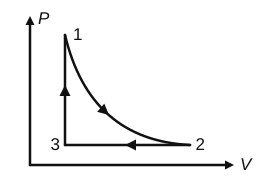
Which of the following is an equivalent cyclic process corresponding to the thermodynamic cycle given in the figure? Here, $1 \to 2$ is adiabatic. (Graphs are schematic and are not to scale)
Concept. Translate each leg to a $V$–$T$ graph. $1\to2$ adiabatic expansion: $V$ rises, $T$ falls (a curve). $2\to3$ isobaric compression: $V\propto T$, a straight line towards the origin. $3\to1$ isochoric: $V$ constant (horizontal on $V$–$T$), $T$ rises.
Step 1. Choose. The graph with a horizontal $3\to1$, a straight line through the origin for $2\to3$, and a curve for $1\to2$.
Answer. Option C.
Solution by Sreeraj P, M.Sc Physics
Q 11-11-134JEE MainJEE Main 2020 (9 Jan, Shift 2)Medium
Starting at temperature $300$ K, one mole of an ideal diatomic gas $(\gamma = 1.4)$ is first compressed adiabatically from volume $V_1$ to $V_2 = \dfrac{V_1}{16}$. It is then allowed to expand isobarically to volume $2V_2$. If all the processes are quasi-static then the final temperature of the gas (in K) is (to the nearest integer) ______.
Concept. Two stages: adiabatic compression ($TV^{\gamma-1}=$ constant), then isobaric expansion ($V\propto T$).
Step 1. Adiabatic. $T_2=300\times16^{0.4}=300\times3.031=909.4$ K.
Step 2. Isobaric doubling of volume. $T_3=2\times909.4=1818.9\approx1819$ K.
Answer. $1819$.
Solution by Sreeraj P, M.Sc Physics
Q 11-11-135JEE MainJEE Main 2020 (5 Sep, Shift 2)Easy
In an adiabatic process, the density of a diatomic gas becomes $32$ times its initial value. The final pressure of the gas is found to be $n$ times the initial pressure. The value of $n$ is:
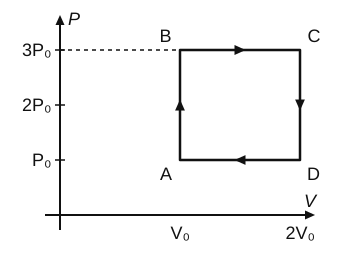
Concept. Same method: net work is the rectangle's area; heat goes in only during the isochoric pressure rise and the isobaric expansion.
Step 1. Net work. $(3P_0-P_0)(2V_0-V_0)=2P_0V_0$.
Step 2. Heat in. $A\to B$: $\tfrac32(3-1)P_0V_0=3P_0V_0$. $B\to C$: $\tfrac52(6-3)P_0V_0=7.5P_0V_0$. Total $10.5P_0V_0$.
Step 3. Efficiency. $\dfrac{2}{10.5}=0.19=19\%$.
Answer. $19$.
Solution by Sreeraj P, M.Sc Physics
Q 11-11-137JEE MainJEE Main 2020 (7 Jan, Shift 1)Medium
A litre of dry air at STP expands adiabatically to a volume of $3$ litres. If $\gamma = 1.40$, the work done by air is: ($3^{1.4} = 4.6555$) [Take air to be an ideal gas]
Concept. Adiabatic expansion: $W=\dfrac{P_1V_1-P_2V_2}{\gamma-1}$ with $P_2=P_1\left(\dfrac{V_1}{V_2}\right)^\gamma$.
Step 1. Initial $PV$. STP: $P_1=1.013\times10^5$ Pa, $V_1=10^{-3}$ m$^3$, so $P_1V_1=101.3$ J.
Step 2. Final $PV$. $P_2V_2=P_1V_1\cdot\dfrac{3}{3^{1.4}}=101.3\times\dfrac{3}{4.6555}=65.3$ J.
Step 3. Work. $W=\dfrac{101.3-65.3}{0.4}=90$ J.
Answer. About $90$ J, closest to $90.5$ J (Option B).
Solution by Sreeraj P, M.Sc Physics
Q 11-11-138JEE MainJEE Main 2020 (7 Jan, Shift 1)Easy
A Carnot engine operates between two reservoirs of temperatures $900$ K and $300$ K. The engine performs $1200$ J of work per cycle. The heat energy (in J) delivered by the engine to the low temperature reservoir, in a cycle, is ______.
Q 11-11-139JEE MainJEE Main 2020 (7 Jan, Shift 2)Medium
Two ideal Carnot engines operate in cascade (all heat given up by one engine is used by the other engine to produce work) between temperatures $T_1$ and $T_2$. The temperature of the hot reservoir of the first engine is $T_1$ and the temperature of the cold reservoir of the second engine is $T_2$. $T$ is the temperature of the sink of the first engine, which is also the source for the second engine. How is $T$ related to $T_1$ and $T_2$, if both the engines perform equal amounts of work?
Concept. For Carnot engines, heat is proportional to temperature: $\dfrac{Q_1}{T_1}=\dfrac{Q}{T}=\dfrac{Q_2}{T_2}$. Equal work means equal heat differences: $Q_1-Q=Q-Q_2$.
Step 1. Equal work. Dividing by the common $\dfrac QT$: $T_1-T=T-T_2$.
Step 2. Solve. $T=\dfrac{T_1+T_2}{2}$.
Answer. Option B. (Equal efficiencies would instead give $\sqrt{T_1T_2}$.)
Solution by Sreeraj P, M.Sc Physics
Q 11-11-140JEE MainJEE Main 2020 (8 Jan, Shift 1)Medium
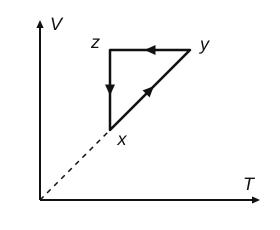
A thermodynamic cycle $xyzx$ is shown on a $V$-$T$ diagram. The $P$-$V$ diagram that best describes this cycle is: (Diagrams are schematic and not to scale)
Concept. Read each leg from the $V$–$T$ graph: $x\to y$ on a line through the origin ($V\propto T$: isobaric expansion); $y\to z$ at constant $V$, $T$ falling (isochoric, pressure falls); $z\to x$ at constant $T$, $V$ falling (isothermal compression, pressure rises).
Step 1. On $P$–$V$. Horizontal to the right, vertical down, then a hyperbola back up to $x$.
Answer. Option A.
Solution by Sreeraj P, M.Sc Physics
Q 11-11-141JEE MainJEE Main 2020 (2 Sep, Shift 1)Medium
An engine takes in $5$ moles of air at $20\ ^\circ\text{C}$ and $1\ \text{atm}$, and compresses it adiabatically to $1/10^{\text{th}}$ of the original volume. Assuming air to be a diatomic ideal gas made up of rigid molecules, the change in its internal energy during this process comes out to be $X\ \text{kJ}$. The value of $X$ to the nearest integer is ______.
Q 11-11-142JEE MainJEE Main 2020 (2 Sep, Shift 2)Medium
A heat engine is involved with exchange of heat of $1915\ \text{J}$, $-40\ \text{J}$, $+125\ \text{J}$ and $-Q\ \text{J}$, during one cycle achieving an efficiency of $50.0\%$. The value of $Q$ is:
Concept. A bursting balloon expands suddenly: no time for heat exchange (adiabatic), and far from equilibrium (irreversible).
Answer. Option B.
Solution by Sreeraj P, M.Sc Physics
Q 11-11-144JEE MainJEE Main 2020 (3 Sep, Shift 2)Medium
If minimum possible work is done by a refrigerator in converting $100$ grams of water at $0^\circ\text{C}$ to ice, how much heat (in calories) is released to the surroundings at temperature $27^\circ\text{C}$ (Latent heat of ice $= 80\ \text{cal/gram}$) to the nearest integer?
Concept. Minimum work means a reversible (Carnot) refrigerator, for which $\dfrac{Q_1}{T_1}=\dfrac{Q_2}{T_2}$. The heat released to the room is $Q_1$.
Step 1. Heat removed from the water. $Q_2=100\times80=8000$ cal at $T_2=273$ K.
Step 2. Heat released at $300$ K. $Q_1=8000\times\dfrac{300}{273}=8791$ cal.
Answer. $8791$.
Solution by Sreeraj P, M.Sc Physics
Q 11-11-145JEE MainJEE Main 2020 (4 Sep, Shift 2)Easy
Match the thermodynamic processes taking place in a system with the correct conditions. In the table: $\Delta Q$ is the heat supplied, $\Delta W$ is the work done and $\Delta U$ is change in internal energy of the system.
Q 11-11-146JEE MainJEE Main 2020 (5 Sep, Shift 1)Medium
Three different processes that can occur in an ideal monoatomic gas are shown in the $P$ vs $V$ diagram. The paths are labelled as $A \to B$, $A \to C$ and $A \to D$. The change in internal energies during these processes are taken as $E_{AB}$, $E_{AC}$ and $E_{AD}$ and the work done as $W_{AB}$, $W_{AC}$ and $W_{AD}$. The correct relation between these parameters are:
Q 11-11-147JEE MainJEE Main 2019 (9 Jan, Shift 2)Easy
Two Carnot engines $A$ and $B$ are operated in series. The first one, $A$, receives heat at $T_1\,(= 600\ \text{K})$ and rejects to a reservoir at temperature $T_2$. The second engine $B$ receives heat rejected by the first engine and, in turn, rejects to a heat reservoir at $T_3\,(= 400\ \text{K})$. Calculate the temperature $T_2$ if the work outputs of the two engines are equal:
Concept. Two Carnot engines in series with equal work: $Q_1-Q_2=Q_2-Q_3$ and $Q\propto T$, so $T_2$ is the mean.
Step 1. Value. $\dfrac{600+400}{2}=500$ K.
Answer. Option A.
Solution by Sreeraj P, M.Sc Physics
Q 11-11-148JEE MainJEE Main 2019 (10 Jan, Shift 1)Medium
Three Carnot engines operate in series between a heat source at a temperature $T_1$ and a heat sink at temperature $T_4$. The first engine works between $T_1$ and $T_2$, the second between $T_2$ and $T_3$, and the third between $T_3$ and $T_4$, with $T_1 > T_2 > T_3 > T_4$. The three engines are equally efficient if:
Q 11-11-149JEE MainJEE Main 2019 (10 Jan, Shift 2)Easy
Half mole of an ideal monoatomic gas is heated at a constant pressure of $1\ \text{atm}$ from $20^\circ\text{C}$ to $90^\circ\text{C}$. Work done by the gas is (Gas constant $R = 8.21\ \text{J mol}^{-1}\text{K}^{-1}$)
Step 1. Substitute. $0.5 \times 8.21 \times 70 \approx 287$ J; the closest option is $291$ J.
Answer. $291$ J (Option C).
Solution by Sreeraj P, M.Sc Physics
Q 11-11-150JEE MainJEE Main 2019 (10 Apr, Shift 1)Easy
$n$ moles of an ideal gas with constant volume heat capacity $C_V$ undergo an isobaric expansion by certain volume. The ratio of the work done in the process, to the heat supplied is:
Concept. Isobaric with total heat capacity $C_V$ at constant volume: $Q=(C_V+nR)\Delta T$, $W=nR\Delta T$.
Step 1. Ratio. $\dfrac WQ=\dfrac{nR}{C_V+nR}$.
Answer. Option C.
Solution by Sreeraj P, M.Sc Physics
Q 11-11-151JEE MainJEE Main 2019 (9 Jan, Shift 1)Easy
A gas can be taken from A to B via two different processes ACB and ADB shown in the figure. When path ACB is used 60 J of heat flows into the system and 30 J of work is done by the system. If the path ADB is used then work done by the system is 10 J, the heat flows into the system in the path ADB is
Concept. $\Delta U$ between $A$ and $B$ is the same for every path. Find it from $ACB$, then apply the first law to $ADB$.
Step 1. $\Delta U$ from $ACB$. $\Delta U=60-30=30$ J.
Step 2. Path $ADB$. $Q=\Delta U+W=30+10=40$ J.
Answer. Option C.
Solution by Sreeraj P, M.Sc Physics
Q 11-11-152JEE MainJEE Main 2019 (8 Apr, Shift 2)Easy
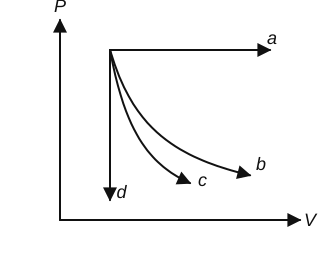
The given diagram shows four processes i.e., isochoric, isobaric, isothermal and adiabatic. The correct assignment of the processes, in the same order is given by
Concept. From one point on a $P$–$V$ diagram: isochoric is vertical, isobaric horizontal, and the adiabatic falls more steeply than the isothermal ($\gamma P/V$ vs $P/V$).
Step 2. Order (isochoric, isobaric, isothermal, adiabatic). $d,a,b,c$.
Answer. Option B.
Solution by Sreeraj P, M.Sc Physics
Q 11-11-153JEE MainJEE Main 2019 (9 Apr, Shift 1)Easy
Following figure shows two processes A and B for a gas. If $\Delta Q_A$ and $\Delta Q_B$ are the amount of heat absorbed by the system in two cases, and $\Delta U_A$ and $\Delta U_B$ are changes in internal energies, respectively, then
Concept. Same initial and final states: $\Delta U$ is the same. The path higher on the $P$–$V$ diagram (A) has more area under it, so more work, and $Q=\Delta U+W$ is larger.
Answer. Option C.
Solution by Sreeraj P, M.Sc Physics
Q 11-11-154JEE MainJEE Main 2019 (11 Jan, Shift 1)Easy
A rigid diatomic ideal gas undergoes an adiabatic process at room temperature. The relation between temperature and volume for this process is $TV^x = $ constant, then $x$ is:
Q 11-11-155JEE MainJEE Main 2019 (11 Jan, Shift 2)Medium
In a process, temperature and volume of one mole of an ideal monoatomic gas are varied according to the relation $VT = K$, where $K$ is a constant. In this process the temperature of the gas is increased by $\Delta T$. The amount of heat absorbed by gas is ($R$ is gas constant):
Concept. Use the process relation with the gas law to find the work, then the first law. With $VT=K$ and $PV=RT$, the pressure is $P=\dfrac{RT}{V}=\dfrac{RT^2}{K}$.
Step 1. Work. $V=\dfrac KT$, so $dV=-\dfrac{K}{T^2}dT$. Then $$dW=P\,dV=\frac{RT^2}{K}\left(-\frac{K}{T^2}\right)dT=-R\,dT\ \Rightarrow\ W=-R\Delta T$$
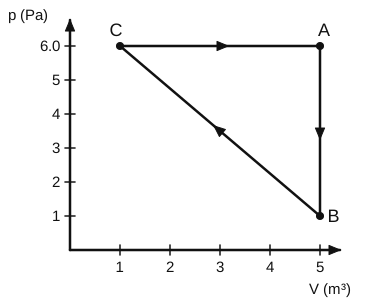
Step 1. Shape. $C(1,6)$, $A(5,6)$, $B(5,1)$: a right triangle with base $4$ m$^3$ and height $5$ Pa, traversed clockwise.
Step 2. Area. $\tfrac12\times4\times5=10$ J.
Answer. Option A.
Solution by Sreeraj P, M.Sc Physics
Q 11-11-157JEE MainJEE Main 2019 (12 Apr, Shift 1)Easy
A sample of an ideal gas is taken through the cyclic process abca as shown in the figure. The change in the internal energy of the gas along the path ca is $-180$ J. The gas absorbs $250$ J of heat along the path ab and $60$ J along the path bc. The work done by the gas along the path abc is:
Concept. Around the closed cycle $abca$ the total $\Delta U$ is zero. So $\Delta U_{abc}=-\Delta U_{ca}=+180$ J. Then the first law on path $abc$ gives the work.
Step 1. Heat on $abc$. $250+60=310$ J.
Step 2. Internal energy change on $abc$. $+180$ J.
Step 3. Work. $W_{abc}=310-180=130$ J.
Answer. Option A.
Solution by Sreeraj P, M.Sc Physics
Q 11-11-159JEE MainJEE Main 2019 (12 Apr, Shift 2)Easy
A diatomic gas with rigid molecules does $10$ J of work when expanded at constant pressure. What would be the heat energy absorbed by the gas, in this process?
Concept. Isobaric: $W = nR\Delta T$, $Q = nC_P\Delta T = \dfrac72nR\Delta T$ for rigid diatomic.
Step 1. Heat. $\dfrac72 \times 10 = 35$ J.
Answer. $35$ J (Option B).
Solution by Sreeraj P, M.Sc Physics
Q 11-11-160JEE MainJEE Main 2018 (15 Apr, Shift 1)Easy
One mole of an ideal monatomic gas is compressed isothermally in a rigid vessel to double its pressure at room temperature, $27^\circ\text{C}$. The magnitude of work done on the gas will be:
Q 11-11-161JEE MainJEE Main 2018 (15 Apr, Shift 1)Easy
A Carnot's engine works like a refrigerator between $250\ \text{K}$ and $300\ \text{K}$. It receives $500\ \text{cal}$ heat from the reservoir at a lower temperature. The amount of work done in each cycle to operate the refrigerator is,
Step 2. Work. $W=\dfrac{Q_2}{5}=\dfrac{500\times4.2}{5}=420$ J.
Answer. Option B.
Solution by Sreeraj P, M.Sc Physics
Q 11-11-163JEE MainJEE Main 2018 (16 Apr, Shift 1)Medium
One mole of an ideal monatomic gas is taken along the path $ABCA$ as shown in the $PV$ diagram. The maximum temperature attained by the gas along the path $BC$ is given by:
Concept. On a straight-line path, $T\propto PV$ is a quadratic in $V$, so its maximum may lie in the middle of the line, not at an end. Write $P(V)$ for line $BC$ and maximise $PV$.
Step 1. Line $BC$. Through $(V_0,3P_0)$ and $(2V_0,P_0)$: $P=5P_0-\dfrac{2P_0}{V_0}V$.
Step 2. Maximise $PV$. $\dfrac{d}{dV}\left(5P_0V-\dfrac{2P_0}{V_0}V^2\right)=0\Rightarrow V=\dfrac54V_0$, where $P=\dfrac52P_0$.
An engine operates by taking $n$ moles of an ideal gas through the cycle $ABCDA$ shown in figure. The thermal efficiency of the engine is (take $C_v = 1.5R$, where $R$ is gas constant):
Concept. Efficiency $=\dfrac{\text{net work}}{\text{heat absorbed}}$. Count only the parts of the cycle where heat goes in. Use $nC\Delta T$ with $nR\Delta T=\Delta(PV)$.
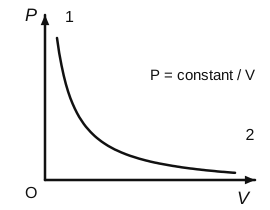
For the $P$–$V$ diagram given for an ideal gas, the gas goes from state $1$ to state $2$ along the curve $P = \dfrac{\text{constant}}{V}$. Out of the following, which one correctly represents the $T$–$P$ diagram?
Concept. $PV = $ const means $T$ constant: a horizontal line on a $T$–$P$ diagram.
Step 1. Direction. From 1 to 2 the volume grows, so $P$ falls: state 2 is to the left of state 1. Graph (2).
Answer. Graph (2) (Option B).
Solution by Sreeraj P, M.Sc Physics
Q 11-11-166JEE MainJEE Main 2018 (8 Apr)Medium
Two moles of an ideal monoatomic gas occupies a volume $V$ at $27^\circ$C. The gas expands adiabatically to a volume $2V$. Calculate (a) the final temperature of the gas and (b) change in its internal energy.
Concept. Adiabatic: $TV^{\gamma-1}=$ constant. Then $\Delta U=nC_V\Delta T$ (negative on expansion: the gas does work using its own internal energy).
Step 1. Final temperature (monatomic, $\gamma-1=\tfrac23$): $T_2=300\times2^{-2/3}=\dfrac{300}{1.587}=189$ K.
Step 2. Internal energy change. $\Delta U=2\times\tfrac32\times8.31\times(189-300)=-2.77\times10^3$ J.
Answer. $189$ K and $-2.7$ kJ (Option D).
Solution by Sreeraj P, M.Sc Physics
Q 11-11-167NEETNEET 2022Top questionEasy
An ideal gas undergoes four different processes from the same initial state as shown in the figure below. Those processes are adiabatic, isothermal, isobaric and isochoric. The curve which represents the adiabatic process among 1, 2, 3 and 4 is
Concept. Adiabatic: $Q=0$, so the work equals the change in internal energy in size ($W=-\Delta U$), and $W=nC_V(T_1-T_2)\propto(T_2-T_1)$. $U$ is not constant; $TV^{\gamma-1}$ (not $TV$) and $PV^\gamma$ (not $PV$) are constant.
Answer. (B), (E) only (Option C).
Solution by Sreeraj P, M.Sc Physics
Q 11-11-170JEE MainJEE Main 2025 (3 Apr, Shift 1)Medium
During the melting of a slab of ice at $273\ \text{K}$ at atmospheric pressure:
Answer: (D) Positive work is done on the ice-water system by the atmosphere.
Concept. Ice is less dense than water, so on melting the volume decreases. The atmosphere pushes in on the shrinking system: positive work is done on it, and $\Delta U=Q+W_{\text{on}}>0$.
Answer. Option D.
Solution by Sreeraj P, M.Sc Physics
Q 11-11-171JEE MainJEE Main 2025 (3 Apr, Shift 1)Easy
A gas is kept in a container having walls which are thermally non-conducting. Initially the gas has a volume of $800\ \text{cm}^3$ and temperature $27^\circ\text{C}$. The change in temperature when the gas is adiabatically compressed to $200\ \text{cm}^3$ is: (Take $\gamma = 1.5$)
Step 1. Final temperature. $300\times\left(\dfrac{800}{200}\right)^{0.5}=600$ K.
Step 2. Change. $300$ K.
Answer. Option D.
Solution by Sreeraj P, M.Sc Physics
Q 11-11-172JEE MainJEE Main 2025 (3 Apr, Shift 2)Medium
An ideal gas exists in a state with pressure $P_0$ and volume $V_0$. It is isothermally expanded to 4 times its initial volume, then isobarically compressed to its original volume. Finally the system is heated isochorically to bring it to its initial state. The amount of heat exchanged in this process is:
($\Delta Q$ = heat supplied, $\Delta W$ = work done by the system, $\Delta U$ = change in internal energy, $P$ = pressure of the system, $\Delta V$ = change in volume of the system)
Choose the correct answer from the options given below:
Q 11-11-174JEE MainJEE Main 2025 (7 Apr, Shift 1)Medium
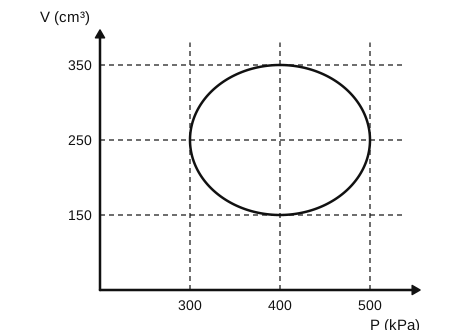
An ideal gas undergoes the cyclic process shown in the figure: on a graph of $V$ (in $\text{cm}^3$, vertical) against $P$ (in kPa, horizontal) the cycle is a circle extending from $P = 300$ to $500\ \text{kPa}$ and from $V = 150$ to $350\ \text{cm}^3$. The work done by the gas in the entire cycle is ______ $\times10^{-1}\ \text{J}$. (Take $\pi = 3.14$)
Concept. The work in a cycle is the area enclosed, whichever variable is on which axis (only the sign depends on the direction). Here the loop is a circle of radius $100$ kPa by $100$ cm$^3$.
Step 1. Area. $\pi\times10^5\times10^{-4}=10\pi=31.4$ J.
Answer. $314\times10^{-1}$ J.
Solution by Sreeraj P, M.Sc Physics
Q 11-11-175JEE MainJEE Main 2025 (7 Apr, Shift 2)Easy
Q 11-11-176JEE MainJEE Main 2025 (8 Apr, Shift 2)Easy
A monoatomic gas having $\gamma = \dfrac53$ is stored in a thermally insulated container and the gas is suddenly compressed to $\left(\dfrac18\right)^{\text{th}}$ of its initial volume. The ratio of final pressure to initial pressure is: ($\gamma$ is the ratio of specific heats of the gas at constant pressure and at constant volume)


 Solution by Sreeraj P, M.Sc Physics