

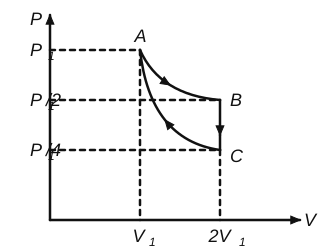
If one mole of an ideal gas at $(P_1, V_1)$ is allowed to expand reversibly and isothermally ($A$ to $B$) its pressure is reduced to one-half of the original pressure (see figure). This is followed by a constant volume cooling till its pressure is reduced to one-fourth of the initial value ($B \to C$). Then it is restored to its initial state by a reversible adiabatic compression ($C$ to $A$). The net workdone by the gas is equal to:
Answer: (D) $RT\left[\ln(2) - \frac{1}{2(\gamma-1)}\right]$
Let $T$ be the temperature at A, so $P_1V_1 = RT$.
$A\to B$ (isothermal, volume doubles): $W_1 = RT\ln 2$.
$B\to C$ (isochoric): $W_2 = 0$.
$C\to A$ (adiabatic): $W_3 = \dfrac{P_CV_C - P_AV_A}{\gamma - 1} = \dfrac{\frac{P_1}{4}(2V_1) - P_1V_1}{\gamma-1} = -\dfrac{RT}{2(\gamma-1)}$
$$W = RT\left[\ln 2 - \frac{1}{2(\gamma-1)}\right]$$
 Solution by Sreeraj P, M.Sc Physics