

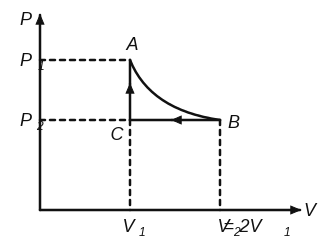
$n$ mole of a perfect gas undergoes a cyclic process $ABCA$ (see figure) consisting of the following processes.
$A \to B$: Isothermal expansion at temperature $T$ so that the volume is doubled from $V_1$ to $V_2 = 2V_1$ and pressure changes from $P_1$ to $P_2$.
$B \to C$: Isobaric compression at pressure $P_2$ to initial volume $V_1$.
$C \to A$: Isochoric change leading to change of pressure from $P_2$ to $P_1$.
Total work done in the complete cycle $ABCA$ is:
Answer: (A) $nRT\left(\ln2 - \frac12\right)$
Concept. Add the work of each process: isothermal $nRT\ln\dfrac{V_2}{V_1}$, isobaric $P\Delta V$, isochoric $0$.
Step 1. $A\to B$ (isothermal doubling). $W=nRT\ln2$.
Step 2. $B\to C$ (isobaric compression at $P_2$). $W=P_2(V_1-V_2)=-P_2V_1$. Since $P_2V_2=nRT$ and $V_2=2V_1$: $P_2V_1=\dfrac{nRT}{2}$.
Step 3. $C\to A$. $W=0$.
Step 4. Total. $nRT\left(\ln2-\dfrac12\right)$.
Answer. Option A.
 Solution by Sreeraj P, M.Sc Physics


