

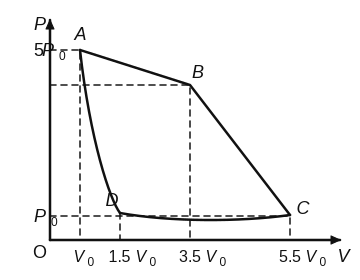
In the reported figure, there is a cyclic process $ABCDA$ on a sample of $1$ mol of a diatomic gas. The temperature of the gas during the process $A \to B$ and $C \to D$ are $T_1$ and $T_2$ $(T_1 > T_2)$ respectively.
Choose the correct option out of the following for work done if processes $BC$ and $DA$ are adiabatic.
Answer: (B) $W_{AD} = W_{BC}$
Concept. On the adiabats $Q=0$, so $W=-\Delta U=nC_V\times$(temperature drop). $BC$ falls from $T_1$ to $T_2$; $DA$ rises from $T_2$ to $T_1$.
Step 1. Works. $W_{BC}=nC_V(T_1-T_2)$; $W_{DA}=nC_V(T_2-T_1)$, so $W_{AD}=-W_{DA}=nC_V(T_1-T_2)=W_{BC}$.
Step 2. Others. $W_{BC}+W_{DA}=0$; the isothermal works differ because the volume ratios differ ($1.5V_0/V_0$ vs $5.5/3.5$) and the temperatures differ.
Answer. Option B.
 Solution by Sreeraj P, M.Sc Physics


