

Q 11-11-070JEE MainJEE Main 2024 (8 Apr, Shift 1)Medium
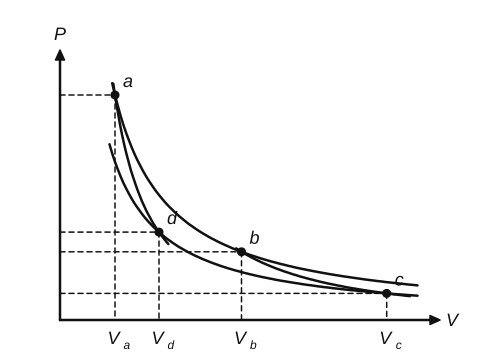
Two different adiabatic paths for the same gas intersect two isothermal curves as shown in the P–V diagram. The relation between the ratio $\dfrac{V_a}{V_d}$ and the ratio $\dfrac{V_b}{V_c}$ is:
Answer: (B) $\dfrac{V_a}{V_d} = \dfrac{V_b}{V_c}$
Points $a$ and $b$ are at the higher temperature $T_1$; $d$ and $c$ are at the lower temperature $T_2$. On an adiabat $TV^{\gamma-1}$ is constant:
$$T_1V_a^{\gamma-1} = T_2V_d^{\gamma-1} \;\Rightarrow\; \left(\frac{V_a}{V_d}\right)^{\gamma-1} = \frac{T_2}{T_1}$$
$$T_1V_b^{\gamma-1} = T_2V_c^{\gamma-1} \;\Rightarrow\; \left(\frac{V_b}{V_c}\right)^{\gamma-1} = \frac{T_2}{T_1}$$
Hence $\dfrac{V_a}{V_d} = \dfrac{V_b}{V_c}$.
 Solution by Sreeraj P, M.Sc Physics