

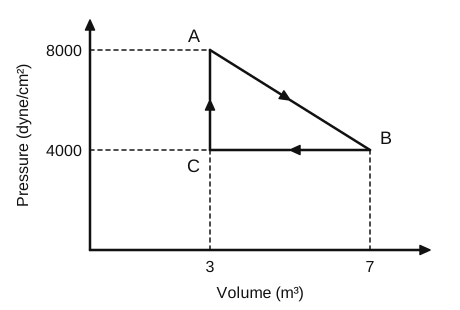
A thermodynamic system is taken from an original state $A$ to an intermediate state $B$ by a linear process as shown in the figure. Its volume is then reduced to the original value from $B$ to $C$ by an isobaric process. The total work done by the gas from $A$ to $B$ and $B$ to $C$ would be:
Answer: (D) $800\ \text{J}$
Convert pressure: $1\ \text{dyne cm}^{-2} = 0.1\ \text{Pa}$, so $8000\ \text{dyne cm}^{-2} = 800\ \text{Pa}$ and $4000\ \text{dyne cm}^{-2} = 400\ \text{Pa}$.
$A \to B$ (expansion, area of trapezium):
$$W_{AB} = \frac12(800 + 400)\times(7-3) = 2400\ \text{J}$$
$B \to C$ (isobaric compression):
$$W_{BC} = 400\times(3-7) = -1600\ \text{J}$$
Total work $= 2400 - 1600 = 800\ \text{J}$ (the area of triangle ABC).
 Solution by Sreeraj P, M.Sc Physics