

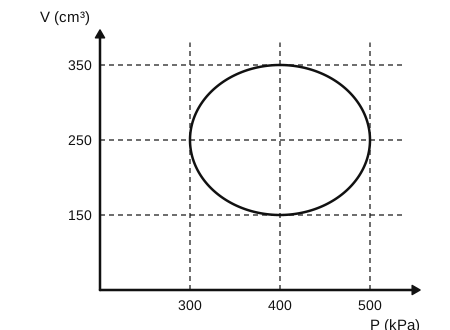
An ideal gas undergoes the cyclic process shown in the figure: on a graph of $V$ (in $\text{cm}^3$, vertical) against $P$ (in kPa, horizontal) the cycle is a circle extending from $P = 300$ to $500\ \text{kPa}$ and from $V = 150$ to $350\ \text{cm}^3$. The work done by the gas in the entire cycle is ______ $\times10^{-1}\ \text{J}$. (Take $\pi = 3.14$)
Numerical value type. Enter your answer.
Answer: 314
The magnitude of the work in a cycle is the area enclosed. With different scales on the axes the circle is an ellipse in $P$–$V$ units, of area $\dfrac\pi4d_1d_2$:
$$W = \frac\pi4\times(200\times10^3\ \text{Pa})\times(200\times10^{-6}\ \text{m}^3) = 10\pi = 31.4\ \text{J}$$
So the work is $314\times10^{-1}\ \text{J}$.
 Solution by Sreeraj P, M.Sc Physics