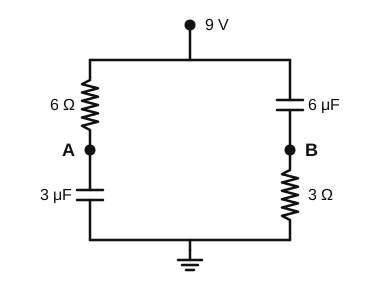
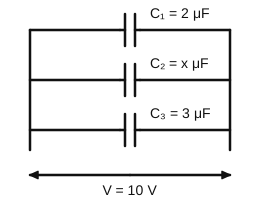
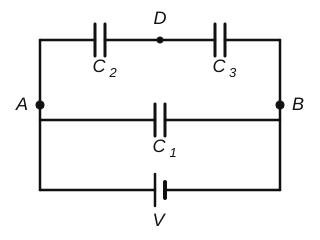
Three identical capacitors $P$, $Q$ and $S$, each of the capacitance $C$, are connected to a battery of voltage $V$, as shown in the figure. If the energy stored in the capacitor $P$ and total energy stored in the system are $U_P$ and $U_T$, respectively, then the ratio $\dfrac{U_P}{U_T}$ is :
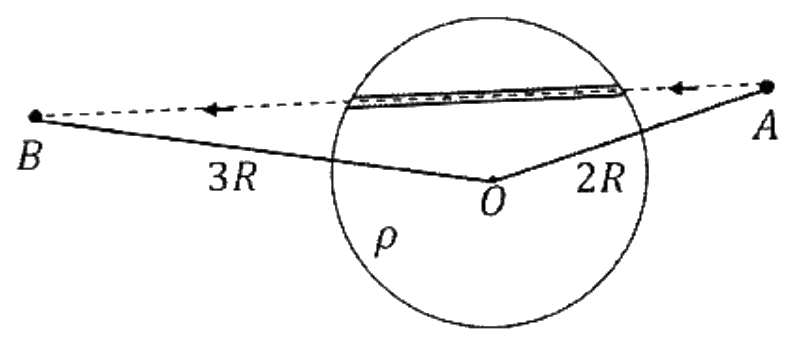
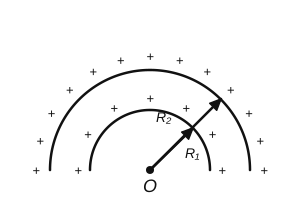
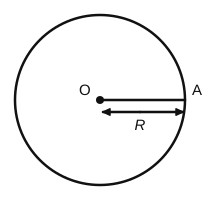
A unit positive point charge is taken slowly through an infinitesimally thin tube that is inside a charged dielectric sphere of radius $R$, having uniform positive charge density $\rho$, as shown in the figure. The initial and final positions of the charge are marked by $A$ and $B$ at distances $2R$ and $3R$ respectively, from the centre of the sphere. In this process, the magnitude of the total work done on the point charge is $\dfrac{\rho R^2}{n\epsilon_0}$. The value of $n$ is :
Consider a fixed uniformly charged insulating sphere with radius $R$ and total charge $+Q$. A point charge $-q$ ($q << Q$) with mass $m$ is released from rest at a distance of $3R$ from the centre of the charged sphere. When the point charge reaches the surface of the sphere, its speed is :
($\epsilon_0$ is the permittivity of vacuum, neglect gravitational forces).
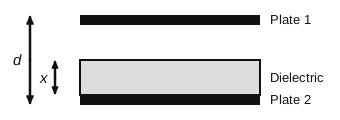
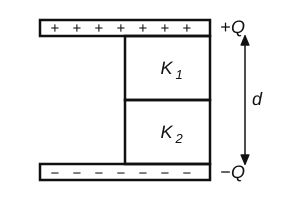
The plates of a parallel plate capacitor are separated by $d$. Two slabs of different dielectric constant $K_1$ and $K_2$ with thickness $\dfrac{3}{8}d$ and $\dfrac{d}{2}$, respectively are inserted in the capacitor. Due to this, the capacitance becomes two times larger than when there is nothing between the plates.
An electric dipole with dipole moment $5 \times 10^{-6}$ C m is aligned with the direction of a uniform electric field of magnitude $4 \times 10^5$ N/C. The dipole is then rotated through an angle of $60°$ with respect to the electric field. The change in the potential energy of the dipole is :
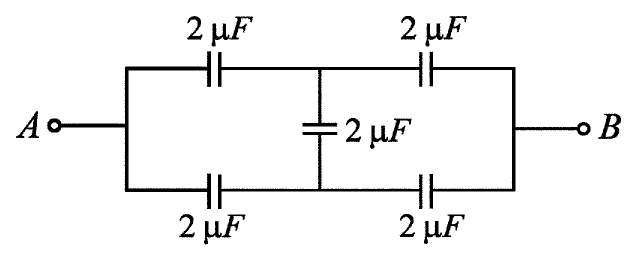
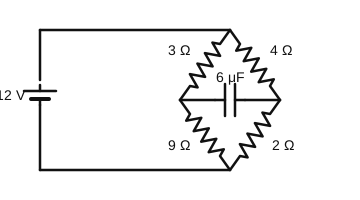
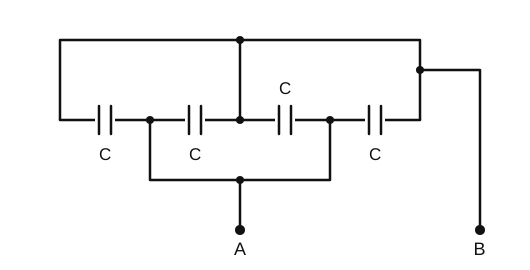
Concept. Equal arms make a balanced bridge: the middle capacitor carries no charge.
Step 1. Branches. Each is two $2\ \mu$F in series: $1\ \mu$F.
Step 2. Total. $1 + 1 = 2\ \mu$F.
Answer. $2\ \mu$F (Option C).
Solution by Sreeraj P, M.Sc Physics
Q 12-02-007NEETNEET 2024Top questionMedium
Given below are two statements: one is labelled as Assertion A and the other is labelled as Reason R.
Assertion A : The potential ($V$) at any axial point, at $2$ m distance ($r$) from the centre of the dipole of dipole moment vector $\vec{P}$ of magnitude, $4 \times 10^{-6}$ C m, is $\pm 9 \times 10^3$ V.
(Take $\dfrac{1}{4\pi\epsilon_0} = 9 \times 10^9$ SI units)
Reason R : $V = \pm\dfrac{2P}{4\pi\epsilon_0 r^2}$, where $r$ is the distance of any axial point, situated at $2$ m from the centre of the dipole.
In the light of the above statements, choose the correct answer from the options given below:
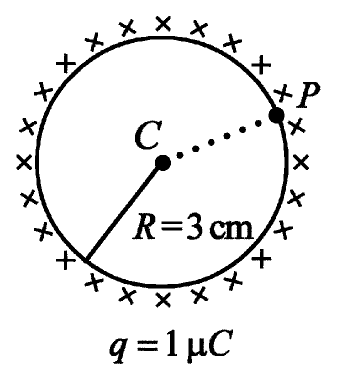
Concept. Inside a charged thin shell the field is zero, so the potential is constant up to the shell.
Step 1. Compare. $V_C = V_P$: difference zero.
Answer. zero (Option B).
Solution by Sreeraj P, M.Sc Physics
Q 12-02-009NEETNEET 2024Top questionMedium
If the plates of a parallel plate capacitor connected to a battery are moved close to each other, then
A. the charge stored in it, increases. B. the energy stored in it, decreases. C. its capacitance increases. D. the ratio of charge to its potential remains the same. E. the product of charge and voltage increases.
Choose the most appropriate answer from the options given below:
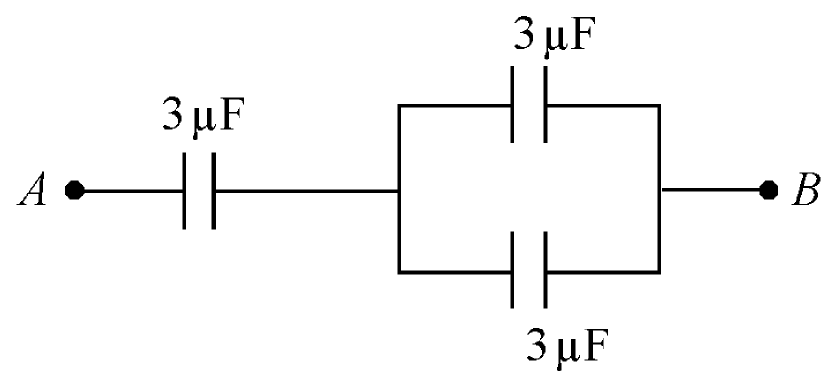
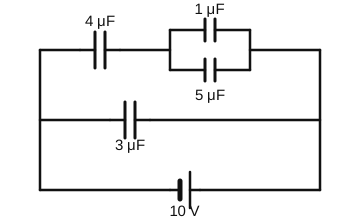
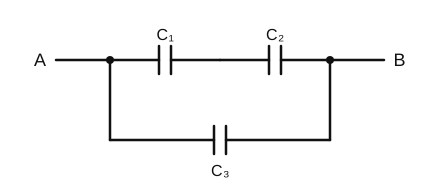
Concept. Parallel capacitors add; series combine reciprocally.
Step 1. Parallel pair. $3 + 3 = 6\ \mu$F.
Step 2. Series with $3\ \mu$F. $\dfrac{18}{9} = 2\ \mu$F.
Answer. $2\ \mu$F (Option A).
Solution by Sreeraj P, M.Sc Physics
Q 12-02-011NEETNEET 2023Top questionMedium
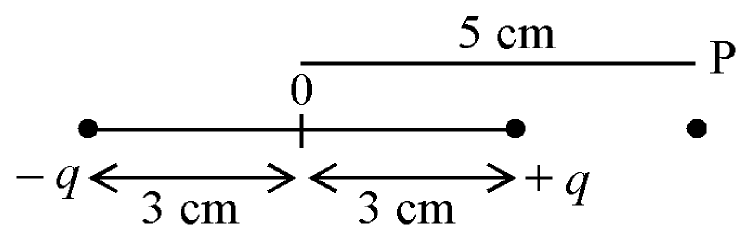
An electric dipole is placed as shown in the figure. The electric potential (in $10^2$ V) at point P due to the dipole is ($\epsilon_0$ = permittivity of free space and $\dfrac{1}{4\pi\epsilon_0} = K$):
A parallel plate capacitor has a uniform electric field '$\vec{E}$' in the space between the plates. If the distance between the plates is 'd' and the area of each plate is 'A', the energy stored in the capacitor is : ($\epsilon_0$ = permittivity of free space)
Concept. Energy density $\dfrac12\epsilon_0E^2$ over volume $Ad$.
Step 1. Energy. $U = \dfrac12\epsilon_0E^2Ad$.
Answer. $\dfrac12\epsilon_0E^2Ad$ (Option D).
Solution by Sreeraj P, M.Sc Physics
Q 12-02-013NEETNEET 2021Top questionEasy
Two charged spherical conductors of radius $R_1$ and $R_2$ are connected by a wire. Then the ratio of surface charge densities of the spheres ($\sigma_1/\sigma_2$) is :
In a certain region of space with volume $0.2\ \text{m}^3$, the electric potential is found to be $5$ V throughout. The magnitude of electric field in this region is :
The capacitance of a parallel plate capacitor with air as medium is $6\ \mu$F. With the introduction of a dielectric medium, the capacitance becomes $30\ \mu$F. The permittivity of the medium is : ($\epsilon_0 = 8.85 \times 10^{-12}\ \text{C}^2\text{N}^{-1}\text{m}^{-2}$)
A short electric dipole has a dipole moment of $16 \times 10^{-9}$ C m. The electric potential due to the dipole at a point at a distance of $0.6$ m from the centre of the dipole, situated on a line making an angle of $60°$ with the dipole axis is : $\left(\dfrac{1}{4\pi\epsilon_0} = 9 \times 10^9\ \text{N m}^2/\text{C}^2\right)$
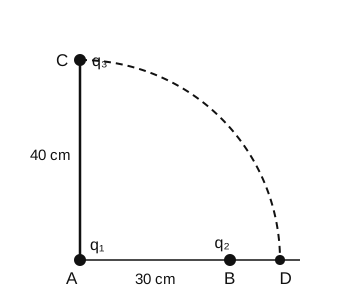
Step 1. Pairs. One like ($+$), two unlike ($-$): $\dfrac{kq^2}{a}(1 - 1 - 1) = -\dfrac{kq^2}{a}$.
Answer. $-\dfrac{kq^2}{a}$ (Option A).
Solution by Sreeraj P, M.Sc Physics
Q 12-02-025NEETJEE MainMedium
A hollow metal sphere of radius $10$ cm carries a charge that makes its surface potential $80$ V. The potential at its centre and at $20$ cm from its centre are
A parallel plate capacitor has plates of area $0.02\ \text{m}^2$ separated by $1$ mm of air. Its capacitance is ($\epsilon_0 = 8.85 \times 10^{-12}$ F/m)
A capacitor is charged by a battery and then disconnected. A dielectric slab of constant $K$ is now inserted to fill the gap. Which of the following is true?
Answer. The charge stays the same, and the energy becomes $\dfrac1K$ times (Option D).
Solution by Sreeraj P, M.Sc Physics
Q 12-02-028NEETJEE MainMedium
A parallel plate capacitor with plate separation $d$ has a metal slab of thickness $\dfrac{d}{2}$ inserted between its plates, parallel to them. The capacitance becomes
Concept. No field inside a metal slab: effective gap $d - t$.
Step 1. Gap. $\dfrac d2$: capacitance doubles.
Answer. $2$ times (Option A).
Solution by Sreeraj P, M.Sc Physics
Q 12-02-029NEETJEE MainMedium
A slab of dielectric constant $4$ and thickness $\dfrac{d}{2}$ is placed between the plates of a parallel plate capacitor of separation $d$ and capacitance $C_0$ (air). The new capacitance is
Q 12-02-035JEE MainJEE Main 2026 (8 Apr, Shift 2)Medium
A parallel plate capacitor is having separation between plates $0.885$ mm. It has a capacitance of $1\,\mu\text{F}$ when the space between the plates is filled with an insulating material of resistivity $1 \times 10^{13}\ \Omega$ m and resistance $17.7 \times 10^{14}\ \Omega$. Relative permittivity of the insulating material is $\alpha \times 10^7$. The value of $\alpha$ is ______.
(Take permittivity of free space $= 8.85 \times 10^{-12}$ F/m)
Concept. For a capacitor filled with a leaky dielectric, $R=\dfrac{\rho d}{A}$ and $C=\dfrac{K\varepsilon_0A}{d}$, so $RC=\rho K\varepsilon_0$ whatever the shape.
Q 12-02-036JEE MainJEE Main 2026 (6 Apr, Shift 1)Medium
A three coulomb charge moves from the point $(0, -2, -5)$ to the point $(5, 1, 2)$ in an electric field expressed as $\vec{E} = 2x\hat{i} + 3y^2\hat{j} + 4\hat{k}$ N/C. The work done in moving the charge is ______ J.
Concept. Work by the field $W=q\int\vec E\cdot d\vec l$. Each component integrates separately (this field is conservative, so the path does not matter).
Concept. The field is the negative gradient of the potential: $E_x=-\dfrac{\partial V}{\partial x}$, $E_y=-\dfrac{\partial V}{\partial y}$.
Step 1. Components. $E_x=-10x$, $E_y=+10y$.
Step 2. At $(2,3)$. $\vec E=-20\hat i+30\hat j$ V/m.
Answer. Option A.
Solution by Sreeraj P, M.Sc Physics
Q 12-02-038JEE MainJEE Main 2026 (6 Apr, Shift 2)Medium
A sphere of capacitance $100$ pF is charged to a potential of $100$ V. Another identical uncharged metal sphere is brought in contact with the charged sphere, then the change in the total energy stored on these spheres, when they touch is $\alpha \times 10^{-7}$ J. The value of $\alpha$ is ______. (combined capacitance of spheres is $200$ pF)
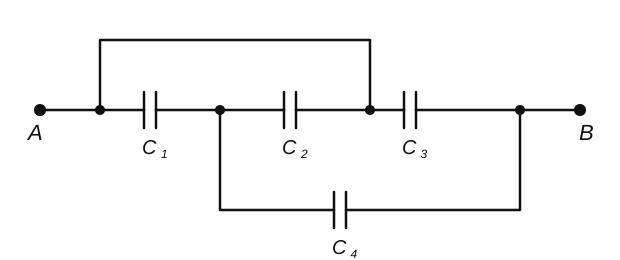
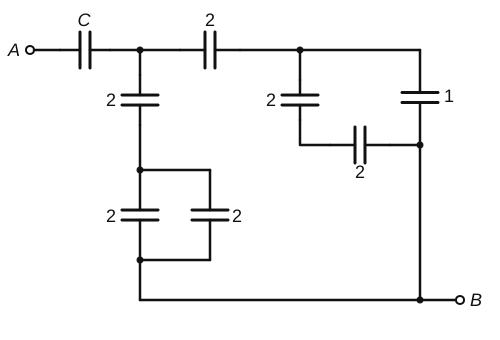
Concept. Identify nodes: the top wire puts the left of $C_1$ and the $C_2$–$C_3$ junction at A.
Step 1. A to Q. $C_1 \parallel C_2 = 2\ \mu$F; Q to B: $C_4 = 2\ \mu$F; series $1\ \mu$F.
Step 2. Parallel with $C_3$. $1 + 1 = 2\ \mu$F.
Answer. $2$ (Option A).
Solution by Sreeraj P, M.Sc Physics
Q 12-02-040JEE MainJEE Main 2026 (4 Apr, Shift 2)Medium
Given below are two statements: one is labelled as Assertion A and the other is labelled as Reason R
Assertion A : In electrostatics, a conductor does not store any net charge inside.
Reason R : Inside the capacitor (with no dielectric medium), the free charge carriers, if placed between the plates of capacitor, experience force and drift.
Choose the correct answer from the options given below
Answer: (B) Both $\mathbf{A}$ and $\mathbf{R}$ are true but $\mathbf{R}$ is NOT the correct explanation of $\mathbf{A}$
Concept. In electrostatic equilibrium the field inside a conductor is zero; by Gauss's law there can be no net charge inside, so any excess charge sits on the surface.
Step 1. Assertion. True.
Step 2. Reason. Free charges in the field of a capacitor do feel a force and drift: true. But it describes charges in a field between plates, not why a conductor holds no internal charge.
Answer. Option B.
Solution by Sreeraj P, M.Sc Physics
Q 12-02-041JEE MainJEE Main 2026 (4 Apr, Shift 1)Medium
A parallel plate air capacitor is connected to a battery. The plates are pulled apart at uniform speed $v$. If $x$ is the separation between the plates at any instant, then the time rate of change of electrostatic energy of the capacitor is proportional to $x^\alpha$, where $\alpha$ is ______.
Q 12-02-042JEE MainJEE Main 2026 (2 Apr, Shift 1)Medium
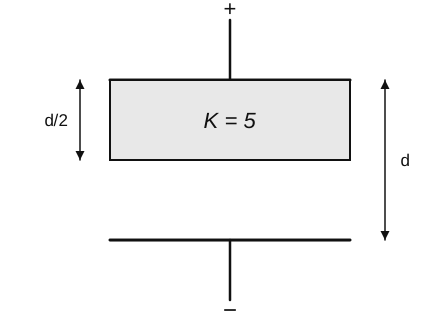
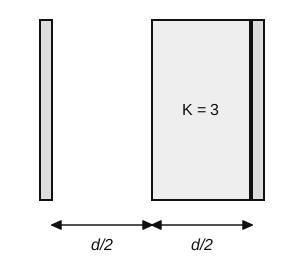
A parallel plate air capacitor has a capacitance $C$. When it is half filled as shown in figure with a dielectric constant $K=5$, the percentage increase in the capacitance is ______.
Concept. A slab covering the whole plate area but only half the gap: the air layer and the dielectric layer are in series, $C'=\dfrac{\varepsilon_0A}{d/2+d/(2K)}$.
Q 12-02-043JEE MainJEE Main 2026 (2 Apr, Shift 1)Easy
Two charged conducting spheres $S_1$ and $S_2$ of radii $8$ cm and $18$ cm are connected to each other by a wire. After equilibrium is established, the ratio of electric fields on $S_1$ and $S_2$ spheres are $E_{S1}$ and $E_{S2}$ respectively. The value of $\dfrac{E_{S1}}{E_{S2}}$ is ______.
Concept. Connected spheres reach the same potential: $\dfrac{kq_1}{r_1}=\dfrac{kq_2}{r_2}$. Surface field $E=\dfrac{kq}{r^2}=\dfrac{V}{r}$, so $E\propto\dfrac1r$.
Answer. Option D. (Sharp points, small $r$, have the strongest field.)
Solution by Sreeraj P, M.Sc Physics
Q 12-02-044JEE MainJEE Main 2026 (2 Apr, Shift 2)Hard
Two metal plates (A, B) are kept horizontally with separation of $\left(\dfrac{12}{\pi}\right)$ cm, with plate A on the top.
An atomizer jet sprays oil (density 1.5 g/cm³) droplets of radius 1 mm horizontally. All oil droplets carry a charge 5 nC. The potentials $V_A$ and $V_B$ are required on plates A and B respectively in order to ensure the droplets do not descend. The values of $V_A$ and $V_B$ are ______.
(Neglect the air resistance to the droplets and take g = 10 m/s²)
Concept. The drop is held when $qE=mg$ with $E=\dfrac{\Delta V}{d}$, and the force on a positive charge must point up, so the field points up: the lower plate B is at the higher potential.
Step 1. Weight. $m=1500\times\dfrac43\pi(10^{-3})^3=6.28\times10^{-6}$ kg; $mg=6.28\times10^{-5}$ N.
Step 3. PD. $d=\dfrac{12}{\pi}$ cm $=0.0382$ m: $\Delta V=Ed=480$ V, with $V_B-V_A=480$ V.
Step 4. Pick. Only $V_A=100$ V, $V_B=580$ V fits.
Answer. Option A.
Solution by Sreeraj P, M.Sc Physics
Q 12-02-045JEE MainJEE Main 2026 (28 Jan, Shift 2)Easy
Identify the correct statements :
A. Effective capacitance of a series combination of capacitors is always smaller than the smallest capacitance of the capacitor in the combination.
B. When a dielectric medium is placed between the charged plates of a capacitor, displacement of charges cannot occur due to insulation property of dielectric.
C. Increasing of area of capacitor plate or decreasing of thickness of dielectric is an alternate method to increase the capacitance.
D. For a point charge, concentric spherical shells centered at the location of the charge are equipotential surfaces.
Choose the correct answer from the options given below :
Step 1. A. $\dfrac1{C_s}=\sum\dfrac1{C_i}\gt\dfrac{1}{C_{min}}$: true.
Step 2. B. A dielectric is polarised: its bound charges are displaced slightly. False.
Step 3. C. $C=\dfrac{K\varepsilon_0A}{d}$: larger area or thinner dielectric raises $C$. True.
Step 4. D. $V=\dfrac{kq}{r}$ is constant on spheres centred on the charge. True.
Answer. A, C and D only (Option A).
Solution by Sreeraj P, M.Sc Physics
Q 12-02-046JEE MainJEE Main 2026 (28 Jan, Shift 1)Easy
Two point charges of 1 nC and 2 nC are placed at the two corners of equilateral triangle of side 3 cm . The work done in bringing a charge of 3 nC from infinity to the third corner of the triangle is ______ $\mu$J.
Concept. Work to bring a charge from infinity $=qV$, where $V$ is the potential there due to the other charges.
Step 1. Potential. $V=\dfrac{9\times10^9\times3\times10^{-9}}{0.03}=900$ V.
Step 2. Work. $3\times10^{-9}\times900=2.7\times10^{-6}$ J.
Answer. $2.7\ \mu$J (Option C).
Solution by Sreeraj P, M.Sc Physics
Q 12-02-047JEE MainJEE Main 2026 (24 Jan, Shift 2)Hard
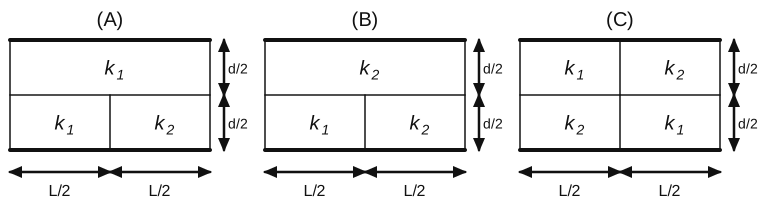
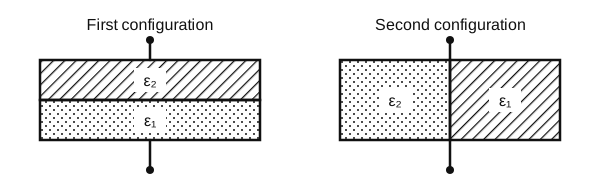
Three parallel plate capacitors each with area $A$ and separation $d$ are filled with two dielectric ( $k_1$ and $k_2$ ) in the following fashion. Which of the following is true?
Concept. Split each capacitor into layers (series) and columns (parallel). With $c=\dfrac{\varepsilon_0A}{d}$, a full-width layer of thickness $\frac d2$ is $2kc$; a block of half width and half thickness is $kc$.
Step 1. (A). Upper layer $2k_1c$; lower layer (two blocks side by side) $(k_1+k_2)c$; in series: $C_A=\dfrac{2k_1(k_1+k_2)}{3k_1+k_2}c$.
Q 12-02-048JEE MainJEE Main 2026 (24 Jan, Shift 1)Medium
The electrostatic potential in a charged spherical region of radius $r$ varies as $V = ar^3 + b$, where $a$ and $b$ are constants. The total charge in the sphere of unit radius is $\alpha\times\pi a\in_0$. The value of $\alpha$ is ______ .
Q 12-02-049JEE MainJEE Main 2026 (24 Jan, Shift 1)Easy
There are three co-centric conducting spherical shells $A, B$ and $C$ of radii $a, b$ and $c$ respectively ( $c > b > a$ ) and they are charged with charge $q_1, q_2$ and $q_3$ respectively. The potentials of the spheres $A, B$ and $C$ respectively, are :
Answer. $V_A$, $V_B$, $V_C$ as found above (Option D).
Solution by Sreeraj P, M.Sc Physics
Q 12-02-050JEE MainJEE Main 2025 (22 Jan, Shift 1)Easy
A parallel-plate capacitor of capacitance $40\ \mu\text{F}$ is connected to a $100\ \text{V}$ power supply. Now the intermediate space between the plates is filled with a dielectric material of dielectric constant $K = 2$. Due to the introduction of dielectric material, the extra charge and the change in the electrostatic energy in the capacitor, respectively, are
Concept. Battery connected: $V$ is fixed. A dielectric multiplies $C$ by $K$, so the charge and energy are both multiplied by $K$.
Step 1. Extra charge. $\Delta Q=(K-1)CV=1\times40\times10^{-6}\times100=4$ mC.
Step 2. Extra energy. $\Delta U=\dfrac12(K-1)CV^2=\dfrac12\times40\times10^{-6}\times10^4=0.2$ J.
Answer. Option A.
Solution by Sreeraj P, M.Sc Physics
Q 12-02-051JEE MainJEE Main 2025 (22 Jan, Shift 2)Medium
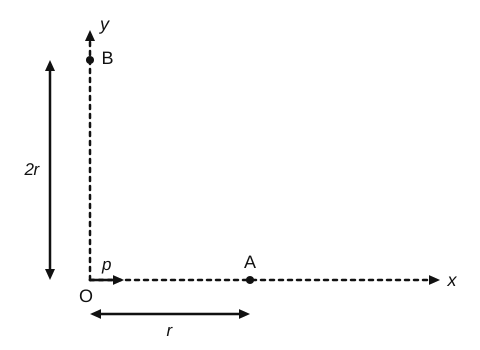
For a short dipole placed at origin $O$, the dipole moment $P$ is along the $x$-axis, as shown in the figure. If the electric potential and electric field at $A$ are $V_0$ and $E_0$, respectively, then the correct combination of the electric potential and electric field, respectively, at point $B$ on the $y$-axis is given by
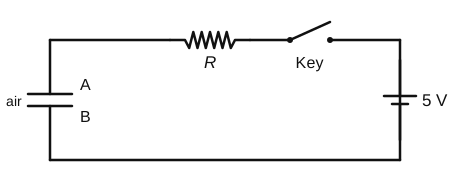
Concept. At the instant the key closes, the capacitor is uncharged, so it acts like a plain wire: the whole emf is across $R$ and the current is the largest it will ever be.
Step 1. Check. A (no current through $R$): false. B (maximum current): true. C (PD across the plates minimum, zero): true. D (charge minimum, zero): true.
Answer. B, C, D only (Option D).
Solution by Sreeraj P, M.Sc Physics
Q 12-02-053JEE MainJEE Main 2025 (23 Jan, Shift 2)Easy
Two charges $7\ \mu\text{C}$ and $-4\ \mu\text{C}$ are placed at $(-7\ \text{cm}, 0, 0)$ and $(7\ \text{cm}, 0, 0)$ respectively. Given $\epsilon_0 = 8.85\times10^{-12}\ \text{C}^2\text{N}^{-1}\text{m}^{-2}$, the electrostatic potential energy of the charge configuration is
Concept. Potential energy of a pair: $U=\dfrac{kq_1q_2}{r}$ (signs included).
Step 1. Distance. $0.14$ m.
Step 2. Energy. $\dfrac{9\times10^9\times7\times10^{-6}\times(-4\times10^{-6})}{0.14}=-1.8$ J.
Answer. Option A.
Solution by Sreeraj P, M.Sc Physics
Q 12-02-054JEE MainJEE Main 2025 (24 Jan, Shift 1)Easy
A parallel plate capacitor was made with two rectangular plates, each with a length of $l = 3\ \text{cm}$ and breadth of $b = 1\ \text{cm}$. The distance between the plates is $3\ \mu\text{m}$. Out of the following, which are the ways to increase the capacitance by a factor of 10?
Q 12-02-055JEE MainJEE Main 2025 (24 Jan, Shift 1)Easy
Consider a parallel plate capacitor of area $A$ (of each plate) and separation $d$ between the plates. If $E$ is the electric field and $\varepsilon_0$ is the permittivity of free space between the plates, then the potential energy stored in the capacitor is
Concept. Energy density $\dfrac12\varepsilon_0E^2$ over volume $Ad$.
Step 1. Energy. $\dfrac12\varepsilon_0E^2Ad$.
Answer. $\dfrac12\varepsilon_0E^2Ad$ (Option B).
Solution by Sreeraj P, M.Sc Physics
Q 12-02-056JEE MainJEE Main 2025 (24 Jan, Shift 2)Medium
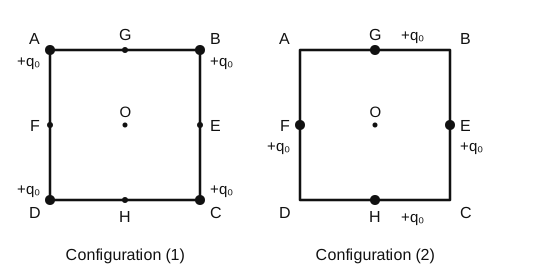
Four identical point charges $+q_0$ are placed at the corners $A$, $B$, $C$, $D$ of a square of side $a$ (configuration 1). They are then moved to the midpoints $G$, $E$, $H$, $F$ of the sides (configuration 2), as shown in the figure. The work done in changing from configuration (1) to configuration (2) is ($K = \dfrac{1}{4\pi\varepsilon_0}$)
Q 12-02-057JEE MainJEE Main 2025 (28 Jan, Shift 1)Hard
Three infinitely long wires with linear charge density $\lambda$ are placed along the $x$-axis, $y$-axis and $z$-axis respectively. Which of the following denotes an equipotential surface?
Step 3. Equipotential. $V$ constant when the product is constant.
Answer. Option C.
Solution by Sreeraj P, M.Sc Physics
Q 12-02-058JEE MainJEE Main 2025 (28 Jan, Shift 1)Medium
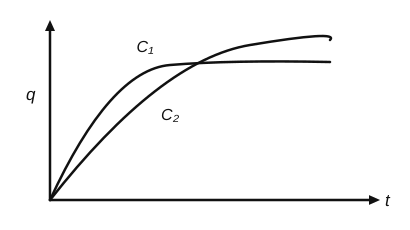
Two capacitors $C_1$ and $C_2$ are connected in parallel to a battery. The charge-time graph is shown below for the two capacitors. The energies stored in them are $U_1$ and $U_2$, respectively. Which of the given statements is true?
Concept. In parallel both capacitors end at the same voltage $V$, so the final charge $Q=CV$ and energy $\dfrac12CV^2$ are both larger for the larger $C$.
Step 1. Read the graph. $C_2$'s curve levels off higher: $Q_2\gt Q_1$, so $C_2\gt C_1$.
Step 2. Energy. $U\propto C$ at the same $V$: $U_2\gt U_1$.
Answer. Option D.
Solution by Sreeraj P, M.Sc Physics
Q 12-02-059JEE MainJEE Main 2025 (28 Jan, Shift 2)Easy
A parallel plate capacitor of capacitance $1\ \mu\text{F}$ is charged to a potential difference of $20\ \text{V}$. The distance between the plates is $1\ \mu\text{m}$. The energy density between the plates of the capacitor is
Q 12-02-060JEE MainJEE Main 2025 (29 Jan, Shift 2)Medium
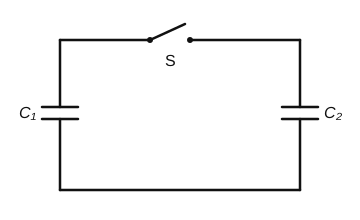
A capacitor $C_1 = 6\ \mu\text{F}$ is charged to a potential difference of $V_0 = 5\ \text{V}$ using a $5\ \text{V}$ battery. The battery is removed and another capacitor $C_2 = 12\ \mu\text{F}$ is inserted in place of the battery. When the switch S is closed, charge flows between the capacitors for some time until equilibrium is reached. What are the charges ($q_1$ and $q_2$) on the capacitors $C_1$ and $C_2$ when equilibrium is reached?
Q 12-02-061JEE MainJEE Main 2025 (29 Jan, Shift 2)Medium
An electric dipole is placed at a distance of $2\ \text{cm}$ from an infinite plane sheet having positive charge density $\sigma_0$, as shown in the figure. Choose the correct option from the following.
Answer: (D) Potential energy of dipole is minimum and torque is zero.
Concept. A positive sheet gives a uniform field pointing away from it. The dipole points from $-q$ (near the sheet) to $+q$ (farther), i.e. along the field.
Step 2. Consequences. Torque $pE\sin0=0$; energy $-pE$ is the minimum; a uniform field gives no net force.
Answer. Option D.
Solution by Sreeraj P, M.Sc Physics
Q 12-02-062JEE MainJEE Main 2025 (29 Jan, Shift 2)Medium
A parallel plate capacitor consisting of two circular plates of radius $10\ \text{cm}$ is being charged by a constant current of $0.15\ \text{A}$. If the rate of change of potential difference between the plates is $7\times10^8\ \text{V/s}$, then the integer value of the distance between the parallel plates is ______ $\mu$m. (Take $\epsilon_0 = 9\times10^{-12}\ \text{F/m}$, $\pi = \dfrac{22}{7}$)
Concept. $I=\dfrac{dQ}{dt}=C\dfrac{dV}{dt}$ gives $C$; then $d=\dfrac{\varepsilon_0A}{C}$.
Step 1. Capacitance. $C=\dfrac{0.15}{7\times10^8}=2.14\times10^{-10}$ F.
Step 2. Area. $\pi(0.1)^2=0.0314$ m$^2$.
Step 3. Gap. $d=\dfrac{9\times10^{-12}\times0.0314}{2.14\times10^{-10}}=1.32\times10^{-3}$ m.
Answer. $1320\ \mu$m.
Solution by Sreeraj P, M.Sc Physics
Q 12-02-063JEE MainJEE Main 2024 (1 Feb, Shift 1)Medium
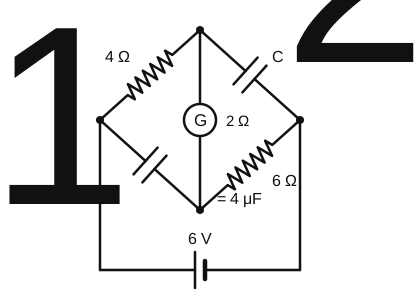
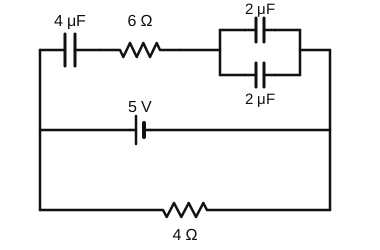
Two identical capacitors have the same capacitance $C$. One of them is charged to potential $V$ and the other to potential $2V$. The negative ends of both are connected together. When the positive ends are also joined together, the decrease in energy of the combined system is
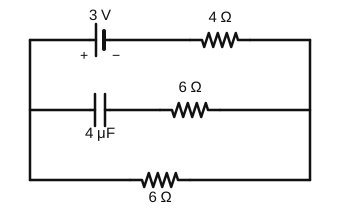
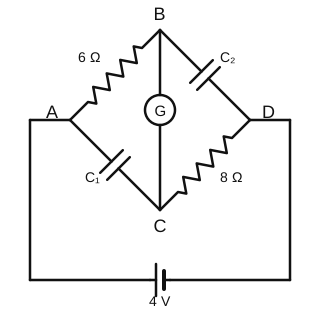
Concept. In the steady state no current flows through the capacitors, so the current goes 4 Ω → G (2 Ω) → 6 Ω. Find the node potentials, then $Q=C\Delta V$.
Step 1. Current. $I=\dfrac{6}{4+2+6}=0.5$ A.
Step 2. Potentials. Left corner $6$ V, right corner $0$. Top node: $6-0.5\times4=4$ V. Bottom node: $4-0.5\times2=3$ V.
Step 3. Charges. $C_2$ (top to right): $6\times4=24\ \mu$C. $C_1$ (left to bottom): $4\times3=12\ \mu$C.
Step 4. Ratio. $\dfrac{Q_1}{Q_2}=\dfrac12$.
Answer. Option D.
Solution by Sreeraj P, M.Sc Physics
Q 12-02-065JEE MainJEE Main 2024 (1 Feb, Shift 2)Medium
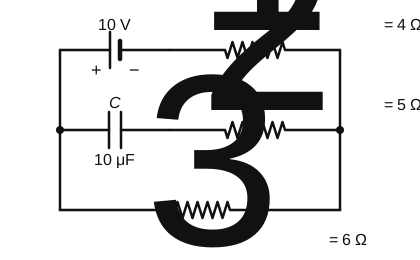
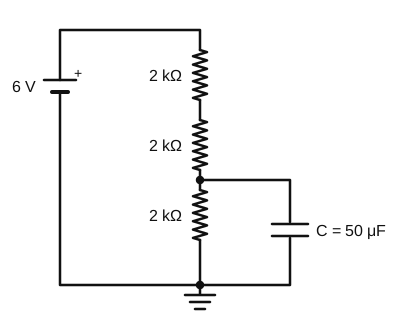
In the electrical circuit drawn below, the amount of charge stored in the capacitor in the steady state is ______ $\mu\text{C}$.
Concept. No steady current through the capacitor branch; it takes the voltage of the parallel resistor.
Step 1. Current. $\dfrac{10}{4 + 6} = 1$ A.
Step 2. Voltage. $1 \times 6 = 6$ V.
Step 3. Charge. $10 \times 6 = 60\ \mu$C.
Answer. $60$.
Solution by Sreeraj P, M.Sc Physics
Q 12-02-066JEE MainJEE Main 2024 (4 Apr, Shift 2)Medium
A parallel plate capacitor of capacitance $12.5\ \text{pF}$ is charged by a battery connected between its plates to a potential difference of $12.0\ \text{V}$. The battery is now disconnected and a dielectric slab ($\varepsilon_r = 6$) is inserted between the plates. The change in its potential energy after inserting the dielectric slab is ______ $\times10^{-12}\ \text{J}$.
Q 12-02-067JEE MainJEE Main 2024 (5 Apr, Shift 1)Medium
Three capacitors of capacitances $25\ \mu\text{F}$, $30\ \mu\text{F}$ and $45\ \mu\text{F}$ are connected in parallel to a supply of $100\ \text{V}$. The energy stored in the above combination is $E$. When these capacitors are connected in series to the same supply, the stored energy is $\dfrac{9}{x}E$. The value of $x$ is ______.
Q 12-02-068JEE MainJEE Main 2024 (5 Apr, Shift 1)Medium
The electric field between the two parallel plates of a capacitor of $1.5\ \mu\text{F}$ capacitance drops to one third of its initial value in $6.6\ \mu\text{s}$ when the plates are connected by a thin wire. The resistance of this wire is ______ $\Omega$. (Given $\ln3 = 1.1$)
Q 12-02-069JEE MainJEE Main 2024 (27 Jan, Shift 1)Easy
An electric charge $10^{-6}\ \mu\text{C}$ is placed at origin $(0, 0)\ \text{m}$ of the X–Y co-ordinate system. Two points $P$ and $Q$ are situated at $(\sqrt3, \sqrt3)\ \text{m}$ and $(\sqrt6, 0)\ \text{m}$ respectively. The potential difference between the points $P$ and $Q$ will be:
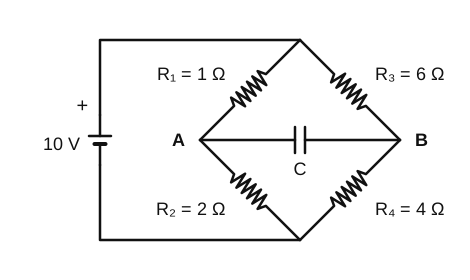
Concept. In the steady state the capacitor branch carries no current, so each side of the bridge is a simple divider. The capacitor takes the difference between the two divider points.
Step 1. Left side (1 Ω above 2 Ω): $V_A=10\times\dfrac{2}{3}=\dfrac{20}{3}$ V.
Step 2. Right side (6 Ω above 4 Ω): $V_B=10\times\dfrac{4}{10}=4$ V.
Answer: (D) Both (A) and (R) are correct and (R) is the correct explanation of (A)
Concept. $W=q\Delta V$, and on an equipotential surface $\Delta V=0$.
Step 1. Assertion. True.
Step 2. Reason. Field lines are perpendicular to equipotentials: true. Because $\vec E\perp$ the displacement, $\vec F\cdot d\vec l=0$, which is why the work is zero.
Answer. Option D.
Solution by Sreeraj P, M.Sc Physics
Q 12-02-072JEE MainJEE Main 2024 (27 Jan, Shift 2)Easy
The electric potential at the surface of an atomic nucleus ($Z = 50$) of radius $9\times10^{-13}\ \text{cm}$ is $\alpha\times10^6\ \text{V}$. What is the value of $\alpha$? (Charge of proton $1.6\times10^{-19}\ \text{C}$)
Concept. Outside a spherical charge (here the nucleus) the potential is that of a point charge at the centre: $V=\dfrac{kZe}{R}$.
Step 1. Values. $Ze=50\times1.6\times10^{-19}=8\times10^{-18}$ C; $R=9\times10^{-13}$ cm $=9\times10^{-15}$ m.
Step 2. Potential. $V=\dfrac{9\times10^9\times8\times10^{-18}}{9\times10^{-15}}=8\times10^6$ V.
Answer. $\alpha=8$.
Solution by Sreeraj P, M.Sc Physics
Q 12-02-073JEE MainJEE Main 2024 (29 Jan, Shift 2)Medium
In the given figure, the charge stored in the $6\ \mu\text{F}$ capacitor, when points $A$ and $B$ are joined by a connecting wire, is ______ $\mu\text{C}$.
Q 12-02-074JEE MainJEE Main 2024 (8 Apr, Shift 1)Easy
Two charged conducting spheres of radii $a$ and $b$ are connected to each other by a conducting wire. The ratio of charges of the two spheres respectively is:
Concept. Connected conductors share a potential: $\dfrac{q_1}{a} = \dfrac{q_2}{b}$.
Step 1. Ratio. $\dfrac{q_1}{q_2} = \dfrac ab$.
Answer. $\dfrac ab$ (Option A).
Solution by Sreeraj P, M.Sc Physics
Q 12-02-075JEE MainJEE Main 2024 (8 Apr, Shift 2)Medium
A capacitor has air as dielectric medium and two conducting plates of area $12\ \text{cm}^2$ and they are $0.6\ \text{cm}$ apart. When a slab of dielectric having area $12\ \text{cm}^2$ and $0.6\ \text{cm}$ thickness is inserted between the plates, one of the conducting plates has to be moved by $0.2\ \text{cm}$ to keep the capacitance same as in previous case. The dielectric constant of the slab is: (Given $\epsilon_0 = 8.834\times10^{-12}\ \text{F/m}$)
Q 12-02-076JEE MainJEE Main 2024 (9 Apr, Shift 1)Medium
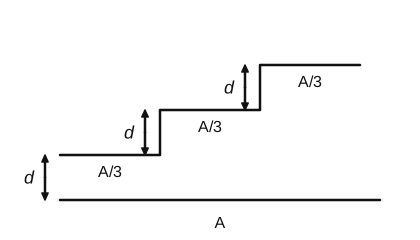
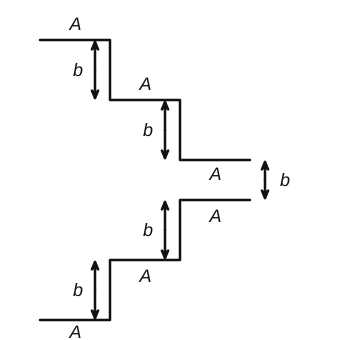
A capacitor is made of a flat plate of area $A$ and a second plate having a stair-like structure as shown in the figure. If the area of each stair is $\dfrac A3$ and the height is $d$, the capacitance of the arrangement is:
Q 12-02-077JEE MainJEE Main 2024 (9 Apr, Shift 1)Easy
At the centre of a half ring of radius $R = 10\ \text{cm}$ and linear charge density $4\ \text{nC m}^{-1}$, the potential is $x\pi\ \text{V}$. The value of $x$ is ______.
Q 12-02-079JEE MainJEE Main 2024 (30 Jan, Shift 1)Medium
A capacitor of capacitance $C$ and potential $V$ has energy $E$. It is connected to another capacitor of capacitance $2C$ and potential $2V$. Then the loss of energy is $\dfrac x3E$, where $x$ is ______.
Q 12-02-080JEE MainJEE Main 2024 (31 Jan, Shift 1)Medium
A parallel plate capacitor with plate separation $5\ \text{mm}$ is charged up by a battery. It is found that on introducing a dielectric sheet of thickness $2\ \text{mm}$, while keeping the battery connections intact, the capacitor draws $25\%$ more charge from the battery than before. The dielectric constant of the sheet is ______.
Concept. A slab of thickness $t$ and constant $K$: $C=\dfrac{\varepsilon_0A}{d-t+t/K}$. With the battery connected, charge $\propto C$.
Step 1. Ratio. $\dfrac{5}{3+2/K}=1.25$.
Step 2. Solve. $3+\dfrac2K=4\Rightarrow K=2$.
Answer. $2$.
Solution by Sreeraj P, M.Sc Physics
Q 12-02-081JEE MainJEE Main 2024 (31 Jan, Shift 2)Medium
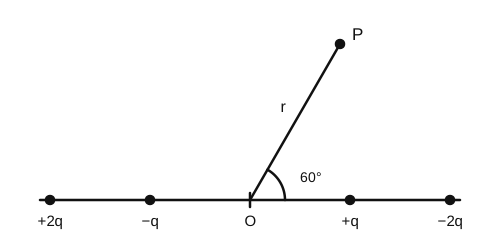
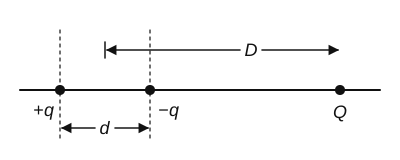
The distance between charges $+q$ and $-q$ is $2l$ and between $+2q$ and $-2q$ is $4l$, all placed on a line with common centre $O$ as shown. The electrostatic potential at point $P$ at a distance $r$ ($r \gg l$) from centre $O$ is $-\alpha\dfrac{ql}{r^2}\times10^9\ \text{V}$, where the value of $\alpha$ is ______. (Use $\dfrac1{4\pi\varepsilon_0} = 9\times10^9\ \text{N m}^2\text{C}^{-2}$)
Concept. Far away ($r\gg l$) each $\pm$ pair acts as a dipole; the total potential is that of the net dipole moment: $V=\dfrac{kp\cos\theta}{r^2}$.
Step 1. Inner pair. $-q$ at $-l$, $+q$ at $+l$: $p_1=2ql$ along $+x$.
Step 2. Outer pair. $+2q$ at $-2l$, $-2q$ at $+2l$: $p_2=2q\times4l=8ql$ along $-x$.
Step 3. Net. $p=6ql$ along $-x$. P is at $60^\circ$ to $+x$, i.e. $120^\circ$ to $\vec p$.
Step 4. Potential. $V=\dfrac{k(6ql)\cos120^\circ}{r^2}=-\dfrac{3kql}{r^2}=-27\dfrac{ql}{r^2}\times10^9$ V.
Answer. $\alpha=27$.
Solution by Sreeraj P, M.Sc Physics
Q 12-02-082JEE MainJEE Main 2023 (29 Jan, Shift 2)Easy
A point charge $2\times10^{-2}\ \text{C}$ is moved from $P$ to $S$ in a uniform electric field of $30\ \text{N C}^{-1}$ directed along positive $x$-axis. If coordinates of $P$ and $S$ are $(1,2,0)\ \text{m}$ and $(0,0,0)\ \text{m}$ respectively, the work done by electric field will be
Q 12-02-083JEE MainJEE Main 2023 (30 Jan, Shift 1)Medium
Two isolated metallic solid spheres of radii $R$ and $2R$ are charged such that both have same charge density $\sigma$. The spheres are then connected by a thin conducting wire. If the new charge density of the bigger sphere is $\sigma'$, the ratio $\dfrac{\sigma'}{\sigma}$ is
Q 12-02-084JEE MainJEE Main 2023 (30 Jan, Shift 1)Medium
A capacitor of capacitance $900\ \mu\text{F}$ is charged by a $100\ \text{V}$ battery. The capacitor is disconnected from the battery and connected to another uncharged identical capacitor such that one plate of uncharged capacitor is connected to positive plate and another plate of uncharged capacitor connected to negative plate of the charged capacitor. The loss of energy in this process is measured as $x\times10^{-2}\ \text{J}$. The value of $x$ is ______.
Concept. A charged capacitor shared with an identical uncharged one: the charge halves on each, and half the energy is lost (as heat and radiation).
Step 1. Initial energy. $\dfrac12\times900\times10^{-6}\times100^2=4.5$ J.
Step 2. Loss. $\dfrac12\times4.5=2.25$ J $=225\times10^{-2}$ J.
Answer. $225$.
Solution by Sreeraj P, M.Sc Physics
Q 12-02-085JEE MainJEE Main 2023 (31 Jan, Shift 1)Easy
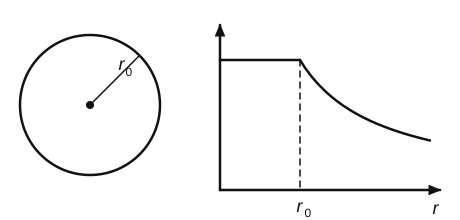
Which of the following correctly represents the variation of electric potential ($V$) of a charged spherical conductor of radius ($R$) with radial distance ($r$) from the centre?
Answer: (A) Net potential of the system cannot be zero at a point but net electric field can be zero at that point
Concept. Potential is a scalar sum of $\dfrac{kq}{r}$ terms; the field is a vector sum.
Step 1. Potential. All charges positive: every term is positive, so $V\gt0$ at every point. It cannot be zero.
Step 2. Field. Fields of different charges can cancel (e.g. midway between two equal charges), so $\vec E$ can be zero.
Answer. Option A.
Solution by Sreeraj P, M.Sc Physics
Q 12-02-087JEE MainJEE Main 2023 (31 Jan, Shift 2)Hard
Two parallel plate capacitors $C_1$ and $C_2$ each having capacitance of $10\ \mu\text{F}$ are individually charged by a $100\ \text{V}$ D.C. source. Capacitor $C_1$ is kept connected to the source and a dielectric slab is inserted between its plates. Capacitor $C_2$ is disconnected from the source and then a dielectric slab is inserted in it. Afterwards the capacitor $C_1$ is also disconnected from the source and the two capacitors are finally connected in parallel combination. The common potential of the combination will be ______ V. (Assuming dielectric constant $=10$)
Q 12-02-089JEE MainJEE Main 2023 (24 Jan, Shift 2)Easy
A parallel plate capacitor with air between the plates has a capacitance of $15\ \text{pF}$. The separation between the plates becomes twice and the space between them is filled with a medium of dielectric constant $3.5$. Then the capacitance becomes $\dfrac x4$ pF. The value of $x$ is ______.
Q 12-02-090JEE MainJEE Main 2023 (25 Jan, Shift 1)Easy
A parallel plate capacitor has plate area $40\ \text{cm}^2$ and plates separation $2\ \text{mm}$. The space between the plates is filled with a dielectric medium of a thickness $1\ \text{mm}$ and dielectric constant $5$. The capacitance of the system is
Step 2. Capacitance. $\dfrac{\varepsilon_0\times40\times10^{-4}}{1.2\times10^{-3}}=\dfrac{10}{3}\varepsilon_0$ F.
Answer. Option C.
Solution by Sreeraj P, M.Sc Physics
Q 12-02-091JEE MainJEE Main 2023 (25 Jan, Shift 2)Easy
A capacitor has capacitance $5\ \mu\text{F}$ when its parallel plates are separated by air medium of thickness $d$. A slab of material of dielectric constant $1.5$ having area equal to that of plates but thickness $\dfrac d2$ is inserted between the plates. Capacitance of the capacitor in the presence of slab will be ______ $\mu\text{F}$.
Q 12-02-095JEE MainJEE Main 2023 (10 Apr, Shift 2)Easy
The distance between two plates of a capacitor is $d$ and its capacitance is $C_1$, when air is the medium between the plates. If a metal sheet of thickness $\dfrac{2d}{3}$ and of the same area as plate is introduced between the plates, the capacitance of the capacitor becomes $C_2$. The ratio $\dfrac{C_2}{C_1}$ is
Concept. A metal sheet of thickness $t$ inside a capacitor removes that thickness from the gap: $C=\dfrac{\varepsilon_0A}{d-t}$.
Step 1. New gap. $d-\dfrac{2d}{3}=\dfrac d3$.
Step 2. Ratio. $C_2:C_1=3:1$.
Answer. Option A.
Solution by Sreeraj P, M.Sc Physics
Q 12-02-096JEE MainJEE Main 2023 (11 Apr, Shift 1)Easy
A parallel plate capacitor of capacitance $2\ \text{F}$ is charged to a potential $V$. The energy stored in the capacitor is $E_1$. The capacitor is now connected to another uncharged identical capacitor in parallel combination. The energy stored in the combination is $E_2$. The ratio $\dfrac{E_2}{E_1}$ is
Concept. Charge shared by double capacitance: $E = \dfrac{Q^2}{2C}$ halves.
Step 1. Ratio. $1 : 2$.
Answer. $1 : 2$ (Option C).
Solution by Sreeraj P, M.Sc Physics
Q 12-02-097JEE MainJEE Main 2023 (11 Apr, Shift 2)Hard
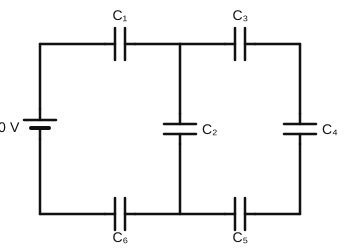
In the given circuit, $C_1=2\ \mu\text{F}$, $C_2=0.2\ \mu\text{F}$, $C_3=2\ \mu\text{F}$, $C_4=4\ \mu\text{F}$, $C_5=2\ \mu\text{F}$, $C_6=2\ \mu\text{F}$. The charge stored on capacitor $C_4$ is ______ $\mu\text{C}$.
Q 12-02-098JEE MainJEE Main 2023 (12 Apr, Shift 1)Easy
$64$ identical drops each charged up to potential of $10\ \text{mV}$ are combined to form a bigger drop. The potential of the bigger drop will be ______ mV.
Concept. For a thin charged shell, $V=\dfrac{kQ}{R}$ everywhere inside (the field is zero there) and $V=\dfrac{kQ}{r}$ outside.
Step 1. Shape. A flat line from $0$ to $R$, then a smooth $1/r$ fall: graph (B).
Answer. Option B.
Solution by Sreeraj P, M.Sc Physics
Q 12-02-100JEE MainJEE Main 2023 (6 Apr, Shift 1)Medium
A parallel plate capacitor with plate area $A$ and plate separation $d$ is filled with a dielectric material of dielectric constant $K=4$. The thickness of the dielectric material is $x$, where $x<d$. Let $C_1$ and $C_2$ be the capacitance of the system for $x=\dfrac13d$ and $x=\dfrac{2d}{3}$, respectively. If $C_1=2\ \mu\text{F}$, the value of $C_2$ is ______ $\mu\text{F}$.
Q 12-02-101JEE MainJEE Main 2023 (6 Apr, Shift 2)Medium
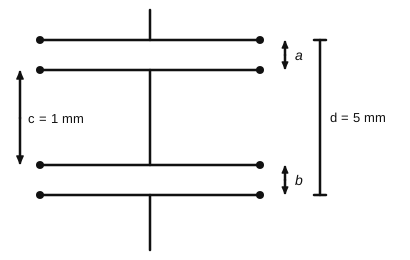
As shown in the figure, two parallel plate capacitors having equal plate area of $200\ \text{cm}^2$ are joined in such a way that $a\ne b$. The equivalent capacitance of the combination is $x\epsilon_0$ F. The value of $x$ is ______.
Concept. The two inner plates are joined, so they form one conductor: the top gap ($a$) and bottom gap ($b$) are capacitors in series. The middle gap $c$ has both its plates at the same potential and stores nothing.
Step 2. Values. $a+b=d-c=4$ mm: $C=\dfrac{200\times10^{-4}}{4\times10^{-3}}\varepsilon_0=5\varepsilon_0$ F.
Answer. $x=5$.
Solution by Sreeraj P, M.Sc Physics
Q 12-02-102JEE MainJEE Main 2023 (8 Apr, Shift 1)Medium
In this figure the resistance of the coil of galvanometer G is $2\ \Omega$. The emf of the cell is $4$ V. The ratio of potential difference across $C_1$ and $C_2$ is
Q 12-02-103JEE MainJEE Main 2023 (8 Apr, Shift 2)Easy
Electric potential at a point $P$ due to a point charge of $5\times10^{-9}$ C is $50$ V. The distance of $P$ from the point charge is (Assume $\dfrac1{4\pi\epsilon_0}=9\times10^9\ \text{N m}^2\,\text{C}^{-2}$)
Step 1. Distance. $\dfrac{45}{50} = 0.9$ m $= 90$ cm.
Answer. $90\ \text{cm}$ (Option D).
Solution by Sreeraj P, M.Sc Physics
Q 12-02-104JEE MainJEE Main 2023 (8 Apr, Shift 2)Easy
A $600$ pF capacitor is charged by $200$ V supply. It is then disconnected from the supply and is connected to another uncharged $600$ pF capacitor. Electrostatic energy lost in the process is ______ $\mu$J.
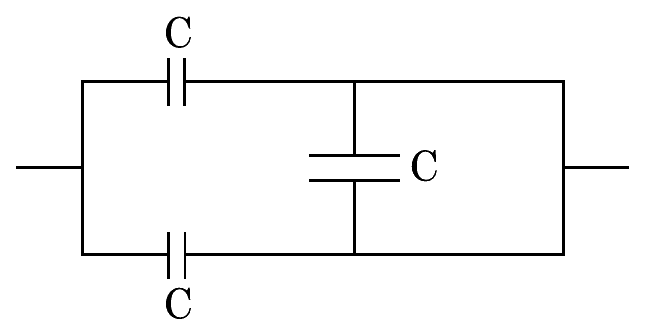
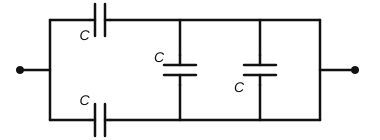
Concept. Both rails join the right terminal, so the vertical capacitors are shorted.
Step 1. Remaining. Two horizontal $C$ in parallel: $2C$.
Answer. $2C$ (Option A).
Solution by Sreeraj P, M.Sc Physics
Q 12-02-106JEE MainJEE Main 2023 (10 Apr, Shift 1)Medium
Three concentric spherical metallic shells $X$, $Y$ and $Z$ of radius $a$, $b$ and $c$ respectively ($a<b<c$) have surface charge densities $\sigma$, $-\sigma$ and $\sigma$, respectively. The shells $X$ and $Z$ are at same potential. If the radii of $X$ and $Y$ are $2$ cm and $3$ cm, respectively, the radius of shell $Z$ is ______ cm.
Concept. Potential of a shell: $\dfrac{kq}{R}$ outside it, $\dfrac{kq}{R_{\text{shell}}}$ inside it. With $q=4\pi R^2\sigma$, each shell contributes $\dfrac{\sigma R^2}{\varepsilon_0\cdot\max(r,R)}$.
Step 1. Shell X ($r=a$). $V_X\propto a-b+c$.
Step 2. Shell Z ($r=c$). $V_Z\propto\dfrac{a^2-b^2+c^2}{c}$.
Step 3. Equate. $c(a-b)=a^2-b^2\Rightarrow c=a+b=5$ cm.
Answer. $5$.
Solution by Sreeraj P, M.Sc Physics
Q 12-02-107JEE MainJEE Main 2023 (1 Feb, Shift 2)Easy
Given below are two statements: one is labelled as Assertion A and the other is labelled as Reason R.
Assertion A: Two metallic spheres are charged to the same potential. One of them is hollow and another is solid, and both have the same radii. Solid sphere will have lower charge than the hollow one.
Reason R: Capacitance of metallic spheres depends on the radii of spheres.
In the light of the above statements, choose the correct answer from the options given below.
Concept. A conductor's charge sits on its surface, so a solid and a hollow sphere of the same radius behave identically: $C=4\pi\varepsilon_0R$ for both.
Step 1. Assertion. Same radius and same potential give the same charge $Q=CV$: false.
Step 2. Reason. The capacitance depends only on the radius: true.
Answer. Option A.
Solution by Sreeraj P, M.Sc Physics
Q 12-02-108JEE MainJEE Main 2022 (24 Jun, Shift 1)Medium
A parallel plate capacitor is formed by two plates each of area $30\pi\ \text{cm}^2$ separated by $1\ \text{mm}$. A material of dielectric strength $3.6\times10^7\ \text{V m}^{-1}$ is filled between the plates. If the maximum charge that can be stored on the capacitor without causing any dielectric breakdown is $7\times10^{-6}\ \text{C}$, the value of dielectric constant of the material is: [Use $\dfrac{1}{4\pi\varepsilon_0} = 9\times10^9\ \text{N m}^2\text{C}^{-2}$]
Q 12-02-109JEE MainJEE Main 2022 (24 Jun, Shift 2)Easy
If the charge on a capacitor is increased by $2\ \text{C}$, the energy stored in it increases by $44\%$. The original charge on the capacitor is (in C)
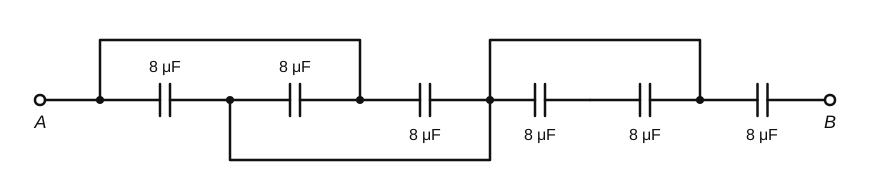
Step 1. Parallel group. The first three capacitors share the same two nodes: $24\ \mu$F.
Step 2. Shorted. The fourth and fifth are bypassed.
Step 3. Series with $8\ \mu$F. $\dfrac{24 \times 8}{32} = 6\ \mu$F.
Answer. $6$.
Solution by Sreeraj P, M.Sc Physics
Q 12-02-111JEE MainJEE Main 2022 (25 Jun, Shift 2)Easy
Two metallic plates form a parallel plate capacitor. The distance between the plates is $d$. A metal sheet of thickness $\dfrac d2$ and of area equal to the area of each plate is introduced between the plates. What will be the ratio of the new capacitance to the original capacitance of the capacitor?
Q 12-02-113JEE MainJEE Main 2022 (26 Jun, Shift 1)Easy
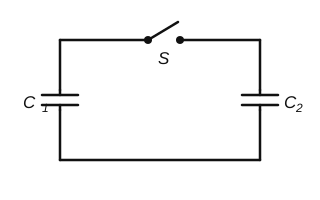
Two capacitors having capacitance $C_1$ and $C_2$ respectively are connected as shown in figure. Initially, capacitor $C_1$ is charged to a potential difference $V$ volt by a battery. The battery is then removed and the charged capacitor $C_1$ is now connected to uncharged capacitor $C_2$ by closing the switch $S$. The amount of charge on the capacitor $C_2$, after equilibrium, is
Concept. Charge $C_1V$ is shared until the voltages match.
Step 1. Common voltage. $V' = \dfrac{C_1V}{C_1 + C_2}$.
Step 2. Charge on $C_2$. $\dfrac{C_1C_2}{C_1 + C_2}V$.
Answer. $\dfrac{C_1C_2}{C_1 + C_2}V$ (Option A).
Solution by Sreeraj P, M.Sc Physics
Q 12-02-114JEE MainJEE Main 2022 (26 Jun, Shift 1)Easy
Given below are two statements: One is labelled as Assertion (A) and the other is labelled as Reason (R).
Assertion (A): Non-polar materials do not have any permanent dipole moment.
Reason (R): When a non-polar material is placed in an electric field, the centre of the positive charge distribution of its individual atom or molecule coincides with the centre of the negative charge distribution.
In the light of above statements, choose the most appropriate answer from the options given below.
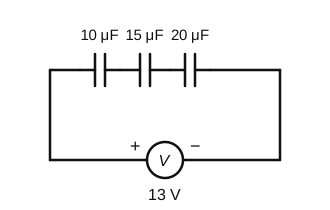
Concept. In series every capacitor carries the same charge $Q=C_sV$.
Step 1. Series capacitance. $\dfrac1{C_s}=\dfrac1{10}+\dfrac1{15}+\dfrac1{20}=\dfrac{6+4+3}{60}=\dfrac{13}{60}$, so $C_s=\dfrac{60}{13}\ \mu$F.
Step 2. Charge. $Q=\dfrac{60}{13}\times13=60\ \mu$C on each.
Answer. Option A.
Solution by Sreeraj P, M.Sc Physics
Q 12-02-116JEE MainJEE Main 2022 (26 Jun, Shift 2)Medium
A parallel plate capacitor with plate area $A$ and plate separation $d = 2\ \text{m}$ has a capacitance of $4\ \mu\text{F}$. The new capacitance of the system if half of the space between them is filled with a dielectric material of dielectric constant $K = 3$ (as shown in figure) will be
Q 12-02-117JEE MainJEE Main 2022 (25 Jul, Shift 1)Easy
A condenser of $2\ \mu\text{F}$ capacitance is charged steadily from $0$ to $5\ \text{C}$. Which of the following graphs represents correctly the variation of potential difference $V$ across its plates with respect to the charge $Q$ on the condenser?
Concept. $V=\dfrac QC$: a straight line through the origin with slope $\dfrac1C$.
Step 1. End point. $Q=5$ C: $V=\dfrac{5}{2\times10^{-6}}=2.5\times10^6$ V.
Step 2. Pick. The straight line reaching $2.5$ (in units of $10^6$ V) at $Q=5$ C is graph (A).
Answer. Option A.
Solution by Sreeraj P, M.Sc Physics
Q 12-02-118JEE MainJEE Main 2022 (25 Jul, Shift 2)Medium
The capacitance of an isolated conducting sphere of radius $R_1$ becomes $n$ times when it is enclosed by a concentric conducting sphere of radius $R_2$ connected to earth. The ratio of their radii $\left(\dfrac{R_2}{R_1}\right)$ is:
Concept. Isolated sphere: $C=4\pi\varepsilon_0R_1$. With an earthed outer shell it becomes a spherical capacitor: $C=4\pi\varepsilon_0\dfrac{R_1R_2}{R_2-R_1}$.
Step 1. Ratio. $n=\dfrac{R_2}{R_2-R_1}$.
Step 2. Solve. $\dfrac{R_2}{R_1}=\dfrac{n}{n-1}$.
Answer. Option A.
Solution by Sreeraj P, M.Sc Physics
Q 12-02-119JEE MainJEE Main 2022 (25 Jul, Shift 2)Medium
Two parallel plate capacitors of capacity $C$ and $3C$ are connected in parallel combination and charged to a potential difference $18\ \text{V}$. The battery is then disconnected and the space between the plates of the capacitor of capacity $C$ is completely filled with a material of dielectric constant $9$. The final potential difference across the combination of capacitors will be ______ V.
Q 12-02-120JEE MainJEE Main 2022 (26 Jul, Shift 1)Easy
The total charge on the system of capacitances $C_1 = 1\ \mu\text{F}$, $C_2 = 2\ \mu\text{F}$, $C_3 = 4\ \mu\text{F}$ and $C_4 = 3\ \mu\text{F}$ connected in parallel is (Assume a battery of $20\ \text{V}$ is connected to the combination)
Q 12-02-121JEE MainJEE Main 2022 (26 Jul, Shift 1)Medium
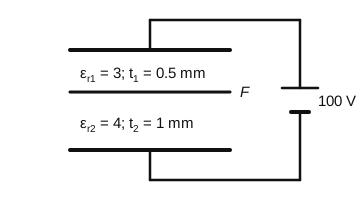
A composite parallel plate capacitor is made up of two different dielectric materials with different thicknesses ($t_1$ and $t_2$) as shown in figure. The two different dielectric materials are separated by a conducting foil $F$. The voltage of the conducting foil is ______ V.
Concept. The foil makes the two layers two capacitors in series; their voltages are in proportion to $\dfrac tK$ (the same charge, $V=\dfrac QC$ with $C\propto\dfrac Kt$).
Step 2. Voltages. Of 100 V: $40$ V across the upper layer, $60$ V across the lower.
Step 3. Foil. The lower plate is at 0 V (negative terminal), so the foil is at $60$ V.
Answer. $60$.
Solution by Sreeraj P, M.Sc Physics
Q 12-02-122JEE MainJEE Main 2022 (26 Jul, Shift 2)Easy
Two uniformly charged spherical conductors $A$ and $B$ of radii $5\ \text{mm}$ and $10\ \text{mm}$ are separated by a distance of $2\ \text{cm}$. If the spheres are connected by a conducting wire, then in equilibrium condition, the ratio of the magnitudes of the electric fields at the surfaces of spheres $A$ and $B$ will be
Q 12-02-123JEE MainJEE Main 2022 (26 Jul, Shift 2)Medium
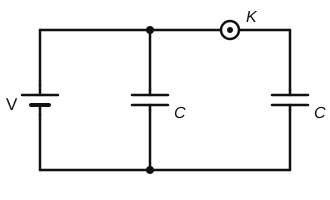
A source of potential difference $V$ is connected to the combination of two identical capacitors as shown in the figure. When key $K$ is closed, the total energy stored across the combination is $E_1$. Now key $K$ is opened and a dielectric of dielectric constant $5$ is introduced between the plates of the capacitors. The total energy stored across the combination is now $E_2$. The ratio $\dfrac{E_1}{E_2}$ will be
Concept. With K closed both capacitors are across $V$. Opening K isolates the second capacitor, which keeps its charge; the first stays on the source and keeps its voltage. The dielectric multiplies both capacitances by 5.
Step 1. Before. $E_1=2\times\dfrac12CV^2=CV^2$.
Step 2. First capacitor after. $V$ fixed: $\dfrac12(5C)V^2=2.5CV^2$.
Step 3. Second capacitor after. $Q=CV$ fixed: $\dfrac{Q^2}{2(5C)}=0.1CV^2$.
Q 12-02-124JEE MainJEE Main 2022 (27 Jun, Shift 1)Easy
A force of $10$ N acts on a charged particle placed between two plates of a charged capacitor. If one plate of capacitor is removed, then the force acting on that particle will be.
Concept. Each plate gives $\dfrac{\sigma}{2\varepsilon_0}$; between the two plates the fields add to $\dfrac{\sigma}{\varepsilon_0}$.
Step 1. One plate removed. The field becomes $\dfrac{\sigma}{2\varepsilon_0}$, half as large, so the force halves.
Answer. $5$ N (Option A).
Solution by Sreeraj P, M.Sc Physics
Q 12-02-125JEE MainJEE Main 2022 (27 Jun, Shift 1)Easy
A capacitor of capacitance $50$ pF is charged by $100$ V source. It is then connected to another uncharged identical capacitor. Electrostatic energy loss in the process is ______ nJ.
Q 12-02-126JEE MainJEE Main 2022 (27 Jun, Shift 2)Hard
A parallel plate capacitor is made up of stair like structure with a plate area $A$ of each stair and that is connected with a wire of length $b$, as shown in the figure. The capacitance of the arrangement is $\dfrac{x}{15}\dfrac{\varepsilon_0 A}{b}$. The value of $x$ is ______ .
Q 12-02-127JEE MainJEE Main 2022 (27 Jul, Shift 2)Medium
A parallel plate capacitor with width $4$ cm, length $8$ cm and separation between the plates of $4$ mm is connected to a battery of $20$ V. A dielectric slab of dielectric constant $5$ having length $1$ cm, width $4$ cm and thickness $4$ mm is inserted between the plates of parallel plate capacitor. The electrostatic energy of this system will be ______ $\varepsilon_0$ J. (Where $\varepsilon_0$ is the permittivity of free space)
Q 12-02-128JEE MainJEE Main 2022 (28 Jul, Shift 1)Easy
Two capacitors, each having capacitance $40\ \mu$F are connected in series. The space between one of the capacitors is filled with dielectric material of dielectric constant $K$ such that the equivalence capacitance of the system became $24\ \mu$F. The value of $K$ will be :
Q 12-02-129JEE MainJEE Main 2021 (27 Jul, Shift 1)Easy
A capacitor of capacitance $C = 1\ \mu\text{F}$ is suddenly connected to a battery of $100$ V through a resistance $R = 100\ \Omega$. The time taken for the capacitor to be charged to get $50$ V is: (Take $\ln 2 = 0.69$)
Q 12-02-130JEE MainJEE Main 2021 (27 Jul, Shift 1)Medium
In the reported figure, a capacitor is formed by placing a compound dielectric between the plates of a parallel plate capacitor. The expression for the capacity of the said capacitor will be: (Given the area of the plate $= A$)
Q 12-02-131JEE MainJEE Main 2021 (27 Jul, Shift 1)Easy
Two capacitors of capacities $2C$ and $C$ are joined in parallel and charged up to potential $V$. The battery is removed and the capacitor of capacity $C$ is filled completely with a medium of dielectric constant $K$. The potential difference across the capacitors will now be:
Concept. No steady current into the capacitor; it takes the voltage of the resistor it spans.
Step 1. Current. $1$ mA.
Step 2. Voltage. $2$ V, upper plate higher.
Step 3. Charge. $50 \times 2 = 100\ \mu$C.
Answer. $100$.
Solution by Sreeraj P, M.Sc Physics
Q 12-02-135JEE MainJEE Main 2021 (31 Aug, Shift 2)Easy
A parallel plate capacitor of capacitance $200\ \mu\text{F}$ is connected to a battery of $200$ V. A dielectric slab of dielectric constant $2$ is now inserted into the space between plates of capacitor while the battery remains connected. The change in the electrostatic energy in the capacitor will be ______ J.
Q 12-02-137JEE MainJEE Main 2021 (25 Feb, Shift 1)Easy
512 identical drops of mercury are charged to a potential of 2 V each. The drops are joined to form a single drop. The potential of this drop is $V$ in Volt. Find $V$.
Q 12-02-138JEE MainJEE Main 2021 (26 Feb, Shift 1)Medium
Consider the combination of two capacitors $C_1$ and $C_2$, with $C_2 > C_1$. When connected in parallel, the equivalent capacitance is $10$ times the equivalent capacitance of the same connected in series. Calculate the ratio of capacitors, $\frac{C_2}{C_1}$.
Q 12-02-139JEE MainJEE Main 2021 (26 Feb, Shift 2)Medium
$27$ similar drops of mercury are maintained at $10$ V each. All these spherical drops combine into a single big drop. The potential energy of the bigger drop is ______ times that of a smaller drop.
Concept. Self-energy of a charged sphere $U=\dfrac{kQ^2}{2R}\propto\dfrac{Q^2}{R}$. Merging $n$ drops: $Q\times n$, $R\times n^{1/3}$.
Step 1. Factor. $\dfrac{27^2}{3}=243$.
Answer. $243$.
Solution by Sreeraj P, M.Sc Physics
Q 12-02-140JEE MainJEE Main 2021 (25 Jul, Shift 2)Easy
If $q_f$ is the free charge on the capacitor plates and $q_b$ is the bound charge on the dielectric slab of dielectric constant $k$ placed between the capacitor plates, then bound charge $q_b$ can be expressed as:
Q 12-02-141JEE MainJEE Main 2021 (26 Aug, Shift 2)Medium
The two thin coaxial rings, each of radius $a$ and having charges $+Q$ and $-Q$ respectively are separated by a distance of $s$. The potential difference between the centres of the two rings is:
Concept. Potential at a ring's centre is $\dfrac{kQ}{a}$; on its axis at distance $s$ it is $\dfrac{kQ}{\sqrt{a^2+s^2}}$. Add the two rings at each centre.
Step 1. Centre of $+Q$ ring. $kQ\left(\dfrac1a-\dfrac{1}{\sqrt{a^2+s^2}}\right)$.
Step 2. Centre of $-Q$ ring. The negative of that.
Q 12-02-142JEE MainJEE Main 2021 (26 Aug, Shift 2)Medium
A parallel-plate capacitor with plate area $A$ has separation $d$ between the plates. Two dielectric slabs of dielectric constant $K_1$ and $K_2$ of same area $\frac{A}{2}$ and thickness $\frac{d}{2}$ are inserted in the space between the plates. The capacitance of the capacitor will be given by:
Concept. Steady state: no current in the capacitor branch, which takes the voltage of the $4\ \Omega$ resistor.
Step 1. Current. $\dfrac{5}{5} = 1$ A: $4$ V across the branch.
Step 2. Capacitance. $(2 + 2)$ in series with $4$: $2\ \mu$F.
Step 3. Charge. $2 \times 4 = 8\ \mu$C (same on the series $4\ \mu$F).
Answer. $8\ \mu$C (Option B).
Solution by Sreeraj P, M.Sc Physics
Q 12-02-144JEE MainJEE Main 2021 (27 Aug, Shift 2)Medium
Three capacitors $C_1 = 2\ \mu$F, $C_2 = 6\ \mu$F and $C_3 = 12\ \mu$F are connected as shown in the figure. Find the ratio of the charges on capacitors $C_1$, $C_2$ and $C_3$ respectively.
Concept. Both branches share the battery voltage; series capacitors carry equal charge.
Step 1. Series branch. $C_2, C_3$: $4\ \mu$F, so $Q_2 = Q_3 = 4V$.
Step 2. Direct branch. $Q_1 = 2V$.
Step 3. Ratio. $1 : 2 : 2$.
Answer. $1 : 2 : 2$ (Option D).
Solution by Sreeraj P, M.Sc Physics
Q 12-02-145JEE MainJEE Main 2020 (8 Jan, Shift 2)Easy
Consider two charged metallic spheres $S_1$ and $S_2$ of radii $R_1$ and $R_2$, respectively. The electric fields $E_1$ (on $S_1$) and $E_2$ (on $S_2$) on their surfaces are such that $\dfrac{E_1}{E_2} = \dfrac{R_1}{R_2}$. Then the ratio $V_1$ (on $S_1$)$/V_2$ (on $S_2$) of the electrostatic potentials on each sphere is:
Q 12-02-146JEE MainJEE Main 2020 (8 Jan, Shift 2)Hard
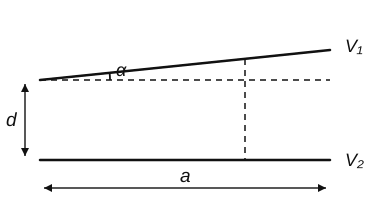
A capacitor is made of two square plates each of side $a$ making a very small angle $\alpha$ between them, as shown in figure. The capacitance will be close to:
Concept. The gap varies across the plate: $y(x)=d+\alpha x$. Strips of width $dx$ are capacitors in parallel: $C=\displaystyle\int_0^a\dfrac{\varepsilon_0a\,dx}{d+\alpha x}$.
Step 2. Small angle. $\ln(1+u)\approx u-\dfrac{u^2}{2}$: $C\approx\dfrac{\varepsilon_0a}{\alpha}\left[\dfrac{\alpha a}{d}-\dfrac{\alpha^2a^2}{2d^2}\right]=\dfrac{\varepsilon_0a^2}{d}\left(1-\dfrac{\alpha a}{2d}\right)$.
Answer. Option A.
Solution by Sreeraj P, M.Sc Physics
Q 12-02-147JEE MainJEE Main 2020 (9 Jan, Shift 2)Medium
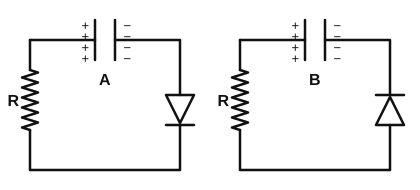
Two identical capacitors $A$ and $B$, charged to the same potential $5V$ are connected in two different circuits as shown below at time $t = 0$. If the charge on capacitors $A$ and $B$ at time $t = CR$ is $Q_A$ and $Q_B$ respectively, then (Here $e$ is the base of natural logarithm)
Concept. A charged capacitor discharges through $R$ only if the diode in the loop is forward biased for the discharge current, which leaves the positive plate (left), goes through $R$ and returns to the negative plate. Then $Q=Q_0e^{-t/RC}$.
Step 1. Circuit A. The diode points against the discharge current: it blocks, so $Q_A=CV$.
Step 2. Circuit B. The diode points along the discharge current: at $t=RC$, $Q_B=\dfrac{CV}{e}$.
Answer. Option C.
Solution by Sreeraj P, M.Sc Physics
Q 12-02-148JEE MainJEE Main 2020 (5 Sep, Shift 2)Medium
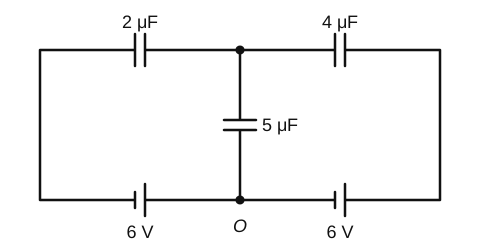
In the circuit shown, the charge on the $5\ \mu\text{F}$ capacitor is:
Concept. With only capacitors and cells, use the node method: the isolated node (the junction of the three capacitors) has zero net charge, so $\sum C_i(V-V_i)=0$.
Step 1. Potentials. Take O as $0$. From the figure, the left cell's positive plate faces O, so the left corner is at $-6$ V; the right cell makes the right corner $+6$ V.
Step 2. Node equation. $2(V+6)+4(V-6)+5(V-0)=0\Rightarrow11V=12\Rightarrow V=\dfrac{12}{11}$ V.
Step 3. Charge on 5 μF. $5\times\dfrac{12}{11}=5.45\ \mu$C.
Answer. Option D.
Solution by Sreeraj P, M.Sc Physics
Q 12-02-149JEE MainJEE Main 2020 (5 Sep, Shift 2)Medium
A parallel plate capacitor has plates of length $l$, width $w$ and separation $d$. It is connected to a battery of emf $V$. A dielectric slab of the same thickness $d$ and of dielectric constant $K = 4$ is being inserted between the plates of the capacitor. At what length of the slab inside the plates will the energy stored in the capacitor be two times the initial energy stored?
Q 12-02-150JEE MainJEE Main 2020 (6 Sep, Shift 2)Hard
Two identical electric point dipoles have dipole moments $\vec p_1 = p\hat i$ and $\vec p_2 = -p\hat i$ and are held on the $x$-axis at distance $a$ from each other. When released, they move along the $x$-axis with the direction of their dipole moments remaining unchanged. If the mass of each dipole is $m$, their speed when they are infinitely far apart is:
Concept. Coaxial dipoles pointing opposite ways repel; their interaction energy $U=\dfrac{2kp^2}{a^3}$ turns into the kinetic energy of both (momentum makes their speeds equal).
Q 12-02-151JEE MainJEE Main 2020 (7 Jan, Shift 1)Medium
A parallel plate capacitor has plates of area $A$ separated by distance $d$ between them. It is filled with a dielectric which has a dielectric constant that varies as $K(x) = K_0(1 + \alpha x)$, where $x$ is the distance measured from one of the plates. If $(\alpha d) \ll 1$, the total capacitance of the system is best given by the expression:
Q 12-02-152JEE MainJEE Main 2020 (7 Jan, Shift 2)Easy
A $60$ pF capacitor is fully charged by a $20$ V supply. It is then disconnected from the supply and is connected to another uncharged $60$ pF capacitor in parallel. The electrostatic energy that is lost in this process by the time the charge is redistributed between them is (in nJ) ______.
Q 12-02-153JEE MainJEE Main 2020 (8 Jan, Shift 1)Easy
The effective capacitance of a parallel combination of two capacitors $C_1$ and $C_2$ is $10\ \mu\text{F}$. When these capacitors are individually connected to a voltage source of $1$ V, the energy stored in the capacitor $C_2$ is $4$ times that of $C_1$. If these capacitors are connected in series, their effective capacitance will be:
Q 12-02-154JEE MainJEE Main 2020 (2 Sep, Shift 1)Medium
A $5\ \mu\text{F}$ capacitor is charged fully by a $220\ \text{V}$ supply. It is then disconnected from the supply and is connected in series to another uncharged $2.5\ \mu\text{F}$ capacitor. If the energy change during the charge redistribution is $\dfrac{X}{100}\ \text{J}$ then value of $X$ to the nearest integer is ______.
Q 12-02-155JEE MainJEE Main 2020 (2 Sep, Shift 2)Medium
A charge $Q$ is distributed over two concentric conducting thin spherical shells of radii $r$ and $R$ $(R > r)$. If the surface charge densities on the two shells are equal, the electric potential at the common centre is:
Q 12-02-156JEE MainJEE Main 2020 (2 Sep, Shift 2)Easy
A $10\ \mu\text{F}$ capacitor is fully charged to a potential difference of $50\ \text{V}$. After removing the source voltage it is connected to an uncharged capacitor in parallel. Now the potential difference across them becomes $20\ \text{V}$. The capacitance of the second capacitor is:
Q 12-02-157JEE MainJEE Main 2020 (3 Sep, Shift 1)Easy
Two isolated conducting spheres $S_1$ and $S_2$ of radius $\dfrac23R$ and $\dfrac13R$ have $12\ \mu\text{C}$ and $-3\ \mu\text{C}$ charges, respectively, and are at a large distance from each other. They are now connected by a conducting wire. A long time after this is done the charges on $S_1$ and $S_2$ are respectively:
Concept. Total charge $12-3=9\ \mu$C shared in the ratio of radii $2:1$.
Step 1. Shares. $6\ \mu$C and $3\ \mu$C.
Answer. Option D.
Solution by Sreeraj P, M.Sc Physics
Q 12-02-158JEE MainJEE Main 2020 (3 Sep, Shift 1)Easy
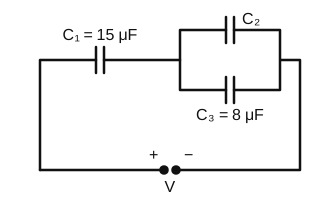
In the circuit shown in the figure, the total charge is $750\ \mu\text{C}$ and the voltage across capacitor $C_2$ is $20\ \text{V}$. Then the charge on capacitor $C_2$ is:
Concept. $C_2 \parallel C_3$ share $20$ V; together they carry the total charge.
Step 1. $C_3$. $8 \times 20 = 160\ \mu$C.
Step 2. $C_2$. $750 - 160 = 590\ \mu$C.
Answer. $590\ \mu\text{C}$ (Option B).
Solution by Sreeraj P, M.Sc Physics
Q 12-02-159JEE MainJEE Main 2020 (3 Sep, Shift 2)Easy
Hydrogen ion and singly ionized helium atom are accelerated, from rest, through the same potential difference. The ratio of final speeds of hydrogen and helium ions is close to:
Concept. $v = \sqrt{\dfrac{2qV}{m}}$ with equal charges.
Step 1. Ratio. $\sqrt{\dfrac41} = 2$.
Answer. $2 : 1$ (Option C).
Solution by Sreeraj P, M.Sc Physics
Q 12-02-160JEE MainJEE Main 2020 (3 Sep, Shift 2)Medium
Concentric metallic hollow spheres of radii $R$ and $4R$ hold charges $Q_1$ and $Q_2$ respectively. Given that surface charge densities of the concentric spheres are equal, the potential difference $V(R) - V(4R)$ is:
Q 12-02-161JEE MainJEE Main 2020 (4 Sep, Shift 1)Medium
Two point charges $4q$ and $-q$ are fixed on the $x$-axis at $x = -\dfrac d2$ and $x = \dfrac d2$, respectively. If a third point charge $q$ is taken from the origin to $x = d$ along a semicircle (centred at $x = \dfrac d2$), the energy of the charge will:
Answer. Decreases by $\dfrac{4q^2}{3\pi\varepsilon_0d}$ (Option D).
Solution by Sreeraj P, M.Sc Physics
Q 12-02-162JEE MainJEE Main 2020 (4 Sep, Shift 2)Medium
A capacitor $C$ is fully charged with voltage $V_0$. After disconnecting the voltage source, it is connected in parallel with another uncharged capacitor of capacitance $\dfrac C2$. The energy loss in the process after the charge is distributed between the two capacitors is:
Q 12-02-163JEE MainJEE Main 2020 (5 Sep, Shift 1)Medium
A solid sphere of radius $R$ carries a charge $Q + q$ distributed uniformly over its volume. A very small point-like piece of it of mass $m$ gets detached from the bottom of the sphere and falls down vertically under gravity. This piece carries charge $q$. If it acquires a speed $v$ when it has fallen through a vertical height $y$, then (assume the remaining portion to be spherical)
Concept. Energy conservation: the falling piece gains kinetic energy from gravity and from electric repulsion by the remaining charge $Q$ (acting as a point charge at the centre).
Step 1. Electric energy released. $kqQ\left(\dfrac1R-\dfrac{1}{R+y}\right)=\dfrac{kqQy}{R(R+y)}$.
Step 2. Energy equation. $\tfrac12mv^2=mgy+\dfrac{kqQy}{R(R+y)}$.
Q 12-02-164JEE MainJEE Main 2020 (5 Sep, Shift 1)Medium
Two capacitors of capacitances $C$ and $2C$ are charged to potential differences $V$ and $2V$, respectively. These are then connected in parallel in such a manner that the positive terminal of one is connected to the negative terminal of the other. The final energy of this configuration is:
Concept. Opposite plates joined: the charges partly cancel. Net charge $2C(2V)-CV=3CV$ on $3C$.
Step 1. Voltage. $V'=\dfrac{3CV}{3C}=V$.
Step 2. Energy. $\tfrac12(3C)V^2=\tfrac32CV^2$.
Answer. Option B.
Solution by Sreeraj P, M.Sc Physics
Q 12-02-165JEE MainJEE Main 2019 (9 Jan, Shift 2)Medium
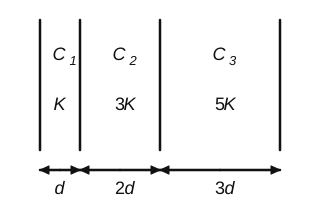
A parallel plate capacitor with square plates is filled with four dielectrics of dielectric constants $K_1, K_2, K_3, K_4$ arranged as shown in the figure. The effective dielectric constant $K$ will be:
Concept. Each block is a small capacitor. Blocks stacked across the gap are in series; side-by-side columns are in parallel. Each block has area $\dfrac A2$ and thickness $\dfrac d2$, so a block alone is $K\dfrac{\varepsilon_0A}{d}$.
Step 1. Upper half. $K_1$ and $K_2$ in series: $\dfrac{K_1K_2}{K_1+K_2}\dfrac{\varepsilon_0A}{d}$.
Step 2. Lower half. $K_3$ and $K_4$ in series: $\dfrac{K_3K_4}{K_3+K_4}\dfrac{\varepsilon_0A}{d}$.
Step 3. In parallel. $K=\dfrac{K_1K_2}{K_1+K_2}+\dfrac{K_3K_4}{K_3+K_4}$.
Answer. Option A.
Solution by Sreeraj P, M.Sc Physics
Q 12-02-166JEE MainJEE Main 2019 (10 Jan, Shift 1)Medium
Two electric dipoles $A$, $B$ with respective dipole moments $\vec d_A = -4qa\,\hat i$ and $\vec d_B = -2qa\,\hat i$ are placed on the $x$-axis with a separation $R$, with $A$ at the origin and $B$ at $x = R$. The distance from $A$ at which both of them produce the same potential is:
Q 12-02-167JEE MainJEE Main 2019 (10 Jan, Shift 1)Medium
A charge $Q$ is distributed over three concentric spherical shells of radii $a, b, c\ (a < b < c)$ such that their surface charge densities are equal to one another.
The total potential at a point at distance $r$ from their common centre, where $r < a$, would be:
Q 12-02-168JEE MainJEE Main 2019 (10 Jan, Shift 1)Easy
A parallel plate capacitor is of area $6\ \text{cm}^2$ and a separation $3\ \text{mm}$. The gap is filled with three dielectric materials of equal thickness (see figure) with dielectric constant $K_1 = 10$, $K_2 = 12$ and $K_3 = 14$. The dielectric constant of a material which when fully inserted in above capacitor, gives same capacitance would be:
Q 12-02-169JEE MainJEE Main 2019 (10 Jan, Shift 2)Medium
Four equal point charges $Q$ each are placed in the $xy$ plane at $(0, 2)$, $(4, 2)$, $(4, -2)$ and $(0, -2)$. The work required to put a fifth charge $Q$ at the origin of the coordinate system will be:
Q 12-02-170JEE MainJEE Main 2019 (10 Jan, Shift 2)Medium
A parallel plate capacitor having capacitance $12\ \text{pF}$ is charged by a battery to a potential difference of $10\ \text{V}$ between its plates. The charging battery is now disconnected and a porcelain slab of dielectric constant $6.5$ is slipped between the plates. The work done by the capacitor on the slab is
Q 12-02-171JEE MainJEE Main 2019 (10 Apr, Shift 1)Medium
A uniformly charged ring of radius $3a$ and total charge $q$ is placed in $x$-$y$ plane centred at origin. A point charge $q$ is moving towards the ring along the $z$-axis and has speed $v$ at $z = 4a$. The minimum value of $v$ such that it crosses the origin is:
Concept. The charge must climb the potential hill to the ring's centre (highest point on the axis). Energy conservation with $V_{\text{axis}}=\dfrac{kq}{\sqrt{R^2+z^2}}$.
Step 1. Potentials. At $z=4a$: $\dfrac{kq}{5a}$; at the centre: $\dfrac{kq}{3a}$.
Step 2. Energy needed. $kq^2\left(\dfrac1{3a}-\dfrac1{5a}\right)=\dfrac{2}{15}\dfrac{kq^2}{a}$.
Q 12-02-172JEE MainJEE Main 2019 (10 Apr, Shift 1)Easy
The charge $q$ versus voltage $V$ graphs for the series and parallel combinations of two given capacitors are straight lines through the origin. At $V = 10\ \text{V}$ one line gives $q = 500\ \mu\text{C}$ and the other gives $q = 80\ \mu\text{C}$. The capacitances are:
Q 12-02-173JEE MainJEE Main 2019 (10 Apr, Shift 2)Medium
In free space, a particle $A$ of charge $1\ \mu\text{C}$ is held fixed at point $P$. Another particle $B$ of the same charge and mass $4\ \mu\text{g}$ is kept at a distance of $1\ \text{mm}$ from $P$. If $B$ is released, then its velocity at a distance of $9\ \text{mm}$ from $P$ is: $\left[\text{Take } \dfrac{1}{4\pi\epsilon_0} = 9\times10^9\ \text{N m}^2\text{C}^{-2}\right]$
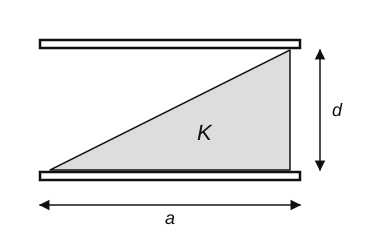
Q 12-02-174JEE MainJEE Main 2019 (9 Jan, Shift 1)Hard
A parallel plate capacitor is made of two square plates of side $a$, separated by a distance $d$ ($d \ll a$). The lower triangular portion is filled with a dielectric of dielectric constant $K$, as shown in the figure. Capacitance of this capacitor is
Concept. At distance $x$ along the plate the dielectric has thickness $t=\dfrac{dx}{a}$, so each strip is a capacitor with effective gap $d-t+\dfrac tK$; the strips are in parallel.
Step 1. Strip. $dC=\dfrac{\varepsilon_0a\,dx}{d\left[1-\beta\frac xa\right]}$ with $\beta=1-\dfrac1K=\dfrac{K-1}{K}$.
Q 12-02-175JEE MainJEE Main 2019 (8 Apr, Shift 1)Easy
A solid conducting sphere, having a charge $Q$, is surrounded by an uncharged conducting hollow spherical shell. Let the potential difference between the surface of the solid sphere and that of the outer surface of the hollow shell be $V$. If the shell is now given a charge of $-4Q$, the new potential difference between the same two surfaces is
Concept. Charge on the outer shell raises the potential of both surfaces equally (everything inside a shell is at its potential), so the difference depends only on the inner sphere's charge.
Answer. Unchanged: $V$ (Option C).
Solution by Sreeraj P, M.Sc Physics
Q 12-02-176JEE MainJEE Main 2019 (8 Apr, Shift 1)Easy
Voltage rating of a parallel plate capacitor is $500\ \text{V}$. Its dielectric can withstand a maximum electric field of $10^6\ \text{V/m}$. The plate area is $10^{-4}\ \text{m}^2$. What is the dielectric constant if the capacitance is $15\ \text{pF}$? (given $\varepsilon_0 = 8.86\times10^{-12}\ \text{C}^2/\text{N m}^2$)
Q 12-02-177JEE MainJEE Main 2019 (8 Apr, Shift 2)Medium
A positive point charge is released from rest at a distance $r_0$ from a positive line charge with uniform charge density. The speed ($v$) of the point charge, as a function of instantaneous distance $r$ from line charge, is proportional to
Q 12-02-178JEE MainJEE Main 2019 (8 Apr, Shift 2)Easy
The electric field in a region is given by $\vec E = (Ax + B)\hat i$, where $E$ is in $\text{N C}^{-1}$ and $x$ is in metres. The values of constants are $A = 20$ SI unit and $B = 10$ SI unit. If the potential at $x = 1$ is $V_1$ and that at $x = -5$ is $V_2$, then $V_1 - V_2$ is
Q 12-02-179JEE MainJEE Main 2019 (8 Apr, Shift 2)Medium
A parallel plate capacitor has $1\ \mu\text{F}$ capacitance. One of its two plates is given $+2\ \mu\text{C}$ charge and the other plate, $+4\ \mu\text{C}$ charge. The potential difference developed across the capacitor is
Q 12-02-181JEE MainJEE Main 2019 (9 Apr, Shift 1)Easy
A capacitor with capacitance $5\ \mu\text{F}$ is charged to $5\ \mu\text{C}$. If the plates are pulled apart to reduce the capacitance to $2\ \mu\text{F}$, how much work is done?
Step 2. Value. $12.5\times10^{-12}\times3\times10^5=3.75\times10^{-6}$ J.
Answer. Option D.
Solution by Sreeraj P, M.Sc Physics
Q 12-02-182JEE MainJEE Main 2019 (9 Apr, Shift 2)Easy
The parallel combination of two air filled parallel plate capacitors of capacitance $C$ and $nC$ is connected to a battery of voltage, $V$. When the capacitors are fully charged, the battery is removed and after that a dielectric material of dielectric constant $K$ is placed between the two plates of the first capacitor. The new potential difference of the combined system is
Answer: (B) Potential of a uniformly charged spherical shell
Concept. Constant inside, $\dfrac1r$ outside: the potential of a shell.
Step 1. Rule out. The shell's field is zero inside; a solid sphere's field and potential vary inside.
Answer. Potential of a uniformly charged spherical shell (Option B).
Solution by Sreeraj P, M.Sc Physics
Q 12-02-184JEE MainJEE Main 2019 (11 Jan, Shift 1)Medium
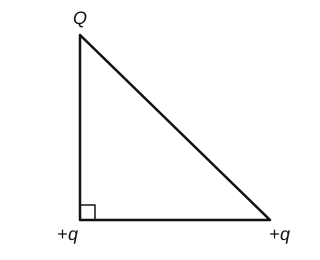
Three charges $Q$, $+q$ and $+q$ are placed at the vertices of a right-angle isosceles triangle as shown below. The net electrostatic energy of the configuration is zero, if the value of $Q$ is
Q 12-02-185JEE MainJEE Main 2019 (11 Jan, Shift 1)Medium
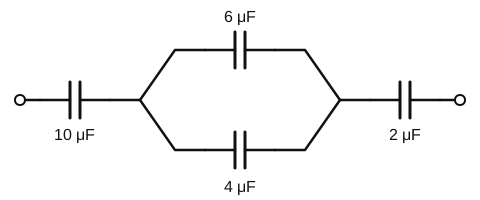
In the figure shown below, the charge on the left plate of the $10\ \mu$F capacitor is $-30\ \mu$C. The charge on the right plate of the $6\ \mu$F capacitor is:
Concept. Charge flows through a series chain unchanged; a parallel pair shares it in proportion to capacitance. Plates facing each other carry equal and opposite charges.
Step 1. Through the chain. The 10 μF capacitor has $-30\ \mu$C on its left plate, so $+30\ \mu$C on its right plate; the parallel pair therefore has $-30\ \mu$C on its left plates.
Step 2. Share. Same voltage across 6 μF and 4 μF: charges $18$ and $12\ \mu$C.
Step 3. Sign. The 6 μF capacitor's left plate has $-18\ \mu$C, so its right plate has $+18\ \mu$C.
Answer. Option D.
Solution by Sreeraj P, M.Sc Physics
Q 12-02-186JEE MainJEE Main 2019 (11 Jan, Shift 2)Medium
Seven capacitors, each of capacitance $2\ \mu$F, are to be connected in a configuration to obtain an effective capacitance of $\left(\dfrac{6}{13}\right)\mu$F. Which of the combinations, shown in figures below, will achieve the desired value?
Concept. Test the options. With $2\ \mu$F units: $k$ in parallel give $2k$; in series $\dfrac{2}{k}$.
Step 1. Option B. Three in parallel ($6\ \mu$F) in series with four single capacitors: $\dfrac1C=\dfrac16+4\times\dfrac12=\dfrac16+2=\dfrac{13}{6}$.
Step 2. Value. $C=\dfrac{6}{13}\ \mu$F, using all seven capacitors.
Answer. Option B.
Solution by Sreeraj P, M.Sc Physics
Q 12-02-187JEE MainJEE Main 2019 (12 Jan, Shift 1)Medium
There is a uniform spherically symmetric surface charge density at a distance $R_0$ from the origin. The charge distribution is initially at rest and starts expanding because of mutual repulsion. The figure that represents best the speed $V(R(t))$ of the distribution as a function of its instantaneous radius $R(t)$ is:
Concept. The shell's own energy $\dfrac{kQ^2}{2R}$ turns into kinetic energy as it expands: $\dfrac12Mv^2=\dfrac{kQ^2}{2}\left(\dfrac1{R_0}-\dfrac1R\right)$.
Step 1. Shape. $v=0$ at $R=R_0$; $v$ rises quickly at first and levels off at $\sqrt{\dfrac{kQ^2}{MR_0}}$ as $R\to\infty$.
Answer. Option A.
Solution by Sreeraj P, M.Sc Physics
Q 12-02-188JEE MainJEE Main 2019 (12 Jan, Shift 1)Medium
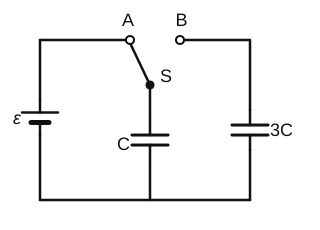
The figure shows a capacitor of capacitance $C$ connected to a battery via a switch, having a total charge $Q$ on it, in steady-state. When the switch S is turned from position A to position B, the energy dissipated in the circuit is
Concept. In position A the capacitor charges to $Q=C\varepsilon$. In position B it is disconnected from the cell and shares charge with $3C$. Energy lost $=\dfrac{C_1C_2}{2(C_1+C_2)}V^2$.
Step 2. In terms of $Q$. $\varepsilon=\dfrac QC$: loss $=\dfrac38\dfrac{Q^2}{C}$.
Answer. Option B.
Solution by Sreeraj P, M.Sc Physics
Q 12-02-189JEE MainJEE Main 2019 (12 Jan, Shift 2)Easy
A parallel plate capacitor with plates of area $1\ \text{m}^2$ each, are at a separation of $0.1$ m. If the electric field between the plates is $100$ N/C, the magnitude of charge on each plate is: (Take $\varepsilon_0 = 8.85\times10^{-12}\ \dfrac{\text{C}^2}{\text{N m}^2}$)
Concept. Reduce series/parallel groups, then solve for $C$.
Step 1. Right path. $(1 + 1)$ then in series with $2$: $1\ \mu$F.
Step 2. Left path. $2$ in series with $4$: $\dfrac43\ \mu$F.
Step 3. With $C$. $\dfrac1C + \dfrac37 = 2 \Rightarrow C = \dfrac{7}{11}\ \mu$F.
Answer. $\dfrac{7}{11}\ \mu$F (Option C).
Solution by Sreeraj P, M.Sc Physics
Q 12-02-191JEE MainJEE Main 2019 (12 Apr, Shift 1)Medium
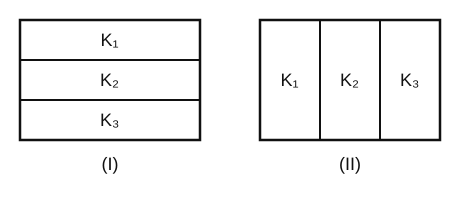
Two identical parallel plate capacitors, of capacitance $C$ each, have plates of area $A$, separated by a distance $d$. The space between the plates of the two capacitors, is filled with three dielectrics, of equal thickness and dielectric constants $K_1$, $K_2$ and $K_3$. The first capacitor is filled as shown in figure I, and the second one is filled as shown in figure II. If these two modified capacitors are charged by the same potential $V$, the ratio of the energy stored in the two, would be ($E_1$ refers to capacitor I and $E_2$ to capacitor II):
Q 12-02-194JEE MainJEE Main 2018 (15 Apr, Shift 2)Medium
A parallel plate capacitor with area $200\ \text{cm}^2$ and separation between the plates $1.5\ \text{cm}$, is connected across a battery of emf $V$. If the force of attraction between the plates is $25\times10^{-6}\ \text{N}$, the value of $V$ is approximately: $\left(\varepsilon_0 = 8.85\times10^{-12}\ \dfrac{\text{C}^2}{\text{N m}^2}\right)$
Concept. Force between plates $F=\dfrac{Q^2}{2\varepsilon_0A}=\dfrac{\varepsilon_0AV^2}{2d^2}$ (each plate feels the field of the other, $\dfrac{\sigma}{2\varepsilon_0}$).
Q 12-02-195JEE MainJEE Main 2018 (16 Apr, Shift 1)Easy
In a circuit, two uncharged capacitors $C_1$ and $C_2$ are connected in series with a cell of emf $E$, a resistor $R$ and a switch $S$. The switch $S$ is closed at $t = 0$. The charge on the capacitor $C_1$ as a function of time will be given by $\left(C_{eq} = \dfrac{C_1C_2}{C_1 + C_2}\right)$
Concept. Capacitors in series charge as one capacitor $C_{\text{eq}}$, and each carries the same charge.
Step 1. Charging law. $q=C_{\text{eq}}E\left(1-e^{-t/RC_{\text{eq}}}\right)$ on each capacitor.
Answer. Option C.
Solution by Sreeraj P, M.Sc Physics
Q 12-02-196JEE MainJEE Main 2017 (2 Apr)Medium
A capacitance of $2\ \mu$F is required in an electrical circuit across a potential difference of $1.0$ kV. A large number of $1\ \mu$F capacitors are available which can withstand a potential difference of not more than $300$ V. The minimum number of capacitors required to achieve this is:
Concept. Put enough capacitors in series to share the voltage safely, then enough such rows in parallel to reach the capacitance.
Step 1. Series per row. $\dfrac{1000}{300}=3.3$, so $4$ in series (each $250$ V); row capacitance $\tfrac14\ \mu$F.
Step 2. Rows. $\dfrac{2}{1/4}=8$ rows.
Step 3. Total. $4\times8=32$.
Answer. Option A.
Solution by Sreeraj P, M.Sc Physics
Q 12-02-198JEE MainJEE Main 2017 (8 Apr)Easy
The energy stored in the electric field produced by a metal sphere is $4.5$ J. If the sphere contains $4\ \mu$C charge, its radius will be: [Take $\dfrac{1}{4\pi\varepsilon_0} = 9\times10^9\ \text{N m}^2\text{C}^{-2}$]
Concept. An isolated sphere has $C=4\pi\varepsilon_0R$, so its stored energy is $U=\dfrac{Q^2}{2C}=\dfrac{kQ^2}{2R}$.
Step 1. Solve. $R=\dfrac{kQ^2}{2U}=\dfrac{9\times10^9\times16\times10^{-12}}{9}=0.016$ m.
Answer. $16$ mm (Option B).
Solution by Sreeraj P, M.Sc Physics
Q 12-02-199JEE MainJEE Main 2017 (9 Apr)Medium
A combination of parallel plate capacitors is maintained at a certain potential difference. When a $3$ mm thick slab is introduced between all the plates, in order to maintain the same potential difference, the distance between the plates is increased by $2.4$ mm. Find the dielectric constant of the slab.
Three concentric metal shells $A$, $B$ and $C$ of respective radii $a$, $b$ and $c$ $(a < b < c)$ have surface charge densities $+\sigma$, $-\sigma$ and $+\sigma$ respectively. The potential of shell $B$ is:
A parallel plate capacitor of capacitance $90$ pF is connected to a battery of emf $20$ V. If a dielectric material of dielectric constant $K = \dfrac53$ is inserted between the plates, the magnitude of the induced charge will be:
Concept. No work along an equipotential: $\vec E \cdot d\vec l = 0$.
Step 1. Angle. $90°$.
Answer. $90°$ (Option D).
Solution by Sreeraj P, M.Sc Physics
Q 12-02-204NEETNEET 2022Top questionMedium
A capacitor of capacitance $C = 900$ pF is charged fully by $100$ V battery $B$ as shown in figure (a). Then it is disconnected from the battery and connected to another uncharged capacitor of capacitance $C = 900$ pF as shown in figure (b). The electrostatic energy stored by the system (b) is
Q 12-02-205JEE MainJEE Main 2025 (2 Apr, Shift 2)Easy
Given below are two statements: one is labelled as Assertion (A) and the other is labelled as Reason (R).
Assertion (A): Net dipole moment of a polar linear isotropic dielectric substance is not zero even in the absence of an external electric field.
Reason (R): In absence of an external electric field, the different permanent dipoles of a polar dielectric substance are oriented in random directions.
In the light of the above statements, choose the most appropriate answer from the options given below:
Concept. In a polar dielectric the molecules have permanent dipoles, but with no field thermal motion points them at random.
Step 1. Assertion. Random orientations cancel: the net dipole moment is zero. False.
Step 2. Reason. True.
Answer. Option D.
Solution by Sreeraj P, M.Sc Physics
Q 12-02-206JEE MainJEE Main 2025 (2 Apr, Shift 2)Easy
Two large plane parallel conducting plates are kept $10\ \text{cm}$ apart as shown in the figure. The potential difference between them is $V$. The potential difference between the points A and B (shown in the figure) is:
Concept. Between large parallel plates the field is uniform, $E=\dfrac{V}{d}$, perpendicular to the plates. The potential difference between two points depends only on their separation along the field.
Step 1. Separation along the field. $AC=3$ cm is parallel to the plates and $AB=5$ cm, so $CB=4$ cm is the part along the field.
Q 12-02-207JEE MainJEE Main 2025 (3 Apr, Shift 1)Medium
A parallel plate capacitor is filled equally (half) with two dielectrics of dielectric constant $\varepsilon_1$ and $\varepsilon_2$, as shown in the figures. The distance between the plates is $d$ and the area of each plate is $A$. In the first configuration the two dielectrics are layers, each of thickness $d/2$, filling the whole plate area; in the second each fills half the plate area across the full gap $d$. If the capacitances in the first and second configurations are $C_1$ and $C_2$ respectively, then $\dfrac{C_1}{C_2}$ is:
Concept. Layers (each $\frac d2$ thick, full area) are in series; side-by-side halves (each half the area, full gap) are in parallel. Let $C_0=\dfrac{\varepsilon_0A}{d}$.
Step 1. Layers. Each layer is $2\varepsilon_iC_0$: $C_1=\dfrac{2\varepsilon_1\varepsilon_2}{\varepsilon_1+\varepsilon_2}C_0$.
Step 2. Side by side. Each half is $\dfrac{\varepsilon_i}{2}C_0$: $C_2=\dfrac{\varepsilon_1+\varepsilon_2}{2}C_0$.
Q 12-02-208JEE MainJEE Main 2025 (3 Apr, Shift 1)Easy
The electrostatic potential on the surface of a uniformly charged spherical shell of radius $R = 10\ \text{cm}$ is $120\ \text{V}$. The potentials at the centre of the shell, at a distance $r = 5\ \text{cm}$ from the centre, and at a distance $r = 15\ \text{cm}$ from the centre of the shell respectively, are:
Concept. Inside a charged shell $V$ is the same as on its surface; outside, $V=\dfrac{kQ}{r}$, so $V\propto\dfrac1r$.
Step 1. Inside. Centre and $r=5$ cm: $120$ V each.
Step 2. Outside. $V(15)=120\times\dfrac{10}{15}=80$ V.
Answer. Option A.
Solution by Sreeraj P, M.Sc Physics
Q 12-02-209JEE MainJEE Main 2025 (3 Apr, Shift 2)Easy
Using a battery, a $100\ \text{pF}$ capacitor is charged to $60\ \text{V}$ and then the battery is removed. After that, a second uncharged capacitor is connected to the first capacitor in parallel. If the final voltage across the second capacitor is $20\ \text{V}$, its capacitance is (in pF):
Step 1. Equation. $(100 + C) \times 20 = 6000 \Rightarrow C = 200$ pF.
Answer. $200$ (Option B).
Solution by Sreeraj P, M.Sc Physics
Q 12-02-210JEE MainJEE Main 2025 (4 Apr, Shift 1)Medium
Four capacitors each of capacitance $16\ \mu\text{F}$ are connected as shown in the figure. The capacitance between points A and B is ______ (in $\mu\text{F}$).
Concept. Name the nodes: points joined by plain wire are one node. Capacitors joined to the same two nodes are in parallel.
Step 1. Nodes. The left end, the middle junction and the right end are wired to B; the first and third junctions are wired to A.
Step 2. Capacitors. Each of the four capacitors has one plate on an A-junction and the other on a B-point: all four lie between A and B.
Step 3. Total. $4\times16=64\ \mu$F.
Answer. $64$.
Solution by Sreeraj P, M.Sc Physics
Q 12-02-211JEE MainJEE Main 2025 (4 Apr, Shift 2)Easy
Three parallel plate capacitors $C_1$, $C_2$ and $C_3$, each of capacitance $5\ \mu\text{F}$, are connected as shown in the figure ($C_1$ and $C_2$ in series, together in parallel with $C_3$). The effective capacitance between points A and B, when the space between the parallel plates of capacitor $C_1$ is filled with a dielectric medium having dielectric constant 4, is:
Concept. $C_1 \to 4 \times 5 = 20\ \mu$F; series with $C_2$, parallel with $C_3$.
Step 1. Series. $\dfrac{100}{25} = 4\ \mu$F.
Step 2. Total. $9\ \mu$F.
Answer. $9\ \mu\text{F}$ (Option C).
Solution by Sreeraj P, M.Sc Physics
Q 12-02-212JEE MainJEE Main 2025 (7 Apr, Shift 1)Medium
Two charges $q_1$ and $q_2$ are separated by a distance of $30\ \text{cm}$. A third charge $q_3$ initially at C, as shown in the figure, is moved along the circular path of radius $40\ \text{cm}$ (centred at $q_1$) from C to D. If the difference in potential energy due to the movement of $q_3$ from C to D is given by $\dfrac{q_3K}{4\pi\epsilon_0}$, the value of $K$ is:
Answer: (A) Both (A) and (R) are correct and (R) is the correct explanation of (A)
Concept. Electrostatic shielding: zero field inside a conductor's cavity.
Step 1. Verdict. Both correct; R explains A.
Answer. Both (A) and (R) are correct and (R) is the correct explanation of (A) (Option A).
Solution by Sreeraj P, M.Sc Physics
Q 12-02-214JEE MainJEE Main 2025 (7 Apr, Shift 2)Easy
A parallel plate capacitor has charge $5\times10^{-6}\ \text{C}$. A dielectric slab is inserted between the plates and almost fills the space between the plates. If the induced charge on one face of the slab is $4\times10^{-6}\ \text{C}$, then the dielectric constant of the slab is ______.
Answer: (B) Both A and R are true and R is the correct explanation of A
Concept. Inside a shell $E = 0$, so $V$ is constant and equals its surface value.
Step 1. Work. $q(V_B - V_A) = 0$ for any path: A follows from R.
Answer. Both A and R are true and R is the correct explanation of A (Option B).
Solution by Sreeraj P, M.Sc Physics
Q 12-02-216JEE MainJEE Main 2025 (8 Apr, Shift 2)Medium
Electric charge is transferred to an irregular metallic disk as shown in the figure. If $\sigma_1$, $\sigma_2$, $\sigma_3$ and $\sigma_4$ are the charge densities at the given points, choose the correct answer from the options given below:
Concept. On a conductor the surface charge density is largest where the surface is most sharply curved (smallest radius of curvature).
Step 1. Order. Point 1 is the sharpest, point 3 less sharp, points 2 and 4 are equally rounded: $\sigma_1\gt\sigma_3\gt\sigma_2=\sigma_4$.
Step 2. Check. A ($\sigma_1\gt\sigma_3$, $\sigma_2=\sigma_4$), B ($\sigma_1\gt\sigma_2$, $\sigma_3\gt\sigma_4$) and C are true; D and E are false.
Answer. A, B and C only (Option A).
Solution by Sreeraj P, M.Sc Physics
Q 12-02-217JEE MainJEE Main 2025 (8 Apr, Shift 2)Easy
Two metal spheres of radius $R$ and $3R$ have the same surface charge density $\sigma$. If they are brought in contact and then separated, the surface charge densities on the smaller and bigger spheres become $\sigma_1$ and $\sigma_2$ respectively. The ratio $\dfrac{\sigma_1}{\sigma_2}$ is:
Concept. In contact, equal potentials: $V = \dfrac{\sigma r}{\varepsilon_0}$.
Step 1. Equation. $\sigma_1R = \sigma_2(3R)$.
Step 2. Ratio. $3$.
Answer. $3$ (Option D).
Solution by Sreeraj P, M.Sc Physics
Q 12-02-218JEE MainJEE Main 2025 (8 Apr, Shift 2)Medium
The space between the plates of a parallel plate capacitor of plate area $4\ \text{cm}^2$ and separation $d = 1.77\ \text{mm}$ is filled with two uniform dielectric layers, each of thickness $d/2$ and covering the whole plate area, with dielectric constants $5$ and $3$. Another capacitor of capacitance $7.5\ \text{pF}$ is connected in parallel with it. The effective capacitance of this combination is ______ pF. (Given $\varepsilon_0 = 8.85\times10^{-12}\ \text{F/m}$)


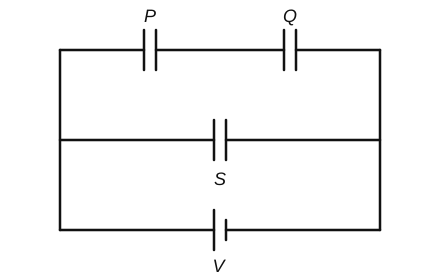
 Solution by Sreeraj P, M.Sc Physics