

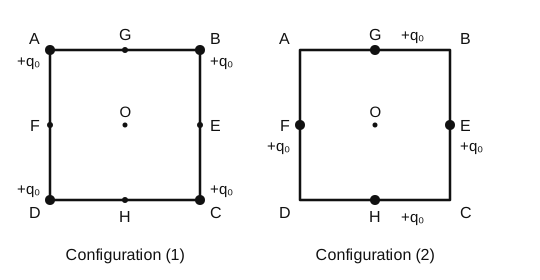
Four identical point charges $+q_0$ are placed at the corners $A$, $B$, $C$, $D$ of a square of side $a$ (configuration 1). They are then moved to the midpoints $G$, $E$, $H$, $F$ of the sides (configuration 2), as shown in the figure. The work done in changing from configuration (1) to configuration (2) is ($K = \dfrac{1}{4\pi\varepsilon_0}$)
Answer: (D) $\dfrac{Kq_0^2}{a}(3\sqrt2 - 2)$
Four equal charges at the corners of a square of side $s$ have 4 pairs at distance $s$ and 2 pairs at distance $s\sqrt2$:
$$U(s) = \frac{Kq_0^2}{s}\left(4 + \frac{2}{\sqrt2}\right) = \frac{Kq_0^2}{s}(4 + \sqrt2)$$
Configuration (1): $s = a$, $U_1 = \dfrac{Kq_0^2}{a}(4 + \sqrt2)$.
Configuration (2): the midpoints form a square of side $s = \dfrac{a}{\sqrt2}$:
$$U_2 = \frac{\sqrt2\,Kq_0^2}{a}(4 + \sqrt2) = \frac{Kq_0^2}{a}(4\sqrt2 + 2)$$
$$W = U_2 - U_1 = \frac{Kq_0^2}{a}(4\sqrt2 + 2 - 4 - \sqrt2) = \frac{Kq_0^2}{a}(3\sqrt2 - 2)$$
 Solution by Sreeraj P, M.Sc Physics