

A capacitor $C_1 = 6\ \mu\text{F}$ is charged to a potential difference of $V_0 = 5\ \text{V}$ using a $5\ \text{V}$ battery. The battery is removed and another capacitor $C_2 = 12\ \mu\text{F}$ is inserted in place of the battery. When the switch S is closed, charge flows between the capacitors for some time until equilibrium is reached. What are the charges ($q_1$ and $q_2$) on the capacitors $C_1$ and $C_2$ when equilibrium is reached?
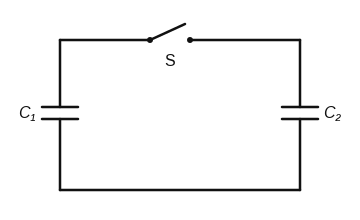
Answer: (A) $q_1 = 10\ \mu\text{C},\ q_2 = 20\ \mu\text{C}$
Concept. When the charged $C_1$ is joined to the uncharged $C_2$, charge flows until both have the same voltage; the total charge is conserved.
Step 1. Initial charge. $6\times5=30\ \mu$C.
Step 2. Common voltage. $V=\dfrac{30}{6+12}=\dfrac53$ V.
Step 3. Charges. $q_1=6\times\dfrac53=10\ \mu$C, $q_2=12\times\dfrac53=20\ \mu$C.
Answer. Option A.
 Solution by Sreeraj P, M.Sc Physics


