

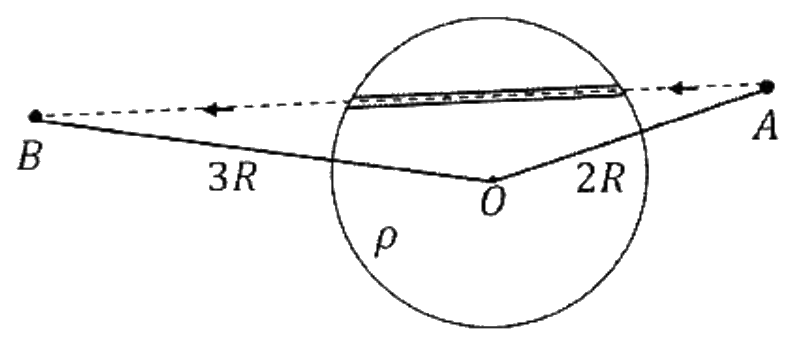
A unit positive point charge is taken slowly through an infinitesimally thin tube that is inside a charged dielectric sphere of radius $R$, having uniform positive charge density $\rho$, as shown in the figure. The initial and final positions of the charge are marked by $A$ and $B$ at distances $2R$ and $3R$ respectively, from the centre of the sphere. In this process, the magnitude of the total work done on the point charge is $\dfrac{\rho R^2}{n\epsilon_0}$. The value of $n$ is :
($\epsilon_0$ is the permittivity of vacuum)
Answer: (D) $18$
The electric field is conservative, so the work done in moving the charge slowly depends only on the end points A and B, not on the path through the sphere.
Total charge: $Q = \dfrac{4}{3}\pi R^3 \rho$. Outside the sphere,
$$V(r) = \frac{Q}{4\pi\epsilon_0 r} = \frac{\rho R^3}{3\epsilon_0 r}$$
$$V_A = V(2R) = \frac{\rho R^2}{6\epsilon_0}, \qquad V_B = V(3R) = \frac{\rho R^2}{9\epsilon_0}$$
Work done by the external agent on the unit charge:
$$|W| = |V_B - V_A| = \frac{\rho R^2}{\epsilon_0}\left(\frac{1}{6} - \frac{1}{9}\right) = \frac{\rho R^2}{18\epsilon_0}$$
So $n = 18$.
 Solution by Sreeraj P, M.Sc Physics