

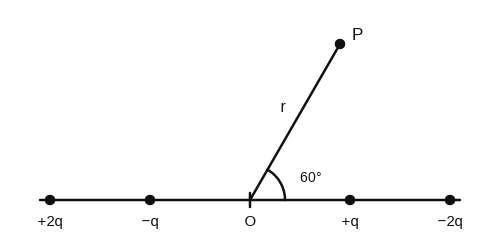
The distance between charges $+q$ and $-q$ is $2l$ and between $+2q$ and $-2q$ is $4l$, all placed on a line with common centre $O$ as shown. The electrostatic potential at point $P$ at a distance $r$ ($r \gg l$) from centre $O$ is $-\alpha\dfrac{ql}{r^2}\times10^9\ \text{V}$, where the value of $\alpha$ is ______. (Use $\dfrac1{4\pi\varepsilon_0} = 9\times10^9\ \text{N m}^2\text{C}^{-2}$)
Numerical value type. Enter your answer.
Answer: 27
Concept. Far away ($r\gg l$) each $\pm$ pair acts as a dipole; the total potential is that of the net dipole moment: $V=\dfrac{kp\cos\theta}{r^2}$.
Step 1. Inner pair. $-q$ at $-l$, $+q$ at $+l$: $p_1=2ql$ along $+x$.
Step 2. Outer pair. $+2q$ at $-2l$, $-2q$ at $+2l$: $p_2=2q\times4l=8ql$ along $-x$.
Step 3. Net. $p=6ql$ along $-x$. P is at $60^\circ$ to $+x$, i.e. $120^\circ$ to $\vec p$.
Step 4. Potential. $V=\dfrac{k(6ql)\cos120^\circ}{r^2}=-\dfrac{3kql}{r^2}=-27\dfrac{ql}{r^2}\times10^9$ V.
Answer. $\alpha=27$.
 Solution by Sreeraj P, M.Sc Physics


