

Q 12-02-011NEETNEET 2023Top questionMedium
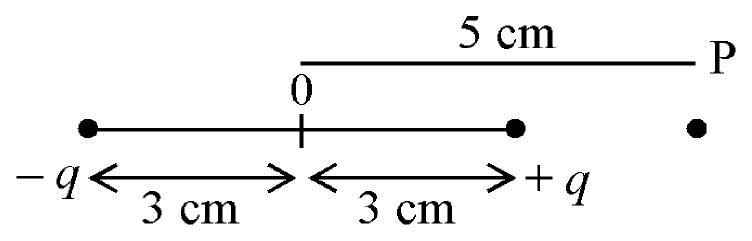
An electric dipole is placed as shown in the figure. The electric potential (in $10^2$ V) at point P due to the dipole is ($\epsilon_0$ = permittivity of free space and $\dfrac{1}{4\pi\epsilon_0} = K$):
Answer: (A) $\left(\dfrac{3}{8}\right)qK$
The charges are at $3$ cm on either side of O, and P is $5$ cm from O on the side of $+q$.
Distance of P from $+q$: $5 - 3 = 2$ cm $= 0.02$ m. From $-q$: $5 + 3 = 8$ cm $= 0.08$ m.
$$V = Kq\left(\frac{1}{0.02} - \frac{1}{0.08}\right) = Kq(50 - 12.5) = 37.5\,Kq = \frac{3}{8} \times 10^2\,Kq$$
So $V = \left(\dfrac{3}{8}\right)qK$ in units of $10^2$ V.
(The short-dipole formula does not apply here, because P is not far from the dipole compared with its length.)
 Solution by Sreeraj P, M.Sc Physics