

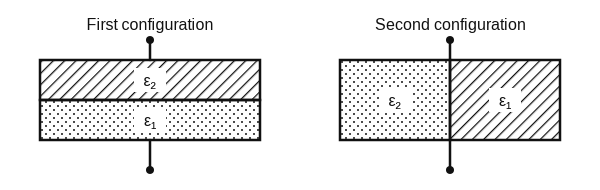
A parallel plate capacitor is filled equally (half) with two dielectrics of dielectric constant $\varepsilon_1$ and $\varepsilon_2$, as shown in the figures. The distance between the plates is $d$ and the area of each plate is $A$. In the first configuration the two dielectrics are layers, each of thickness $d/2$, filling the whole plate area; in the second each fills half the plate area across the full gap $d$. If the capacitances in the first and second configurations are $C_1$ and $C_2$ respectively, then $\dfrac{C_1}{C_2}$ is:
Answer: (B) $\dfrac{4\varepsilon_1\varepsilon_2}{(\varepsilon_1 + \varepsilon_2)^2}$
Concept. Layers (each $\frac d2$ thick, full area) are in series; side-by-side halves (each half the area, full gap) are in parallel. Let $C_0=\dfrac{\varepsilon_0A}{d}$.
Step 1. Layers. Each layer is $2\varepsilon_iC_0$: $C_1=\dfrac{2\varepsilon_1\varepsilon_2}{\varepsilon_1+\varepsilon_2}C_0$.
Step 2. Side by side. Each half is $\dfrac{\varepsilon_i}{2}C_0$: $C_2=\dfrac{\varepsilon_1+\varepsilon_2}{2}C_0$.
Step 3. Ratio. $\dfrac{C_1}{C_2}=\dfrac{4\varepsilon_1\varepsilon_2}{(\varepsilon_1+\varepsilon_2)^2}$.
Answer. Option B.
 Solution by Sreeraj P, M.Sc Physics


