

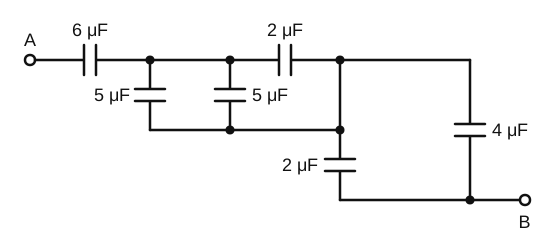
The equivalent capacitance between $A$ and $B$ in the circuit is given below.
Answer: (B) $2.4\ \mu\text{F}$
Call $P$ the node after the $6\ \mu\text{F}$ capacitor. The point after the upper $2\ \mu\text{F}$ capacitor is joined by a plain wire to the lower junction; call this node $N$.
**Between $P$ and $N$:** the two $5\ \mu\text{F}$ capacitors and the upper $2\ \mu\text{F}$ capacitor are in parallel:
$$C_{PN} = 5 + 5 + 2 = 12\ \mu\text{F}$$
**Between $N$ and $B$:** the lower $2\ \mu\text{F}$ capacitor and the $4\ \mu\text{F}$ capacitor are in parallel:
$$C_{NB} = 2 + 4 = 6\ \mu\text{F}$$
Now $6\ \mu\text{F}$, $12\ \mu\text{F}$ and $6\ \mu\text{F}$ are in series:
$$\frac{1}{C} = \frac16 + \frac1{12} + \frac16 = \frac{5}{12} \quad\Rightarrow\quad C = 2.4\ \mu\text{F}$$
 Solution by Sreeraj P, M.Sc Physics