

Three parallel plate capacitors each with area $A$ and separation $d$ are filled with two dielectric ( $k_1$ and $k_2$ ) in the following fashion. Which of the following is true?
$(k_1 > k_2)$
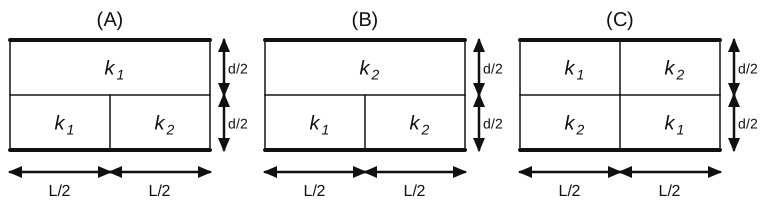
Answer: (C) $C_A > C_C > C_B$
Let $C_0 = \dfrac{\varepsilon_0A}{d}$. A layer of thickness $d/2$ over the full area with constant $k$ has capacitance $2kC_0$; a block of thickness $d/2$ over half the area has $kC_0$.
(A): top layer $2k_1C_0$ in series with the bottom layer $(k_1 + k_2)C_0$:
$$C_A = \frac{2k_1(k_1+k_2)}{3k_1 + k_2}C_0$$
(B): top layer $2k_2C_0$ in series with $(k_1+k_2)C_0$:
$$C_B = \frac{2k_2(k_1+k_2)}{k_1 + 3k_2}C_0$$
(C): each half-width column is $k_1C_0$ in series with $k_2C_0$, and the two columns are in parallel:
$$C_C = 2\cdot\frac{k_1k_2}{k_1+k_2}C_0$$
Take for example $k_1 = 2$, $k_2 = 1$: $C_A = \dfrac{12}{7}C_0 \approx 1.71C_0$, $C_B = \dfrac65C_0 = 1.2C_0$, $C_C = \dfrac43C_0\approx1.33C_0$.
(In general $C_A - C_C$ and $C_C - C_B$ are both proportional to $(k_1-k_2)^2 > 0$ with positive factors.)
$$C_A > C_C > C_B$$
 Solution by Sreeraj P, M.Sc Physics