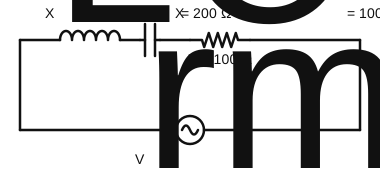
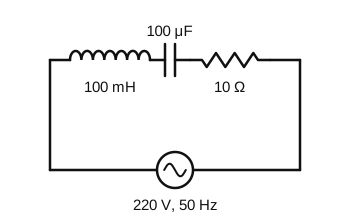
Step 2. Impedance. $X_L = X_C$ (resonance), so $Z = R = 100\ \Omega$.
Step 3. Current amplitude. $I_0 = \dfrac{220}{100} = 2.2$ A.
Answer. $2.2$ A (Option A).
Solution by Sreeraj P, M.Sc Physics
Q 12-07-002NEETNEET 2025Top questionEasy
To an ac power supply of $220$ V at $50$ Hz, a resistor of $20\ \Omega$, a capacitor of reactance $25\ \Omega$ and an inductor of reactance $45\ \Omega$ are connected in series. The corresponding current in the circuit and the phase angle between the current and the voltage is, respectively -
In an ideal transformer, the turns ratio is $\dfrac{N_p}{N_s} = \dfrac{1}{2}$. The ratio $V_s : V_p$ is equal to (the symbols carry their usual meaning) :
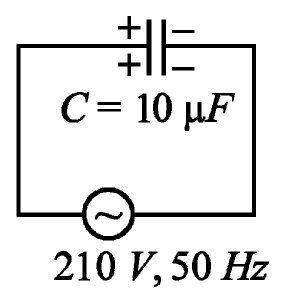
Step 2. rms current. $\dfrac{210}{318.5} \approx 0.66$ A.
Step 3. Peak current. $1.414 \times 0.66 \approx 0.93$ A.
Answer. $0.93$ A (Option D).
Solution by Sreeraj P, M.Sc Physics
Q 12-07-005NEETNEET 2023Top questionEasy
A $12$ V, $60$ W lamp is connected to the secondary of a step down transformer, whose primary is connected to ac mains of $220$ V. Assuming the transformer to be ideal, what is the current in the primary winding?
Concept. $X_C = \dfrac{1}{2\pi fC}$; the displacement current between the plates equals the conduction current $\dfrac{V}{X_C}$.
Step 1. Lower frequency. $X_C$ increases.
Step 2. Current. $I = \dfrac{V}{X_C}$ decreases, so the displacement current decreases.
Answer. Displacement current decreases (Option C).
Solution by Sreeraj P, M.Sc Physics
Q 12-07-007NEETNEET 2023Top questionMedium
In a series $LCR$ circuit, the inductance $L$ is $10$ mH, capacitance $C$ is $1\ \mu$F and resistance $R$ is $100\ \Omega$. The frequency at which resonance occurs is :
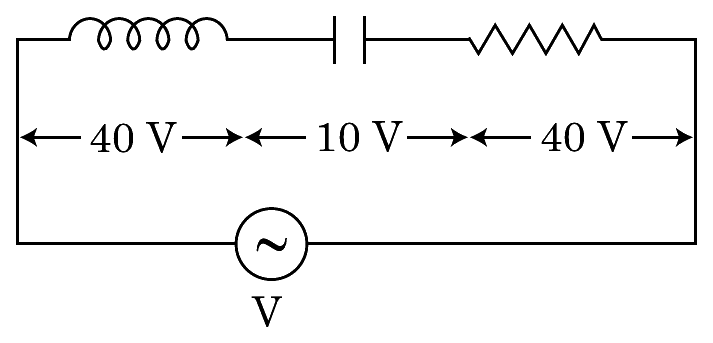
An inductor of inductance L, a capacitor of capacitance C and a resistor of resistance 'R' are connected in series to an ac source of potential difference 'V' volts as shown in figure.
Potential difference across L, C and R is $40$ V, $10$ V and $40$ V, respectively. The amplitude of current flowing through LCR series circuit is $10\sqrt{2}$ A. The impedance of the circuit is :
A step down transformer connected to an ac mains supply of $220$ V is made to operate at $11$ V, $44$ W lamp. Ignoring power losses in the transformer, what is the current in the primary circuit ?
Concept. No losses: primary power $=$ secondary power.
Step 1. Primary current. $I_p = \dfrac{44}{220} = 0.2$ A.
Answer. $0.2$ A (Option B).
Solution by Sreeraj P, M.Sc Physics
Q 12-07-011NEETNEET 2021Top questionHard
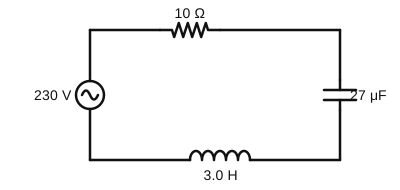
A series LCR circuit containing $5.0$ H inductor, $80\ \mu$F capacitor and $40\ \Omega$ resistor is connected to $230$ V variable frequency ac source. The angular frequencies of the source at which power transferred to the circuit is half the power at the resonant angular frequency are likely to be :
Step 2. Current. $\dfrac{200}{79.6} \approx 2.5$ A.
Answer. $2.5$ A (Option C).
Solution by Sreeraj P, M.Sc Physics
Q 12-07-013NEETNEET 2020Top questionMedium
A series LCR circuit is connected to an ac voltage source. When L is removed from the circuit, the phase difference between current and voltage is $\dfrac{\pi}{3}$. If instead C is removed from the circuit, the phase difference is again $\dfrac{\pi}{3}$ between current and voltage. The power factor of the circuit is :
Concept. Average over half a cycle $= \dfrac{1}{T/2}\displaystyle\int_0^{T/2} I\,dt$.
Step 1. Integrate. $$\bar I = \frac{\omega}{\pi}\int_0^{\pi/\omega}I_0\sin\omega t\,dt = \frac{\omega}{\pi} \cdot \frac{2I_0}{\omega} = \frac{2I_0}{\pi}$$ (Over a full cycle the average is zero.)
Answer. $\dfrac{2I_0}{\pi}$ (Option B).
Solution by Sreeraj P, M.Sc Physics
Q 12-07-016NEETJEE MainEasy
The inductive reactance of a $0.5$ H coil at $50$ Hz is
A series LCR circuit with $R = 30\ \Omega$, $X_L = 60\ \Omega$ and $X_C = 20\ \Omega$ is connected to a $100$ V (rms) ac supply. The average power consumed in the circuit is
Answer: (A) the current, and hence the $I^2R$ loss in the lines, is smaller
Concept. For a given power $P = VI$, the line loss is $I^2R$.
Step 1. Apply. A higher voltage means a smaller current, so the $I^2R$ loss falls sharply.
Answer. The current, and hence the $I^2R$ loss in the lines, is smaller (Option A).
Solution by Sreeraj P, M.Sc Physics
Q 12-07-031NEETJEE MainMedium
A $100\ \Omega$ resistor and a capacitor of reactance $100\ \Omega$ are in series across an ac supply. The phase angle between the current and the supply voltage is
A $220$ V, $100$ W lamp is to be run from a $220$ V, $50$ Hz supply through a series choke (pure inductor) so that the lamp gets only $110$ V. Treating the lamp as a pure resistor, find the inductance of the choke in henry, to two decimal places. (take $\pi = 3.14$)
Q 12-07-034JEE MainJEE Main 2026 (6 Apr, Shift 1)Easy
A LCR series circuit driven with $E_{rms} = 90$ V at frequency $f_d = 30$ Hz has resistance $R = 80\ \Omega$, an inductance with inductive reactance $X_L = 20.0\ \Omega$ and capacitance with capacitive reactance $X_C = 80.0\ \Omega$. The power factor of the circuit is ______.
Q 12-07-035JEE MainJEE Main 2026 (5 Apr, Shift 1)Hard
An a.c. source of angular frequency $\omega$ is connected across a resistor $R$ and a capacitor $C$ in series. The current is observed as $I$. Now the frequency of the source is changed to $\omega/4$, (keeping the voltage unchanged) the current is found to be $I/3$. The ratio of resistance to reactance at frequency $\omega$ is
Q 12-07-036JEE MainJEE Main 2026 (5 Apr, Shift 2)Easy
A series LCR circuit with $R = 20\ \Omega$, $L = 1.6$ H and $C = 40\,\mu$F is connected to a variable frequency a.c. source. The inductive reactance at resonant frequency is ______ $\Omega$.
Q 12-07-037JEE MainJEE Main 2026 (4 Apr, Shift 1)Easy
An inductor of $10$ mH, capacitor of $0.1\,\mu$F and a resistor of $100\ \Omega$ are connected in series across an a.c power supply $220$ V, $70$ Hz. The power factor of the given circuit is $0.5$. The difference in the inductive reactance and capacitance reactance is $\sqrt{3}\alpha\,\Omega$. The value of $\alpha$ is ______.
Concept. Power factor $\cos\phi = 0.5$ gives $\phi = 60°$, and $\tan\phi = \dfrac{|X_L - X_C|}{R}$.
Step 1. Phase. $\tan60° = \sqrt3$.
Step 2. Reactance difference. $|X_L - X_C| = \sqrt3 \times 100\ \Omega$, so $\alpha = 100$. (The given $L$, $C$ and frequency are not needed.)
Answer. $100$.
Solution by Sreeraj P, M.Sc Physics
Q 12-07-038JEE MainJEE Main 2026 (2 Apr, Shift 2)Hard
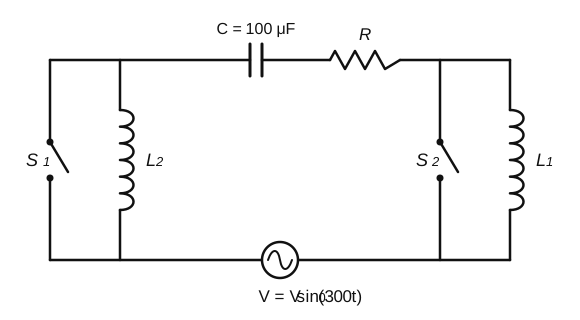
The figure given below shows an $LCR$ series circuit with two switches S$_1$ and S$_2$. When switch S$_1$ is closed keeping S$_2$ open, the phase difference ($\varphi$) between the current and source voltage is $30^\circ$ and phase difference is $60^\circ$ when S$_2$ is closed keeping S$_1$ open. The value of $(3L_1-L_2)$ is ______ H.
Q 12-07-039JEE MainJEE Main 2026 (28 Jan, Shift 2)Medium
An inductor stores 16 J of magnetic field energy and dissipates 32 W of thermal energy due to its resistance when an a.c. current of 2 A (rms) and frequency 50 Hz flows through it. The ratio of inductive reactance to its resistance is ______. ($\pi = 3.14$)
Concept. rms value $=\sqrt{\langle i^2\rangle}$ over the period.
Step 1. Mean square. $\dfrac1T\displaystyle\int_0^Ti_0^2\frac{t^2}{T^2}dt=\frac{i_0^2}{3}$.
Answer. $\dfrac{i_0}{\sqrt3}$ (Option B).
Solution by Sreeraj P, M.Sc Physics
Q 12-07-041JEE MainJEE Main 2026 (24 Jan, Shift 1)Easy
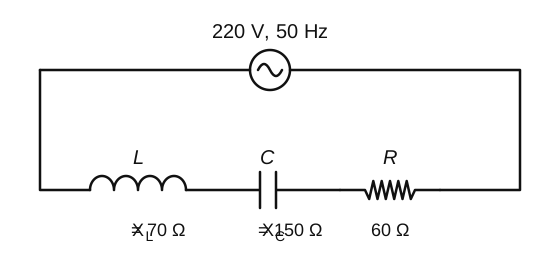
For the series LCR circuit connected with $220\ \text{V}, 50\ \text{Hz}$ a.c source as shown in the figure, the power factor is $\dfrac{\alpha}{10}$. The value of $\alpha$ is ______ .
Concept. Power factor $= \dfrac{R}{Z}$, with $Z = \sqrt{R^2 + (X_C - X_L)^2}$.
Step 1. Impedance (values from the figure). $Z = \sqrt{60^2 + 80^2} = 100\ \Omega$.
Step 2. Power factor. $\dfrac{60}{100} = \dfrac{6}{10}$, so $\alpha = 6$.
Answer. $6$ (Option C).
Solution by Sreeraj P, M.Sc Physics
Q 12-07-042JEE MainJEE Main 2025 (22 Jan, Shift 2)Easy
A series LCR circuit is connected to an alternating source of emf $E$. The current amplitude at resonant frequency is $I_0$. If the value of resistance $R$ becomes twice of its initial value, then amplitude of current at resonance will be
Concept. At resonance $Z=R$, so $I_0=\dfrac{E_0}{R}$, independent of $L$ and $C$.
Step 1. $R$ doubled. $I_0\to\dfrac{I_0}{2}$.
Answer. Option C.
Solution by Sreeraj P, M.Sc Physics
Q 12-07-043JEE MainJEE Main 2025 (23 Jan, Shift 2)Easy
In a series LCR circuit, a resistor of $300\ \Omega$, a capacitor of $25\ \text{nF}$ and an inductor of $100\ \text{mH}$ are used. For maximum current in the circuit, the angular frequency of the ac source is ______ $\times10^4$ radians $\text{s}^{-1}$.
Q 12-07-045JEE MainJEE Main 2025 (29 Jan, Shift 1)Medium
Given below are two statements: one is labelled as Assertion (A) and the other is labelled as Reason (R).
Assertion (A): A choke coil is simply a coil having a large inductance but a small resistance. Choke coils are used with fluorescent mercury-tube fittings. If household electric power is directly connected to a mercury tube, the tube will be damaged.
Reason (R): By using the choke coil, the voltage across the tube is reduced by a factor $\left(R/\sqrt{R^2 + \omega^2L^2}\right)$, where $\omega$ is the frequency of the supply across resistor $R$ and inductor $L$. If the choke coil were not used, the voltage across the resistor would be the same as the applied voltage.
In the light of the above statements, choose the most appropriate answer from the options given below:
Answer: (B) Both (A) and (R) are true and (R) is the correct explanation of (A)
Concept. A choke has large $L$ and small $R$: it drops the extra supply voltage across its reactance while wasting almost no power.
Step 1. Assertion. True.
Step 2. Reason. In series with the tube (resistance $R$) the tube's share is $\dfrac{R}{\sqrt{R^2+\omega^2L^2}}$ of the supply: true, and this is why the tube is protected.
Answer. Option B.
Solution by Sreeraj P, M.Sc Physics
Q 12-07-046JEE MainJEE Main 2024 (1 Feb, Shift 1)Easy
In a series LCR circuit, the capacitance is changed from $C$ to $4C$. To keep the resonance frequency unchanged, the new inductance should be
Concept. Same $\omega_0$ needs the same $LC$: $C\times4$ means $L\div4$.
Answer. Reduced by $\dfrac34L$ (Option C).
Solution by Sreeraj P, M.Sc Physics
Q 12-07-047JEE MainJEE Main 2024 (1 Feb, Shift 2)Easy
A transformer has an efficiency of $80\%$ and works at $10\ \text{V}$ and $4\ \text{kW}$. If the secondary voltage is $240\ \text{V}$, then the current in the secondary coil is
Concept. Current zero when the voltage is at its peak means a $90^\circ$ phase difference.
Step 1. Check. Pure inductor: $90^\circ$. Pure capacitor: $90^\circ$. Pure resistor: in phase. An LC combination (no resistance): $90^\circ$.
Answer. A, B and D only (Option D).
Solution by Sreeraj P, M.Sc Physics
Q 12-07-049JEE MainJEE Main 2024 (4 Apr, Shift 1)Medium
An alternating current at any instant is given by $i = \left[6 + \sqrt{56}\sin(100\pi t + \pi/3)\right]\ \text{A}$. The rms value of the current is ______ A.
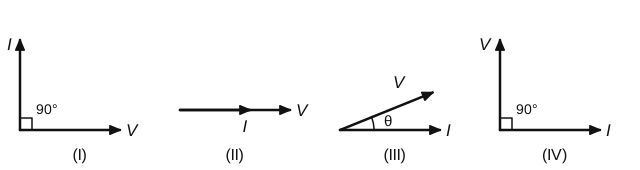
Concept. Capacitor: current leads voltage by $90^\circ$. Inductor: voltage leads current by $90^\circ$. Resonance: in phase. A general LCR circuit: voltage and current at some angle $\theta$.
Step 1. Match. A (capacitive) – I; B (inductive) – IV; C (resonance) – II; D (LCR) – III.
Answer. Option A.
Solution by Sreeraj P, M.Sc Physics
Q 12-07-051JEE MainJEE Main 2024 (5 Apr, Shift 1)Medium
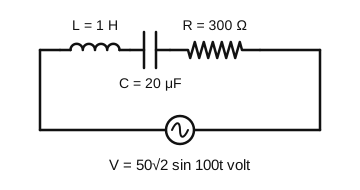
An ac source is connected in the given series LCR circuit. The rms potential difference across the capacitor of $20\ \mu\text{F}$ is ______ V.
Step 3. Voltage. $I_{rms}=\dfrac{50}{500}=0.1$ A; $V_C=0.1\times500=50$ V.
Answer. $50$.
Solution by Sreeraj P, M.Sc Physics
Q 12-07-052JEE MainJEE Main 2024 (5 Apr, Shift 2)Easy
A series LCR circuit is subjected to an ac signal of $200\ \text{V}$, $50\ \text{Hz}$. If the voltage across the inductor ($L = 10\ \text{mH}$) is $31.4\ \text{V}$, then the current in this circuit is
Answer: (C) Both Statement I and Statement II are true
Concept. $I=\dfrac VZ$ with $Z=\sqrt{R^2+(X_L-X_C)^2}\ge R$.
Step 1. Statement I. At resonance $Z=R$ is least, so $I$ is largest: true.
Step 2. Statement II. The same $R$ alone has $Z=R$, never more than the LCR value: its current is never less. True.
Answer. Option C.
Solution by Sreeraj P, M.Sc Physics
Q 12-07-054JEE MainJEE Main 2024 (6 Apr, Shift 1)Medium
When a dc voltage of $100\ \text{V}$ is applied to an inductor, a dc current of $5\ \text{A}$ flows through it. When an ac voltage of $200\ \text{V}$ peak value is connected to the inductor, its inductive reactance is found to be $20\sqrt3\ \Omega$. The power dissipated in the circuit is ______ W.
Concept. DC gives $R$; then $P=I_{\text{rms}}^2R$.
Step 1. Values. $R=20\ \Omega$; $Z=\sqrt{400+1200}=40\ \Omega$; $I_{\text{rms}}=\dfrac{200/\sqrt2}{40}=\dfrac{5}{\sqrt2}$ A.
Step 2. Power. $12.5\times20=250$ W.
Answer. $250$.
Solution by Sreeraj P, M.Sc Physics
Q 12-07-055JEE MainJEE Main 2024 (27 Jan, Shift 2)Easy
The primary side of a transformer is connected to a $230\ \text{V}$, $50\ \text{Hz}$ supply. The turns ratio of primary to secondary winding is $10:1$. Load resistance connected to the secondary side is $46\ \Omega$. The power consumed in it is:
Concept. $\dfrac{V_s}{V_p}=\dfrac{N_s}{N_p}$; load power $\dfrac{V_s^2}{R}$.
Step 1. Secondary. $23$ V.
Step 2. Power. $\dfrac{529}{46}=11.5$ W.
Answer. Option C.
Solution by Sreeraj P, M.Sc Physics
Q 12-07-056JEE MainJEE Main 2024 (27 Jan, Shift 2)Easy
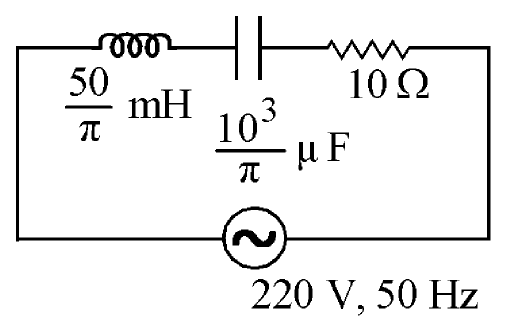
A series LCR circuit with $L = \dfrac{100}{\pi}\ \text{mH}$, $C = \dfrac{10^{-3}}{\pi}\ \text{F}$ and $R = 10\ \Omega$ is connected across an AC source of $220\ \text{V}$, $50\ \text{Hz}$ supply. The power factor of the circuit would be ______.
Step 2. Power factor. Equal reactances (resonance): $Z=R$, $\cos\phi=1$.
Answer. $1$.
Solution by Sreeraj P, M.Sc Physics
Q 12-07-057JEE MainJEE Main 2024 (29 Jan, Shift 1)Easy
A capacitor of capacitance $100\ \mu\text{F}$ is charged to a potential of $12\ \text{V}$ and connected to a $6.4\ \text{mH}$ inductor to produce oscillations. The maximum current in the circuit would be:
Concept. Energy swaps between $C$ and $L$: $\tfrac12CV^2=\tfrac12LI_{\max}^2$.
Step 1. Solve. $I_{\max}=12\sqrt{\dfrac{10^{-4}}{6.4\times10^{-3}}}=12\times0.125=1.5$ A.
Answer. Option B.
Solution by Sreeraj P, M.Sc Physics
Q 12-07-058JEE MainJEE Main 2024 (29 Jan, Shift 2)Easy
In an a.c. circuit, voltage and current are given by $V = 100\sin(100t)\ \text{V}$ and $I = 100\sin\left(100t + \dfrac\pi3\right)\ \text{mA}$ respectively. The average power dissipated in one cycle is:
Q 12-07-059JEE MainJEE Main 2024 (8 Apr, Shift 1)Easy
An LCR circuit is at resonance for a capacitor $C$, inductance $L$ and resistance $R$. Now the value of resistance is halved keeping all other parameters same. The current amplitude at resonance will be now:
Concept. At resonance $Z = R$, so $I_0 = \dfrac{V_0}{R}$; the resonant frequency is independent of $R$.
Step 1. Halve $R$. The current amplitude doubles.
Answer. Double (Option D).
Solution by Sreeraj P, M.Sc Physics
Q 12-07-060JEE MainJEE Main 2024 (8 Apr, Shift 2)Medium
A coil of negligible resistance is connected in series with a $90\ \Omega$ resistor across a $120\ \text{V}$, $60\ \text{Hz}$ supply. A voltmeter reads $36\ \text{V}$ across the resistance. Inductance of the coil is:
Q 12-07-062JEE MainJEE Main 2024 (9 Apr, Shift 1)Easy
A bulb and a capacitor are connected in series across an ac supply. A dielectric is then placed between the plates of the capacitor. The glow of the bulb:
Concept. A dielectric raises $C$, so $X_C=\dfrac{1}{\omega C}$ falls, the current rises and the bulb glows brighter.
Answer. Option A.
Solution by Sreeraj P, M.Sc Physics
Q 12-07-063JEE MainJEE Main 2024 (9 Apr, Shift 1)Easy
When a coil is connected across a $20\ \text{V}$ dc supply, it draws a current of $5\ \text{A}$. When it is connected across a $20\ \text{V}$, $50\ \text{Hz}$ ac supply, it draws a current of $4\ \text{A}$. The self inductance of the coil is ______ mH. (Take $\pi = 3$)
Q 12-07-064JEE MainJEE Main 2024 (9 Apr, Shift 2)Easy
A capacitor of reactance $4\sqrt3\ \Omega$ and a resistor of resistance $4\ \Omega$ are connected in series with an ac source of peak value $8\sqrt2\ \text{V}$. The power dissipation in the circuit is ______ W.
Concept. Only the resistor uses power: $P=I_{\text{rms}}^2R$.
Step 1. Current. $Z=\sqrt{16+48}=8\ \Omega$; $I_{\text{rms}}=\dfrac{8}{8}=1$ A.
Step 2. Power. $1\times4=4$ W.
Answer. $4$.
Solution by Sreeraj P, M.Sc Physics
Q 12-07-065JEE MainJEE Main 2024 (30 Jan, Shift 1)Medium
A series $LR$ circuit connected with an ac source $E = (25\sin1000t)\ \text{V}$ has a power factor of $\dfrac1{\sqrt2}$. If the source of emf is changed to $E = (20\sin2000t)\ \text{V}$, the new power factor of the circuit will be:
Concept. $X_L\propto\omega$. Power factor $\dfrac{1}{\sqrt2}$ means $X_L=R$ at $1000$ rad/s.
Step 1. New reactance. $2R$ at $2000$ rad/s.
Step 2. Power factor. $\dfrac{R}{\sqrt{R^2+4R^2}}=\dfrac{1}{\sqrt5}$.
Answer. Option C.
Solution by Sreeraj P, M.Sc Physics
Q 12-07-066JEE MainJEE Main 2024 (30 Jan, Shift 1)Medium
The primary coil of a transformer is connected to $220\ \text{V}$ AC. The primary and secondary turns of the transformer are 100 and 10 respectively. The secondary coil is connected to two resistances, $15\ \text{k}\Omega$ and $7\ \text{k}\Omega$, in series. The output voltage $V_0$ is measured across the $7\ \text{k}\Omega$ resistance. $V_0$ is:
Concept. Turns ratio gives $V_s$; then a voltage divider.
Step 1. Secondary. $22$ V.
Step 2. Across $7$ kΩ. $22\times\dfrac{7}{22}=7$ V.
Answer. Option A.
Solution by Sreeraj P, M.Sc Physics
Q 12-07-067JEE MainJEE Main 2024 (30 Jan, Shift 2)Medium
An alternating voltage $V(t) = 220\sin100\pi t$ volt is applied to a purely resistive load of $50\ \Omega$. The time taken for the current to rise from half of the peak value to the peak value is:
Concept. Convert values to phases: half peak at phase $\dfrac\pi6$, peak at $\dfrac\pi2$.
Step 1. Phase change. $\dfrac\pi3$.
Step 2. Time. $\dfrac{\pi/3}{100\pi}=3.3$ ms.
Answer. Option B.
Solution by Sreeraj P, M.Sc Physics
Q 12-07-068JEE MainJEE Main 2024 (30 Jan, Shift 2)Medium
A power transmission line feeds input power at $2.3\ \text{kV}$ to a step-down transformer with its primary winding having $3000$ turns. The output power is delivered at $230\ \text{V}$ by the transformer. The current in the primary of the transformer is $5\ \text{A}$ and its efficiency is $90\%$. The winding of the transformer is made of copper. The output current of the transformer is ______ A.
Step 1. Apply. $\dfrac{0.9\times2300\times5}{230}=45$ A.
Answer. $45$.
Solution by Sreeraj P, M.Sc Physics
Q 12-07-069JEE MainJEE Main 2024 (31 Jan, Shift 2)Easy
An AC voltage $V = 20\sin200\pi t$ is applied to a series LCR circuit which drives a current $I = 10\sin\left(200\pi t + \dfrac\pi3\right)$. The average power dissipated is:
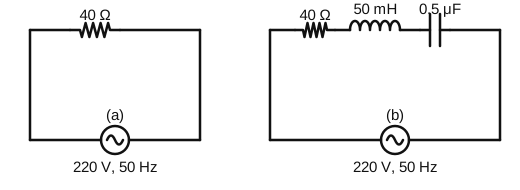
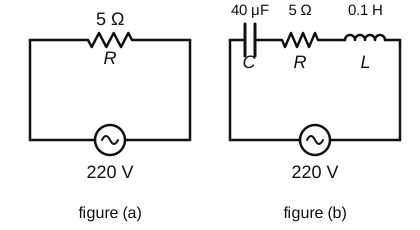
Answer: (A) The rms current in circuit (b) can never be larger than that in (a)
Concept. Circuit (b) has $Z=\sqrt{R^2+(X_L-X_C)^2}\ge R$, with equality only at resonance.
Step 1. Compare. $I_b\le I_a$ always: the rms current in (b) can never be larger than in (a) (they are equal only at resonance).
Answer. Option A.
Solution by Sreeraj P, M.Sc Physics
Q 12-07-071JEE MainJEE Main 2023 (29 Jan, Shift 2)Medium
An inductor of inductance $2\ \mu\text{H}$ is connected in series with a resistance, a variable capacitor and an AC source of frequency $7\ \text{kHz}$. The value of capacitance for which maximum current is drawn into the circuit is $\dfrac1x\ \text{F}$, where the value of $x$ is ______. (Take $\pi=\frac{22}{7}$)
Q 12-07-072JEE MainJEE Main 2023 (30 Jan, Shift 1)Easy
In a series LR circuit with $X_L=R$, power factor is $P_1$. If a capacitor of capacitance $C$ with $X_C=X_L$ is added to the circuit the power factor becomes $P_2$. The ratio of $P_1$ to $P_2$ will be
Step 1. Impedance (values from the figure). $Z = \sqrt{100^2 + 100^2} = 100\sqrt2\ \Omega$.
Step 2. Current. $\dfrac{200\sqrt2}{100\sqrt2} = 2$ A.
Answer. $2$ A (Option A).
Solution by Sreeraj P, M.Sc Physics
Q 12-07-074JEE MainJEE Main 2023 (31 Jan, Shift 1)Medium
An inductor of $0.5\ \text{mH}$, a capacitor of $20\ \mu\text{F}$ and resistance of $20\ \Omega$ are connected in series with a $220\ \text{V}$ ac source. If the current is in phase with the emf, the amplitude of current of the circuit is $\sqrt x$ A. The value of $x$ is ______.
Q 12-07-076JEE MainJEE Main 2023 (31 Jan, Shift 2)Easy
A series LCR circuit consists of $R=80\ \Omega$, $X_L=100\ \Omega$ and $X_C=40\ \Omega$. The input voltage is $2500\cos(100\pi t)$ V. The amplitude of current in the circuit is ______ A.
Q 12-07-078JEE MainJEE Main 2023 (25 Jan, Shift 1)Easy
In an LC oscillator, if values of inductance and capacitance become twice and eight times, respectively, then the resonant frequency of oscillator becomes $x$ times its initial resonant frequency $\omega_0$. The value of $x$ is
Q 12-07-079JEE MainJEE Main 2023 (25 Jan, Shift 1)Easy
An LCR series circuit of capacitance $62.5\ \text{nF}$ and resistance of $50\ \Omega$ is connected to an A.C. source of frequency $2.0\ \text{kHz}$. For maximum value of amplitude of current in circuit, the value of inductance is ______ mH. (Take $\pi^2=10$)
Step 2. $L$. $\dfrac{1}{1.6\times10^8\times62.5\times10^{-9}}=0.1$ H.
Answer. $100$ mH.
Solution by Sreeraj P, M.Sc Physics
Q 12-07-080JEE MainJEE Main 2023 (25 Jan, Shift 2)Easy
A series LCR circuit is connected to an AC source of $220\ \text{V}$, $50\ \text{Hz}$. The circuit contains a resistance $R=80\ \Omega$, an inductor of inductive reactance $X_L=70\ \Omega$, and a capacitor of capacitive reactance $X_C=130\ \Omega$. The power factor of circuit is $\dfrac x{10}$. The value of $x$ is ______.
Answer: (C) Both Statement I and Statement II are false
Concept. Resonance needs both $L$ and $C$; a pure $L$ or $C$ has $\cos\phi=0$ and takes no average power.
Step 1. Statement I. One element alone cannot resonate: false.
Step 2. Statement II. Pure $L$ or $C$: power factor zero, no power: false.
Answer. Option C.
Solution by Sreeraj P, M.Sc Physics
Q 12-07-082JEE MainJEE Main 2023 (11 Apr, Shift 1)Easy
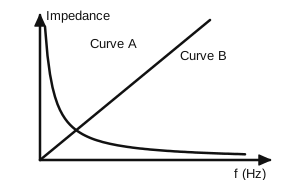
As per the given graph, choose the correct representation for curve $A$ and curve $B$.
{Where $X_C$ = reactance of pure capacitive circuit connected with A.C. source; $X_L$ = reactance of pure inductive circuit connected with A.C. source; $R$ = impedance of pure resistive circuit connected with A.C. source; $Z$ = impedance of the LCR series circuit}
Concept. $X_C=\dfrac{1}{2\pi fC}$ falls as $\dfrac1f$; $X_L=2\pi fL$ rises in a straight line through the origin.
Step 1. Match. Curve A (falling) is $X_C$; curve B (straight line) is $X_L$.
Answer. Option D.
Solution by Sreeraj P, M.Sc Physics
Q 12-07-083JEE MainJEE Main 2023 (12 Apr, Shift 1)Easy
Given below are two statements:
Statement I: When the frequency of an AC source in a series LCR circuit increases, the current in the circuit first increases, attains a maximum value and then decreases.
Statement II: In a series LCR circuit, the value of power factor at resonance is one.
In the light of given statements, choose the most appropriate answer from the options given below.
Step 1. Statement I. As $\omega$ rises, $|X_L-X_C|$ falls to zero at $\omega_0$ and then rises: the current rises to a maximum and falls. True.
Step 2. Statement II. At resonance $Z=R$: $\cos\phi=1$. True.
Answer. Option C.
Solution by Sreeraj P, M.Sc Physics
Q 12-07-084JEE MainJEE Main 2023 (6 Apr, Shift 1)Easy
An ideal transformer with purely resistive load operates at $12\ \text{kV}$ on the primary side. It supplies electrical energy to a number of nearby houses at $120\ \text{V}$. The average rate of energy consumption in the houses served by the transformer is $60\ \text{kW}$. The value of resistive load ($R_s$) required in the secondary circuit will be ______ $\text{m}\Omega$.
Q 12-07-085JEE MainJEE Main 2023 (6 Apr, Shift 2)Easy
A capacitor of capacitance $150.0\ \mu\text{F}$ is connected to an alternating source of emf given by $E=36\sin(120\pi t)$ V. The maximum value of current in the circuit is approximately equal to
Step 1. Apply. $36\times120\pi\times150\times10^{-6}=2.04$ A.
Answer. About $2$ A (Option A).
Solution by Sreeraj P, M.Sc Physics
Q 12-07-086JEE MainJEE Main 2023 (8 Apr, Shift 1)Easy
An oscillating LC circuit consists of a $75$ mH inductor and a $1.2\ \mu\text{F}$ capacitor. If the maximum charge to the capacitor is $2.7\ \mu\text{C}$, the maximum current in the circuit will be ______ mA.
Step 1. Apply. $\dfrac{2.7\times10^{-6}}{\sqrt{9\times10^{-8}}}=9\times10^{-3}$ A.
Answer. $9$ mA.
Solution by Sreeraj P, M.Sc Physics
Q 12-07-087JEE MainJEE Main 2023 (8 Apr, Shift 2)Easy
A series combination of resistor of resistance $100\ \Omega$, inductor of inductance $1$ H and capacitor of capacitance $6.25\ \mu\text{F}$ is connected to an ac source. The quality factor of the circuit will be ______.
Q 12-07-088JEE MainJEE Main 2023 (10 Apr, Shift 1)Easy
Given below are two statements:
Statement I: Maximum power is dissipated in a circuit containing an inductor, a capacitor and a resistor connected in series with an AC source, when resonance occurs.
Statement II: Maximum power is dissipated in a circuit containing pure resistor due to zero phase difference between current and voltage.
In the light of the above statements, choose the correct answer from the options given below.
Concept. Match each device or idea with its principle.
Step 1. AC generator – electromagnetic induction (II); transformer – mutual inductance (IV); resonance – needs both $L$ and $C$ (I); sharpness of resonance – quality factor (III).
Answer. Option C.
Solution by Sreeraj P, M.Sc Physics
Q 12-07-090JEE MainJEE Main 2023 (1 Feb, Shift 1)Easy
A series LCR circuit is connected to an ac source of $220$ V, $50$ Hz. The circuit contains a resistance $R=100\ \Omega$ and an inductor of inductive reactance $X_L=79.6\ \Omega$. The capacitance of the capacitor needed to maximize the average rate at which energy is supplied will be ______ $\mu$F.
Q 12-07-091JEE MainJEE Main 2022 (24 Jun, Shift 1)Medium
A resistance of $40\ \Omega$ is connected to a source of alternating current rated $220\ \text{V}, 50\ \text{Hz}$. Find the time taken by the current to change from its maximum value to the rms value:
Q 12-07-092JEE MainJEE Main 2022 (24 Jun, Shift 1)Medium
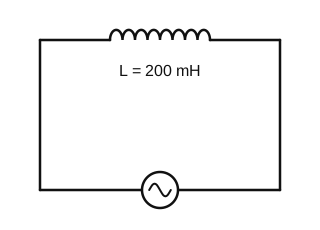
As shown in the figure, an inductor of inductance $200\ \text{mH}$ is connected to an AC source of emf $220\ \text{V}$ and frequency $50\ \text{Hz}$. The instantaneous voltage of the source is $0\ \text{V}$ when the peak value of current is $\dfrac{\sqrt a}{\pi}\ \text{A}$. The value of $a$ is ______.
Concept. In a pure inductor the current lags the voltage by $90^\circ$, so the current is at its peak when the source voltage is zero. Peak current $=\sqrt2\,\dfrac{V_{rms}}{X_L}$.
Answer: (C) Statement I is true but Statement II is false.
Concept. Net reactance $X_L - X_C$ can be zero; average power $V_{\text{rms}}I_{\text{rms}}\cos\phi$ can be zero.
Step 1. Statement I. In an LC (or LCR) circuit at resonance $X_L = X_C$ → true.
Step 2. Statement II. A pure $L$ or $C$ has $\cos\phi = 0$ and zero average power → false.
Answer. Statement I is true but Statement II is false (Option C).
Solution by Sreeraj P, M.Sc Physics
Q 12-07-094JEE MainJEE Main 2022 (25 Jun, Shift 1)Easy
Match List I with List II.
$$\begin{array}{|l|l|l|l|}\hline & \text{List I} & & \text{List II} \\ \hline \text{A.} & \text{AC generator} & \text{I.} & \text{Detects the presence of current in the circuit} \\ \hline \text{B.} & \text{Galvanometer} & \text{II.} & \text{Converts mechanical energy into electrical energy} \\ \hline \text{C.} & \text{Transformer} & \text{III.} & \text{Works on the principle of resonance in AC circuit} \\ \hline \text{D.} & \text{Metal detector} & \text{IV.} & \text{Changes an alternating voltage for smaller or greater value} \\ \hline \end{array}$$
Choose the correct answer from the options given below:
Step 1. AC generator converts mechanical energy into electrical (II); galvanometer detects current (I); transformer changes an alternating voltage (IV); metal detector works on resonance in an AC circuit (III).
Answer. Option A.
Solution by Sreeraj P, M.Sc Physics
Q 12-07-095JEE MainJEE Main 2022 (25 Jun, Shift 1)Easy
If wattless current flows in the AC circuit, then the circuit is:
Concept. A wattless current is one that does no work on average: $\cos\phi=0$, i.e. a $90^\circ$ phase difference.
Step 1. Pick. A purely inductive circuit.
Answer. Option B.
Solution by Sreeraj P, M.Sc Physics
Q 12-07-096JEE MainJEE Main 2022 (25 Jun, Shift 2)Medium
A sinusoidal voltage $V(t) = 210\sin3000t$ volt is applied to a series LCR circuit in which $L = 10\ \text{mH}$, $C = 25\ \mu\text{F}$ and $R = 100\ \Omega$. The phase difference $\Phi$ between the applied voltage and the resultant current will be
Q 12-07-097JEE MainJEE Main 2022 (25 Jun, Shift 2)Medium
In a series LCR circuit, the inductance, capacitance and resistance are $L = 100\ \text{mH}$, $C = 100\ \mu\text{F}$ and $R = 10\ \Omega$ respectively. They are connected to an AC source of voltage $220\ \text{V}$ and frequency of $50\ \text{Hz}$. The approximate value of current in the circuit will be ______ A.
Q 12-07-098JEE MainJEE Main 2022 (26 Jun, Shift 1)Easy
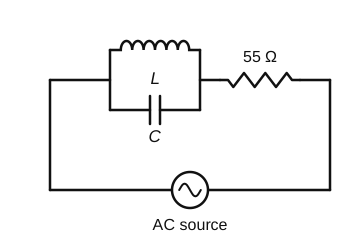
A $110\ \text{V}$, $50\ \text{Hz}$ AC source is connected in the circuit (as shown in figure). The current through the resistance $55\ \Omega$, at resonance in the circuit, will be ______ A.
Concept. At resonance an ideal parallel LC combination has infinite impedance: the currents in L and C are equal and opposite, so no current flows through the rest of the circuit.
Step 1. Current in the resistor. $0$.
Answer. $0$.
Solution by Sreeraj P, M.Sc Physics
Q 12-07-099JEE MainJEE Main 2022 (25 Jul, Shift 1)Easy
To increase the resonant frequency in a series LCR circuit,
Answer: (C) Another capacitor should be added in series with the first capacitor
Concept. $\omega_0=\dfrac{1}{\sqrt{LC}}$ depends only on $L$ and $C$. Capacitors in series give a smaller total capacitance.
Step 1. Pick. Adding a capacitor in series lowers $C$ and raises $\omega_0$. The source frequency and $R$ do not change $\omega_0$.
Answer. Option C.
Solution by Sreeraj P, M.Sc Physics
Q 12-07-100JEE MainJEE Main 2022 (25 Jul, Shift 1)Easy
The RMS value of conduction current in a parallel plate capacitor is $6.9\ \mu\text{A}$. The capacitance of this capacitor, if it is connected to a $230\ \text{V}$ AC supply with an angular frequency of $600\ \text{rad s}^{-1}$, will be
Concept. A metal detector uses a coil in a tuned AC circuit.
Step 1. Working. A metal object changes the circuit's impedance and pulls it off resonance; the resulting change in current sets off the alarm.
Answer. Resonance in ac circuits (Option B).
Solution by Sreeraj P, M.Sc Physics
Q 12-07-102JEE MainJEE Main 2022 (26 Jul, Shift 1)Easy
In a series LR circuit $X_L = R$ and the power factor of the circuit is $P_1$. When a capacitor with capacitance $C$ such that $X_L = X_C$ is put in series, the power factor becomes $P_2$. The ratio $\dfrac{P_1}{P_2}$ is
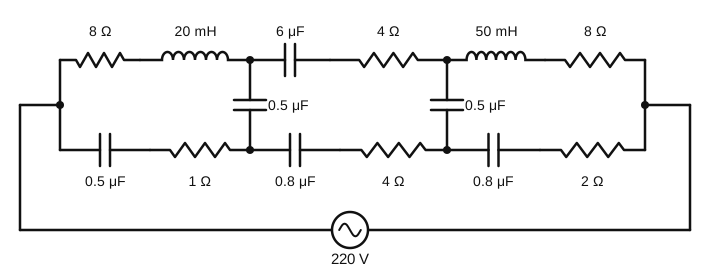
Concept. At very high frequency inductors act as open circuits ($X_L \to \infty$) and capacitors as short circuits ($X_C \to 0$).
Step 1. Remaining circuit. The top branches with $20$ mH and $50$ mH carry no current; the vertical capacitors join the top and bottom junctions. The path is $1\ \Omega$, then $4\ \Omega \parallel 4\ \Omega = 2\ \Omega$, then $2\ \Omega$.
Step 2. Resistance. $1 + 2 + 2 = 5\ \Omega$.
Step 3. Current. $\dfrac{220}{5} = 44$ A.
Answer. $44$.
Solution by Sreeraj P, M.Sc Physics
Q 12-07-104JEE MainJEE Main 2022 (27 Jun, Shift 1)Easy
The current flowing through an ac circuit is given by $I = 5\sin(120\pi t)$ A. How long will the current take to reach the peak value starting from zero?
Concept. From zero to the peak the phase goes from $0$ to $\dfrac\pi2$: a quarter period.
Step 1. Period. $\omega=120\pi$, so $T=\dfrac{2\pi}{120\pi}=\dfrac1{60}$ s.
Step 2. Time. $\dfrac T4=\dfrac{1}{240}$ s.
Answer. Option D.
Solution by Sreeraj P, M.Sc Physics
Q 12-07-105JEE MainJEE Main 2022 (27 Jun, Shift 1)Medium
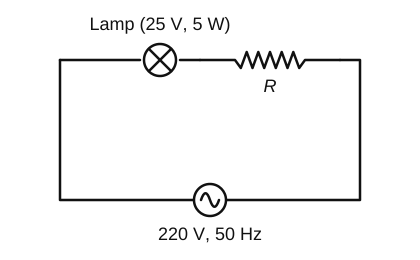
A $220$ V, $50$ Hz AC source is connected to a $25$ V, $5$ W lamp and an additional resistance $R$ in series (as shown in figure) to run the lamp at its peak brightness, then the value of $R$ (in ohm) will be
Concept. A lamp's ratings are rms values. Run at its rating it carries $I=\dfrac PV$ and has $R_{lamp}=\dfrac{V^2}{P}$; the series resistor takes the rest of the supply.
Step 1. Lamp. $I=\dfrac{5}{25}=0.2$ A, $R_{lamp}=\dfrac{625}{5}=125\ \Omega$.
Step 2. Total. $\dfrac{220}{0.2}=1100\ \Omega$, so $R=1100-125=975\ \Omega$.
Answer. $975$.
Solution by Sreeraj P, M.Sc Physics
Q 12-07-106JEE MainJEE Main 2022 (27 Jul, Shift 1)Easy
A direct current of $4$ A and an alternating current of peak value $4$ A flow through resistance of $3\ \Omega$ and $2\ \Omega$ respectively. The ratio of heat produced in the two resistances in same interval of time will be :
Concept. Heat $=I_{\text{rms}}^2Rt$; for AC $I_{\text{rms}}^2=\dfrac{I_0^2}{2}$.
Step 1. Ratio. $\dfrac{16\times3}{8\times2}=3$.
Answer. $3:1$ (Option B).
Solution by Sreeraj P, M.Sc Physics
Q 12-07-107JEE MainJEE Main 2022 (27 Jul, Shift 1)Medium
To light, a $50$ W, $100$ V lamp is connected, in series with a capacitor of capacitance $\dfrac{50}{\pi\sqrt x}\ \mu$F, with $200$ V, $50$ Hz AC source. The value of $x$ will be ______ .
Q 12-07-108JEE MainJEE Main 2022 (27 Jul, Shift 2)Medium
A series LCR circuit has $L = 0.01$ H, $R = 10\ \Omega$ and $C = 1\ \mu$F and it is connected to ac voltage of amplitude $(V_m)$ $50$ V. At frequency $60\%$ lower than resonant frequency, the amplitude of current will be approximately
Q 12-07-109JEE MainJEE Main 2022 (28 Jul, Shift 1)Medium
The equation of current in a purely inductive circuit is $5\sin(49\pi t - 30^\circ)$. If the inductance is $30$ mH then the equation for the voltage across the inductor, will be
Concept. In a pure inductor the voltage leads the current by $90^\circ$; $V_0=I_0\omega L$.
Step 1. Amplitude. $5\times49\pi\times0.03=23.1$ V.
Step 2. Phase. $-30^\circ+90^\circ=60^\circ$.
Answer. Option D.
Solution by Sreeraj P, M.Sc Physics
Q 12-07-110JEE MainJEE Main 2022 (28 Jul, Shift 1)Medium
The frequencies at which the current amplitude in an LCR series circuit becomes $\dfrac{1}{\sqrt2}$ times its maximum value, are $212\ \text{rad s}^{-1}$ and $232\ \text{rad s}^{-1}$. The value of resistance in the circuit is $R = 5\ \Omega$. The self inductance in the circuit is ______ mH.
Concept. Half-power points are separated by the bandwidth $\Delta\omega=\dfrac RL$.
Step 1. Solve. $20=\dfrac5L\Rightarrow L=0.25$ H.
Answer. $250$ mH.
Solution by Sreeraj P, M.Sc Physics
Q 12-07-111JEE MainJEE Main 2021 (27 Jul, Shift 1)Easy
A $0.07$ H inductor and a $12\ \Omega$ resistor are connected in series to a $220$ V, $50$ Hz AC source. The approximate current in the circuit and the phase angle between current and source voltage are respectively. [Take $\pi$ as $\dfrac{22}{7}$]
Q 12-07-112JEE MainJEE Main 2021 (27 Jul, Shift 2)Easy
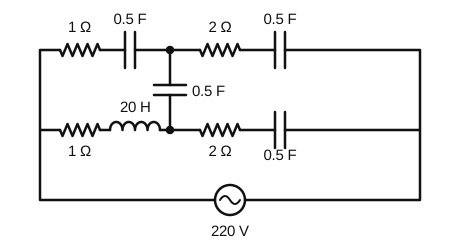
A $100\ \Omega$ resistance, a $0.1\ \mu\text{F}$ capacitor and an inductor are connected in series across a $250$ V supply at variable frequency. Calculate the value of inductance of inductor at which resonance will occur. Given that the resonant frequency is $60$ Hz.
Concept. At very high frequency a capacitor behaves as a wire ($X_C\to0$) and an inductor as a break ($X_L\to\infty$). Then reduce the resistor network.
Step 1. Redraw. The upper branch becomes $1\ \Omega$ to a node X, then $2\ \Omega$ to the right end. The 20 H inductor cuts off the lower 1 Ω. The joining capacitor connects X to the lower 2 Ω, which also goes to the right end.
Step 2. Reduce. From X the two $2\ \Omega$ resistors are in parallel: $1\ \Omega$; plus the first $1\ \Omega$: $2\ \Omega$.
Answer. $2$.
Solution by Sreeraj P, M.Sc Physics
Q 12-07-115JEE MainJEE Main 2021 (24 Feb, Shift 1)Easy
A common transistor radio set requires 12 V (D.C.) for its operation. The D.C. source is constructed by using a transformer and a rectifier circuit, which are operated at 220 V (A.C.) on standard domestic A.C. supply. The number of turns of secondary coil are 24, then the number of turns of primary are ______.
Q 12-07-116JEE MainJEE Main 2021 (24 Feb, Shift 1)Easy
A resonance circuit having inductance and resistance $2\times10^{-4}$ H and $6.28\ \Omega$ respectively oscillates at 10 MHz frequency. The value of quality factor of this resonator is ______. ($\pi = 3.14$)
Q 12-07-117JEE MainJEE Main 2021 (24 Feb, Shift 2)Easy
A series LCR circuit is designed to resonate at an angular frequency $\omega_0 = 10^5\ \text{rad s}^{-1}$. The circuit draws 16 W power from 120 V source at resonance. The value of resistance $R$ in the circuit is ______ $\Omega$.
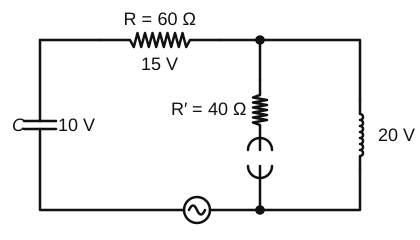
Q 12-07-118JEE MainJEE Main 2021 (25 Feb, Shift 1)Medium
The angular frequency of alternating current in a L-C-R circuit is $100\ \text{rad s}^{-1}$. The components connected are shown in the figure. Find the value of inductance of the coil and capacity of condenser.
Concept. With the key open no current flows in $R'$. The resistor's voltage gives the current; then each reactance is its voltage divided by that current.
Step 3. Coil. $X_L=\dfrac{20}{0.25}=80\ \Omega=100L\Rightarrow L=0.8$ H.
Answer. Option D.
Solution by Sreeraj P, M.Sc Physics
Q 12-07-119JEE MainJEE Main 2021 (18 Mar, Shift 2)Easy
In a series LCR circuit, the inductive reactance $(X_L)$ is $10\ \Omega$ and the capacitive reactance $(X_C)$ is $4\ \Omega$. The resistance $(R)$ in the circuit is $6\ \Omega$. The power factor of the circuit is:
Step 2. Power factor. $\dfrac{6}{6\sqrt2} = \dfrac{1}{\sqrt2}$.
Answer. $\dfrac{1}{\sqrt2}$ (Option C).
Solution by Sreeraj P, M.Sc Physics
Q 12-07-120JEE MainJEE Main 2021 (20 Jul, Shift 1)Easy
In an $LCR$ series circuit, an inductor 30 mH and a resistor $1\ \Omega$ are connected to an AC source of angular frequency $300\ \text{rad s}^{-1}$. The value of capacitance for which the current leads the voltage by $45^\circ$ is $\dfrac1x\times10^{-3}$ F. Then the value of $x$ is ______.
Step 2. Capacitance. $C=\dfrac{1}{300\times10}=\dfrac13\times10^{-3}$ F.
Answer. $x=3$.
Solution by Sreeraj P, M.Sc Physics
Q 12-07-121JEE MainJEE Main 2021 (20 Jul, Shift 2)Medium
For a series LCR circuit with $R = 100\ \Omega$, $L = 0.5$ mH and $C = 0.1$ pF connected across 220 V - 50 Hz AC supply, the phase angle between current and supplied voltage and the nature of the circuit is:
Q 12-07-122JEE MainJEE Main 2021 (20 Jul, Shift 2)Easy
A series LCR circuit of $R = 5\ \Omega$, $L = 20$ mH and $C = 0.5\ \mu\text{F}$ is connected across an AC supply of 250 V, having variable frequency. The power dissipated at resonance condition is ______ $\times10^2$ W.
Concept. At resonance $Z=R$, so $P=\dfrac{V^2}{R}$.
Step 1. Apply. $\dfrac{250^2}{5}=12500$ W.
Answer. $125$.
Solution by Sreeraj P, M.Sc Physics
Q 12-07-123JEE MainJEE Main 2021 (22 Jul, Shift 1)Easy
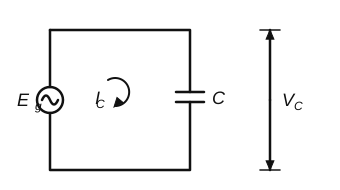
In a circuit consisting of a capacitance and a generator with alternating emf, $E_g = E_{g0}\sin\omega t$, $V_C$ and $I_C$ are the voltage and current. Correct phasor diagram for such circuit is
Concept. $\omega L\gt\dfrac1{\omega C}$: inductive, current lags. Equal: resonance, current in phase. $\omega L\lt\dfrac1{\omega C}$: capacitive, current leads. At the resonant frequency the current is maximum.
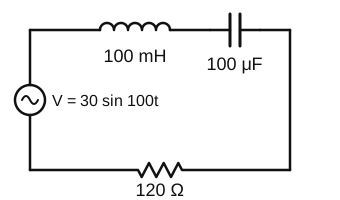
Q 12-07-126JEE MainJEE Main 2021 (26 Feb, Shift 1)Medium
In a series LCR resonant circuit, the quality factor is measured as $100$. If the inductance is increased by two fold and resistance is decreased by two fold, then the quality factor after this change will be ______
Concept. Peak current $\dfrac{V_0}{Z}$ at the source frequency; resonant frequency $\dfrac{1}{2\pi\sqrt{LC}}$.
Step 1. Reactances at $\omega=100$. $X_L=10\ \Omega$, $X_C=100\ \Omega$.
Step 2. Peak current. $Z=\sqrt{120^2+90^2}=150\ \Omega$; $I_0=\dfrac{30}{150}=0.2$ A.
Step 3. Resonance. $f_0=\dfrac{1}{2\pi\sqrt{0.1\times10^{-4}}}=\dfrac{1}{2\pi\times3.16\times10^{-3}}\approx50$ Hz.
Answer. Option D.
Solution by Sreeraj P, M.Sc Physics
Q 12-07-128JEE MainJEE Main 2021 (25 Jul, Shift 2)Medium
A $10\ \Omega$ resistance is connected across $220$ V $-$ $50$ Hz AC supply. The time taken by the current to change from its maximum value to the rms value is:
Concept. With $i = i_0\sin\omega t$, the maximum is at phase $\dfrac{\pi}{2}$ and the next value $\dfrac{i_0}{\sqrt2}$ at $\dfrac{3\pi}{4}$.
Step 1. Phase interval. $\dfrac{\pi}{4}$, i.e. $\dfrac{T}{8}$.
Step 2. Time. $T = 20$ ms, so $\Delta t = 2.5$ ms.
Answer. $2.5$ ms (Option A).
Solution by Sreeraj P, M.Sc Physics
Q 12-07-129JEE MainJEE Main 2021 (25 Jul, Shift 2)Medium
Two circuits are shown in figure (a) and (b). At a frequency of ______ rad s$^{-1}$ the average power dissipated in one cycle will be the same in both the circuits.
Q 12-07-130JEE MainJEE Main 2021 (26 Aug, Shift 1)Easy
A series LCR circuit driven by $300$ V at a frequency of $50$ Hz contains a resistance $R = 3$ k$\Omega$, an inductor of inductive reactance $X_L = 250\pi\ \Omega$ and an unknown capacitor. The value of capacitance to maximise the average power should be: (take $\pi^2 = 10$)
Q 12-07-131JEE MainJEE Main 2021 (26 Aug, Shift 2)Hard
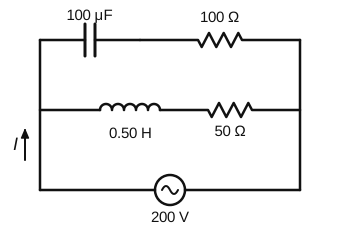
In the given circuit the AC source has $\omega = 100$ rad s$^{-1}$. Considering the inductor and capacitor to be ideal, what will be the current $I$ flowing through the circuit?
Concept. Each branch takes $I=\dfrac{V}{Z}$ at its own phase; add the branch currents as phasors.
Step 1. Capacitor branch. $X_C=\dfrac{1}{100\times10^{-4}}=100\ \Omega$: $Z_1=100\sqrt2$, $I_1=\sqrt2$ A, leading by $45^\circ$.
Step 2. Inductor branch. $X_L=50\ \Omega$: $Z_2=50\sqrt2$, $I_2=2\sqrt2$ A, lagging by $45^\circ$.
Step 3. Total. The two currents are $90^\circ$ apart: $I=\sqrt{2+8}=\sqrt{10}\approx3.16$ A.
Answer. Option D.
Solution by Sreeraj P, M.Sc Physics
Q 12-07-132JEE MainJEE Main 2021 (27 Aug, Shift 1)Medium
The alternating current is given by, $i = \left\{\sqrt{42}\sin\left(\frac{2\pi}{T}t\right) + 10\right\}$ A. The R.M.S. value of this current is ______ A.
Q 12-07-133JEE MainJEE Main 2021 (27 Aug, Shift 2)Easy
An AC circuit has an inductor and a resistor of resistance $R$ in series, such that $X_L = 3R$. Now, a capacitor is added in series such that $X_C = 2R$. The ratio of the new power factor with the old power factor of the circuit is $\sqrt{5} : x$. The value of $x$ is
Q 12-07-134JEE MainJEE Main 2020 (9 Jan, Shift 2)Medium
In an $LC$ circuit the inductance $L = 40$ mH and capacitance $C = 100\ \mu$F. If a voltage $V(t) = 10\sin(314t)$ is applied to the circuit, the current in the circuit is given as:
Q 12-07-136JEE MainJEE Main 2020 (6 Sep, Shift 1)Medium
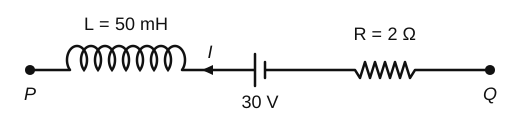
A part of a complete circuit is shown in the figure. At some instant, the value of current $I$ is $1$ A and it is decreasing at a rate of $10^2\ \text{A s}^{-1}$. The value of the potential difference $V_P - V_Q$ (in volts) at that instant is ______.
Concept. Walk from P to Q, adding the potential changes. The current flows from Q towards P and is decreasing: $\dfrac{dI}{dt}=-100$ A/s.
Step 1. Inductor. Current flows through it towards P, so $V_{x}-V_P=L\dfrac{dI}{dt}=0.05\times(-100)=-5$ V: P is 5 V above the far end of the inductor.
Step 2. Cell. Its positive plate faces the inductor: crossing it towards Q drops 30 V.
Step 3. Resistor. Current flows from Q into the resistor: Q is $IR=2$ V above the other end, so going towards Q rises 2 V.
Step 4. Total. $V_P-V_Q=5+30-2=33$ V.
Answer. $33$.
Solution by Sreeraj P, M.Sc Physics
Q 12-07-137JEE MainJEE Main 2020 (6 Sep, Shift 2)Medium
In a series LR circuit, a power of $400$ W is dissipated from a source of $250$ V, $50$ Hz. The power factor of the circuit is $0.8$. In order to bring the power factor to unity, a capacitor of value $C$ is added in series to the $L$ and $R$. Taking the value of $C$ as $\left(\dfrac{n}{3\pi}\right)\ \mu\text{F}$, the value of $n$ is ______.
Q 12-07-138JEE MainJEE Main 2020 (7 Jan, Shift 1)Easy
An LCR circuit behaves like a damped harmonic oscillator. Comparing it with a physical spring-mass damped oscillator having damping constant $b$, the correct equivalence would be:
Q 12-07-140JEE MainJEE Main 2020 (3 Sep, Shift 1)Medium
A $750\ \text{Hz}$, $20\ \text{V (rms)}$ source is connected to a resistance of $100\ \Omega$, an inductance of $0.1803\ \text{H}$ and a capacitance of $10\ \mu\text{F}$ all in series. The time in which the resistance (heat capacity $2\ \text{J}/^\circ\text{C}$) will get heated by $10^\circ\text{C}$ (assume no loss of heat to the surroundings) is close to:
Step 2. Current. $Z=\sqrt{100^2+828.4^2}=834.4\ \Omega$; $I_{rms}=\dfrac{20}{834.4}=0.0240$ A.
Step 3. Time. $P=0.0240^2\times100=0.0575$ W; $t=\dfrac{2\times10}{0.0575}\approx348$ s.
Answer. Option D.
Solution by Sreeraj P, M.Sc Physics
Q 12-07-141JEE MainJEE Main 2019 (9 Jan, Shift 2)Easy
A power transmission line feeds input power at $2300\ \text{V}$ to a step down transformer with its primary windings having $4000$ turns. The output power is delivered at $230\ \text{V}$ by the transformer. If the current in the primary of the transformer is $5\ \text{A}$ and its efficiency is $90\%$, the output current would be:
Step 2. Output power. $0.9 \times 11500 = 10350$ W.
Step 3. Output current. $\dfrac{10350}{230} = 45$ A.
Answer. $45$ A (Option D).
Solution by Sreeraj P, M.Sc Physics
Q 12-07-142JEE MainJEE Main 2019 (9 Jan, Shift 2)Medium
A series AC circuit containing an inductor $(20\ \text{mH})$, a capacitor $(120\ \mu\text{F})$ and a resistor $(60\ \Omega)$ is driven by an AC source of $24\ \text{V}/50\ \text{Hz}$. The energy dissipated in the circuit in $60\ \text{s}$ is:
Q 12-07-143JEE MainJEE Main 2019 (10 Apr, Shift 1)Easy
A transformer consisting of $300$ turns in the primary and $150$ turns in the secondary gives output power of $2.2\ \text{kW}$. If the current in the secondary coil is $10\ \text{A}$, then the input voltage and current in the primary coil are:
Step 2. Primary. $V_p=220\times\dfrac{300}{150}=440$ V; $I_p=\dfrac{2200}{440}=5$ A.
Answer. Option C.
Solution by Sreeraj P, M.Sc Physics
Q 12-07-144JEE MainJEE Main 2019 (8 Apr, Shift 1)Easy
An alternating voltage $V(t) = 220\sin(100\pi t)$ volt is applied to a purely resistive load of $50\ \Omega$. The time taken for the current to rise from half of the peak value to the peak value is
Q 12-07-145JEE MainJEE Main 2019 (8 Apr, Shift 2)Easy
A circuit connected to an ac source of emf $e = e_0\sin(100t)$ with $t$ in seconds, gives a phase difference of $\dfrac\pi4$ between the emf $e$ and current $i$. Which of the following circuits will exhibit this?
Answer: (D) RC circuit with $R = 1\ \text{k}\Omega$ and $C = 10\ \mu\text{F}$
Concept. A phase difference of $\dfrac\pi4$ needs the reactance to equal the resistance. Here $\omega=100$ rad/s.
Step 1. Test. RC with $C=10\ \mu$F: $X_C=\dfrac{1}{100\times10^{-5}}=1000\ \Omega=R$. The RL options give $X_L=0.1$ or $1\ \Omega$; the other RC gives $10^4\ \Omega$.
Answer. Option D.
Solution by Sreeraj P, M.Sc Physics
Q 12-07-146JEE MainJEE Main 2019 (12 Jan, Shift 2)Medium
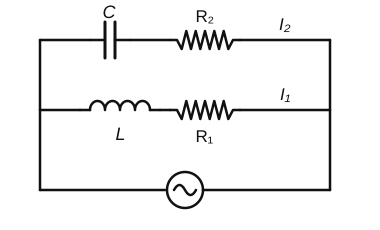
In the circuit shown, $C = \dfrac{\sqrt3}{2}\ \mu$F, $R_2 = 20\ \Omega$, $L = \dfrac{\sqrt3}{10}$ H and $R_1 = 10\ \Omega$. Current in $L$-$R_1$ path is $I_1$ and in $C$-$R_2$ path it is $I_2$. The voltage of AC source is given by, $V = 200\sqrt2\sin(100t)$ volts. The phase difference between $I_1$ and $I_2$ is:
Q 12-07-147JEE MainJEE Main 2018 (15 Apr, Shift 1)Medium
An ideal capacitor of capacitance $0.2\ \mu\text{F}$ is charged to a potential difference of $10\ \text{V}$. The charging battery is then disconnected. The capacitor is then connected to an ideal inductor of self inductance $0.5\ \text{mH}$. The current at a time when the potential difference across the capacitor is $5\ \text{V}$ is:
Concept. Energy conservation: $\tfrac12CV_0^2=\tfrac12CV^2+\tfrac12LI^2$.
Step 1. Solve. $I=\sqrt{\dfrac{C(V_0^2-V^2)}{L}}=\sqrt{\dfrac{0.2\times10^{-6}\times75}{0.5\times10^{-3}}}=0.17$ A.
Answer. Option B.
Solution by Sreeraj P, M.Sc Physics
Q 12-07-148JEE MainJEE Main 2018 (16 Apr, Shift 1)Easy
A power transmission line feeds input power at $2300\ \text{V}$ to a step-down transformer with its primary windings having 4000 turns giving the output power at $230\ \text{V}$. If the current in the primary coil of the transformer is $5\ \text{A}$ and its efficiency is $90\%$, the output current would be:
Step 2. Output power. $0.9 \times 11500 = 10350$ W.
Step 3. Output current. $\dfrac{10350}{230} = 45$ A.
Answer. $45$ A (Option A).
Solution by Sreeraj P, M.Sc Physics
Q 12-07-149JEE MainJEE Main 2017 (9 Apr)Easy
A sinusoidal voltage of peak value $283$ V and angular frequency $320\ \text{s}^{-1}$ is applied to a series $LCR$ circuit. Given that $R = 5\ \Omega$, $L = 25$ mH and $C = 1000\ \mu$F. The total impedance and phase difference between the voltage across the source and the current will respectively be:
For an RLC circuit driven with voltage of amplitude $v_m$ and frequency $\omega_0 = \dfrac{1}{\sqrt{LC}}$ the current exhibits resonance. The quality factor, $Q$ is given by:
In an A.C. circuit, the instantaneous e.m.f. and current are given by $E = 100\sin30t$, $I = 20\sin\left(30t - \dfrac\pi4\right)$. In one cycle of A.C., the average power consumed by the circuit (in watt) and the wattless current (in ampere) are, respectively:
Answer: (D) $\sqrt{2}$ times the rms value of the ac source
Concept. For a sinusoid $V_{\text{rms}} = \dfrac{V_0}{\sqrt2}$.
Step 1. Rearrange. $V_0 = \sqrt2V_{\text{rms}}$.
Answer. $\sqrt2$ times the rms value of the ac source (Option D).
Solution by Sreeraj P, M.Sc Physics
Q 12-07-153NEETNEET 2022Top questionEasy
A series LCR circuit with inductance $10$ H, capacitance $10\ \mu$F, resistance $50\ \Omega$ is connected to an ac source of voltage, $V = 200\sin(100t)$ volt. If the resonant frequency of the LCR circuit is $\nu_0$ and the frequency of the ac source is $\nu$, then
Q 12-07-154JEE MainJEE Main 2025 (3 Apr, Shift 2)Easy
An electric bulb rated as $100\ \text{W}$–$220\ \text{V}$ is connected to an ac source of rms voltage $220\ \text{V}$. The peak value of current through the bulb is:
Concept. Ratings are rms: $I_{\text{rms}}=\dfrac PV$; peak $=\sqrt2I_{\text{rms}}$.
Step 1. Apply. $\sqrt2\times\dfrac{100}{220}=0.64$ A.
Answer. Option A.
Solution by Sreeraj P, M.Sc Physics
Q 12-07-155JEE MainJEE Main 2025 (4 Apr, Shift 1)Easy
An alternating current is represented by the equation $i = 100\sqrt2\sin(100\pi t)$ ampere. The RMS value of the current and the frequency of the given alternating current are:
Concept. For $i=I_0\sin\omega t$: $I_{rms}=\dfrac{I_0}{\sqrt2}$ and $f=\dfrac{\omega}{2\pi}$.
Step 1. rms. $\dfrac{100\sqrt2}{\sqrt2}=100$ A.
Step 2. Frequency. $\dfrac{100\pi}{2\pi}=50$ Hz.
Answer. Option C.
Solution by Sreeraj P, M.Sc Physics
Q 12-07-156JEE MainJEE Main 2025 (4 Apr, Shift 2)Medium
An inductor of self inductance $1\ \text{H}$ is connected in series with a resistor of $100\pi\ \Omega$ and an ac supply of $100\pi\ \text{V}$, $50\ \text{Hz}$. The maximum current flowing in the circuit is ______ A.
Q 12-07-158JEE MainJEE Main 2025 (7 Apr, Shift 1)Hard
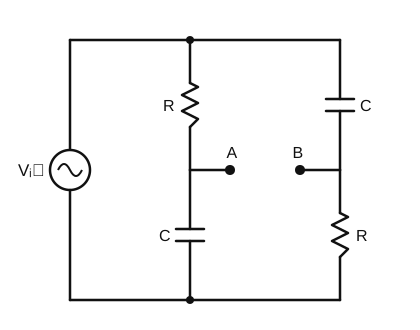
For the ac circuit shown in the figure, $R = 100\ \text{k}\Omega$ and $C = 100\ \text{pF}$. Two branches are connected across the source $V_{in}$: one has R (top) in series with C (bottom), with A the point between them; the other has C (top) in series with R (bottom), with B the point between them. The phase difference between $V_{in}$ and $(V_B - V_A)$ is $90^\circ$. The input signal frequency is $10^x\ \text{rad/s}$, where $x$ is ______.
Concept. Each branch is a divider. With $x=\omega RC$, $V_A=\dfrac{V_{in}}{1+jx}$ and $V_B=\dfrac{jxV_{in}}{1+jx}$, so $V_B-V_A=V_{in}\dfrac{jx-1}{jx+1}$, which has the same size as $V_{in}$ and a phase that depends on $x$.
Step 1. $90^\circ$. $\dfrac{jx-1}{jx+1}$ is purely imaginary when $x=1$ (it equals $j$).
Q 12-07-159JEE MainJEE Main 2025 (7 Apr, Shift 2)Easy
An inductor of reactance $100\ \Omega$, a capacitor of reactance $50\ \Omega$, and a resistor of resistance $50\ \Omega$ are connected in series with an AC source of $10\ \text{V}$, $50\ \text{Hz}$. The average power dissipated by the circuit is ______ W.


 Solution by Sreeraj P, M.Sc Physics