

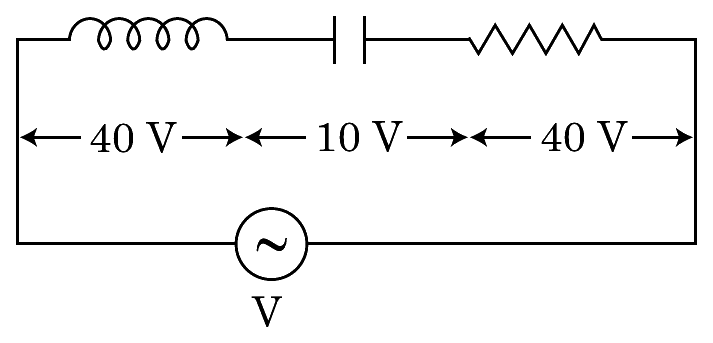
An inductor of inductance L, a capacitor of capacitance C and a resistor of resistance 'R' are connected in series to an ac source of potential difference 'V' volts as shown in figure.
Potential difference across L, C and R is $40$ V, $10$ V and $40$ V, respectively. The amplitude of current flowing through LCR series circuit is $10\sqrt{2}$ A. The impedance of the circuit is :
Answer: (A) $5\ \Omega$
Concept. The element voltages (rms) combine as $V = \sqrt{V_R^2 + (V_L - V_C)^2}$; then $Z = \dfrac{V}{I_{\text{rms}}}$.
Step 1. Source voltage. $V = \sqrt{40^2 + 30^2} = 50$ V.
Step 2. rms current. $\dfrac{10\sqrt2}{\sqrt2} = 10$ A.
Step 3. Impedance. $Z = \dfrac{50}{10} = 5\ \Omega$.
Answer. $5\ \Omega$ (Option A).
 Solution by Sreeraj P, M.Sc Physics